
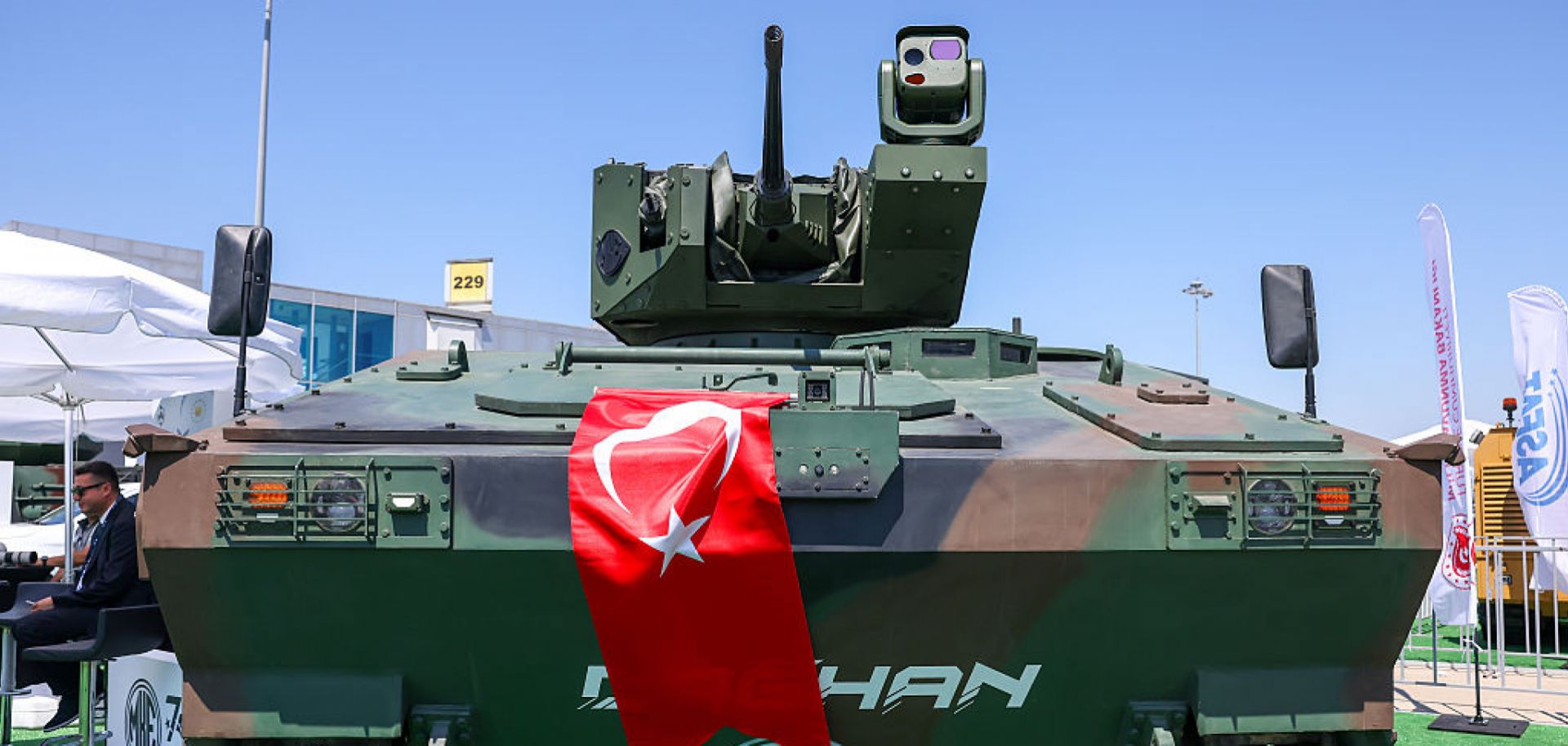
In Syria, Israel's competing interests and ongoing airstrikes are driving Turkey to accelerate its own military buildup, raising the risk of accidents, miscalculations or other incidents that could open the door to a brief crisis. In recent weeks, Turkey has made a number of announcements about improving its military capabilities with new jet purchases, which have coincided with recent warnings from Turkish officials about perceived growing threats from Israel. On June 18, Devlet Bahceli, the leader of Turkey's far-right nationalist party that is allied with President Recep Tayyip Erdogan, asserted that Israel's war against Iran was part of a broader strategy to encircle Turkey and curtail its regional ambitions. Two days earlier, Erdogan announced that Turkey planned to increase its medium- and long-range missile stockpiles to a ''deterrent level'' against the backdrop of regional instability and what he described as rising military threats. Relatedly, on July 23, Turkey signed a preliminary memorandum of understanding with the United Kingdom and Germany for the acquisition of 40 Eurofighter Typhoons — which could begin to be delivered in late 2026. Turkey is also accelerating its negotiations with the United States for 40 new F-16 fighters.
Israel's increasingly aggressive military actions in the region, particularly in Syria, are fueling the urgency of Turkey's new military modernization push. With Iran's proxies and influence weakened, Turkey and Israel now have the region's two most powerful militaries — creating a new operational reality that largely explains the timing of Turkey's push to accelerate the acquisition of advanced fighter jets. In the wake of the Oct. 7 Hamas attack on Israel in 2023, the country has shifted to a hawkish foreign policy that has gradually crept into Turkish spheres of influence. In its campaigns against Hamas, Hezbollah and the Houthis, Israel demonstrated a willingness to employ precision targeting, air power and other advanced capabilities to take significant, new risks against adversaries and fight once-unthinkable wars with rivals. Israel's attacks on Iran in June 2025 then confirmed a willingness to conduct large-scale, cross-border strikes to neutralize threats before they can materialize. Under this emerging new security doctrine, Israel has since continued its military interventions across the Middle East, including in southern Syria. But Ankara views Israel's increasingly aggressive military actions as worrisome — not only for regional stability but also for the potential for Syria to become an arena for conflict and competition with Israel. This has, in turn, driven Turkey to try to consolidate its influence in Syria by backing interim President Ahmad al-Sharaa's rule. It is also fueling Turkey's accelerated acquisition of advanced fighter jets, which has included focusing on indigenous upgrades for its existing fleet of U.S.-made F-16s, expediting flight testing for Turkey's indigenous fifth-generation fighter jet KAAN, and securing the delivery of Eurofighter Typhoons as a stopgap measure until KAAN is fully operational. Together, these actions indicate Ankara's intent to not only deter Israel from ever considering attacks on Turkey or Turkish assets in the region, but also to ensure that Turkey maintains a sphere of influence in Syria.
- Beyond securing national interests in Syria, a more modernized military would also help Turkey deter Greece in the Aegean and Eastern Mediterranean, strengthen its influence in the Caucasus, and project power across North Africa, the Red Sea and the Black Sea.
- Following the fall of former Syrian President Bashar al Assad's regime in December 2024, Israel launched a sustained airstrike campaign to destroy Syria's remaining weapons stockpiles and advanced air defense systems. The strikes sought to prevent the new government from rebuilding significant military capabilities and to secure long-term Israeli air dominance over Syrian skies.
- Turkey already has thousands of troops, armor, artillery and drones in neighboring northern Syria, with entrenched bases in Idlib, Afrin, al-Bab, Jarabulus, Tell Abyad and Ras al-Ain. This presence provides Turkey with a permanent military footprint against Kurdish militias and the Islamic State.
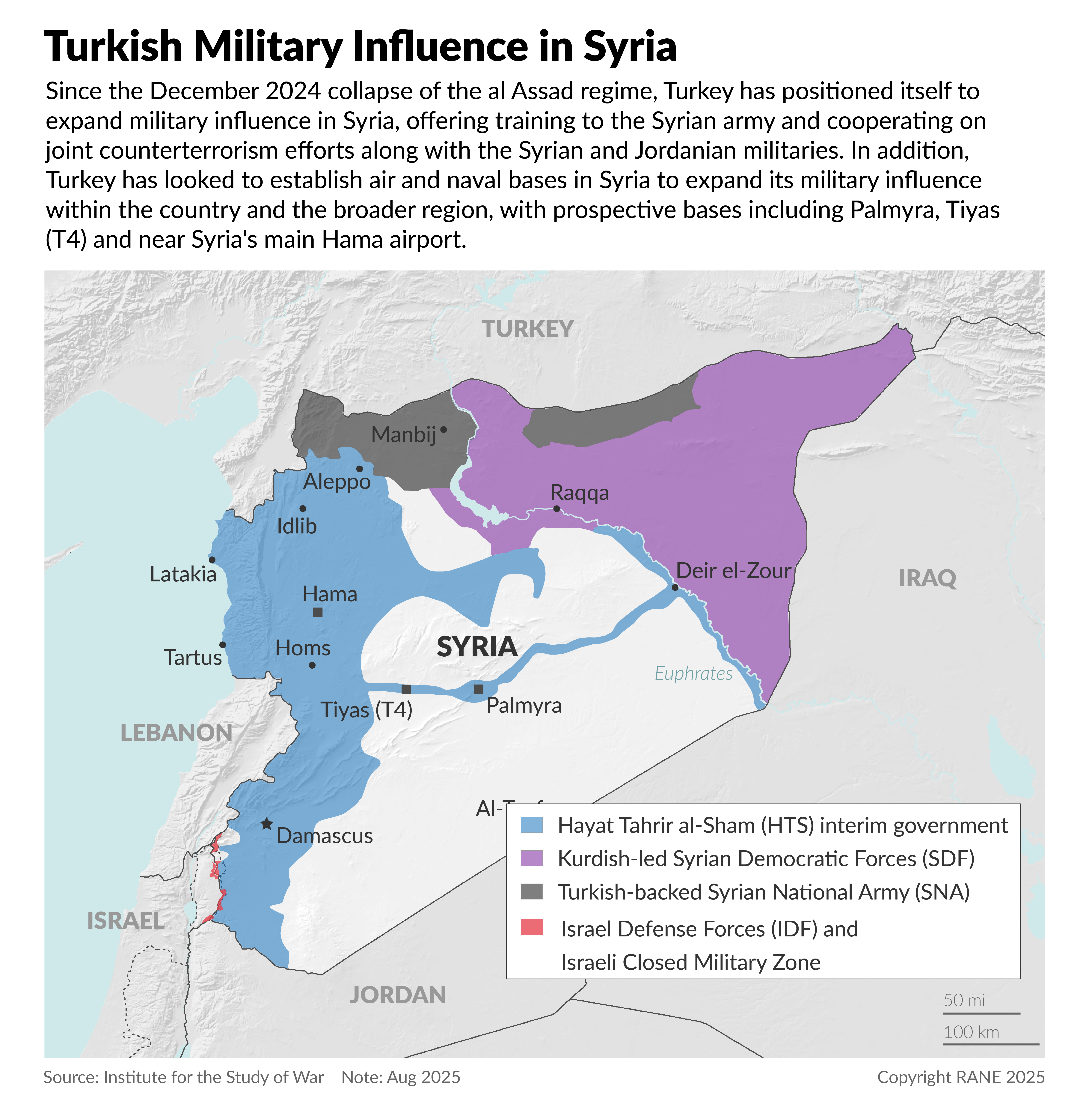
Turkey will prioritize the acquisition and/or development of air defenses, fighter jets and drones as part of a broader strategy to secure its interests in northern Syria and hedge against regional rivals. Having closely studied both Iran's vulnerabilities and Israel's precision-strike and aerial superiority during the 12 Day War, Turkish planners will accelerate efforts to plug the remaining gaps in their layered air-defense network, especially through the rollout of SIPER long-range systems and the acceleration of indigenous reconnaissance and attack drones like the Bayraktar TB2. Ankara will also race to modernize its fighter jet fleet, in a bid to both protect its strategic interests in northern Syria (i.e., countering Kurdish militias, combating terrorist groups and preventing cross-border infiltration) and challenge Israel's aerial dominance in shared airspaces. With the KAAN 5th-generation stealth fighter set for deployment in 2028-29, the newly secured Eurofighter Typhoons are expected to arrive by late 2026 to serve as an interim solution. These jets could be used to support forward bases near the Euphrates-M4 axis (an area between the Euphrates River and the strategic M4 highway in the northeast of Syria), where Turkey is discreetly establishing new composite brigades equipped with loitering munitions and TB2 drones to create a buffer against remnants of Iranian proxies and Kurdish militias. Should the F-16 deal with the United States continue to face delays, Ankara might opt to intensify flight testing for its new KAAN jets in order to accelerate their rollout. It may also seek to purchase more Typhoon jets, though this would risk increasing Turkey's reliance on European supply chains.
- Despite a tentative agreement for Turkey to buy 40 new F‑16s, U.S. congressional approval remains unresolved due to domestic political disputes, leaving the deal in limbo. Turkish officials warn that these delays are impairing the readiness of the country's air force.
- Turkey's SIPER long-range air and missile defense system is designed to intercept aircraft, cruise missiles and ballistic missiles at ranges exceeding 100 kilometers. SIPER is the country's first domestically produced system in this class, marking a strategic step toward reducing reliance on foreign platforms like the U.S. Patriot or Russian S-400.
In the coming months, Turkey will likely increase its military presence in Syria, positioning its forces to block perceived Israeli threats to its core interests. In post-Assad Syria, Israel seeks a decentralized, fragmented and weakened state to mitigate future security threats and Iranian influence. Conversely, Turkey supports al-Sharaa's efforts to consolidate centralized authority, hoping this will lead to a friendly Syrian government that will help Turkey secure its borders, return Syrian refugees, expand its regional influence and counter Kurdish autonomy. Should Syria remain weak and prone to insurgency, Ankara faces the risk of spillover threats like terrorism and Kurdish militancy, which could destabilize its southern border and threaten its military foothold in Syria. In this context, Turkey's accelerated acquisition of air defenses, fighter jets and drones will enhance its operational flexibility and increase its capacity to deter or match Israeli airpower if Ankara deems intervention necessary. The more militarily self-reliant Turkey becomes, the more room it gains to act in Syria without needing formal de-confliction with Israel through the United States and other backchannels — especially if Israeli actions begin to threaten core Turkish interests there.
- On Aug. 13, Turkey and Syria's new interim government signed a defense cooperation memorandum under which Turkey will provide logistical support, military training, consultancy and technical assistance to Syrian forces. The agreement aims to improve the new Syrian government's ability to counter militias (especially Kurdish ones) and the Islamic State, and cements Turkey as Syria's main security and military backer.
- Turkey is also advancing plans to establish a forward military presence at the Tiyas Air Base, located in central Syria, including by deploying air‑defense systems and reconnaissance/combat drones. This signals Turkey's strategic intent to expand Ankara's operational reach against not only Kurdish militias and remnants of the Islamic State, but also Israel, given that positioning these systems at the airbase would enable them to reach southern Syria and some areas of northern Israel.
The concurrent deployment of Israeli and Turkish forces into Syrian territory will increase the risk of tactical incidents that could trigger a brief crisis, though a larger conflict remains unlikely. As Turkey establishes air-defense systems and deploys fighter jets and drones near key corridors like the Euphrates and central Syria, and as Israel increases its airstrikes in these same zones, the risk of accidents, miscalculations or other minor, non-fatal incidents will increase in the coming months and going into 2026. Based on recent precedent, these incidents could include radar locks, electronic jamming, drone shoot-downs, and potential pre-emptive Israeli strikes on Syrian army or Turkish military assets operated by Syrians. Israeli officials have made clear that they will not tolerate any perceived threat to Israel's air supremacy, especially if Turkish assets challenge its freedom of action over Syria. Both Turkey and Israel are more likely to quietly pursue limited backchannel diplomacy to manage this tension, but neither side will be willing to grant the other decisive and unopposed influence in Syria. Syria's airspace will also grow increasingly crowded, with Israeli, Turkish, Syrian and Russian air-defense systems operating in close proximity. This will further raise the risk of miscalculation and unintended escalation, including potentially accidental attacks against civilian aircraft. However, any crisis would likely be brief and limited. For one, Israel and Turkey are both U.S. allies, while Turkey is also a NATO member. Additionally, Turkey's more robust economy and advanced military infrastructure, compared with Iran's, would make any escalation extremely costly for both sides. A direct and widespread conflict between Turkey and Israel thus remains highly unlikely. However, the United States will find it harder to balance its commitments to both NATO ally Turkey and security partner Israel, especially as it supplies both with advanced air platforms.
- Following the collapse of the al Assad regime on Dec. 8. Russia largely reduced its military assets it had deployed for a decade in Syria, including long-range air defenses like the S-400 system, keeping only some smaller air defense systems to protect its two remaining military bases in the country. In August 2025, Syria's transitional government reportedly requested the return of Russian military police patrols to the southern provinces, seeking to limit ongoing Israeli incursions.
- In May, Turkish fighter jets entered Syrian airspace during Israeli airstrikes near the Presidential Palace and used electronic warfare systems to send warning signals and jam Israeli aircraft. A brief radio exchange between the two sides helped de-escalate what could have become a direct confrontation.
- Russian and Turkish forces maintained a pragmatic military competition in Syria during the civil war, coordinating joint patrols and deconfliction mechanisms to balance competition with cooperation to protect their respective strategic footholds. Still, this did not prevent incidents like the Turkish shootdown of a Russian fighter jet near the Turkish-Syrian border in 2015. This incident severely strained diplomatic ties, with Russia banning charter flights to Turkey, restricting imports of Turkish goods and suspending some investments in Turkey. Russia also cut off military contacts with Turkey that were meant for deconfliction.
- In September 2018, Syrian air defenses accidentally shot down a Russian Il-20 surveillance plane during Israeli strikes in Latakia, killing 15 crewmembers. Moscow blamed Israel for inadequate warning and using the aircraft as cover, straining military coordination and prompting Russia to deliver S-300 systems to Syria.
- U.S. diplomacy has so far mediated between Turkey and Israel, particularly after Israeli strikes on Syrian government forces. However, Israel's unwillingness to compromise on its strategic goals or permit al-Sharaa to consolidate power is likely to inflame tensions with Turkey, rendering further U.S. mediation efforts ineffective, as U.S. troops steadily withdraw from the country.
- The United States has sought to mediate tensions between Israel and Turkey over Syria. However, Israel's refusal to compromise on its strategic goals or allow al-Sharaa to consolidate power will likely render further U.S. mediation efforts ineffective.
