
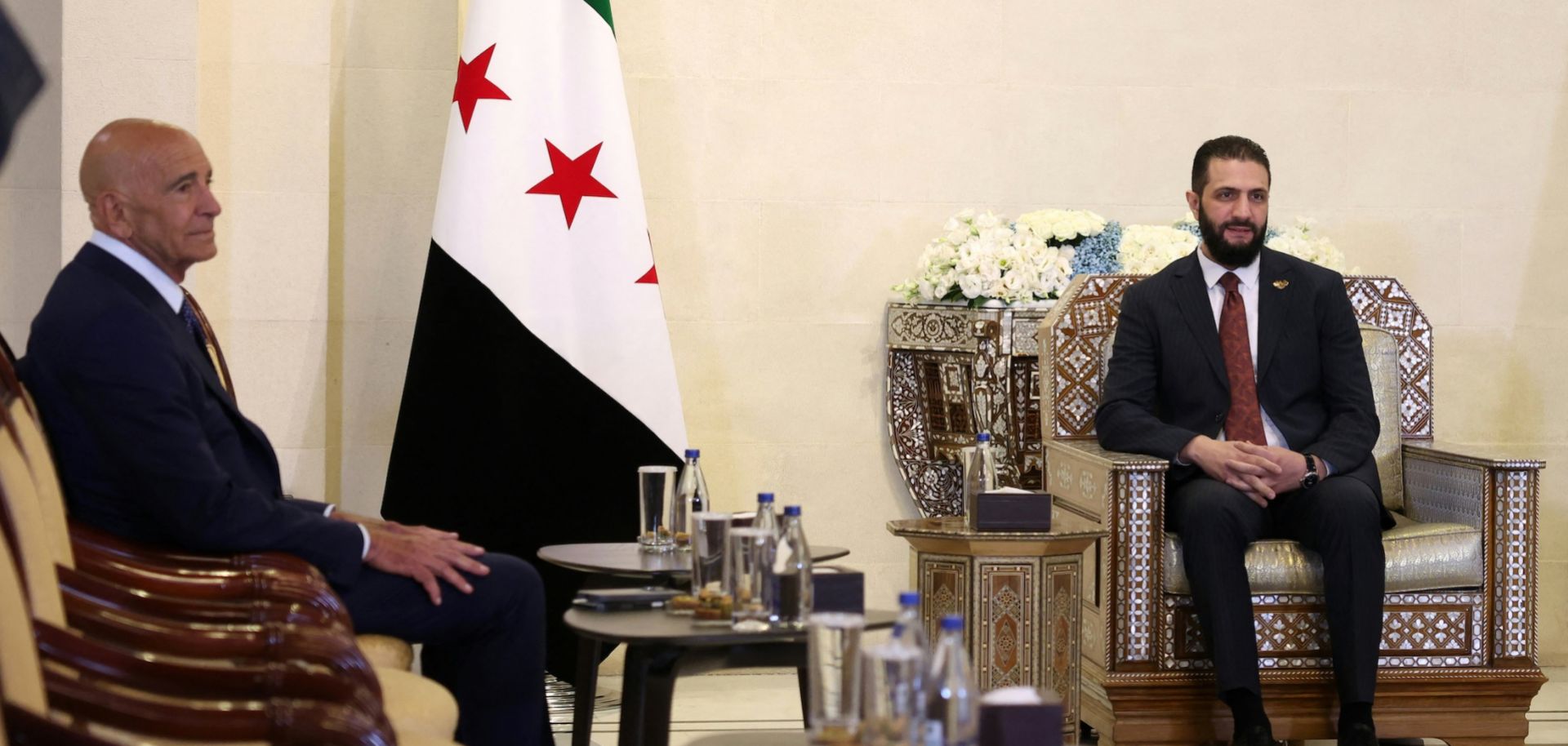
The United States will likely use sanctions relief leverage to de-escalate tensions between Syria and Israel and support Syria's economic and reconstruction recovery efforts, while continuing to provide sufficient, albeit diminished, support to the Kurds, enabling them to slow-walk integration with the Syrian government. In recent weeks, the U.S. envoy to Syria, Tom Barrack, has met with Syria's interim President Ahmad al-Sharaa and visited the Kurdish-majority northeastern city of al-Hasaka to discuss mechanisms to facilitate the integration of the Kurdish-led, U.S.-backed Syrian Democratic Forces, or SDF, into the Syrian central government. In March, the SDF and al-Sharaa reached an agreement to integrate SDF institutions into the state, but little progress has been made after separate outbreaks of violence between government forces and minority Alawites and Druze communities led the SDF to seek to maintain their arms out of concern for similar clashes with government forces. However, following Barrack's visits and ongoing discussions between government officials and SDF leadership, the commander of the SDF announced on Oct. 12 that it had reached a preliminary agreement to integrate the SDF and Kurdish Internal Security Forces, totaling around 100,000 people, into the Syrian Ministry of Defense. Even so, significant gaps between the SDF demands and those of the central government remain, namely over Kurdish demands for a decentralized system and enshrining Kurdish rights in the new constitution.
- The SDF and Syrian government forces have sporadically clashed in the northeast since the collapse of former President Bashar al Assad's regime in December 2024. Barrack's meetings came after the Syrian Minister of Defense and the commander of the SDF signed a comprehensive ceasefire agreement on Oct. 7 after clashes between government forces and the SDF in northeast Syria. Even so, just after the signing of the ceasefire agreement, on Oct. 8, the Syrian Defense Ministry alleged that the SDF had conducted several attacks against army positions in eastern Aleppo, resulting in the death of one Syrian soldier and injuries to several others.
- Although specific details regarding Kurdish integration remain unresolved, one of the proposals reportedly involves including the Kurdish forces in three corps under a unified command.
The United States, which has provided significant but not full sanctions relief, has increasingly engaged with the interim Syrian government to promote domestic stability and de-escalate tensions with Israel. Following the collapse of the Assad regime, the Biden administration cautiously and in a limited fashion engaged with the new Syrian regime under al-Sharaa. The United States and other Western countries were skeptical of the links that the group he led, Hayat Tahrir al-Sham (HTS), formerly had to al Qaeda in the 2010s and worried about political instability following the collapse of the Assad regime, which had ruled for decades. The Biden administration waived some sanctions in January 2025 to facilitate the expanded provision of public services for domestic stability and humanitarian aid. The Trump administration has since gone further, waiving additional sanctions and removing others. However, key sanctions under the Caesar Act — which sanctioned entities under the al Assad regime and those profiting from the Syrian civil war through reconstruction activities — remain. Even so, the sanctions relief thus far has enabled Middle Eastern countries, including Qatar, Saudi Arabia and Turkey to provide financial, technical and material support to boost the interim government's domestic legitimacy and expand public service provision, though many businesses remain reluctant to engage with the Syrian government and companies since some sanctions still have not been permanently removed. In addition, the United States has been facilitating discussions between Syrian and Israeli officials for a security agreement to de-escalate tensions between the two countries.
- U.S. engagement with Syria has expanded following U.S. President Donald Trump's May visit to the Middle East, during which he met with al-Sharaa in Saudi Arabia. At the time, Trump said that sanctions relief would give Syria a "chance at greatness."
- The Caesar Act requires congressional approval to be rescinded. A Senate-approved draft budget bill has included provisions to revoke the Caesar Act, though it requires backing from the House of Representatives, some members of which are skeptical of permanently removing Caesar Act sanctions due to HTS's jihadist past.
- Israel has conducted sporadic attacks for months against strategic targets in Syria, targeting military infrastructure dating back to the Assad era and belonging to the new Syrian forces under al-Sharaa's leadership. Tensions escalated in July when Israeli military forces intervened in Syria's southern Sweida province on behalf of Druze militias after violent clashes broke out between Druze fighters, government-aligned Bedouin militias and the new Syrian authorities.
The United States will likely use its sanctions relief leverage over Syria to de-escalate tensions with Israel through a negotiated security pact and support Syria's domestic stability through economic development and reconstruction efforts, though full rebuilding will take decades. Though the United States has already waived and lifted some sanctions on Syria, the permanent removal of all sanctions, especially those tied to the Caesar Act, will likely require Syria to reach a security agreement with Israel to assuage remaining concerns that the Syrian government could pose a threat to Israel. While the Syrian government is highly unlikely to fully normalize relations with Israel due to hardliners in the Syrian government and a pro-Palestinian, anti-Israel population that would reject normalization efforts, al-Sharaa has said that he plans to have a Syria-Israel security agreement finalized by the end of 2025. An agreement would likely de-escalate regional tensions and reduce the frequency of Israeli airstrikes in Syria, two deterrents that are likely security concerns for prospective businesses to engage with Syria. In order to support domestic stability through economic development and public service provision, U.S. companies will likely support the reconstruction of Syria's energy sector since, prior to the 2011 outbreak of the Syrian civil war and the imposition of sanctions, oil exports accounted for around 20% of Syria's GDP and about 50% of state revenue. Such deals will depend on domestic stability to operate in Syrian government-controlled areas, continued cooperation between the SDF and government for oil exports from the northeastern oil fields and security to protect investments and personnel. While Turkey and Qatar have provided early support for Syria's electricity infrastructure and humanitarian aid, the United States is poised to provide additional support through technical knowledge and strategic planning for the energy sector. Most importantly, permanent U.S. sanctions relief would likely enable other countries — especially Turkey, Qatar, the United Arab Emirates and Saudi Arabia — and international lenders to expand reconstruction support, a process that will likely take decades.
- Some congressional holdouts and Syria hawks, such as Republican Sen. Lindsey Graham, have said that they would be more likely to consider removing sanctions if Syria and Israel reached a security agreement. Graham and Democratic Sen. Chris Van Hollen introduced an amendment to the 2026 defense budget that conditioned the suspension of Syrian sanctions under the Caesar Act on human rights conditions, counterterrorism efforts against the Islamic State and maintaining peaceful relations with Israel.
- According to July media reports, several U.S.-based firms are set to develop an energy master plan for Syria to reconstruct and expand its oil, gas and power sectors. In September, Syria resumed oil exports for the first time in 14 years. Qatar is supporting the expansion of Syria's power generation capabilities through the construction of new power generation plants. In addition, Turkey will likely cooperate with Syria on oil and gas initiatives, especially as Turkey positions itself to become a regional energy hub.
- The United States' early engagement with the Syrian government is also designed to check the influence of adversaries as Syria has kept open the possibility of normalized relations with countries including China, Russia and, to a lesser extent, Iran.
The United States will encourage the SDF to integrate into the Syrian government, but continued U.S. support and the U.S. redeployment of forces in Iraq to counter the Islamic State in Syria will enable the Kurdish-led force to slow-walk integration. Barrack's facilitation of talks between the Syrian government and the SDF is part of the U.S. strategy to encourage minority integration into the government and prevent destabilizing domestic fragmentation and sectarian violence in Syria. To this end, the United States has rejected an independent Kurdish state in Syria and has indicated that the United States' military presence in Syria is not permanent to pressure the SDF to reach an agreement to integrate into the Syrian central government. Even so, U.S. concerns over a rising Islamic State threat in Syria have sustained an — albeit scaled-back — U.S. military presence in northeastern Syria and redeployment of some forces from central to northern Iraq to support the counter-Islamic State mission in Syria. As a result, the U.S. troop presence will continue to act as a blocking mechanism against more aggressive military campaigns by the Syrian government or Turkish-backed Syrian militias to force the SDF to integrate due to concerns of potential incidental attacks on U.S. forces. While the SDF will likely comply with these ongoing discussions and negotiations with the Syrian central government amid persistent wariness of the reliability and continuity of the U.S. support, the U.S. presence, even if slimmed down, will enable the SDF to slow-walk integration while significant gaps between the central government and Kurdish demands remain. This will likely remain a point of friction between the United States and Turkey. Some Turkish politicians have accused Barrack — who also serves as U.S. ambassador to Turkey — of undermining Turkey's national security interests with his visit to al-Hasaka. Even so, the SDF is unlikely to accelerate integration into the central government over the next several months. Over time, as the United States likely further draws down troops or further cuts aid to the SDF, the SDF will be pressured to integrate or risk expanded clashes with the Syrian government forces or Turkish-backed forces.
- Under the Trump administration, the United States has withdrawn around 600 of 2,000 troops from Syrian bases and concentrated the remaining ones in the Kurdish-majority northeast. The United States has also indicated that it will likely only keep a military presence at one of the eight bases. In addition, as part of the September 2024 agreement to end the U.S.-led coalition mission in Iraq, the United States has redeployed some forces to northern Iraq to support the U.S. mission to counter an Islamic State resurgence in Syria.
- As part of the Trump administration's broader foreign aid reassessments and cuts, the United States froze aid to SDF-controlled prisons holding Islamic State fighters and their families in northeastern Syria. While aid was restored, confusion over U.S. policies impeded service provision and led to some security gaps.
- In the Department of Defense's 2026 draft budget, the United States allocated $130 million to support the SDF and U.S.-backed Syrian Free Army, a decline from $147.9 million in 2025.
