
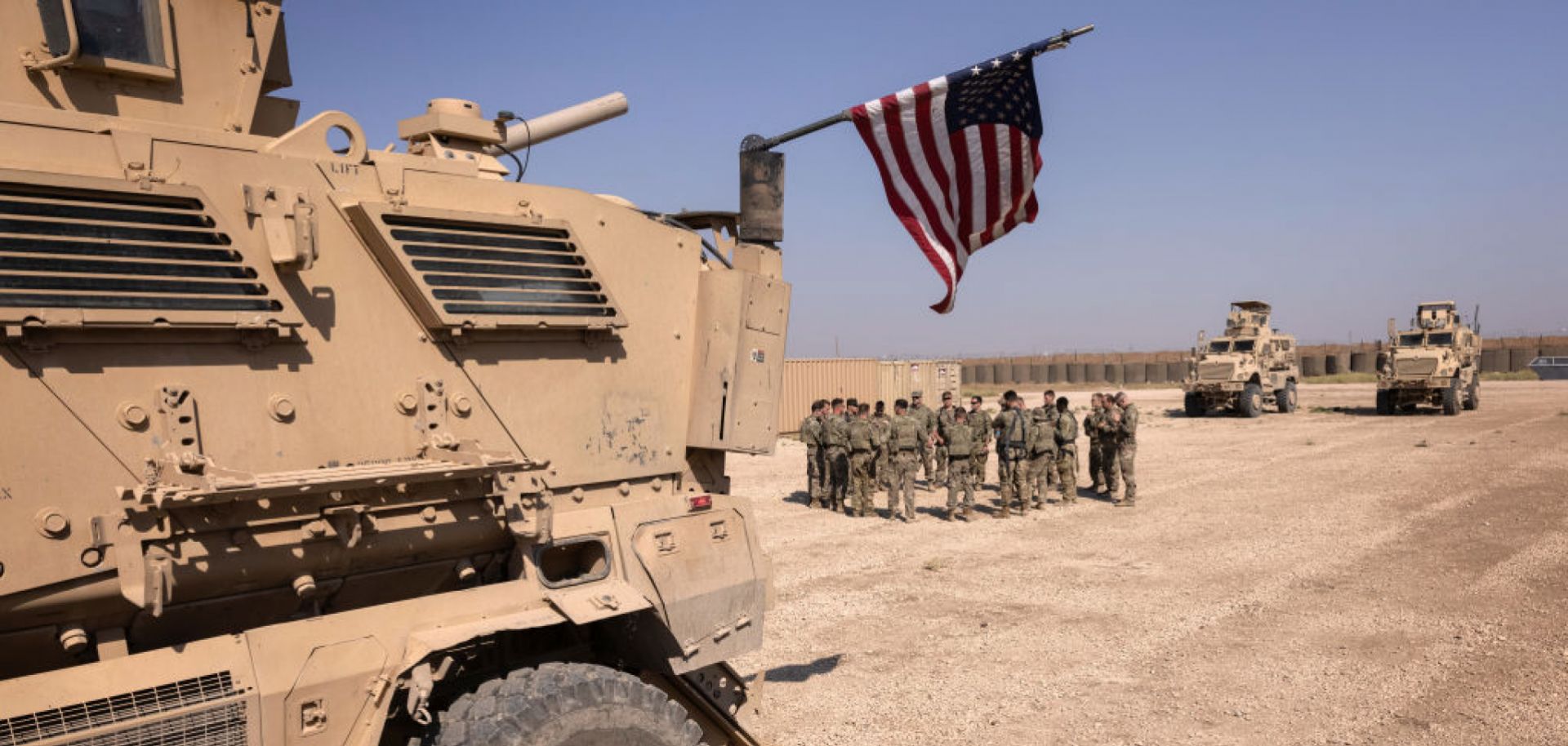
Following the rapid collapse of Bashar al Assad's government in December 2024, the United States' strategy in Syria is shifting from isolation to engagement, in the hopes that normalizing Syria will also stabilize it — and protect Washington's long-term interests. But this engagement remains limited, and it is unclear whether the United States is willing to balance the Turkish and Israeli influence campaigns trying to change Syria's strategic orientation. While the United States is trying to signal that Syria is open for business, this strategy could yield unwanted outcomes if Washington doesn't remain proactively engaged, and instead stays reactive as regional powers, and Syrians themselves, vie for the country's future. Should this happen, the United States may be pulled back in to fight old foes like the Islamic State and al Qaeda (arising from state collapse or balkanization), or forced to reimpose isolation.
America's Historical Interests in Syria
U.S. interest in Syria is rooted in the country's central geographic location within the Levant, bordering Jordan, Iraq, Lebanon, Turkey and Israel. But Syria does not have enough resources or people to make it central to any given American strategy. Indeed, the country has always been part of the U.S. regional strategy, not the focus of it. During the Cold War, America's focus was on balancing Soviet-aligned powers, and specifically on flipping Egypt, the most populous Arab state, into the Western camp; Syria was corollary to that. Once Egypt switched sides after the Camp David Accords, U.S. policy on Syria remained in place by inertia, focused on balancing the country by supporting Israel and isolating Damascus through economic sanctions.
Even when the Cold War ended, this remained the United States' approach to Syria, as the country was not important enough to be the target of a regime change war, even at the height of American neoconservatives' power post-9/11. When the Arab Spring and the civil war began, Syria's status as a regional minor power meant the United States could, and did, take a hands-off approach to the upheaval, letting regional actors like Turkey, Israel, Iran and, more distantly, Russia compete for influence there. During this period of internal conflict, Syria cannibalized itself, which transformed the country into a geopolitical borderland where the influence of Turkey, Israel, Russia and Iran converged. Russian bases in Syria also contributed to this dynamic, operating almost as remote military outposts for Moscow.
Only the emergence of the Islamic State propelled a strategic shift in the United States and a direct U.S. military intervention in Syria, and only after the jihadist group entered Iraq and started inspiring a global terror campaign. Still, in terms of its approach to al Assad, Washington's strategy was relatively clear: take no strong stance and do not engage, letting local problems be solved by local actors. When al Assad's government collapsed in December 2024, it was not due to U.S. involvement, but rather to Turkish-trained Hayat Tahrir al-Shams rebels seizing an opportune moment to attack a hollowed-out regime.
The fall of al-Assad threw America's hands-off approach into flux. Suddenly, not only was a pro-Iran and pro-Russian government gone, but a new provisional government was trying to assemble itself to take its place. The United States quickly realized that it had to engage in some fashion with this new Syria if it was to help shape its behavior in its favor.
What the U.S., Israel and Turkey Want in Syria
The United States maintains several interests in Syria, despite the country being a minor power largely reduced to a borderland. These include counterterrorism efforts, safeguarding U.S. regional allies, curbing Iranian influence and facilitating the return of Syrian refugees. Additionally, U.S. President Donald Trump has expressed an interest in accessing Syria's limited energy resources. These U.S. goals are all currently being met: the Islamic State has been driven underground (and local partners appear capable of handling the remnants), Iran has been largely expelled, the refugees may soon be able to go home, and U.S. sanctions relief creates the prospect of a resurrected energy sector. For now, the United States thus lacks a strong incentive to further intervene in Syria. But the increasing competition for influence between Israel, Turkey and Syrians themselves could eventually threaten those U.S. interests.
Israel and Turkey certainly have strong opinions on how they want Syria to develop. Through its airstrikes and southern buffer zone, Israel is hoping to create a weak and divided Syria that poses no threat. But rather than easing the Syrian-Israeli conflict, Israel's campaign is reinforcing it by fueling anti-Israeli sentiment among Syrian leaders and citizens. It is also putting President Ahmed Sheraa's provisional government in a difficult political position, because responding to the Israeli attacks would risk alienating the United States, where pro-Israel voices are arguing that sanctions relief should be linked to Israeli-Syrian normalization.
Israel's strategy in Syria threatens U.S. interests as well. Israeli airstrikes, even if limited to the south, will inevitably dampen enthusiasm for reconstruction and energy sector rehabilitation by stoking fears of renewed conflict. The ongoing attacks will also make it hard to return all of the country's refugees. The Syrian government's stability is at risk as well, as Damascus faces a difficult balancing act of needing to appease the United States by not attacking Israel while also formulating a response to Israel's actions. Too much appeasement would strengthen radicals and hard-liners, and too little could spark U.S. pushback and intense Israeli military action that further undermines reconstruction and rehabilitation efforts. Failure to strike this delicate balance could either lead to the rise of a radical Islamist government that Israel is trying to prevent, or unravel the government completely as a new civil war erupts.
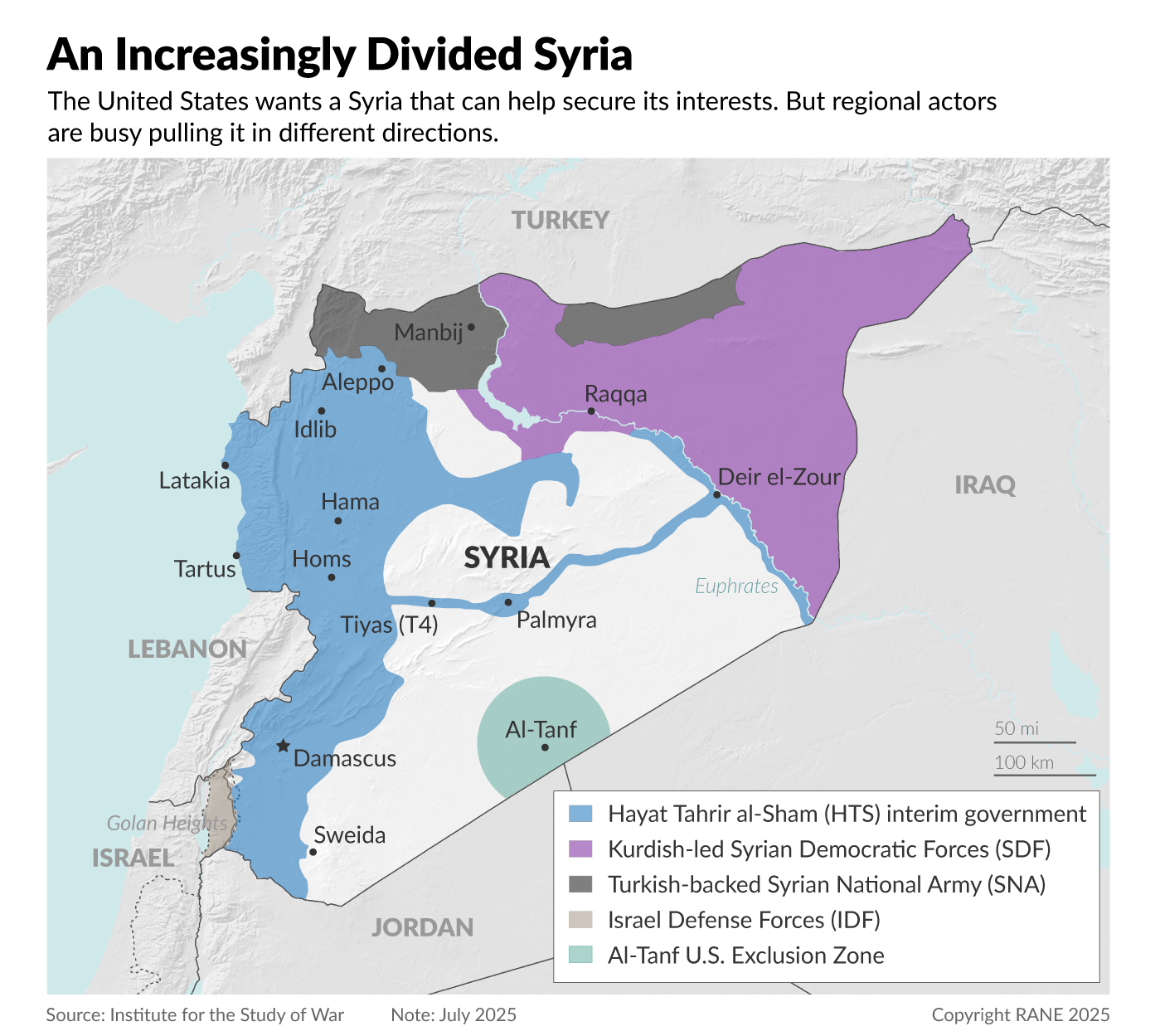
Turkey's strategy in Syria also creates complications for the United States. Turkey seeks a unified Syrian state under its influence, which entails suppressing the political rights of ethnic and religious groups, especially those of the country's substantial Kurdish population. Additionally, Turkey desires an Islamist-tinged government in Syria (whether it's democratic is perhaps up for debate) to bridge ethnic divides between Syrian Arabs and Turks and strengthen political ties between Ankara and Damascus. Turkey also wants a Syria that is strong and independent enough to prevent the emergence of a Kurdish state and to host the return of millions of refugees, but not so strong as to revert to the al-Assad-era foreign policies that periodically strained Turko-Syrian relations.
But more directly for the United States, Turkey's goals for the Syrian Kurds could be an issue. The Kurdish-led Syrian Democratic Forces currently represent the most effective force against the Islamic State. If they are suppressed, rather than smoothly integrated into a provisional government, it could shift the SDF's focus away from counterterrorism, which could enable militant groups to resurge, especially in the northeast. This risk of a botched integration effort is heightened by Israel's strategy, which encourages the formation of ethnic statelets within Syria. Kurds might be encouraged by Israel's efforts to protect the Druze, potentially making them less receptive to Damascus' control. The return of millions of refugees to Syria may create more opportunities for extremism to rebound, particularly if humanitarian aid is insufficient or delayed. There is also the prospect that Turkey's gambit to turn Syria into a client state sparks nationalist backlash. Although the provisional government and Turkish authorities are partners, this relationship may not remain stable in the long term, as Arab-Turkish differences could reemerge. On a long enough timeline, Syria will want to reclaim its status as a minor regional power rather than a borderland between neighbors, which will inevitably cause friction with Turkey — possibly manifesting in grassroots movements — that could destabilize the Syrian government, once more undermining stability and reconstruction.
Growing tensions between Israel and Turkey will likely become a problem for Washington, too. Turkey remains a NATO ally and crucial for securing the Black Sea against an expansionist Russia. Israel, meanwhile, will continue to be a vital U.S. military and political partner, particularly as long as Iran's nuclear program remains a regional threat. The United States cannot afford to let its two close allies clash and weaken each other in ways that could lead to accidental escalation or create power vacuums that threaten American interests. While U.S. diplomacy will undoubtedly strive to prevent such accidental escalations, it may not be enough to prevent the two countries' competing strategies from unraveling Syria without deeper American engagement.
The Syrians' Own Agency
Regardless of how the United States balances its partners. Syria's post-Assad development will ultimately be driven by Syrians — it remains their country, after all. The current trajectory points to a government that likely won't pose a major threat to U.S. interests and might even qualify for a prolonged sanctions suspension. However, if Israel's campaign, Turkish influence operations, or the Israeli-Turkish rivalry unravel the current provisional government — replacing it with a hard-line regime or new factions igniting a fresh civil war — the United States would have to reassert its priorities through sanctions (which would kill reconstruction efforts) and potentially military intervention.
Nonetheless, the United States retains its agency and could choose to overlook Syria's potential unraveling, especially as Washington grapples with larger geopolitical struggles in Asia and Europe. If America walks away from balancing the post-Assad era in Syria entirely, it would create an opening for currently humbled powers, notably Iran and Russia, to try to rebuild their influence in the Levant.
