
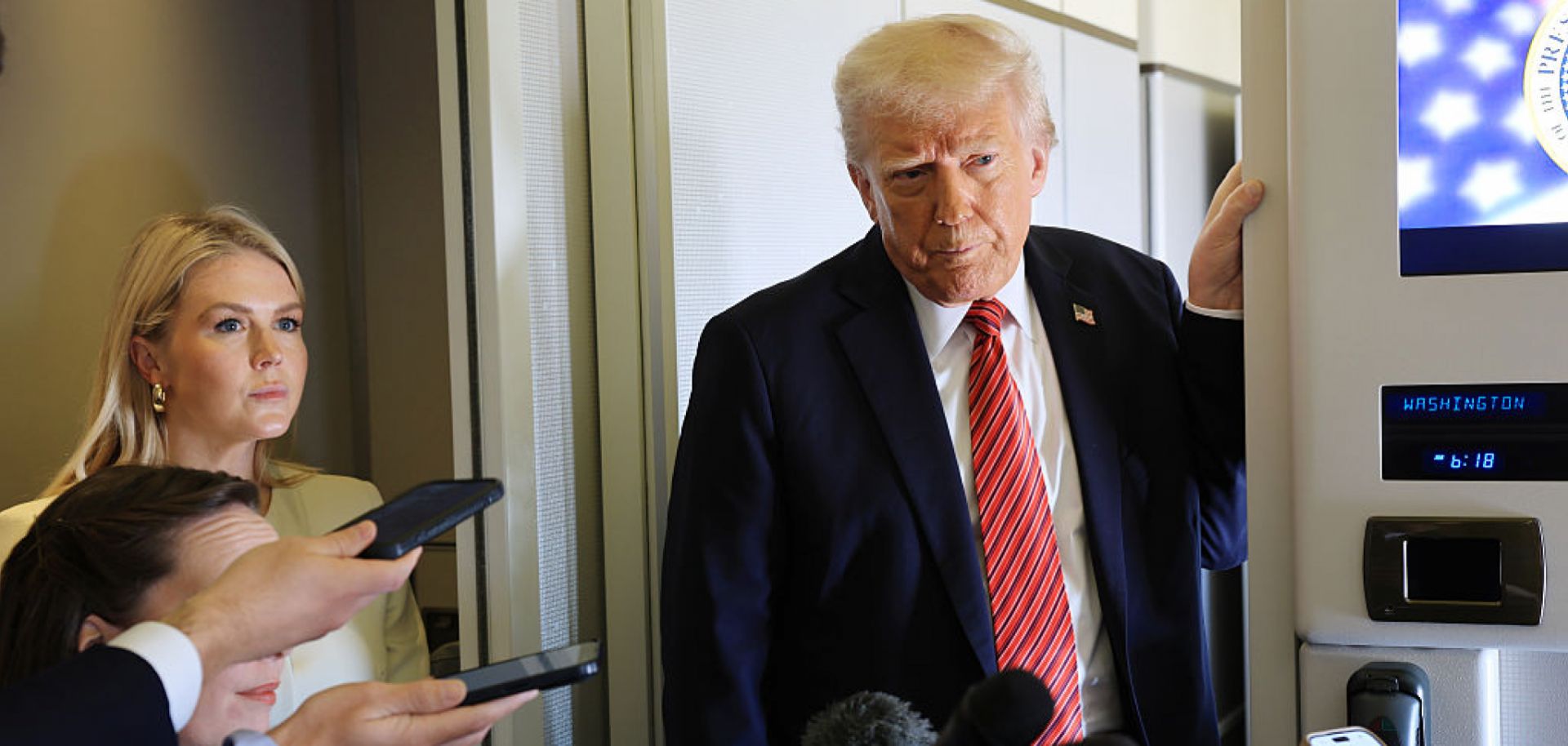
The removal of U.S. sanctions on Syria will open the door for Gulf Arab and Turkish investments to help kickstart the economy, spur normalization with Lebanon and talks on normalizing with Israel, and further cement the provisional government's power base. However, the slow pace of recovery, sectarian infighting, Israeli aggression and a resurging Islamic State will hamper Syria's progress. Donald Trump became the first U.S. president in 25 years to meet with a Syrian leader on May 14, a day after he announced the lifting of all sanctions on Syria while visiting Saudi Arabia. In a statement, the White House confirmed that the meeting was attended by interim Syrian President Ahmad al-Sharaa and Saudi Crown Prince Mohammad bin Salman, with Turkish President Recep Tayyip Erdogan joining remotely. Additionally, the White House said Trump asked al-Sharaa to deport Palestinian militants in Syria, normalize ties with Israel and help the United States combat the Islamic State, while also assuming "responsibility for [Islamic State] detention centers in northeast Syria." After the meeting, Trump reportedly said Washington will consider normalizing ties with Damascus as well.
Trump's announcement comes after months of intense lobbying by key U.S. allies and close partners like Saudi Arabia and Turkey, as well as Syria itself. Turkey and Saudi Arabia played a pivotal role in pressing for the move. Ankara argued that lifting crushing U.S. sanctions on Syria would support regional stability, enable the return of refugees, and curb Kurdish separatist influence along Turkey's southern border, in addition to opening the door to deeper trade with Syria since Turkish entities were concerned about falling afoul of U.S. sanctions. Riyadh, for its part, positioned normalization with Syria as part of a broader Arab-led stabilization plan, promising to underwrite reconstruction and pay off Syria's World Bank debt if Washington eased its stance. At the same time, Damascus repeatedly signaled its willingness to meet recently presented U.S. conditions for normalization. These included expelling foreign militants (especially those in the ranks of Syria's army), deporting Palestinian militants, preventing the Islamic State's resurgence in addition to taking control of the detention facilities housing Islamic State members and their families, and joining the Abraham Accords (a series of U.S.-brokered agreements signed in 2020 that normalized diplomatic relations between Israel and several Arab countries). In recent statements, Syrian officials, including al-Sharaa, have pledged to gradually disband foreign militias embedded in state institutions and restart U.N.-mediated constitutional talks, while also expressing willingness to join the Abraham Accords if Israel refrains from undermining Syria's sovereignty and continuing its attacks on the country.
- In addition to Saudi Arabia, Turkey and Qatar stand as Syria's biggest financial and military backers, having financed and supported al-Sharaa's Hayat Tahrir al-Sham rebel group against the former Syrian regime.
- The United States and Syria have historically had turbulent ties. They improved in the 1990s when Syria joined the U.S.-led coalition in the Gulf War and participated in the Madrid Peace Conference to launch direct talks between Israel and Arab states. But relations then deteriorated sharply in the 2000s due to Syria's support for Hezbollah and Palestinian militant groups, alleged involvement in the assassination of Lebanese Prime Minister Rafik Hariri in 2005, and its backing of insurgents during the Iraq War. The rift further deepened during the 2011-2024 Syrian civil war, with the United States imposing sweeping sanctions and backing opposition forces, culminating in Syria's designation as a state sponsor of terrorism and near-total diplomatic isolation. During his first term, Trump ordered air strikes on Syria twice in 2017 and 2018 over its use of chemical weapons during the civil war.
- The Caesar Syrian Civilian Protection Act of 2019 — part of a wider U.S. sanctions regime against Syria and its former regime — was designed to deter foreign investments in Syria and has meant that any Arab or Turkish company investing in Syria was at risk of facing secondary sanctions that would include being cut off from the U.S. financial system. The act covered sectors like defense, energy, construction, banking and finance.
The eventual removal of U.S. sanctions will help Syria kickstart its economic recovery and reconstruction in a bid to re-emerge as a key regional trade and transit hub, particularly for Gulf Arab states and Turkey, but long-term investments will take time to recover amid lingering security concerns and sanctions risks. Trump can lift a number of U.S. sanctions on Syria at will, including those imposed under the Caesar Act and others targeting the energy sector and financial services. The likely removal of these restrictions will help Damascus start at least part of its economic recovery by enabling it to access the dollar through banking transactions and attract funds for reconstruction — both of which U.S. sanctions have hampered for years. This could also open the door to Syria eventually reclaiming its traditional economic role in cross-border commerce and re-entering international oil and gas markets. Furthermore, the lifting of U.S. sanctions on Syria would likely galvanize a broader movement for additional sanctions relief, especially in Western Europe, which has already repealed some sanctions on the country. Additionally, Damascus' slow reintegration into the global financial system will support trade and investments by allowing banks to resume international transactions, potentially stabilizing the Syrian pound and curbing inflation, which will ease socio-economic grievances in Syria. All of these will create jobs, as well as stimulate broader economic activity and growth. The removal of sanctions will also reopen trade routes for Syria's agricultural products and manufactured goods, reviving rural economies, boosting small- and medium-sized enterprises, and reinvigorating sectors like textiles and food production. Still, all of these processes will take time and face numerous stumbling blocks, not least the severe degradation of Syria's physical infrastructure after more than a decade of war. Long-term investments, such as in the oil and gas sector, will also be slow to recover amid ongoing concerns about physical security threats like terrorism and the potential return of sanctions if al-Sharaa does not make good on his promises to Trump and other foreign leaders.
- Before the civil war broke out in 2011, Syria served as a logistics hub connecting the Mediterranean to the Gulf via key highways like the M5 and M4. The country also produced up to 380,000 barrels of oil per day before 2011, primarily from fields in the Deir el-Zour and al-Hasakah regions. It exported crude through the Baniyas and Tartous ports and was a transit country for regional gas pipelines, including proposals like the Arab Gas Pipeline, positioning it as a strategic energy bridge between Egypt, Iraq, Turkey and Europe.
- While some U.S. companies may be interested in investing in Syria, Trump gave no signal that the United States intends to lift Syria's designation as a state sponsor of terrorism — a label imposed in 1979 due to its backing of Palestinian militant groups. This designation will continue to pose a major barrier to foreign investment.
- On Feb. 24, the European Union suspended specific sanctions against Syria, including restrictions related to energy, banking and transport sectors. This suspension lifted asset freezes on five banks, eased restrictions on the Syrian central bank, and indefinitely extended an exemption to facilitate the delivery of humanitarian aid. Subsequently, on April 24, the United Kingdom lifted sanctions on a dozen Syrian entities, including key government departments and media outlets.
Over time, sanctions relief will enable al-Sharaa to further consolidate power within Syria. While lifting sanctions will serve Syria more broadly in the longer term, there are some issues that the interim president can tackle in the short term to improve his control over the government. By unlocking access to U.S. dollars and clearing the way for Gulf‑ and Turkey‑backed reconstruction funds, sanctions relief will enable al-Sharaa to deliver at least some quick, visible wins that war‑weary Syrians have not seen for many years, including fully paid public-sector salaries, which Qatar recently promised to start bankrolling starting in June 2025. These early wins will likely boost al-Sharaa's approval ratings and domestic legitimacy, enabling him to install favored officials in key economic ministries while further marginalizing or co-opting rival factions. Moreover, the influx of foreign funds and the promise of economic revival will give al-Sharaa leverage to neutralize or absorb former militia leaders by offering reconstruction contracts or positions within newly created administrative bodies, further weakening potential rivals. Together, these factors mean al-Sharaa will be in a position to centralize decision-making and entice militias still opposing the transition to join his Syrian government.
- The transitional government's economic team has already drafted a "100‑day stabilization package" that uses Saudi bridge financing to prop up the Syrian pound and restart two idle refineries at Baniyas and Homs, steps expected to cut black‑market fuel prices by half before winter.
- Despite al-Sharaa's effort to centralize his authority and bring sectarian militias to the transitional government's fold, several sectarian militias have yet to integrate, including the Alawites in the Syrian west coast, the Druze to the south, and the Kurds to the northeast. Some have outright refused to join the government, while others (like the Kurds) have expressed willingness to integrate but with conditions that Damascus is unlikely to meet, like having regional autonomy.
The lifting of sanctions may also act as a catalyst for Syria's normalization, not only with Lebanon but also in the longer run with Israel through the Abraham Accords. Historically intertwined, Damascus and Beirut share a symbiotic trade dynamic, with Lebanon acting as the commercial gateway and Syria as the land transit corridor to the wider Arab region. However, bilateral relations have been turbulent over the past two decades due to Syrian political interference in Lebanon, Hezbollah's intervention in Syria's civil war, and the presence of Syrian refugees in Lebanon, among other issues. With sanctions on Syria removed, both countries may find mutual incentives to pursue normalization talks, starting with long-delayed negotiations over land and maritime border demarcation. This would help de-escalate recurring tensions and enable more structured cooperation on key bilateral issues, including the repatriation of over one million Syrian refugees currently in Lebanon and the resolution of the fate of Lebanese detainees in Syrian prisons. On a broader scale, with al-Sharaa publicly pledging to uphold the decades-long armistice with Israel, and with Gulf-backed reconstruction efforts accelerating, the United States will capitalize on this momentum to press Damascus for gradual normalization with Israel, which Syria has already expressed willingness to do so. If successful, this would not only reduce the risk of border flare-ups but also pave the way for deeper economic integration and stability across the Levant. However, Syrian-Israeli normalization would likely be a longer-term prospect compared with a Syrian-Lebanese normalization process, which would be more straightforward, albeit still difficult.
- Trump has publicly urged al-Sharaa to pursue normalization with Israel as part of broader regional integration efforts. In response, Syrian officials have signaled a conditional openness to the idea, stating that normalization is "not off the table" if Israel respects Syria's territorial integrity and agrees to phased security guarantees. This was the first time Damascus had hinted at such a possibility in over a decade.
Despite the potential momentum toward economic recovery and regional reintegration, Syria's future remains fraught with destabilizing security dynamics that, if unaddressed, will significantly impede any progress. The resurgence of the Islamic State in the central Syrian desert will continue to pose a serious threat, with active cells already targeting oil infrastructure in Homs and Deir el-Zour. A return to regular sabotage of energy assets would not only reduce export revenues but also deter essential foreign investment in the sector. Despite the al-Sharaa regime's pledge to combat the Islamic State, Syria's capabilities are limited. It also remains unclear if other countries will join the fight and whether such external support would be enough to halt a resurging Islamic State in Syria and Iraq. Simultaneously, sectarian tensions remain high and will risk reigniting internal conflict, particularly among Druze groups in Sweida, Alawite factions along the coast competing over resource control, and pro-Iran militias scattered throughout the country. These tensions could threaten vital transit corridors like the M4 and M5 highways, key to Syria's strategy of reestablishing itself as a regional trade hub. Compounding this dynamic is Israel, which currently remains firmly opposed to normalization with Syria and keen on expanding its security buffer zones in the country, citing Damascus' new transitional government as an anti-Israeli Islamist regime that cannot be trusted. Israeli airstrikes and occasional incursions will thus likely continue and entrench a low-intensity conflict that deters investor confidence and disrupts infrastructure rebuilding, especially with Israel having committed to supporting Druze militias in southern Syria. Additionally, despite the Kurdistan Workers' Party's May 12 announcement that it will dissolve and end its decades-long conflict with Turkey, the peace process will probably take time, as the Kurdish militant group has conditioned laying down its arms on a broad set of issues that are unlikely to be resolved anytime soon. In the meantime, clashes between Syrian authorities and Kurdish militias linked to the PKK will remain a risk, ultimately adding another obstacle to Syria's political, security and economic recovery.
- The United States has conditioned sanctions relief on the expulsion of Palestinian militants and other foreign fighters from Syria. But any move by al-Sharaa to sideline these factions, some of which are embedded in the defense ministry, could trigger backlash or even an armed insurgency from hard-line groups.
- Failure by Damascus to curb flows of the amphetamine-like stimulant Captagon into neighboring countries — a drug trade tied to Iranian militias and other transnational criminal networks — could also become an obstacle to normalization and reconstruction.
- In recent weeks, Israel has intensified its military involvement in southern Syria, citing the protection of the Druze minority as a primary motive. This includes deploying forces beyond the U.N.-monitored buffer zone, capturing territories such as Quneitra and parts of Mount Hermon, and establishing a sustained military presence in these areas. Israeli officials have vowed to shield Druze communities by conducting airstrikes against groups allegedly threatening these populations.
