
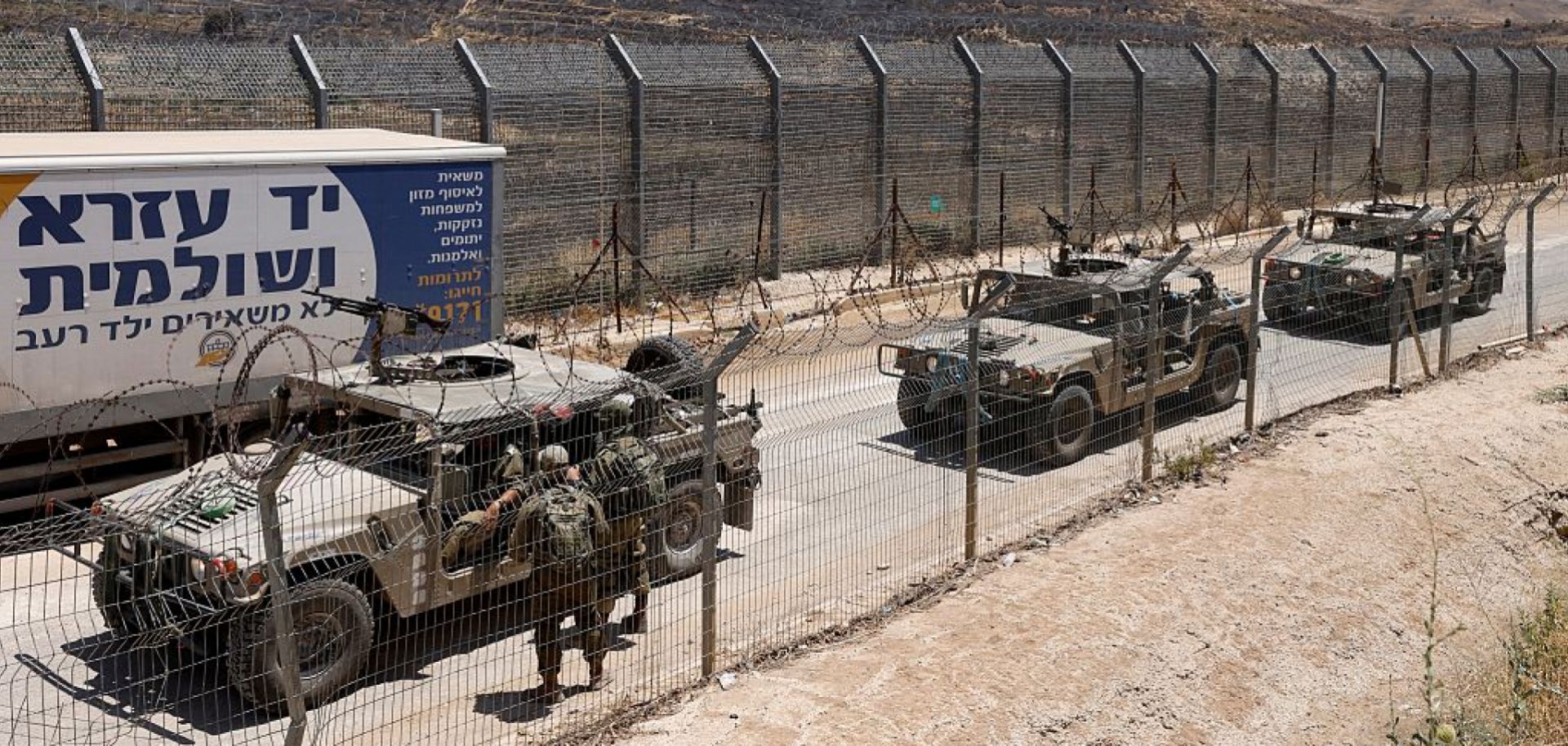
While Syria will seek pragmatic ties with Israel for limited security cooperation, domestic anti-Israeli sentiment and pressure from hard-liners, stoked by additional Israeli military interventions in Syria, will prevent any formal normalization of relations between the two countries, especially in the absence of U.S. economic pressure on Damascus. On July 26, U.S. envoy Tom Barrack moderated a meeting in Paris between Syrian and Israeli representatives to de-escalate tensions following the latest round of Israeli airstrikes on Syrian targets on July 16, which included attacks near the presidential palace and on the army headquarters in Damascus. The Israel Defense Forces (IDF) conducted the strikes after the Syrian army deployed to the southern province of Sweida, a region Israel wants to be demilitarized, to break up sectarian clashes between Sunni Bedouin clans and Syrian Druze backed by Israel. But U.S. mediation successfully pressured both Israel and Syria to de-escalate, with interim Syrian President Ahmad al-Sharaa agreeing to withdraw government forces to appease Israeli demands. This comes amid the White House's recent push to normalize ties between Israel and Syria following the May 14 meeting between U.S. President Donald Trump and al-Sharaa in Riyadh. To that end, Israeli media reports indicated as recently as June 30 that Israel and Syria were engaged in ''advanced talks'' to de-escalate bilateral tensions. However, any agreement reached during those talks would likely be limited in scope and not a full peace deal.
- Following the meeting between Trump and al-Sharaa, the United States has warmed relations with the interim Syrian government. On June 30, Trump signed an executive order lifting most U.S. sanctions on Syria, except for those linked to members of Bashar al Assad's deposed government. On July 8, the U.S. State Department also revoked the foreign terrorist organization designation of Hayat Tahrir al-Sham (HTS), the group led by al-Sharaa that overthrew the al Assad regime. The United States designated HTS' predecessor, Jabhat al-Nusra, as an FTO in 2014 due to the group's links to al Qaeda.
The HTS-led interim government has struggled to militarily resist Israel's ongoing presence in southern Syria and sporadic aerial strikes across the country, with Damascus focused on consolidating power and stabilizing the war-torn country. Following the Dec. 8, 2024, collapse of the al-Assad regime, the IDF crossed the buffer zone in the disputed Golan Heights and seized strategic positions in southern Syria, including positions on Mount Hermon. Since then, the IDF has reportedly destroyed over 80% of Syria's arsenal through sporadic strikes on al-Assad-era weapons caches, remnants of the Syrian air force and the Syrian navy, and chemical weapons stockpiles. The HTS-led interim government has been largely unable to retaliate against these attacks, due to significant limitations on its military capabilities and domestic fragmentation by various militias within Syria. Instead, the government has emphasized that its focus remains on consolidating power and stabilizing the country. Al-Sharaa has demonstrated pragmatism in eschewing HTS' jihadist past to appeal to Western powers in order to secure sanctions relief, which is crucial for facilitating humanitarian aid and reconstruction efforts, as well as deepening Syria's economic integration with Turkey and Gulf Arab countries. Despite this pragmatism, his government still includes former jihadist fighters who are pushing for a more assertive policy. Even as he is consolidating power, al-Sharaa also faces ongoing resistance from sectarian groups such as the Alawites, Druze militias and Kurdish groups in the northeast, all of which oppose integrating into the interim government.
- In March 2025, the Kurdish-led Syrian Democratic Forces (SDF) reached an agreement with al-Sharaa to integrate into the central government. However, little progress has been made on implementing the deal, and clashes between the Druze and the Syrian army in mid-July have since emboldened the SDF to keep its weapons. Subsequently, on Aug. 4, Syrian government-linked security forces clashed with the SDF in the Deir Hafer area of Aleppo province, illustrating persistent tensions between the central Syrian government and the Kurdish-led group.
- The European Union and the United Kingdom have also relaxed sanctions on Syria, especially on the country's energy, banking and transport sectors. In addition to providing relief for the new Syrian government, the easing of Western sanctions will help facilitate the return of some Syrians living abroad.
- The estimated cost of Syria's reconstruction after the country's multiyear civil war ranges from $250 billion-$400 billion, though the actual total cost could be even higher.
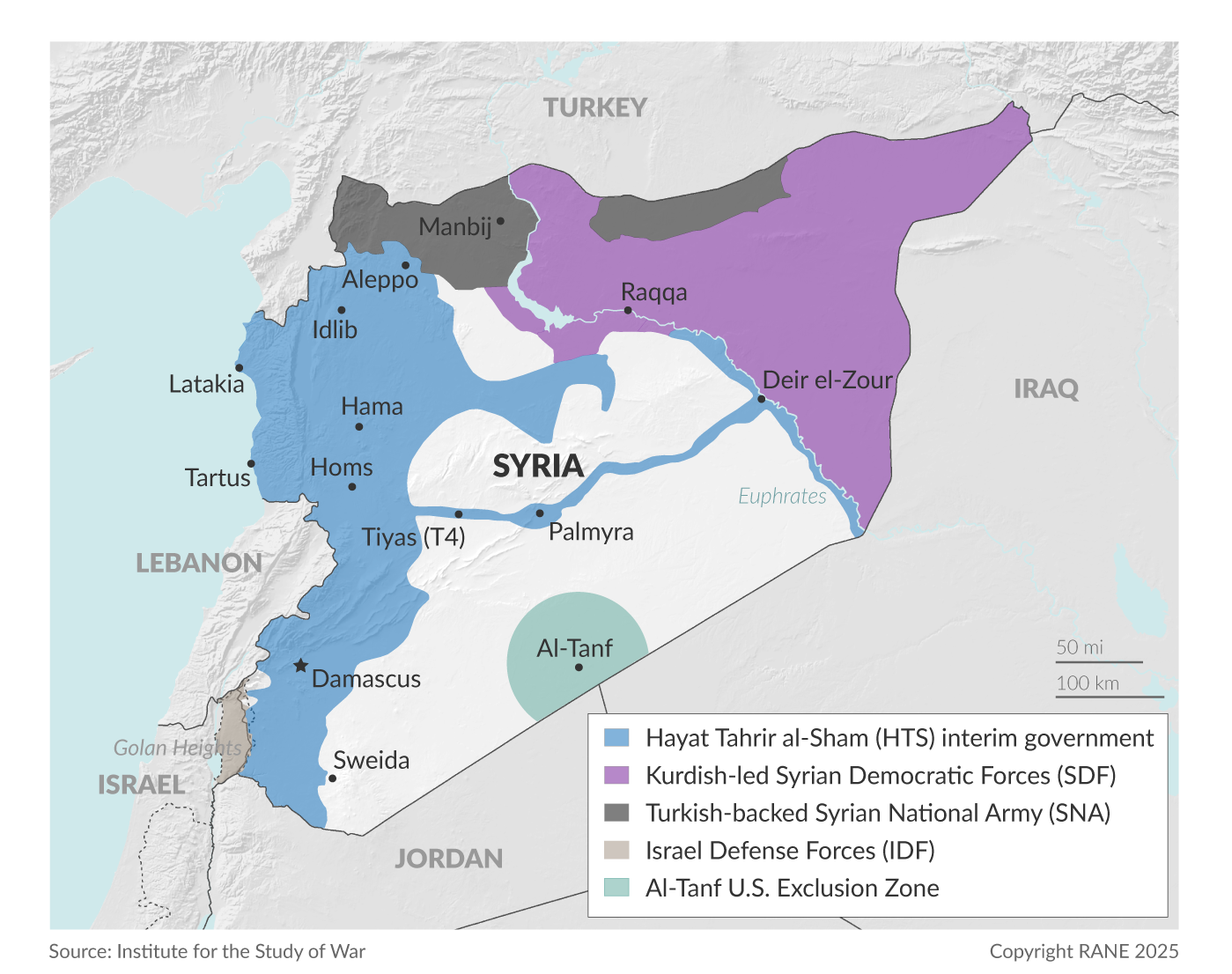
Ongoing talks between the Syrian and Israeli governments will facilitate some security cooperation, particularly in southern Syria. Israeli strikes on Syria's military assets have significantly weakened the new government's fighting capabilities. This, combined with domestic fragmentation, will incentivize Syria to refrain from becoming embroiled in an extended, direct conflict with Israel, which has military superiority. Separately, Israel's own constraints — with an increasingly war-weary electorate and military — will also deter it from entering a prolonged conflict with Syria. Indeed, despite Israel's pledged and demonstrated support for Syrian Druze, extensive clashes like those in mid-July could require greater Israeli involvement in Syria than it is likely willing to expend, especially with Turkish and U.S. military personnel still present in the country. This mutual interest in avoiding a larger destabilizing conflict will likely yield some quiet security coordination between Syria and Israel, in order to let Syrian security forces temporarily deploy to southern areas to quell pockets of unrest there, with decreased risk of triggering renewed Israeli airstrikes on government targets. Such limited cooperation is unlikely to alienate the hard-liners in the Syrian government, as subduing domestic unrest will bolster the government's domestic political legitimacy. Other areas for potential bilateral cooperation — such as energy, trade and investment — are less likely due to Syria's internal instability, prevailing anti-Israeli sentiment, and fewer technological areas for cooperation compared with Israel's Gulf Arab partners.
- Ongoing security threats in Gaza and Lebanon will further compel Israel to minimize its role in Syria. On Aug. 8, the Israeli government approved a proposal to take over Gaza City. This decision followed IDF resistance to more extensive plans to fully occupy the Gaza Strip, amid concerns that such an endeavor would strain military resources already stretched thin by war weariness and reservists refusing to report for duty. Meanwhile, Hezbollah is also threatening to resume cross-border attacks if Israel escalates along the Israel-Lebanon border.
- However, Israel has demonstrated a high risk tolerance since the start of its war with Hamas and could expand its military operations in Syria if it increasingly perceives immediate security threats emanating from the country. A January 2025 report by Israel's Nagel Commission, a committee providing recommendations for Israel's long-term defense needs and potential threats, wrote that the ''threat from Syria could evolve into something even more dangerous than the Iranian threat,'' specifically noting the role Turkish proxies in Syria could play in threatening Israel's security.
Al-Sharaa will be unable to agree to Israel's maximalist demands for a broader peace agreement in order to maintain the legitimacy of the new government and appease hardliners within it. In discussions with Syria, Israel has issued maximalist demands aimed at advancing its own national security interests, including the demilitarization of southern provinces and the retention of some strategic military positions in southern Syria. In response, Damascus has demanded the IDF's withdrawal from Syrian territory to respect Syrian sovereignty. But while the Syrian government has not called for Israel to relinquish the disputed Golan Heights (which Israel annexed in 1982), it is highly unlikely that Syria will accede to Israel's maximalist demands, despite the interim government's limited leverage due to its depleted arsenal. For one, agreeing to these demands would significantly reduce the government's control over southern provinces, as Syrian security forces would be barred from deploying there. It would also make the interim government appear weak and draw popular backlash, as many Syrians would likely oppose such substantial concessions to Israel. This would, in turn, risk emboldening hard-line factions within the government to undermine al-Sharaa's authority as interim president. These hard-liners could also push for more assertive retaliatory measures against Israel, or, in a more extreme case, attempt a coup. Additionally, should al-Sharaa agree to Israel's maximalist demands and grant greater autonomy to the Druze, it would likely encourage other sectarian groups, such as the Alawites and the SDF, to seek similar concessions, thereby further eroding the government's control over Syria.
- An HTS splinter group, Saraya Ansar al-Sunna, claimed responsibility for several sectarian attacks in Syria, including a June suicide bombing at a Damascus church. Hard-liners' dissatisfaction with al-Sharaa and the interim Syrian government would risk giving rise to additional splinter groups, which could fuel sectarian violence.
Without U.S. sanctions relief as leverage, and with the IDF unlikely to fully disengage from Syria, normalization between Syria and Israel remains highly unlikely for the foreseeable future. The United States' move to lift most sanctions on Syria and remove HTS' terrorist designation was not accompanied by strong, public demands that Syria make concessions to Israel or take concrete steps toward normalization. And while the Trump administration could reimpose the sanctions, it has not indicated any intent to do so. This has, in turn, significantly decreased U.S. leverage over the Syrian central government to normalize relations with Israel. Furthermore, Israel's continued sporadic attacks within Syria, both in support of the Druze and against military targets to prevent Syria's army from strengthening, will make normalization nearly impossible. Indeed, although Israel does not intend to annex or directly govern southern Syria, it will likely continue to try to strategically undermine the new government to keep it weak by maintaining air dominance over southern Syria, conducting attacks on weapons stockpiles, and providing support to minority groups within Syria. This will further dim the prospects for normalization by exacerbating anti-Israeli sentiment within Syria, already elevated by Israel's new plan to take over Gaza City. In a less likely scenario, if al-Sharaa faces increasing pressure from Syrian hard-liners over time, he could take a more assertive stance against Israeli violations of Syrian sovereignty. This, however, would risk triggering significant pushback from moderate, war-weary Syrians. It could also prompt the Trump administration to reimpose sanctions on Syria, which would jeopardize the country's ability to pay public sector salaries (currently funded by Gulf countries), provide public services like electricity (currently being supported by Turkey and Qatar), conduct business and strengthen defense ties, since other countries — especially U.S. allies — would likely not violate U.S. sanctions. Nevertheless, even if ongoing sanctions relief was jeopardized, the government's domestic constraints against cooperating with Israel would probably take precedence over Syria's economic needs.
- According to Israeli media sources, Israeli officials had wanted the Trump administration to delay any sanctions relief in order to use it as leverage to pressure Syria to make concessions.
- The new Syrian government has so far inked $14 billion in investment deals, including infrastructure deals for airport and subway construction with Qatar and the United Arab Emirates, as well as $6.4 billion in investments from Saudi Arabia in sectors like real estate, telecommunications, information technology and infrastructure.
- Turkey has provided electricity to Syria's HTS-controlled province of Idlib to ease power shortages since 2021, and has signed agreements with the interim Syrian government to provide additional energy supplies.
