
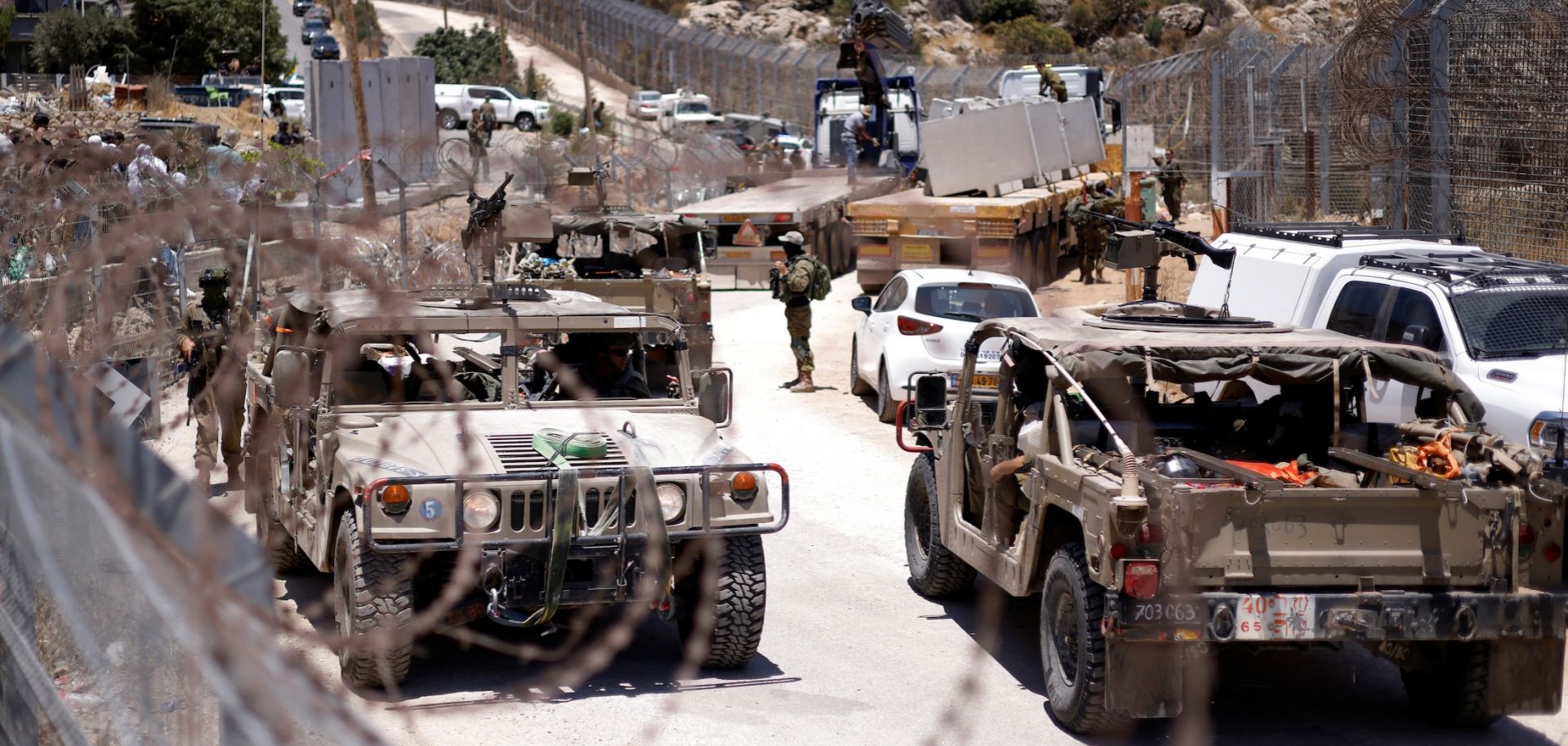
Syria and Israel will likely ink a security pact to ease border tensions by the end of the year, but the deal's likely narrow scope and other unresolved disputes will keep it fragile and at elevated risk of collapse in the months ahead. In recent days, U.S. officials have signaled that Syria and Israel are finalizing a pact to de-escalate their border tensions, with special U.S. envoy to Syria Tom Barrack noting on Sept. 24 that both sides were ''closing in'' on an agreement to restrict Syria's stationing of heavy weapons near the border in exchange for Israel halting attacks on Syria. Barrack's comment came shortly after Syrian President Ahmad al-Sharaa's high-profile meeting with U.S. Secretary of State Marco Rubio in New York on Sept. 23, where the two discussed counterterrorism cooperation and progress in security talks with Israel. On Sept. 18, Syrian Foreign Minister Asaad al-Shaibani traveled to Washington to link the negotiations on a security agreement to greater sanctions relief. Just a day earlier, al-Sharaa declared that ''talks with Israel could yield results in the coming days,'' stressing that any pact must safeguard Syria's airspace and territorial integrity under U.N. monitoring. Still, Israeli Prime Minister Benjamin Netanyahu's cautious admission that a deal was ''still far off,'' despite recent progress, underscores Israel's insistence on red lines, such as disarming southern Syria, retaining Israeli military positions on Mount Hermon and establishing a no-fly zone over southern Syria, which al-Sharaa has until now refused to accept.
- On May 23, the United States eased most sanctions on Syria. But some parts of the Caesar Act, which maintains the threat of secondary sanctions on entities doing business with the Syrian government, remain in place given that they need congressional approval to be completely lifted.
- Since the December 2024 collapse of the former Syrian President Bashar al Assad's regime, Israel has carried out thousands of airstrikes targeting both the remnants of the Assad-era military infrastructure and that of the newly established Syrian forces under al-Sharaa's leadership. Most recently, tensions escalated in July when Israeli military forces intervened in Syria's southern Sweida province on behalf of Druze militias, after violent clashes broke out between Druze fighters, government-aligned Bedouin militias and the new Syrian authorities.
- Al-Sharaa has emphasized that any pact must ensure Syrian sovereignty, result in Israeli military withdrawal from the south and remove Israeli forces from Mount Hermon. Despite denying he is acting under U.S. pressure, al-Sharaa has linked progress on a deal with Israel to the lifting of U.S. sanctions, and has stressed that normalization or broader peace will only follow once a credible security framework is in place.
- Al-Sharaa has indicated that Syria seeks a pact modeled on the 1974 Disengagement Agreement, which created demilitarized zones in the Golan Heights under a U.N. peacekeeping force. He views this framework, force separation, U.N. monitoring and pre-1974 territory lines as the baseline for any new arrangement with Israel.
The push for a security pact is part of U.S. mediation efforts to help stabilize Syria and its southern region while addressing Israel's concerns about Syria as a threat, in support of al-Sharaa's attempts to unify the country and kickstart its economic recovery. The United States has been increasingly active in mediating between Syria and Israel in the past few months, aiming to broker a security agreement that would limit Israeli airstrikes, ensure its military withdrawal from parts of southern Syria and stabilize their shared frontier. This is largely due to U.S. interests in promoting a stable and unified Syria as a conduit for regional stability to guard against Iranian influence and the threat from the Islamic State. Despite that view in Washington, Israel has intensified airstrikes and limited ground operations inside Syrian territory in the past few months, often citing the protection of Druze communities in areas like Sweida, where sectarian clashes in July 2025 eventually led the Israeli air force to conduct airstrikes near the Presidential Palace in Damascus and the Syrian Ministry of Defense. In contrast to the U.S. position, Israel prefers a weakened Syria over a stable one governed by Islamists, as it fears the latter could eventually become a security threat. This concern has shaped Israel's policy of supporting various militias and targeting Syrian military and government assets. For al-Sharaa, reducing Israeli pressure and restoring a measure of territorial integrity has become central to his diplomatic agenda, as he views stabilizing the border with Israel and halting Israeli strikes on Syria as essential for jumpstarting Syria's economic recovery and unification, and ultimately advancing the country's reintegration into the international community.
- Since the collapse of the al Assad regime, Turkish-Israeli competition in Syria has deepened. Turkey has emerged as Damascus' primary ally and military backer, working to bolster al-Sharaa's authority and advance the unification of the country. Conversely, Israel has pursued an opposing strategy that aims to limit al-Sharaa's consolidation of power — due to distrust stemming from his past as a jihadist — by ensuring Syria remains fragmented, militarily constrained and politically weakened.
An Israel-Syria security pact that would give the United States a sought-after diplomatic win is likely by year's end, even though the agreement will likely be fairly narrow in scope and leave out some crucial issues. Despite persistent divergences, the drivers for a Syrian-Israeli security pact outweigh the constraints, making an agreement before the end of 2025 more likely than not. Syria is under pressure to stabilize its southern border to free up bandwidth for more urgent priorities, notably the challenge posed by the defiant Kurdish-led and U.S.-backed Syrian Democratic Forces (SDF) in the northeast, where armed clashes are intensifying and risk expanding — an issue that Syria's main backer, Turkey, also views as critical. Additionally, Damascus is motivated by the prospect of improved relations with Washington and further sanctions relief, meaning it is likely to compromise more than Israel. Israel, under U.S. pressure, may make tactical concessions but will not cross its red lines: insisting on a disarmed southern Syria and retaining its forward positions on Mount Hermon, which provide leverage not only over Damascus but also Hezbollah in Lebanon, given that it overlooks the Hezbollah-dominated Bekaa Valley. The most probable outcome is an agreement narrowly focused on security, with Syria not moving heavy military equipment to the south in exchange for Israel halting attacks against Syria, rather than thornier political issues like creating a demilitarized zone in the Golan Heights or fully normalizing bilateral ties. Israel will likely vow to withdraw from occupied territories in principle while still holding the Golan and positions in Mount Hermon, a point Syria will push to discuss but is unlikely to derail the pact. The United States will almost certainly present such an agreement, even if fairly narrow in scope, as a diplomatic success, seeking to reclaim credibility in a region where its mediator role has come under question.
- The United States has come under growing criticism recently from Arab states for its perceived passivity in restraining Israeli military operations in the region, especially after Israel's Sept. 9 attack on Doha, Qatar. Arab states have also increasingly criticized Washington's failure to deliver meaningful progress on long-standing conflicts, most notably Israel's military campaign in the Gaza Strip. Against this backdrop, the United States has strong incentives to secure a diplomatic win by brokering a Syria-Israel security agreement, framing it as evidence that American mediation can still produce tangible outcomes. The urgency is heightened by the fact that parallel U.S. efforts to de-escalate tensions between Lebanon and Israel have largely stalled, with border talks failing to yield results.
A security pact would likely defuse Syrian-Israeli tensions in the short term, creating space for confidence-building measures and reducing the probability of direct clashes along their shared border, due largely to Damascus' incentives to adhere to a deal, at least for now. With Syria in a precarious position and in need of a stable security environment to kickstart its economic recovery and address other security challenges, Damascus is more likely to comply with an agreement in the short term, even if Israel commits occasional violations. With Damascus likely to implement the pact, which would appease Israel, it could open the door to incremental negotiations on contentious issues such as the Golan Heights, Israeli military positions on Mount Hermon or even steps toward normalization. This would effectively defuse tensions between the two sides, though progress will almost certainly remain slow and conditioned by the pact's durability. Such an arrangement would also help ease friction between Turkey and Israel, as Ankara would see less risk of an Israeli military build-up along Syria's southern front, given that Turkey is Syria's main military backer and has, in recent months, sought to expand its presence there, running counter to Israeli interests. For Damascus, adhering to a pact would also be a strategic necessity in securing U.S. approval for broader sanctions relief, including the full lifting of sanctions under the Caesar Act, and in attracting international investment. Additionally, the agreement would give the new Syrian government space to consolidate domestic control, stabilize its fragile economy and manage tense relations with the SDF. Israel, meanwhile, would use the pact to reduce immediate security risks along its northern frontier while testing whether Damascus can deliver on commitments.
The pact, however, would remain fragile due to Israel's aggressive military stance, territorial claims to the Golan Heights and continued backing of Druze militias, which — combined with the unpredictable behavior of various armed groups in Syria — would collectively sustain a high risk of renewed clashes and the potential for the agreement to unravel. Any pact that emerges in the coming months will likely remain very fragile and susceptible to collapse, as Israeli security priorities will continue to drive a risk-tolerant, aggressive regional posture. Since its many victories against Hezbollah in Lebanon in 2024, its war against Iran in June and the ongoing war in Gaza, which has severely damaged Hamas' fighting capabilities, Israel has grown aggressive in its regional security strategy, attacking threats before they grow, while minimizing how much it compromises with its foes. Additionally, short of tangible Syrian steps toward normalization or compliance with Israel's red lines and security demands, Israel will remain skeptical of Damascus' intentions and will continue to press its longstanding claims over the Golan Heights and supporting Druze factions in a demilitarized Syrian south, fueling mistrust. Additionally, hard-line and rogue Sunni militias in Syria that, despite their allegiance to the transitional authorities, are opposed to any agreement with Israel, may also attempt to derail the pact through sporadic rocket attacks or raids against Israeli patrols along the borders with Syrian territory or in territories captured by Israel, further testing its resilience. Hard-liners in al-Sharaa's government could also seek to undermine any agreement they see as overly generous to Israel and/or not being adhered to by Israel. At the same time, Israel's continued support for Druze militias directly contradicts the security pact and Syrian state interests in a unified Syria, which would raise the probability of renewed armed clashes, especially as Bedouin militias in the province may clash with the Druze even without direct or indirect government support. This would, in turn, likely prompt Israel to intervene again, effectively undermining any security agreement.
- The Camp David Accords of 1978, which established peace between Israel and Egypt, worked in large part because the United States not only mediated the deal but also invested heavily in stabilizing it through sustained diplomatic pressure, large-scale economic and military aid to both Egypt and Israel, and the establishment of a robust monitoring mechanism in Sinai (the Multinational Force and Observers) to guarantee compliance. That combination of incentives, enforcement and U.S. guarantees gave the agreement durability despite deep mistrust between the two parties. By contrast, in the current Syrian-Israeli negotiations, Washington appears reluctant to commit resources or a peacekeeping presence, limiting its role to mediation and sanction flexibility. Without a credible security force to monitor demilitarized zones and reassure skeptical actors like the Druze community, any agreement will be fragile, vulnerable to local spoilers and prone to unraveling under the weight of renewed clashes or Israeli interventions.
- The high risk that a Syrian-Israeli security pact collapses, or at least sees repeated violations that undermine its effectiveness, is also underscored by Israel's record in Lebanon, where, despite a November 2024 ceasefire, it has continued pursuing Hezbollah aggressively, undermining U.S. efforts to facilitate disarmament and bolster the Lebanese government. By refusing to withdraw its troops from Lebanon and setting objectives that run counter to its truce with Hezbollah, Israel has weakened the ceasefire's credibility. A similar dynamic in Syria is highly likely, as Israeli security priorities could once again override negotiated commitments, leaving any pact fragile and vulnerable to a breakdown.
