
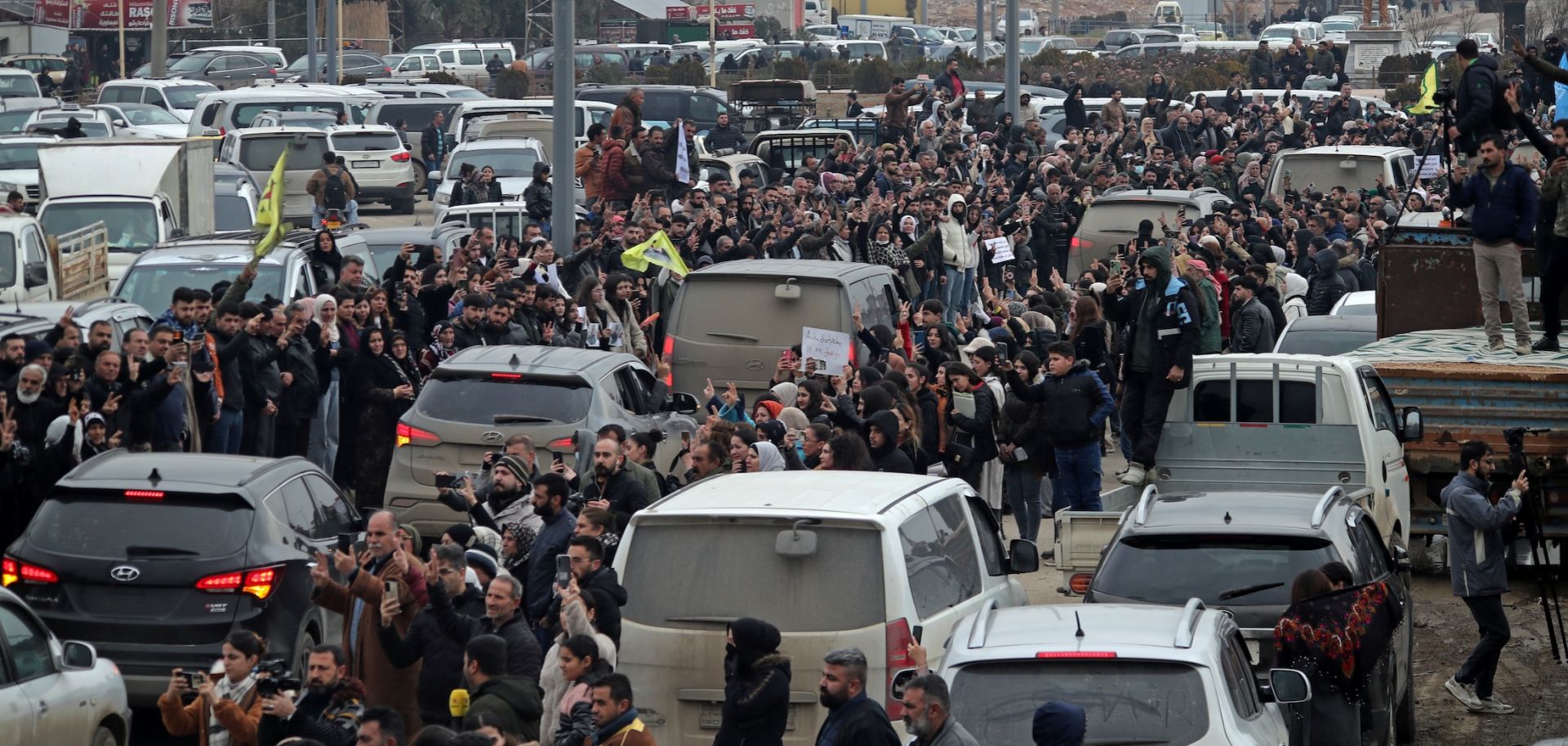
The withdrawal of the Kurdish-led Syrian Democratic Forces (SDF) from Aleppo will likely reduce conflict in the city, but it will also threaten Kurdish integration efforts in Syria; if the army launches a major offensive in the northeast, clashes with the SDF would likely be more intense and prolonged, potentially disrupting the country's recently resumed oil exports. Remaining SDF fighters left Aleppo on Jan. 11 after days of clashes with the Syrian army, which killed at least 24 people and injured more than 100. According to SDF commander Mazloum Abdi, the group reached a U.S.-mediated ceasefire agreement with the central Syrian government to withdraw from the city and secure the evacuation of the remaining fighters. The latest agreement comes after an earlier Jan. 9 ceasefire collapsed when SDF militants failed to meet the government's deadline to withdraw from Aleppo.
- On Jan. 7, the Syrian government forces launched a "limited operation" against SDF militants in Kurdish-majority neighborhoods in Aleppo to remove the militants and consolidate government control over the city. The SDF had established a presence in the Kurdish-majority neighborhoods of Ashrafiyeh and Sheikh Maqsoud since 2011, though the group repeatedly denied a militant presence in the neighborhoods.
- U.S. envoy to Syria, Tom Barrack, has urged both the SDF and the Syrian government to ease tensions and protect civilians in the area, as Washington tries to balance its ties to both actors. The United States has historically supported the SDF as a key partner in the fight against the Islamic State, though this support has declined in recent years. But in recent months, the Trump administration has increasingly warmed ties with the interim Syrian government and Congress repealed the Caesar Act sanctions against the former Bashar al Assad regime, as well as individuals and companies that profited from the Syrian civil war and reconstruction efforts.
- On Jan. 12, a senior SDF commander alleged that Turkey had played a role in the Syrian government's Jan. 7 operation, which the Turkish defense ministry previously denied. Turkey views the SDF as a terrorist organization and a national security threat, and recent comments from Turkish Foreign Minister Hakan Fidan suggest Ankara is becoming increasingly impatient with the slow pace of the SDF's integration into the Syrian government.
The Aleppo clashes came after stalled efforts to integrate the SDF into the Syrian central government. The SDF and interim Syrian President Ahmad al-Sharaa reached an agreement in March 2025 to integrate the SDF and Kurdish-led institutions in northeastern Syria into the central government. However, the SDF missed the integration deadline of Dec. 31, 2025, with few concrete steps taken toward integration. Disputes centered on Kurdish demands for autonomy and minority rights secured during the civil war, and the SDF's fear of government attacks against minority groups after Syrian forces clashed with Alawite and Druze militias. Government forces and SDF militants have since clashed sporadically in northern Syria, often triggered by government accusations of SDF attacks.
- The SDF and the Syrian government reached a preliminary agreement in December 2025 for the SDF to maintain three divisions within the Syrian army under federal authority. However, essential details — including how the divisions would operate, as well as roles and responsibilities — remain unresolved.
- According to 2025 estimates, the SDF has around 50,000 fighters, along with a cadre of small arms, advanced artillery (including drones and armored vehicles) and some U.S. assets. In comparison, the Syrian army has over 100,000 enlisted fighters (mostly former militia members), along with an arsenal of militia assets, advanced weaponry and drones, as well as some Turkish-provided assets, including armored vehicles. However, Syria has not made much progress rebuilding its air force and navy after Israeli strikes destroyed almost all of the Assad-era remnants.
The SDF's withdrawal from Aleppo's Kurdish-majority neighborhoods will reduce fighting in the city, though some hard-line fragments may still sporadically conduct attacks on government-aligned forces there. Most of the fighters who were in the city have since relocated to the SDF strongholds in Syria's northeastern Hasakah province. While government forces have continued to clash with SDF forces in rural areas outside Aleppo, the withdrawal will likely reduce major fighting in the city. However, the recent ceasefire agreement may have caused a rift between some SDF militants in Aleppo and senior leadership. Indeed, reports during the brief Jan. 9 ceasefire, noted by Al Jazeera, indicated divisions between local SDF fighters, who vowed to "defend their neighborhoods," and the Kurdish leaders, who were allegedly willing to negotiate a withdrawal and to ease tensions in Aleppo. Consequently, while the majority of remaining SDF fighters have evacuated, some hard-line militants who opposed the withdrawal may break with the SDF leadership and launch sporadic attacks against government-aligned forces in Aleppo. However, government-aligned forces will likely be able to suppress these attacks due to their likely reliance on small arms and unsophisticated tactics.
However, SDF integration will likely remain slow due to the group's ongoing mistrust of the government and its likely entrenchment in the Kurdish-led northeast, which will fuel tensions. The withdrawal from Aleppo marks the Syrian Kurds' first major territorial loss to the interim government since the fall of the al Assad regime in December 2024. But the loss will not necessarily make the SDF more willing to accelerate its integration into the Syrian government. For one, ethnic tensions will likely remain high after the Kurds accused the government of committing war crimes during the latest bout of clashes; and this, combined with longstanding concerns of potential government violence against minorities, will likely embolden the SDF to maintain their weapons. Secondly, although the SDF had a strong presence in two Kurdish-majority neighborhoods in Aleppo, Syrian Arabs controlled most of the rest of the city. By contrast, the SDF holds much greater control in Syria's Kurdish-majority northeast, including in the cities of Qamishli and Raqqa. While Syrian government forces have clashed with the SDF elsewhere, including in the central, north and eastern regions of the country, they have so far largely avoided the northeast. Most of the SDF fighters who have left Aleppo will thus likely entrench themselves in these northeastern strongholds to avoid more clashes with government troops. Concentrating its fighters in the northeast will also bolster the SDF's ability to resist any attempts by the Syrian army to forcibly seize the territory, thereby helping the group retain the positions it secured during the civil war. While their success in Aleppo might encourage some hard-liners in the government to seek further confrontations with the SDF, an operation in northeastern Syria would likely be costlier and protracted. With its resources already strained by efforts to suppress other sources of minority dissent, the Syrian government is thus unlikely to pursue such a conflict at this time. Furthermore, both the government and the SDF will likely prioritize consolidating their own power and capabilities in the coming months, and neither side has signaled an intent to engage in a prolonged conflict. Finally, overt U.S. pressure, such as sanction threats, would likely constrain the Syrian government from adopting a more assertive policy against the SDF.
- The United States expressed broad concern about minority protections during the latest round of fighting between the SDF and Syrian troops. While neither Trump nor senior officials within his administration have threatened to re-impose sanctions or decrease support for Damascus over the issue, the violence against Kurds will likely still raise human rights concerns among Syria hawks in the U.S. Congress.
Any attempts by the Syrian army to seize more SDF territory in the northeast would likely be met with strong resistance, resulting in heavier fighting and a halt to government cooperation that could disrupt Syria's recently resumed oil exports. Despite the myriad risks and constraints, the Syrian army may still launch a larger campaign against the SDF in the northeast — especially if Turkey pressures the government to escalate against the Kurds and provides the military aid needed to do so. In response, the SDF would highly likely mount a significant resistance to such a campaign, driven by an imperative to maintain control over its territory and, consequently, its leverage in future integration negotiations with the Syrian government. Due to the better organization and concentration of military capabilities among SDF forces in the northeast, any extensive government operation there would thus likely result in more intense — albeit largely regionally confined — fighting. Such a conflict would prompt the SDF to halt all cooperation with the central government and resist integration efforts. The SDF may also restrict the oil exports from fields in the northeast, which recently resumed following the lifting of Western sanctions on Syria. Given Damascus's reliance on Kurdish cooperation for those exports, this disruption would undermine a key source of state revenue and hinder government efforts to rebuild Syria's energy sector following years of civil war. Kurdish impediments to renewed oil exports would also risk incurring U.S. backlash.
- Some Sunni Arab tribes in Syria's northeast have reportedly said that they would back a military offensive against the SDF. But this alone is unlikely to influence the government's decision to launch such an offensive, as these tribes' limited manpower and small arms support would do little to ease the Syrian army's resource constraints.
