
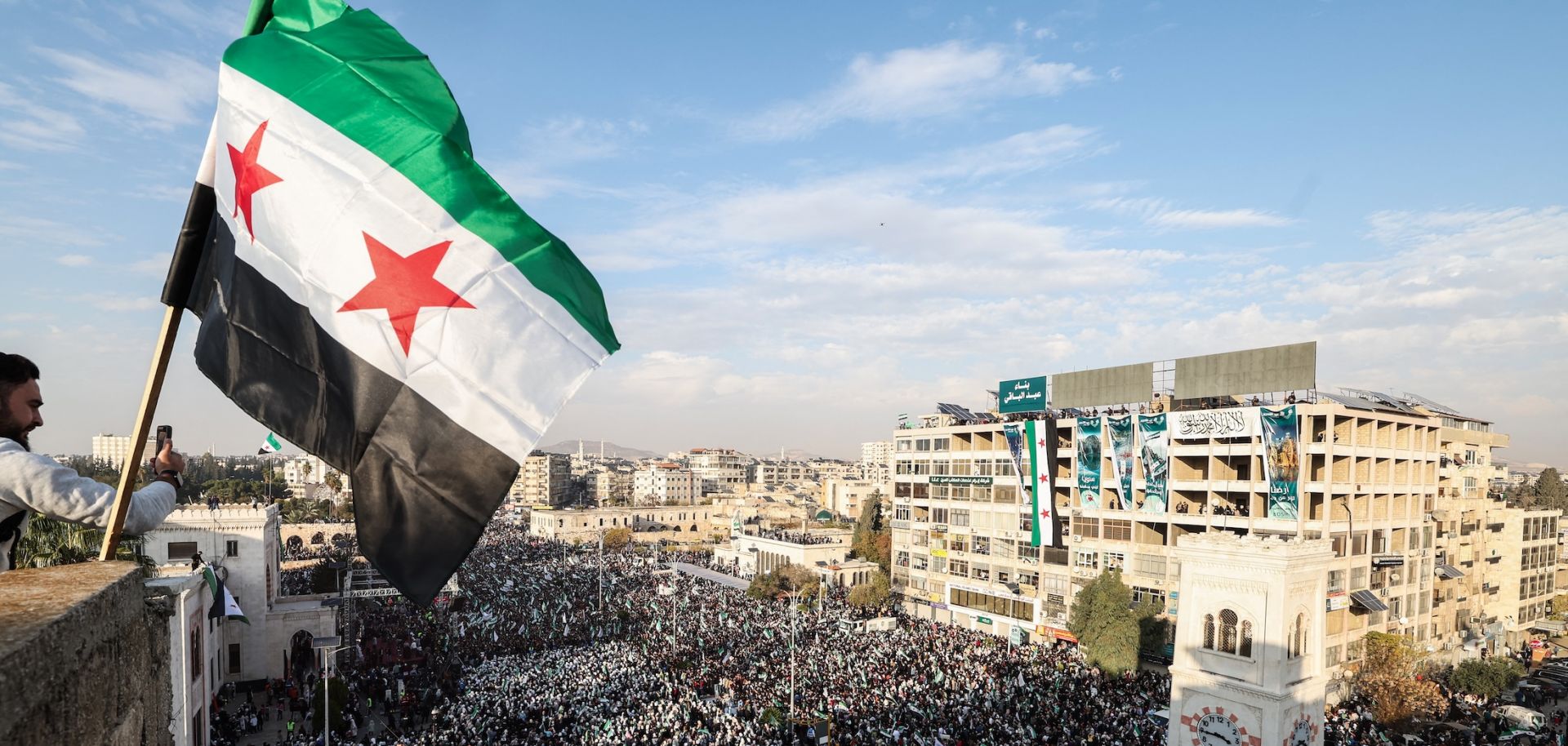
More than a year after the fall of former President Bashar al Assad, the new Syria is still firming up its state identity — and its place in the wider region. But the broader contours are now clear. There will be no Rojava, the decade-plus experiment in Kurdish self-rule that emerged in 2012, now that Syrian government forces, backed by Turkey and tolerated by the United States, have rolled over the Kurdish-led Syrian Democratic Forces (SDF). However, Syria will also not return to Assad-era repression, as the new government has offered Kurds significant language and cultural rights.
Navigating domestic and foreign pressures, Syria is emerging as a Turkish-aligned, authoritarian state. For stability and reconstruction, it will maintain formal neutrality in the region's many conflicts, but Syria, struggling to escape Turkey's shadow and the Gulf Arabs' interests, will still inevitably be forced to endure some of those wars anyway.
The Three Syrian States
This might be thought of as the third Syrian state and a third pitch to find balance in a place historically relegated to a geopolitical borderland. The first state, formed after independence from France in 1946, attempted to replicate the political structure of the French Republic. However, internal divisions and external pressures — not least from the French themselves — led to profound instability, marked by numerous coups, a short-lived unification with Egypt and eventually the 1963 coup that brought the nationalist Ba'athist party to power. This began the second Syrian state. Unlike its predecessor, this regime viewed plurality, equality and democracy as liabilities, and the Ba'athists ruthlessly suppressed political, religious and ethnic opposition alike.
Taking influence from the Soviet Union, Egypt and fellow Ba'athists like Saddam Hussein, the Ba'athists under Hafez Assad from 1970 and Bashar al Assad from 2000 constructed a rigid, if predictable, nationalist-secular state. This state was profoundly hierarchical internally, with power flowing down from the al Assad family to their core Alawite supporters and then further down to loyalists among Syria's Sunnis, Shiites, Kurds and Christians. To ward off foreign interference, Syrian leaders blurred the line between the pro-Soviet camp and the non-aligned world led by countries like Egypt and, after 1979, Iran. This second state had a greater degree of stability than the first. It used brute force to suppress the divided nature of Syria's borderland identity, riven by so many internal differences after being far from the homogenizing influence of an imperial core. But it could only afford such force so long as it had external backers to backroll it; first the Soviets, then later the Iranians and Russians. And force alone could not unify Syria's many groups, only suppress them, or corral them away from Damascus. When the civil war broke out in 2011, the al Assad government accepted the loss of its northeast almost without a fight, while its strategy focused on hemming in rebels into controlled territory in Idlib province. This worked until Iran and Russia could no longer backstop the government in 2024.
Now, interim President Ahmad al-Sharaa and his provisional government are building a third Syrian state — and a third era of foreign relations. The imperatives for now, and likely for many years ahead, are largely focused on the internal. Syria's destruction during the civil war means it has neither wealth nor manpower to be a player on the world stage. Its role as a great Arab army, like it was when it occupied Lebanon and fought the Israelis during the Cold War, is a distant memory. And its position as a nationalist-secularist pan-Arab capital has crumbled. Al-Sharaa has so far not shown much personal interest in chasing such dreams again, partially out of personal inclination but mostly because it would be to risk the very foreign interference and internal division that brought down al Assad. Out of preference and necessity, al-Sharaa is charting a new course.
Al-Shaara's New Strategy
If there is a maxim by which al-Sharaa now lives, it might be to keep Turkey in, Israel and Iran out, and the rest of the international community friendly, in order to facilitate the much-needed reconstruction that will prevent Syria from returning to a failed state. For Damascus, Turkey is a crucial military and economic partner. Its troops will train and arm the nucleus of the third Syrian military, while its large economy will be the primary market for Syria's exports in the years to come. But while Turkey must be kept close, there is such a thing as too close. For one, Turkey's own conflicts, including with Israel, could turn Syria back into a battleground. And Turkey may not be entirely reliable for Syria's self-interest: Turkey has an imperative to return its Syrian refugees, even if Syria is not ready for them, while Turkey's long conflict with the Kurds has already spilled over into Syrian Kurdistan. And lurking on the far edge of Turkish politics are neo-Ottoman revisionists who have never accepted the modern borders and aspire to elevate Syria's Turkmen well beyond their demographic or political heft. With the world in a state of multipolar flux, those who may be on the extremes of Turkish politics today might become tomorrow's coalition partners; Damascus can ill afford to ignore them wholesale.
Meanwhile, Damascus must keep Iran and Israel from treating Syrian territory as a gigantic proxy battleground. Hence, al-Shaara's government has kept Iran at arm's length and worked to prevent the return of the smuggling routes Tehran needs to reach its cherished ally Hezbollah in Lebanon. Damascus has also tolerated recurrent Israeli military strikes and its expansive interference in Syria's domestic affairs, worried that antagonizing Israel could prompt the Israeli military to more openly back minorities like the Kurds, or to target members of the Syrian government. Remarkably, Israeli strikes have spurred al-Shaara to seek appeasement with Israel rather than confrontation, a full about-face from the Cold War nationalist era, where the Syrian government reacted ferociously to Israeli provocations.
But in addition to its neighbors, Syria is seeking a different type of non-alignment in the modern world: one that embraces friendly neutrality rather than ideological third ways. This is its approach to the United States and Gulf Arab states, as well as Russia, China and Europe. Its refusal to retaliate against Israel is also about its ties with Washington, which, under the Trump administration, cares little about which political direction Syria's third state goes but does care immensely about Israel's security. And the United States still cares about the Islamic State, which once ruled large swathes of Syria, too. So long as Damascus appeases the United States on these fronts, Washington is ready to hand Syria back to Damascus to run. Already, the United States has largely abandoned its SDF allies, seeing the Kurdish-led group's value as spent now that al-Sharaa is ticking the handful of interest boxes the United States has in Syria, and rumors are rife that the United States will also soon withdraw its forces from Syria. With Washington appeased (and, most crucially, U.S. sanctions lifted), much of the hard work of international reintegration has already been done. However, Syria must also make, or imply, commitments to other states. It must assure the Gulf Arabs that it will not revert to an Iranian stronghold or a source of Sunni militants. It must promise Europe that it will take back its Syrian refugees sooner or later. And it must convince China that it will be a secure enough place to invest and do business.
This strategy may steadily be effective, as most countries are banking on Syrian stability after so many years of chaos. But it may come into conflict with al-Sharaa's domestic imperatives over time. Syria will not always be able to follow where Turkey leads, particularly against Israel. Former rivals like Russia and Iran may also become of value to Damascus again, even if it risks jeopardizing Syria's warming ties with the United States. Additionally, the provisional government's current foreign policy strategy will not change Syria from a borderland back into the minor power it once was. Syria's geopolitical agency will thus be extremely limited and buffeted by the winds of regional change.
The Geopolitics of Syria's Political Choices
As Syria shifts from a provisional to a permanent government, a political choice will have to be made: will it pluralize, as its U.S. backers want, at the risk of returning to the first state's recurrent instability and coups? Or will it lean on the Assadist playbook and establish a new authoritarian regime designed to suppress the cracks in Syria's demography, at the risk of repeating its recent civil war?
To pluralize into a decentralized state, let alone a democracy, would appease much of the outside world, but it could antagonize Turkey, which is eager to keep the Kurds suppressed. But returning to brute authoritarianism against minorities would risk re-triggering U.S. sanctions, a shift that could empower hard-line religious and nationalist elements inside the provisional government that see the United States and Israel as eternal enemies rather than pragmatic partners. Moreover, authoritarianism would further alienate political have-nots — including the Alawites, Druze and Kurds, as well as potentially Shiites and Christians — all of whom would be ready-made communities for foreign interference in the country. While the United States, Russia and regional powers like Jordan and the Gulf states may not be interested in a democratic Syria, they do not necessarily want minority communities to be wiped out by a domineering Syrian state. Still, authoritarianism has a better record than pluralism in Syria and may buy years of stability, evidenced by the Ba'athists' decades of successful control.
Syria's foreign policy will also eventually have to adapt. Assiduous neutrality does not guarantee safety, as demonstrated by separate attacks by both Iran and Israel against targets on Qatari soil in 2025. Alignment with Turkey could pull Syria into Turkey's conflicts, including with the Kurds and Israel. In the more distant multipolar future, Turkey will also be increasingly at odds with its NATO partners, its Gulf Arab rivals and even major Sunni powers like Egypt.
But without Turkey, Syria lacks a ready-made security partner and would have to rely on deeper appeasement of potential rivals to achieve security, which would erode Syria's sovereignty and weaken its government, whether it is a pluralistic or authoritarian one. Damascus may also seek out new security partners to diversify from Turkey. It may return to its Arab roots, perhaps even rebuilding ties with Egypt, with which it had a short-lived union. But such outreach will only work if the Arab world has an interest in projecting power into Syria again and hasn't ceded the country to the Turkish sphere of influence. China will also not be a viable option, unless Beijing starts to project power far beyond what it has been historically comfortable with or able to do. And Russia, al-Sharaa's former civil war rival, may be willing to once again serve as Syria's security partner, but its geopolitical flesh remains weak, so long as it is mired in the Ukraine war. Turkey thus remains, by default, the prime partner.
Like its predecessors, the third Syrian state will not solve all of the country's internal imbalances. But it will try to correct for the second state's excesses while avoiding the first state's mistakes, which portends a shift away from pluralism toward autocracy and Turkey. However, while this imperfect formula may address enough challenges to enable limited reconstruction in the near term, it will also create imbalances that, combined with internal or external changes, could still unravel the third Syrian state.
