
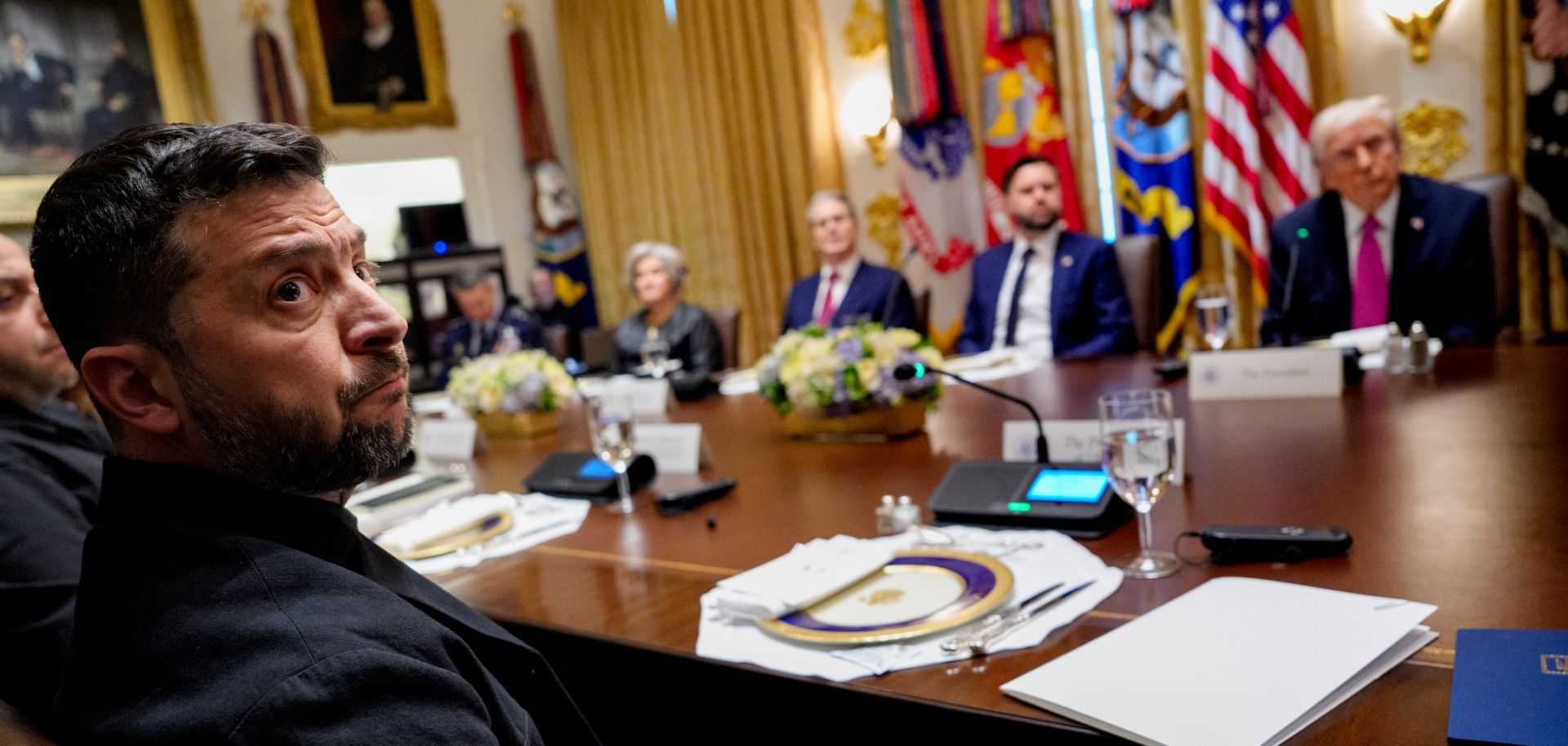
U.S. President Donald Trump's recent statements indicate a shift toward pressuring Ukraine to make territorial concessions to Russia, signaling a potential U.S.-backed deal on terms largely favorable to Moscow and heightening uncertainty about future American support for Kyiv. Trump stated on Oct. 19 that the war in Ukraine should be frozen along the current front lines. This statement followed media reports about a tense Oct. 17 White House meeting at which Trump is said to have urged Ukrainian President Volodymyr Zelensky to cede Ukrainian-controlled territories in the Donbas region to end the conflict. Just hours earlier, Trump had spoken with his Russian counterpart, Vladimir Putin, by phone and announced a bilateral summit in Budapest, Hungary, "within the next two weeks." Trump also indicated that high-ranking delegations, including U.S. Secretary of State Marco Rubio and Russian Foreign Minister Sergei Lavrov, would meet in the coming days (though no specific date or venue have been announced).
- The Donbas is a region in eastern Ukraine home to a large population of Russian speakers and has long been viewed by Moscow as the most pro-Russian part of the country. In 2014, pro-Russian forces in the Donbas started a war against Ukrainian forces with support from Russia, and then contributed to Russia's full-on invasion in 2022. In September 2022, Russia unilaterally declared the annexation of four provinces — Donetsk and Luhansk, which together make up the Donbas region, Kherson and Zaporizhzhia — even though Russian forces were not in full control of any of them. Speaking to reporters about the Donbas on Oct. 19, Trump said that "I think 78% of the land is already taken by Russia. You leave it the way it is right now, they can negotiate something later on down the line."
- According to a Financial Times article published on Oct. 19, Trump urged Zelensky to accept Putin's terms to end the war or else Russia would "destroy" Ukraine. The FT reported that the meeting descended several times into "a shouting match," with Trump saying he was "sick" of being shown the map of the Ukrainian battle lines. Reuters and other media sources also reported that the Trump-Zelensky meeting was tense.
Trump's recent statements indicate a renewed U.S. push for a negotiated settlement in Ukraine involving territorial concessions, marking a shift from earlier signals of increased military support. The media reports and Trump's recent public statements suggest that the White House is once again asking for Ukraine to make territorial concessions to end the war. This argument is not new. Trump and many other high-ranking U.S. officials have repeatedly said in the past that Ukraine would need to give up unspecified amounts of territory to Russia in order to achieve a quick peace agreement. Still, these calls come after weeks of the Trump administration making pro-Ukraine moves and threatening Russia with additional sanctions. In late August, the White House approved a $825 million arms sale to Ukraine that included longer-range missiles and related equipment to improve Kyiv's defensive capabilities. In mid-September, Trump said that the United States would provide logistical and intelligence support to the European countries that would deploy troops to protect Ukraine after the war. In early October, several media outlets reported that the United States had agreed to provide Ukraine with intelligence on long-range energy infrastructure targets deep inside Russia. Then in mid-October, Trump suggested that the United States could give Ukraine long-range Tomahawk missiles, which would allow Kyiv to reach targets deep inside Russia. However, on Oct. 19 Trump backtracked on the Tomahawk issue, saying that the United States could need these missiles in the future. The extent to which the Oct. 17 phone call with Putin changed Trump's position on the Tomahawks issue and broader U.S. support for Ukraine is unclear, but the timeline of events suggests that by accepting another face-to-face meeting with Trump, Putin has once again delayed a U.S. move that could benefit Ukraine.
- According to media reports, during the meeting in Alaska in August, Putin asked Trump for full control of the Donbas (which includes territories currently under Ukrainian control) and offered to freeze the war along the current lines in Kherson and Zaporizhzhia. According to the Financial Times, during the Oct. 17 phone call, Putin offered to give up unspecified parts of Kherson and Zaporizhzhia in exchange for control of all of the Donbas. If true, this would mean the first concrete concession that Moscow has made since the start of the U.S.-mediated peace process earlier this year. However, it is not clear exactly what territories, if any, Russia would be willing to return to Ukraine.
- On Oct. 12, Trump said he had discussed with Zelensky the possibility of the U.S. selling Tomahawk missiles to Ukraine. Trump said that he would speak with Putin about the issue, adding that "I might tell him (Putin) that if the war is not settled, that we may very well — we may not, but we may do it." However, on Oct. 19 Trump said that "Well, I've been asked by Ukraine if they could have Tomahawks, I'm looking at it … We have to remember one thing; we need them for ourselves too … If we're going to be short, I don't want to do that. I can't jeopardize the United States." While the Tomahawks by themselves would not change the direction of the war fundamentally, they would allow Ukraine to take the war deeper inside Russian territory, forcing Moscow to divert resources away from the battlefield.
The main risk associated with the upcoming round of U.S.-Russia negotiations is that, in order to accelerate a deal, the Trump administration could pressure Ukraine into accepting an agreement that is largely on Russian terms or risk losing crucial U.S. support. While the Kremlin has repeatedly accepted the White House's calls for dialogue, it is sticking to its maximalist demands, which include control of all of the Donbas and most, if not all, the other Ukrainian territories under its control, weak or no security guarantees for Ukraine after the war and no NATO membership. While the Ukrainian government understands that it will have to give up some territory to end the war, ceding areas currently under Ukrainian control would prove particularly problematic for Kyiv, which means that this issue is likely to delay an eventual peace process. The issue of NATO membership should be less problematic, as the United States and many other European NATO countries are against Ukraine's membership, so there's little Kyiv can obtain on this front. This leaves the issue of security guarantees as arguably a substantial obstacle to a deal, as Ukraine will reject any deals that leave it exposed to future Russian attacks. Ukraine's reluctance to make territorial and security guarantees concessions could irritate the White House and result in greater pressure to take a deal, which could include threats to end all military or intelligence sharing cooperation with Kyiv, as the Trump administration briefly did earlier this year.
While Moscow currently feels little pressure to negotiate, it is likely to seek a deal on Ukraine during Trump's presidency — preferably before the 2026 midterm elections — given the uncertain U.S. political landscape after the end of Trump's administration. Russia is currently in no rush to reach a deal, because economically painful U.S. sanctions are unlikely at this point and Moscow believes it can make additional progress on the battlefield. However, the Kremlin will probably want to reach a deal when Trump is president, as his successor may not be as receptive to Russia's demands. The Kremlin may even think that a deal is needed before the U.S. midterm elections in November 2026, as Trump's influence may decrease in the final two years of his term, especially if Democrats gain control of one or both congressional chambers. This means that while the upcoming high-ranking U.S.-Russia meeting and the face-to-face Trump-Putin summit may not result in any concrete developments, the Kremlin will be more open to a deal in the coming months. A concrete threat of stronger U.S. sanctions would accelerate Russia's recalibration, but so far the White House has shown little willingness to significantly escalate economic pressure on Moscow.
- In early August, Trump threatened to impose secondary tariffs on countries purchasing Russian oil. However, the United States has only imposed tariffs on India over this issue. Extending the tariffs to China, the other major purchaser of Russian oil, could give the U.S. more leverage but Washington is highly unlikely to do so as it seeks to avoid a significant worsening of the trade war with Beijing.
- The Sanctioning Russia Act of 2025, which would give Trump power to impose very harsh tariffs on countries purchasing Russian oil, has significant bipartisan support in Congress. However, the bill has not yet passed either chamber of Congress, and while Trump has spoken favorably about it, the White House has so far not given any indications that it wants it to be approved in the immediate future.
- The United States' ambiguous position on Ukraine means that the European Union will remain Kyiv's main ally. The bloc is currently debating a 19th package of sanctions against Russia, which include a full prohibition on Russian liquefied natural gas imports into European markets starting in 2027, a full ban on transactions with major Russian state-controlled energy companies including Rosneft and Gazpromneft and an expansion of the list of vessels in Russia's "shadow fleet." The package, which is expected to be approved in the coming days, also imposes full transaction bans on more Russian banks and their operations in third countries. Europe's support for Ukraine also means that the continent will continue to be the target of Russian hybrid warfare, including drone incursions into its territory.
