
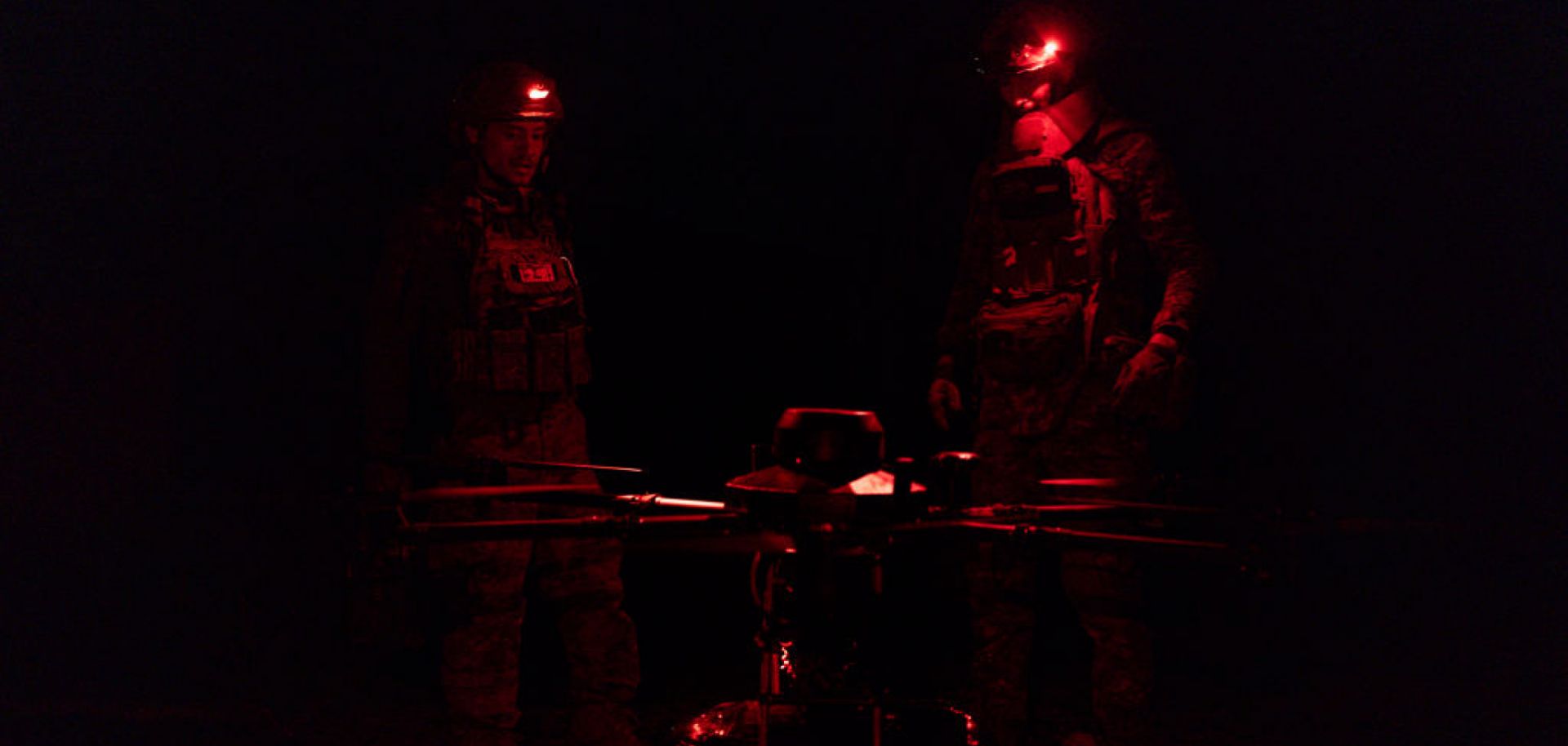
A series of Ukrainian attacks across Russia indicates a more brazen and frequent pace of asymmetric operations that could pressure the Kremlin to be flexible in ongoing talks but also risk blowback that at least temporarily derails diplomatic efforts to wind down the war in Ukraine. On June 1, Ukraine's main civilian intelligence agency, the SBU, carried out a major operation, reportedly a year-and-a-half in the making, in which it activated more than 100 quadcopter drones it had smuggled into Russian territory to reportedly hit 41 long-range strike aircraft at four airfields across the country. The attack came after Ukrainian media reported on May 30 that the country's military intelligence service, the HUR, allegedly triggered two explosions targeting a Russian military site near the eastern city of Vladivostok — which would be the deepest inside Russia that Ukrainian saboteurs have attacked — at a location often used for Russian military exercises and that hosts a naval base for a Russian brigade fighting in Ukraine. The day before, a top Russian commander was killed in an explosion, widely assumed to have been sponsored by Ukraine, in the southern city of Stavropol. The attacks were merely the latest in an increasingly frequent series of asymmetric operations carried out by the SBU and HUR on Russian soil, as well as other plots that Russian security services have reportedly thwarted. Meanwhile, over the past few weeks, on a near-daily basis, large barrages of Ukrainian drones have flown towards Moscow, repeatedly disrupting operations at the capital's airports.
- The June 1 operation involved the SBU reportedly smuggling the drones into Russian territory and hiding them in wooden containers that appeared as commercial freight. These were placed on trucks and, when the order was given to attack, the crates were remotely opened, allowing swarms of drones to strike targets deep inside Russia — including one as far east as Irkutsk oblast, approximately 2,800 miles (about 4,500 kilometers) from Ukraine's border with Russia.
- The HUR has not publicly claimed responsibility for the May 30 explosions, which Russian authorities blamed on the accidental ignition of propane-butane cylinders in a car. Still, deliberate Ukrainian attacks would be in line with past sabotage operations and Russian denials. The same day, Russian authorities announced that they had thwarted an allegedly Ukrainian-sponsored plot to carry out an attack using an improvised explosive device, or IED, against an unspecified target in Moscow, which would also fit with a pattern of Ukrainian targeted assassinations using IEDs.
- In recent weeks, there have also been suspicious incidents that, while not explicitly blamed on or claimed by Ukrainian intelligence services, would make strategic sense for them to carry out and would be well within their capabilities. For instance, overnight on May 28-29, a fire broke out at a manufacturing facility in St. Petersburg that produces microelectronics for Russia's defense industry.
- According to data compiled by the independent Russian media outlet Novaya Gazeta Europe, Ukrainian drones have forced more temporary airport closures across Russia since the start of 2025 than the combined figure for all of 2023 and 2024.
The drone attacks are seemingly the most audacious that Ukrainian intelligence services have carried out inside Russia since the start of the war. Although details are still coming to light, the June 1 attacks appear to be the boldest Ukraine has carried out in Russia and demonstrate the strong intent and capabilities of Ukrainian intelligence services to inflict damage against Russian targets on their own soil. While potentially the most significant in terms of scope, scale and sophistication, they form part of a much longer chain of attacks stretching back to the start of the war. Within weeks of beating back the Russian invasion in February 2022, and ramping up in 2023 and 2024, the HUR and SBU have conducted myriad operations on Russian soil. These have included drone strikes against both strategic and symbolic targets (including the Kremlin in May 2023), acts of sabotage against infrastructure linked to Russia's war effort (such as railways and airports used to move troops and equipment, in addition to defense industry sites), as well as assassinations against top Russian military personnel and other high-profile targets. To do so, the HUR and SBU have been able to take advantage of existing human assets in Russia, sympathetic Russians disillusioned with the war, corruptible Russian officials, as well as a large amount of sensitive information leaked online that can be easily purchased and used to plan attacks. The motivations for these operations have varied, but top Ukrainian officials have routinely cited three aims: to retaliate for Russian attacks inside Ukraine, weaken Russia's military capabilities and psychologically bring the war to the Russian homeland. But while Kyiv has displayed a high risk tolerance, at least until recently, its reliance on U.S. support has kept Ukrainian intelligence services from being even more aggressive, given that Washington repeatedly tried to put an upper limit on Kyiv's asymmetric operations inside Russia due to fear of escalating the conflict.
- Numerous media investigations and government inquiries have blamed Ukraine for conducting the September 2022 explosions that severely damaged the Nord Stream 1 and 2 natural gas pipelines connecting Russia to Germany. While the explosions occurred in technically international waters, the attacks — which originally were widely blamed on Russia — illustrated Ukrainian intelligence services' high risk tolerance.
- There have been many media reports detailing the significant behind-the-scenes role that the United States has played in supporting Ukraine's defense — but which has included U.S. limits on what Ukraine could attack inside Russia. Aside from the long-time but now-reversed U.S. opposition to letting Ukraine use long-range U.S. weapons for strikes inside Russian territory, the former Biden administration pressured Ukraine to keep an upper limit on asymmetric attacks against and within Russia. For instance, following what was widely assessed to have been a Ukrainian operation to kill the daughter of a high-profile Russian nationalist in August 2022, U.S. officials reportedly reprimanded their Ukrainian partners and told them to avoid future attacks against non-military targets. According to media reports, Biden administration officials also refused to provide intelligence to support Ukrainian sabotage and assassinations inside Russia.
Facing a battlefield situation favoring Russia, the Kremlin's intransigence in negotiations and less reliance on the United States at an operational level, Ukraine has incentives to sustain, or potentially even increase the frequency and brazenness of its asymmetric operations. Although Kyiv has repeatedly stated its desire to implement a ceasefire, thus far, Moscow is dragging its feet and appears to have already begun a summer ground offensive. Despite the slow pace of Russian forces' advances, they continue to make incremental gains, which, if anything, are likely to at least marginally expand in some areas in their emerging offensive. Ukrainian forces, though unlikely to suffer a strategic collapse in the coming months due to strong defenses and precarious but currently sufficient personnel and weaponry, are similarly unlikely to retake significant territory, meaning that carrying out acts of sabotage, assassinations and other asymmetric operations against Russian targets are likely its best means to pressure the Kremlin. For Kyiv, continuing, or even increasing, pressure is likely particularly important given that Moscow has been inflexible in talks, including by refusing to entertain the idea of a ceasefire and demanding concessions that Kyiv considers wholly unacceptable. Meanwhile, Kyiv's relationship with the Trump administration, which has reduced financial and military aid, has been much more distant, especially in contrast to Kyiv's closeness with the Biden administration. With much less Ukrainian-U.S. coordination at an operational level, this means that Kyiv likely feels less restrained in its targeting decisions. To be sure, Kyiv has an interest in not drawing the ire of U.S. President Donald Trump by undertaking operations that he would view as derailing talks in which he has heavily invested personally (and which could lead to punitive measures like the brief halt in U.S. intelligence-sharing following the disastrous Feb. 28 Oval Office meeting between Trump and Ukrainian President Volodomyr Zelensky). But even so, the recent uptick in confirmed and suspected Ukrainian attacks inside Russia thus far has not led to any blowback from the United States, and Kyiv may even calculate that bold attacks inside Russia could change Trump's opinion that Ukraine has "no cards" to play against Russia.
- Ukraine reportedly did not inform the United States in advance of its June 1 attacks, which occurred a day before Ukrainian and Russian delegations met in Istanbul for the second round of direct talks. The Kremlin has repeatedly said that it will only discuss a full end to the conflict, not an interim ceasefire, which is Ukraine's preference. Though it has not publicly disclosed its precise terms, numerous media leaks indicate that Russia has adopted a maximalist negotiating position, including by demanding full control of the Ukrainian oblasts where its troops are present (not merely the territory they currently hold) and concrete guarantees to limit Ukraine's future military capabilities — both of which Kyiv says are non-starters.
Although Ukraine faces constraints in its asymmetric operations against Russia, it has many options to add pressure on the Kremlin. To be sure, Ukrainian operations on Russian soil require varying levels of pre-planning, on-the-ground intelligence, willing proxies and other capabilities, meaning that it would be very difficult for Kyiv to undertake a wave of new attacks, let alone those on the scale of the June 1 drone strikes. Those would be incredibly complex to try to repeat in any form, whereas sponsoring an act of physical sabotage, like starting a fire at a sensitive location, would be comparatively much easier to do in short order. Moreover, even if attacks are more brazen and frequent, Ukraine still has an interest in avoiding attacks that cause mass civilian casualties that could backfire on Kyiv's interest to be viewed as the victim. Still, Ukrainian intelligence services have repeatedly demonstrated that they have significant capabilities within Russia and presumably have many plots in various stages of development that could be greenlit in the coming weeks. Most immediately, these include simply ramping up the frequency of what the HUR and SBU have generally carried out, such as targeted killings and sabotage of military infrastructure. Moreover, Ukraine could seek to amplify its nascent ability to infiltrate Russian military supply chains — most recently by sabotaging shipments of drone goggles by equipping them with explosives — to conduct other forms of sabotage. Ukrainian intelligence services could also replicate their alleged explosions in Vladivostok via sabotage deeper inside Russian territory — which is geographically harder to reach but also less defended compared to border regions — as a means to demonstrate their capability to attack anywhere. Still, for both practical and symbolic reasons, operations in major cities like Moscow and St. Petersburg are likely to be most impactful, putting on the table asymmetric operations designed to sabotage critical infrastructure, like disrupting key services like electricity or transportation. Ukraine-backed saboteurs could also carry out stunts similar to the types of intimidation and harassment that pro-Russian saboteurs have wreaked across Europe, ranging from low-level acts like public vandalism that seek to embarrass the Kremlin to more impactful actions like conducting arson attacks in the heart of major cities. Ukrainian intelligence services could even seek to conduct operations against Russian targets and/or interests in third countries, as seen in their alleged help in providing drones to Tuareg rebels in Mali fighting Russian paramilitaries.
- Just as Russia recruits proxies online to conduct sabotage in Europe, Ukraine could expand what is reportedly an existing campaign to do the same in Russian-occupied parts of eastern Ukraine to Russia itself, which could help the HUR and SBU overcome Russian counterintelligence measures and likely be very cost-effective.
- Though Kyiv has denied helping the Tuaregs, who are fighting Malian forces backed by Russian Wagner Group/Africa Corps fighters, multiple media reports since mid-2024 have found that Ukraine has provided support to the rebels. With Russian paramilitaries active in several African countries and Ukraine increasing both its drone production and capabilities, supporting other groups fighting these paramilitaries could offer Ukraine an additional way to exert pressure on the Kremlin beyond the battlefield.
- Illustrating how Ukrainian intelligence services could infiltrate Russian military supply chains, in February 2025, the HUR hid explosives in goggles used by Russian drone pilots and then used Russian sympathizers to send the sabotaged items to Russian army units ostensibly as a charitable donation. According to media leaks, the attacks allegedly resulted in at least eight Russians going blind after the explosions.
- Aside from kinetic operations, there are presumably also new cyberattacks that Ukrainian intelligence services and pro-Ukrainian hackers could carry out. Just as the HUR and SBU evidently have spent many months preparing for certain operations, pro-Ukrainian hackers likely have gained access to sensitive Russian systems but have been waiting for the right moment to activate their malware payloads.
Continued — let alone expanded — Ukrainian asymmetric attacks on Russian soil could increase pressure on Moscow to compromise in negotiations, but they also risk provoking blowback that could at least temporarily derail diplomatic efforts. With the Kremlin appearing to believe that time is on its side in the war and the frontlines generally ranging from static to favoring Russia, Ukrainian intelligence services' sustained, or even more frequent, display of their ability to strike across Russia may be one of the only ways to make Russia more flexible at the negotiating table. This is both because further Ukrainian attacks may help erode Russia's military capabilities — for instance, according to Ukraine, one-third of Russia's strategic bomber fleet was damaged in the June 1 attacks — and because more attacks may lead at least some Russian elites who have the ear of the Kremlin to pressure for de-escalation, due to fear of how deep the HUR and SBU have penetrated into Russia. But even so, Ukraine's strategy carries a risk of backfiring and, at least temporarily, setting back negotiations. For one thing, the Kremlin presumably does not want to negotiate from a position of perceived weakness and thus may use Ukrainian attacks on Russian soil as a pretext to push off talks. Moreover, Ukraine's attacks, even if primarily focusing on military targets, often come with the risk of civilian casualties, especially if the HUR and SBU try to ramp up the pace of their operations, which would likely emphasize speed rather than precision. If a Ukrainian attack were to harm, let alone kill, a large number of Russian civilians, the Kremlin would likely not have incentives to show flexibility in negotiations, at least for some period of time. Finally, though thus far Trump has not publicly commented on the June 1 drone attacks, judging from his past critiques of Ukraine and personal friction with Zelensky, he could conclude that the operation, especially if there are more high-profile Ukrainian attacks on Russian soil, is responsible for the lack of progress in peace talks. This could lead Trump to make good on his repeated pledges to walk away from mediation or, worse, from Kyiv's perspective, lessen or even end various forms of continued U.S. support, such as intelligence-sharing.
- In the hours before the June 1 drone strikes, two railroad overpasses collapsed in the Russian oblasts of Bryansk and Kursk, which both border Ukraine. While the incident in Kursk reportedly did not result in any fatalities, the one in Bryansk reportedly killed seven people and injured dozens more. The governor of Bryansk blamed the incident on a deliberate explosion, which has not been confirmed but is eminently possible given that the HUR and SBU frequently blow up railroads carrying Russian military equipment, with the HUR taking credit for an operation in Russian-occupied Zaporizhizia the same day as the Bryansk incident. While Ukrainian intelligence services are generally very careful to avoid civilian casualties, their high risk tolerance opens the door to an accident — especially if they rely on local proxies who are less well-trained and careful.
- According to a Ukrainian military spokesperson, the recent surge in drone swarms targeting Moscow's airports is part of a deliberate strategy to disrupt civilian air travel and put pressure on the Kremlin. Even though Russian air defenses shoot down many of the drones, there is always a chance that one collides with a plane or, perhaps even more likely, that debris from a destroyed drone lands in a populated area, causing casualties.
- In recent weeks, Trump has vacillated between personal critiques of Zelensky and Russian President Vladimir Putin, while also repeatedly threatening to stop U.S. mediation efforts. Most recently, Trump's own rhetoric, confirmed by media leaks, indicates he has grown more frustrated with Putin's lack of flexibility. Still, Trump has continued to not follow through on threats to ramp up pressure on Russia as he has publicly made clear that he would like to engage in a rapprochement with Russia to extricate the United States from the Ukraine conflict and revive economic cooperation with Russia.
