
In Myanmar, the military regime's claimed recapture of an eastern township portends intensified violence ahead of elections, which will be tightly managed and deepen fissures with rebel forces, but could open the door to limited international reengagement after years of civil war. On Aug. 19, Myanmar's military regime announced that its troops had captured Demoso township in eastern Kayah state. This followed weeks of heavy clashes with ethnic Karenni armed groups and pro-democracy militias, which had held parts of the township since the junta seized power in a coup in February 2021. Demoso residents immediately disputed the news, citing ongoing gunfire and bombardment in the area. But the military has nonetheless touted its alleged victory as proof of its ability to claw back rebel-contested areas, and that it retains momentum heading into its newly declared election cycle. Indeed, just days earlier, the regime unveiled its most concrete election plan since seizing power, setting Dec. 28 as the first polling day, with additional phases to follow in early 2026. According to state media, 102 of Myanmar's 330 townships will participate in this initial stage, including the capital Naypyidaw and selected areas of Yangon (the largest city and commercial center), while conflict-hit regions such as Rakhine and Sagaing will see only limited participation. The announcement offers the clearest electoral timetable yet after years of vague promises by coup leader Sen. Gen. Min Aung Hlaing. But it has been met with deep skepticism from both domestic opponents and international observers, who view the process as a mere facade.
- The elections will designate representatives to Myanmar's bicameral Assembly of the Union, which consists of the Pyithu Hluttaw (lower house) and the Amyotha Hluttaw (upper house). In the lower house, 110 of the 440 seats are appointed by the military, while in the upper house, the military appoints 56 of the 224 seats. The new legislature will then select the country's next president via the Presidential Electoral College mechanism.
- Resistance groups assert that any pledge of ''free and fair'' elections is meaningless, given the military's track record of jailing political rivals, violently repressing dissent and overturning the 2020 landslide victory of former President Aung San Suu Kyi's National League for Democracy party.
- According to the latest estimates, the ongoing war has so far displaced 3.3 million people nationwide.
The junta's decision to put forward an election timetable is a calculated response to both domestic battlefield pressures and international legitimacy concerns. The timing of the Demoso announcement and the electoral rollout in the same week reflects the military's political strategy of linking selective battlefield claims with the promise of a transition to multiparty democracy (albeit only technically, as anti-military parties are banned from the process). In doing so, the junta is aiming to create a narrative of consolidation, order and legitimacy, despite the majority of Myanmar's townships remaining outside its effective control. Indeed, on the battlefield, the regime is overstretched. Despite the alleged recapture of Demoso, the military's ground forces are increasingly hollowed out by desertions, casualties and unpopular conscription drives, leaving the regime reliant on airstrikes, artillery and proxy militias to maintain a semblance of control. The junta has lost large swathes of northern Shan state to the ethnic militias, faces relentless Arakan Army advances in western Rakhine state, and has ceded the initiative in eastern Karenni, northwestern Sagaing and west-central Magway to decentralized resistance networks. Against this backdrop, the junta's election plan serves multiple purposes. Domestically, it offers reassurance to the military's officer corps, civilian bureaucracy and supporters that their positions remain secure under the 2008 constitution, which guarantees military appointments for 25% of seats and control of key ministries. Internationally, it provides a narrative of political transition that regional actors — including fellow members of the Association of Southeast Asian Nations (ASEAN), as well as India and even potentially the United States — can point to as sufficient reform for reengagement.
- On July 31, the junta formally ended the nationwide state of emergency that had been in place since its February 2021 coup, dissolving the governing State Administration Council and transferring authority to the newly created State Security and Peace Commission, headed once again by Hlaing as acting president. This move was less a concession than a legal sleight of hand as, by lifting emergency rule, the junta claimed to be preparing a constitutional return to civilian-led government, even as it entrenched its own control through new laws and forced conscription.
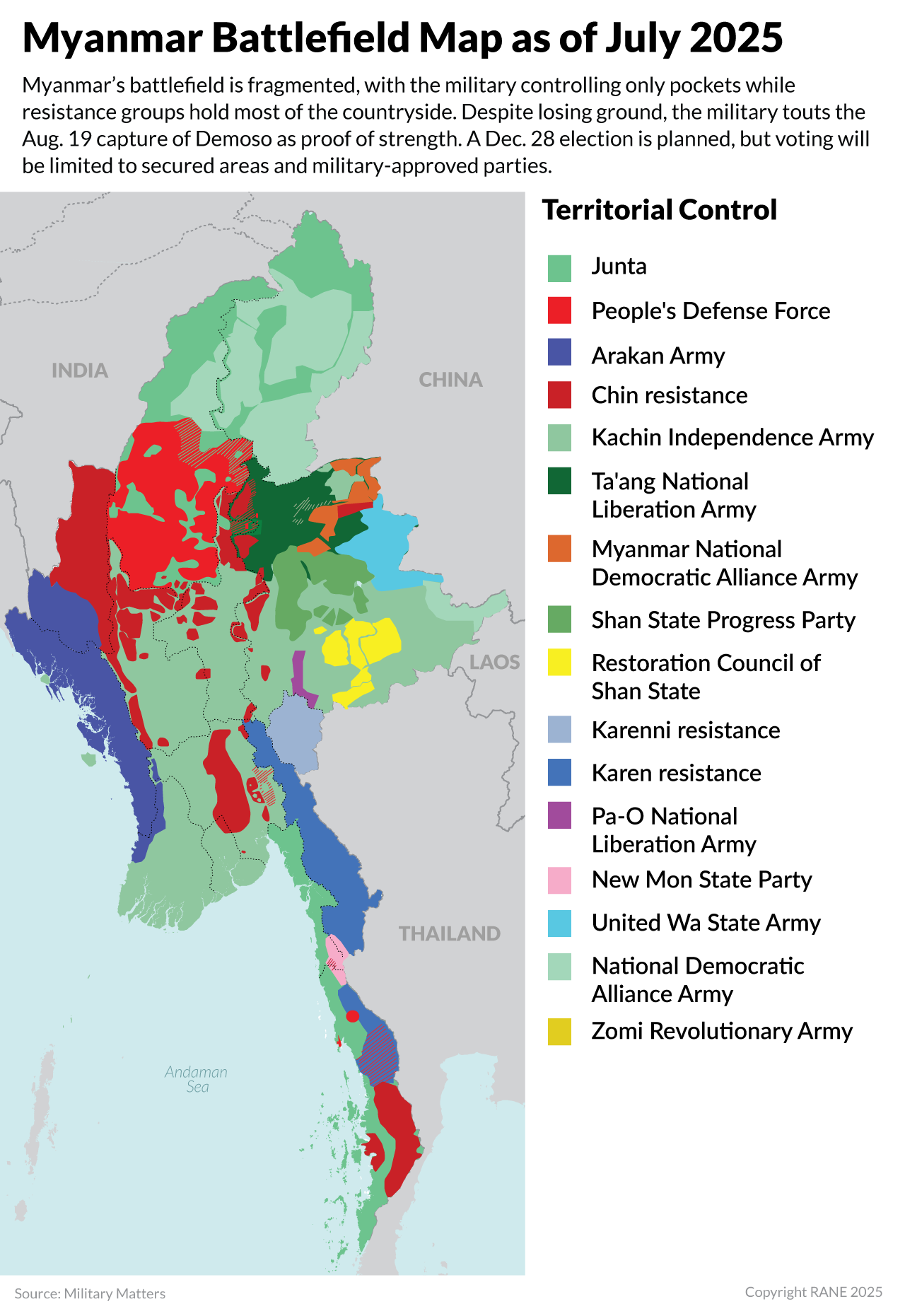
The elections will likely deepen political fragmentation in Myanmar as the junta attempts further offensives to reclaim more territory and expand the areas in which the vote can be held, fueling tensions with anti-government forces who will stage attacks and reject the results. The junta's decision to hold the election in phases reflects the reality that vast parts of Myanmar remain under insurgent or contested authority, making a nationwide vote logistically impossible. By focusing the first phase on the capital Naypyidaw and certain Yangon districts and townships where the army retains garrisons, the regime is attempting to craft the image of an orderly democratic process while sidestepping zones of entrenched resistance. Yet even in these urban centers, the likelihood of credible polling is minimal. For one, levels of violence will surge in the run-up to the ballot as the army pushes offensives to extend the vote's footprint for planned future phases in 2026, and as resistance forces (which have already pledged to either boycott or disrupt the election process) attack first-phase townships. Myanmar's civil society is also severely repressed, with the prior ruling party dissolved and its leader, former President Aung San Suu Kyi, imprisoned. To enforce participation in the election and forestall public criticism, the junta recently enacted new legal measures, including prison sentences of up to ten years for obstructing the vote. But turnout will still be depressed against the backdrop of the regime's ongoing offensives and the absence of genuine political competition. Nonetheless, the junta's strategic goal is less about securing a genuine public mandate and more about producing a legal veneer of legitimacy. By early 2026, the regime will thus likely still convene a new parliament stacked with loyalists, claim constitutional compliance and install a civilian government — all while keeping real power within the military hierarchy. Resistance groups and much of the population will reject the election outcome, deepening Myanmar's political fragmentation, with parallel claims to legitimacy hardening between the military's institutions and those of the government-in-exile National Unity Government.
- For the military regime, battlefield gains are being directly tied to its political project, with military campaigns serving as precursors to holding elections in more areas of Myanmar. But the prospects for regime success in clawing back territory are limited, as overstretched ground forces and reliance on airpower make any gains difficult to sustain against entrenched resistance networks and ethnic armed groups.
- The new electoral framework, shifting from first-past-the-post to proportional representation, further tilts the playing field toward the military's civilian proxy, the Union Solidarity and Development Party — ensuring that even modest turnout in junta-controlled areas will translate into parliamentary dominance. This is because it can now turn small vote shares in junta-controlled areas into seats, whereas under the old first-past-the-post system, it would have won little or nothing without outright majorities.
Holding elections, however flawed, could enable the junta to ease its international isolation and re-engage with ASEAN states, India and potentially even the United States. Since the 2021 coup, the junta has faced widespread condemnation from Western democracies, targeted sanctions and exclusion from ASEAN forums. The regime is hoping a staged election will ease this isolation by providing just enough cover for Myanmar's neighbors to resume diplomatic and economic dealings, especially as many Southeast Asian states prioritize stability over democratic reform and recognize the war poses little chance of a decisive victory for either side. To that end, regional dynamics have been shifting in the junta's favor. China has remained the regime's most consequential external patron, brokering ceasefires in northern Shan and pressing for stability around its strategic investments and cross-border pipelines. India has engaged pragmatically along its northeast border, prioritizing security and migration management. Within ASEAN, frustration at years of stalemate in resolving the Myanmar conflict is giving way to quiet normalization of the military regime. Malaysia, as the bloc's 2025 chair, has already announced it will seek ''clarity'' on Myanmar's December election during the October ASEAN leaders' summit, signaling a possible pivot toward conditional engagement. Meanwhile, the United States is also softening its posture vis-a-vis Myanmar. In July, the administration of U.S. President Donald Trump lifted sanctions on several military-linked companies after Hlaing sent a praiseful letter to Trump. At the same time, the White House is exploring ways to access Myanmar's critical heavy rare earth minerals to reduce the United States' strategic dependence on Chinese supplies, which the junta could leverage in trade talks to secure relief from the United States' new 40% tariff on Myanmar exports. Against this backdrop, holding elections could enable the military regime to deepen its engagement with the United States, assuming the ballot provides enough cover for the pragmatic, resource-driven Trump administration to prioritize mineral access over democratic norms. However, the first steps toward easing the junta's diplomatic and economic isolation would likely occur closer to home, beginning with restored participation in ASEAN ministerial meetings, reopened trade and border cooperation mechanisms with Thailand and India, and resumed progress on stalled Chinese-backed infrastructure projects, such as the Kyaukphyu port and oil-and-gas pipeline corridor.
- China, the junta's most important foreign backer, has pressured Myanmar's junta to hold elections in the hope that the process will help stabilize the country. Beijing's goal is not democratic reform but predictability along its border, securing its heavy rare earths supply from Myanmar and protecting major investments like the Kyaukphyu port and vital oil and gas pipelines, which depend on a functioning central government in Naypyidaw.
- Russia has also deepened military and economic cooperation with Myanmar's military regime, including arms supplies, nuclear energy pacts and infrastructure investment — particularly following Hlaing's high-profile Moscow visit in March. But compared with China, Russia is less concerned with elections in Myanmar and has applied less pressure on the junta to hold one.
- The United States, European Union, United Kingdom, Canada and Australia have imposed targeted sanctions on Myanmar's junta, primarily against senior generals, military-owned conglomerates and state-owned enterprises in sectors such as energy, mining and arms procurement. All of these Western actors (including, previously, the United States) have strongly criticized the junta's planned election.
- Rare earths-related proposals that the United States is considering in Myanmar include easing sanctions, negotiating deals with the junta or Kachin rebels, and potentially engaging India and other Quad partners in processing. Myanmar holds large-scale deposits of heavy rare earth elements, particularly dysprosium and terbium, in northern Kachin state, with annual exports to China rising to over 41,000 metric tons in 2023, making it one of the world's most significant sources. However, access is severely complicated by the ongoing conflict, rendering the feasibility of U.S. engagement in this area questionable at best.
