
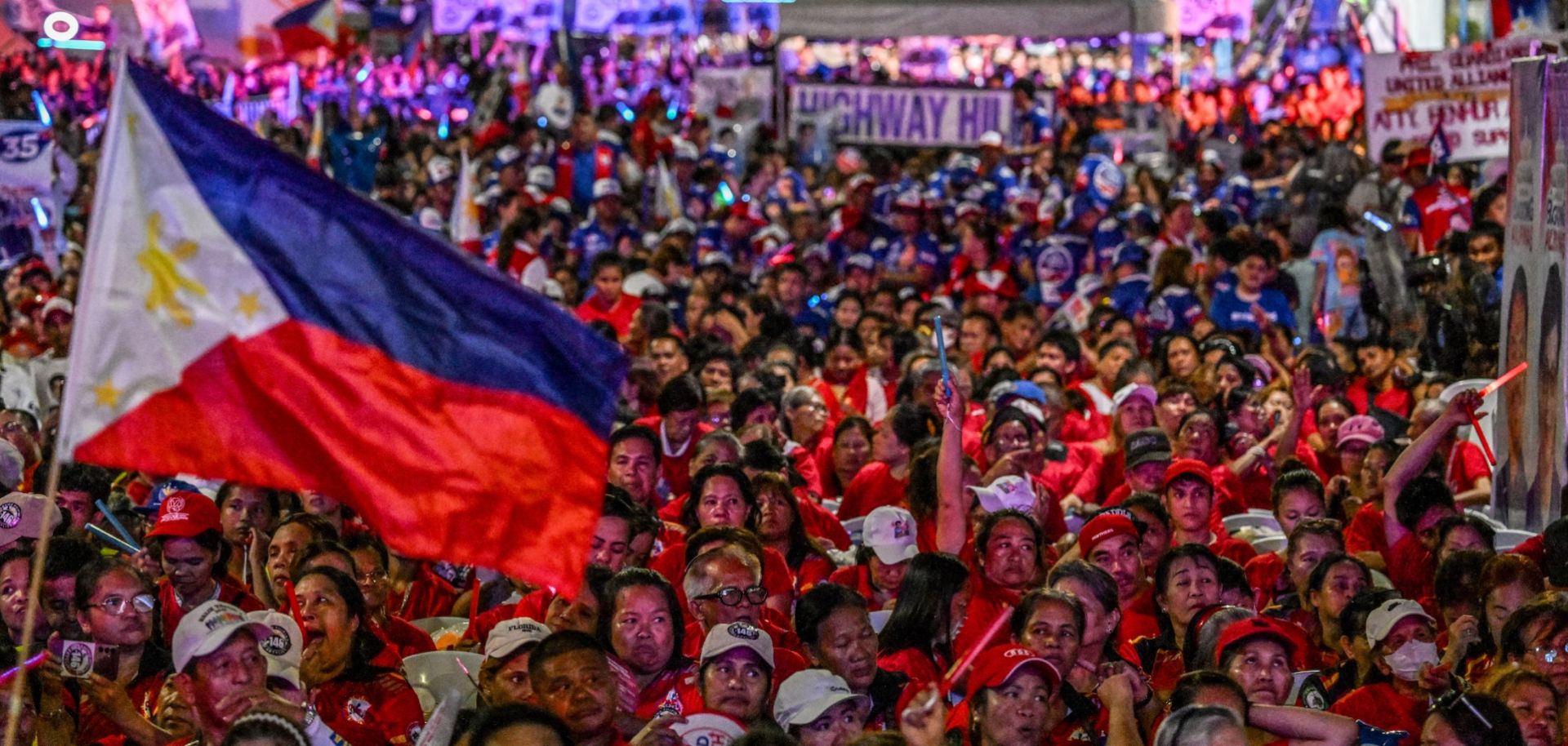
The Philippine president's Senate majority diminished in midterm elections, which could slow defense deals in the short term and tilt foreign policy back toward neutrality or a China-friendly stance in the long term. The May 12 Philippine midterm elections reduced President Ferdinand Marcos Jr.'s majority in the country's Senate and reaffirmed the dominance of former President Rodrigo Duterte's family (Marcos' main political rivals) in its southern stronghold of Mindanao. Prior to the vote, Marcos' coalition held 15 of 24 Senate seats, one shy of a supermajority that it hoped to gain in the vote. However, of the 12 contested this cycle, preliminary results show candidates aligned with Marcos won only six, reducing the pro-Marcos bloc to 14 seats, now two short of the 16-seat supermajority needed to approve or block impeachment processes. Duterte-aligned candidates, meanwhile, gained at least five seats. Two independents are currently projected to hold the remaining seats. In Davao City on the southern island of Mindanao, the Duterte political dynasty swept local races. Duterte himself, currently detained at the International Criminal Court in The Hague, was elected mayor in a landslide. His son, incumbent Mayor Sebastian Duterte, won the vice mayoral race, while eldest son Paolo Duterte retained his congressional seat.
- Given the elder Duterte's detainment in The Hague, Sebastian will step in as mayor of provincial-level Davao City, which is the Philippines' third-largest city.
- Two of Duterte's grandsons also won local-level positions.
The elections were held against the backdrop of a full-blown rift between the Marcos and Duterte factions. While most midterm elections in the Philippines are not particularly relevant, the May 12 vote happened amid rising political tensions. On Feb. 5, the House of Representatives impeached Vice President Sara Duterte (who is former President Rodrigo Duterte's daughter), alleging misuse of confidential funds and assassination threats against Marcos and congressional allies. The decision to pursue impeachment follows growing personal animosity between the Marcos and Duterte factions, compounded by Sara Duterte's likely presidential ambitions in 2028. Meanwhile, on March 11, Rodrigo Duterte was arrested by Interpol upon landing in Manila, which required Marcos' approval. He was transferred into ICC custody shortly after, facing charges of crimes against humanity for his leading role in the 2016-2022 drug war in the Philippines that killed thousands. While President Marcos has publicly distanced himself from the arrest, the predominant view in the Duterte camp and among their supporters is that the former president's arrest and his daughter's impeachment were both politically motivated.
- The Philippine House of Representatives impeached Vice President Sara Duterte on a bevy of charges including misuse of confidential funds, unexplained wealth and, most controversially, publicly and voluntarily divulging she had contracted an assassin to kill President Marcos and his wife — as well as his cousin, Speaker of the House Martin Romualdez — in the event Sara was assassinated first.
- Marcos authorized Interpol's arrest of Rodrigo Duterte despite previously opposing ICC involvement in litigating the former president's war on drugs.
The elections also happened as Marcos is seeking to deepen the Philippines' alignment with the United States amid rising tensions with China. Since coming to office in June 2022, Marcos has substantially realigned Manila's foreign policy away from his predecessor Duterte's relatively more China-friendly stance toward stronger military and economic ties with the United States. He has expanded the the U.S.-Philippine Enhanced Defense Cooperation Agreement, or EDCA, authorized additional U.S. access to and construction of four additional military bases under the EDCA, coordinated joint patrols in the South China Sea with the United States and other partners (such as Japan and Australia), and strengthened trilateral defense ties within this context through new summit mechanisms and defense agreements. These moves coincide with — or have perhaps caused — a surge in confrontations between Chinese and Philippine vessels in the South China Sea, including around Scarborough Shoal, Second Thomas Shoal and Sandy Cay flashpoints, which has only reinforced Manila's desire to deepen alignment with Washington.
- In addition to bolstering ties with the United States under the EDCA, the Philippines has expanded its defense partnerships by signing a reciprocal access agreement with Japan and a defense cooperation agreement with Singapore in July 2024, along with a status of visiting forces agreement with New Zealand in April. The Philippines is currently finalizing similar agreements with Canada and France.
- The nine EDCA sites are strategically distributed to cover key flashpoints. The four sites in northern Luzon put U.S. forces within 250 miles of Taiwan, enabling rapid response to potential cross-strait contingencies. Other sites in Palawan and Zamboanga position U.S. military assets, including troops and naval vessels, near the South China Sea, enhancing surveillance and logistical support for maritime domain awareness and potential naval operations.
- China has strongly opposed the Philippines' efforts to expand the EDCA, accusing Marcos' government of allowing foreign powers to stoke regional tension. Beijing has also warned that the added U.S. access points, particularly those near Taiwan, risk dragging Manila into an armed conflict that would risk decimating the country.
The Marcos faction's weakened institutional position could lead to domestic gridlock and rising regional autonomy demands, constraining the Philippines' long-term reliability as a U.S. security partner. With 14 seats, the Marcos faction still controls a simple majority in the 24-seat Senate. But it is now two votes shy of the 16-seat supermajority needed to convict Vice President Sara Duterte, curbing its ability to consolidate power or sideline rivals. With an emboldened Duterte bloc and a diminished pro-Marcos coalition, this means future Senate approval of expanded security cooperation with the United States and other strategic partners could face gridlock, dilution or outright rejection, as only two senators now need to defect or abstain from votes to block initiatives. If Sara Duterte is acquitted, as is now more likely, her political stock will sharply rise. She would emerge as a resilient figure capable of surviving institutional attack, likely capturing significant momentum heading into the 2028 presidential race. Another Duterte presidency would likely portend a recalibration of the Philippines' currently strong pro-U.S. tilt, potentially slowing or even reversing recent defense milestones. While full alignment with Beijing is unlikely, Sara Duterte's previous calls for a "neutral" foreign policy and her father's China-friendly legacy suggest a more hedged approach. Moreover, at the domestic level, the Duterte family's sweep in Mindanao and its broader influence complicate national cohesion. Mindanao-centric loyalty and demands for greater autonomy will likely increase if the federal government in Manila is seen locally as overreaching, with Sara's impeachment and Rodrigo's ICC arrest already stoking such sentiment.
- The Senate plays a central role in ratifying defense agreements and shaping the country's external posture.
- Securing the 16 Senate votes needed to convict Sara in her July impeachment trial will require support from independents.
- The Philippines' constitution limits presidents to one five-year term, meaning Marcos cannot run in 2028. His cousin, Speaker of the House Martin Romualdez, is the most likely to run as a continuity candidate.
