
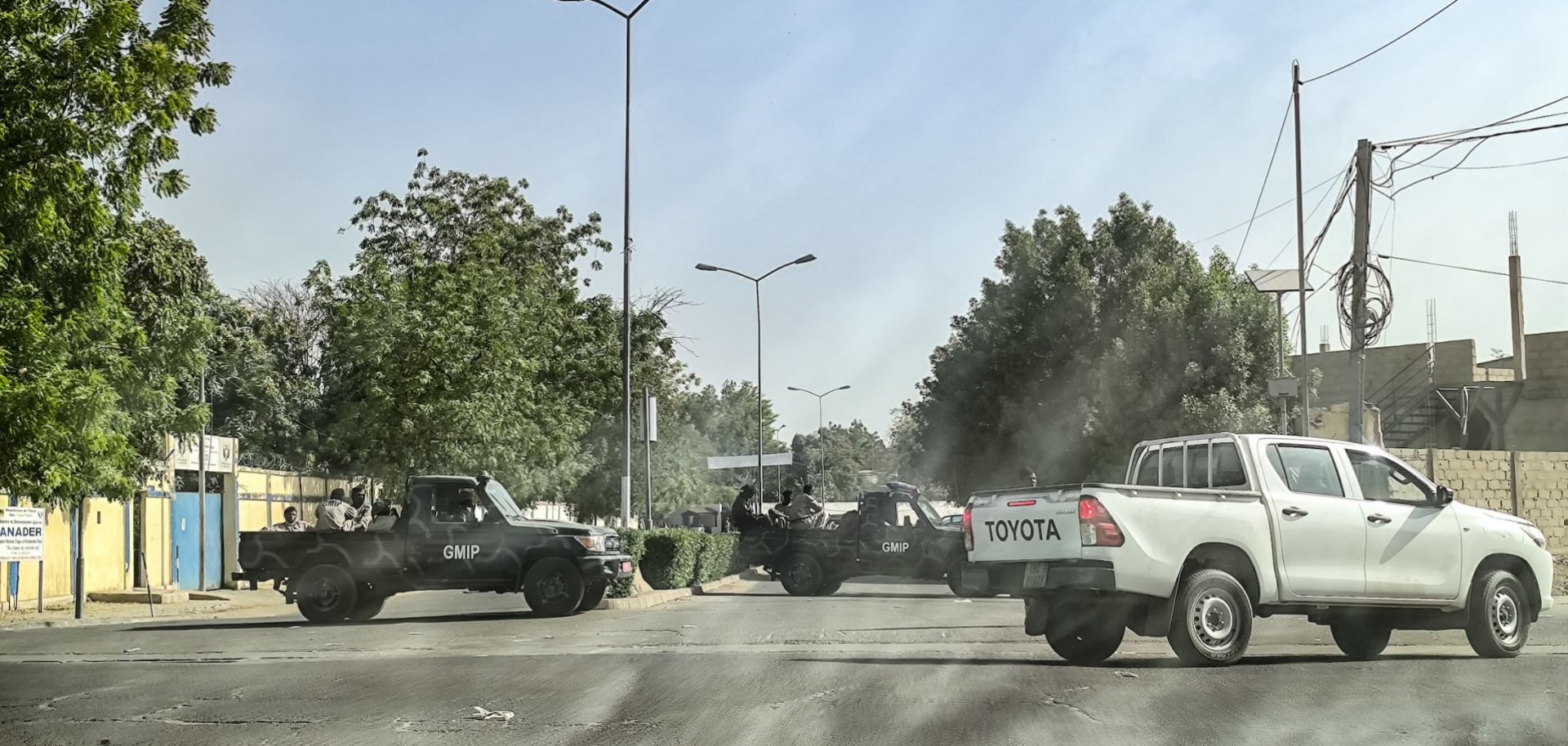
Recent armed clashes in Chad's capital were likely an attempt by junta leader Mahamat Deby to consolidate power ahead of upcoming elections, but they risk triggering more violence that could further destabilize the Central African country. On the night of Feb. 27-28, several people were killed in an attack on the headquarters of Chad's intelligence agency (ANSE), which the government subsequently blamed on the opposition Socialist Party Without Borders (PSF). While the government claimed the situation was ''under control,'' on Feb. 28, government forces assaulted the PSF's headquarters in the capital, which caused dozens of fatalities, according to news outlet Tchad One. Thereafter, reports emerged that PSF leader Yaya Dillo had been killed, which was later confirmed by Chad's public prosecutor on Feb. 29. It also appears that the uncle of Chadian junta leader Mahamat Deby, Saleh Deby Itno, was arrested following a raid on his residence.
- Following the events of Feb. 28, Chadian Prime Minister and former opposition leader Success Masra expressed his ''total and unconditional support'' for junta leader Mahamat Deby.
- The outbreak of clashes on the evening of Feb. 27 reportedly followed an attempted arrest of PSF finance secretary Abakar Torabi, who was ultimately brought to the ANSE's offices, which in turn prompted PSF members to launch an assault on the intelligence agency's headquarters.
- The PSF was established in 2015 as an opposition party against former Chadian President Idriss Deby Itno. In October 2022 the junta suspended the party's activities for three months following its participation in anti-government protests that same month.
The government's violent crackdown on the PSF is likely an attempt by junta leader Mahamat Deby to quelch growing threats to his authority from within his ruling Zaghawa ethnic group ahead of Chad's presidential election in May and June. Following the death of long-time President Idriss Deby Itno in April 2021, the country's military suspended the constitution, dissolved the government and national assembly, and established a Transitional Military Council headed by one of the late president's sons, Mahamat Deby, that would lead the country through an 18-month transition period. However, the transition period was extended by another 24 months in October 2022, which triggered protests that turned deadly as demonstrators clashed with law enforcement. Since taking over, Mahamat Deby has sought to reinforce his control over the country's military, as well as his Zaghawa ethnic group, which has ruled over Chad since 1990. However, Deby has faced repeated difficulties on both fronts, as highlighted on Feb. 10 when his paternal uncle Saleh Deby Itno joined the PSF following the junta leader's nomination as the candidate for the ruling Patriotic Salvation Movement for Chad's May-June presidential election. The move challenged Deby's authority and threatened to further undermine his standing within the Zaghawa community, especially given that late PSF leader Yaya Dillo was also a Zaghawa. With the alleged killing of Dillo and the arrest of Saleh Deby Itno, the incidents of Feb. 28 were thus likely an attempt by Chad's junta leader to take advantage of the PSF's assault on the ANSE headquarters to assert his authority ahead of the election.
- Slain PSF leader Dillo was distantly related to Mahamat Deby, with Dillo's mother being the cousin of late president Idriss Deby Itno.
- The government's attack on the PSF's headquarters came a day after Chad's election agency announced on Feb. 27 that the presidential election would be held in May and June.
The clashes highlight Chad's heightened political instability and raise the prospect of another coup attempt, with the crackdown on the PSF potentially paving the way for more destabilizing violence between government forces and PSF supporters in the coming weeks. In the immediate term, Dillo's death and the arrest of Mahamat Deby's paternal uncle could prompt further armed clashes between PSF supporters and government forces. Notably, the PSF and anti-Deby factions within the Zaghawa ethnic group could look to draw support from Russia's Africa Corps, formerly known as the Wagner Group, given the paramilitary organization's presence in neighboring Libya and Sudan. Sustained clashes between the military and the PSF, especially if they occur near the capital N'Djamena, could further delay Chad's presidential election, which would only worsen the country's political and security environment. But even in the absence of additional clashes, the violent incidents on Feb. 27 and Feb. 28 highlight Chad's high domestic instability, as well as Deby's authoritarian rule. Resentment against the junta leader, both among the public and factions of the military, could result in protests and ultimately result in a coup attempt against Deby, which remains a distinct possibility given reports that not all factions within the military followed the head of state's orders to crack down on the PSF. These latest political developments will also likely convince French President Emmanuel Macron to press ahead with his alleged plans to draw down French troops from the country. Should France expedite this allegedly planned drawdown in light of Chad's growing instability, the subsequent security vacuum would risk further deteriorating the security environment in neighboring countries, including Sudan, Niger, Libya and the Central African Republic.
- On Feb. 26, leading trade unions in Chad extended their nationwide strike by two weeks to protest surging fuel prices, further underscoring the country's political instability.
- While the PSF could look to reach out to Russia, it is unclear if Russia's Africa Corps will provide tangible support to the group given Deby's Jan. 24 meeting with President Vladimir Putin.
- French defense officials reportedly agreed to reduce the country's military presence across Africa during a meeting in December following the departure of French troops from Niger. While France still retains around 1,000 troops in Chad, the timing of such a drawdown remains unclear.
