
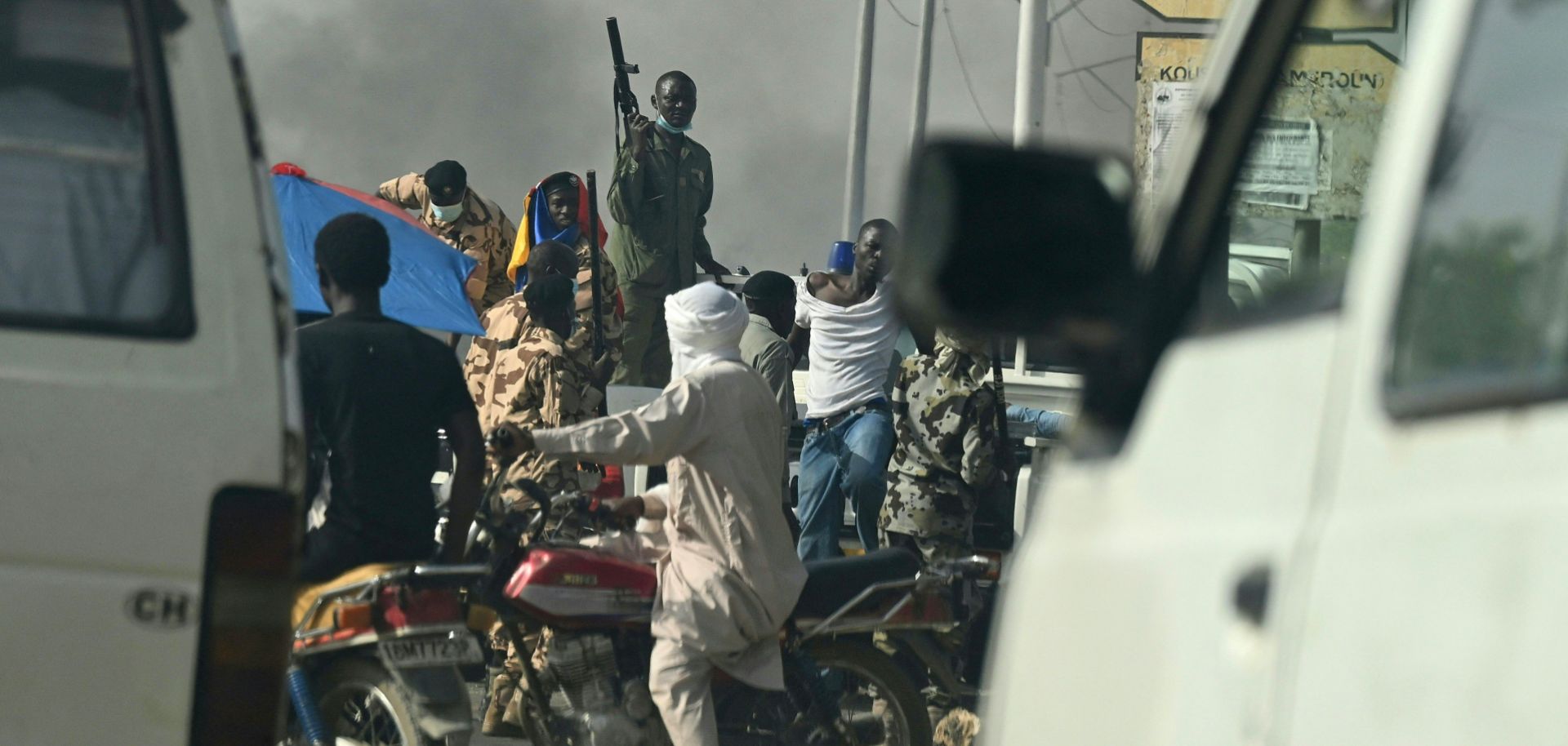
Police clash with opposition demonstrators in N'Djamena, Chad, on April 27, 2021.
Following the unexpected death of long-time President Idriss Deby, Chad’s new Transitional Military Council (TMC) faces several domestic security and political crises that will reduce the country’s participation in France-led foreign counterterrorism efforts in nearby Mali, Niger and Burkina Faso.
Protests
Ongoing protests in Chad’s capital of N’Djamena pose an immediate threat to the TMC’s stability. After announcing Deby’s death on April 19, the Chadian army effectively suspended the country’s constitution, dissolved the government and legislature, and formed a transitional military council. This has since triggered a wave of protests in N’Djamena pushing for greater civilian representation in the transition, which turned deadly on April 27 when at least five demonstrators were killed. The rallies show little sign of slowing, putting pressure on the TMC to accept a clear military-civilian power-sharing transition akin to those seen in the political transitions in Sudan and Mali.
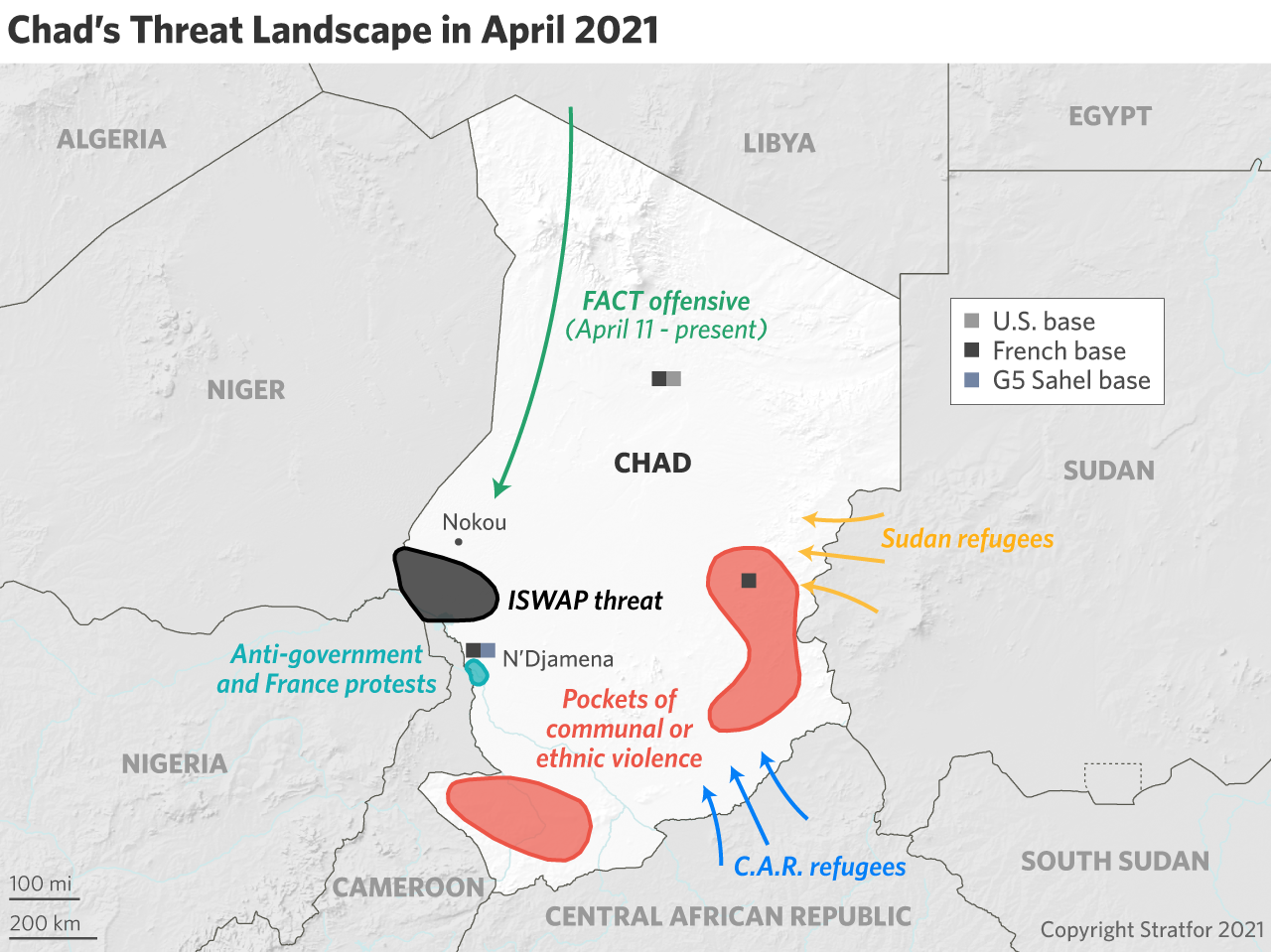
Despite the public outcry, France has been steadfast in supporting the TMC. Unlike the United States and several regional organizations, France has yet to issue any significant calls for greater civilian participation in the transition process. Paris prioritizes continuity in Chad, as the country is crucial to France’s overall security strategy in the Sahel — the operations of which are based out of N’Djamena. This continued support to the TMC, however, has also made France a target of protesters’ anger, with at least one report of a fueling station owned by the French supermajor Total being burned down in a demonstration.
A Rebel Offensive
The other significant crisis the TMC is facing is an offensive launched by the Front for Change and Concord in Chad (FACT) rebel group earlier this month, which continues to inch closer to N’Djamena. On April 29, FACT claimed to reach the town of Nokou, about 200 miles north of the Chadian capital. Chad’s military leaders, however, have denied this report, along with FACT’s calls for a national dialogue. The rebels do not appear to have enough manpower to continue their assault all the way to N’Djamena unless there are defections in the military. But the ongoing offensive could evolve into a constant insurgent threat that draws the Chadian military’s resources away from other theaters. Should FACT have further success than anticipated, France will likely provide military support to protect the TMC.
Other Threats
Elsewhere, Chad is dealing with a constant threat of Islamic State-West African Province (ISWAP) attacks in the Lake Chad tri-border region with Niger and Nigeria. Southern Chad has long been home to frequent communal and ethnically motivated violence related to clashes over water rights and territorial disputes between farmers and herders, which often requires the attention of the government and security forces. The ongoing political and security crisis in the Central African Republic, along with sporadic bounds of violence in Sudan’s Darfur region, is driving a wave of refugees to Chad’s eastern and southern borders as well. But compared with the ongoing protests and FACT offensive, ISWAP militants, violence in southern Chad and the influx of refugees do not directly pose an existential threat to the TMC.
