
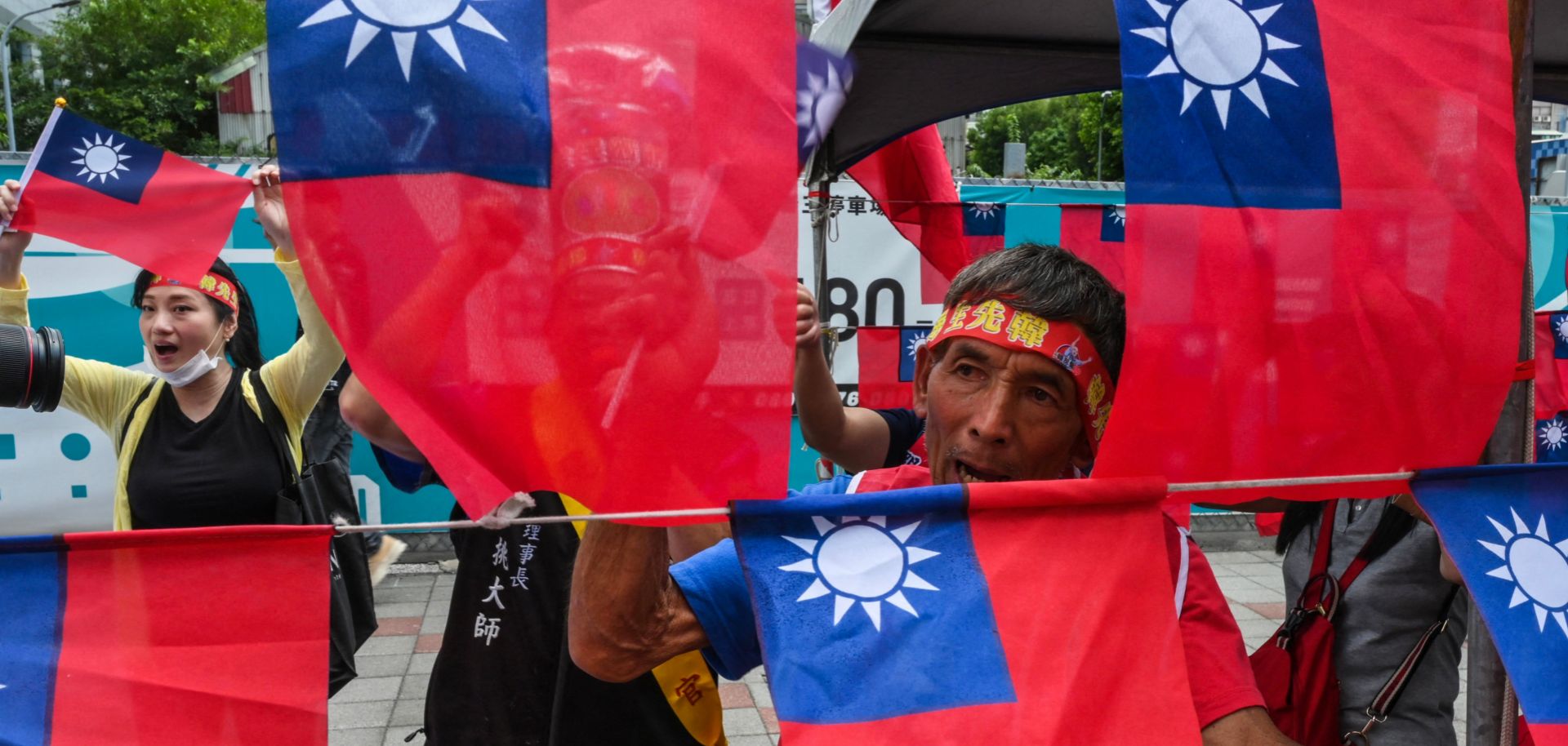
Taiwan's upcoming presidential election will likely result in another leader from the ruling Democratic Progressive Party (DPP), heralding four more years of Chinese military coercion and an increased risk of war. The concurrent legislative election, meanwhile, will probably yield a three-way split that could facilitate Taiwan's energy transition, economic diversification and military buildup in the short term, but may increase policy gridlock in the long term. Taiwan's presidential and legislative elections will take place on Jan. 13, 2024. The main contenders vying for the presidency include William Lai from the liberal and China-skeptic Democratic Progressive Party (DPP), Hou Yu-ih from the conservative and comparatively pro-China Kuomintang (KMT) party, and Ko Wen-je from the centrist Taiwan People's Party (TPP). With billionaire Terry Gou also throwing his hat into the ring in August, the four-way presidential race will determine the trajectory of Taiwan's trade policy, the risk of war with China, and the prospects for partisan policy gridlock at home. Concurrently with the presidential ballot, Taiwan will also hold elections to appoint the members of the country's Legislative Yuan, where the DPP currently controls 64 of the unicameral body's 113 seats.
- DPP candidate William Lai is the current vice president for outgoing Taiwanese President Tsai Ing-wen. Lai has cast his candidacy as effectively a third term for Tsai, who has sought to preserve Taiwan's status quo of de facto independence from China and diversify Taiwan's trade partners away from China. Lai has consistently led in most Taiwanese presidential polls since June.
- KMT candidate Hou Yu-ih is the current mayor of New Taipei and the former head of Taiwan's police. Hou has defined his candidacy primarily in opposition to the DPP. He characterizes the DPP's Tsai and Lai as provocateurs of conflict with China, and has cast this election as a choice between war or peace. Hou supports reviving Taiwan's economic and diplomatic talks with China while continuing to bolster national defense.
- TPP candidate Ko Wen-je was the mayor of Taipei from 2014-2020. He founded the TPP in 2019 as a centrist party geared toward Taiwanese voters fed up with the deadlocked partisanship of the KMT and the DPP. Throughout his presidential campaign, Ko has been vague on foreign and economic policy, and he aims to bolster the TPP's representation in Taiwan's legislature, where the party currently has only five of the body's 113 seats.
- Independent candidate Terry Gou is the billionaire founder of iPhone component supplier Foxconn. He entered the race as an independent in August after two failed attempts in 2019 and 2023 to become the KMT's presidential nominee. Gou is running on a pro-business platform and has declared that his candidacy is primarily aimed at unifying opposition candidates in a joint ticket against Lai.
- As of Oct. 21, a Taiwan News weighted presidential poll of 17 separate media surveys showed Lai in the lead with 33% of support, followed by Ko at 23%, Hou at 20% and Gou at 9%, with the remaining 15% of Taiwanese voters undecided.
This election comes amid growing national security concerns in Taiwan in response to escalating Chinese threats and intensifying U.S.-China competition over the island, which both global powers view as a linchpin for Indo-Pacific maritime dominance. Since the 1990s, support among Taiwanese for unification with China has all but disappeared, and most Taiwanese are content with preserving Taiwan's de facto independence. Beijing, however, is unsatisfied with this status quo. Since 2012, Chinese President Xi Jinping has linked China's unification with Taiwan to China's ''great rejuvenation'' to superpower status, and he has urged the military to be ready to invade Taiwan, if necessary, by the end of his third term in 2027. The United States has long tried to balance supporting Taiwan's sovereignty with avoiding war with China, all while preserving U.S. military dominance in Asia. This balancing act has become harder since 2020, however, as Beijing has conducted more and larger military drills around Taiwan and U.S. lawmakers have ramped up visits to the island. Amid this environment, the issue of sovereignty has become more important to Taiwanese voters than it has been in previous presidential elections.
- From 1996 to 2023, the share of Taiwanese who seek to maintain de facto independence from China rose from 46% to 61%, while those seeking de jure (i.e. constitutional) independence grew from 14% to 26% and those seeking unification with China dropped from 22% to 7%. This dropoff is largely due to elderly Taiwanese, many of whom fled China in 1949 and still sought unification, dying off.
- In August 2022, China conducted its largest live-fire military drills around Taiwan in nearly three decades, disrupting maritime and air traffic in Taiwan's busy shipping lanes. Meanwhile, since late 2020, Chinese air force and naval incursions into Taiwan's unofficial air defense identification zone have become a daily occurrence.
While polls currently indicate that Lai is most likely to win the presidency, that could change if someone drops from the race or the opposition unites behind one candidate. Lai has consistently led in presidential polls since June, followed by Ko and Hou (usually in that order), with Gou in a distant fourth place. Given his poor performance in the polls, Gou could withdraw prior to the Nov. 24 registration deadline if his bid to unify the opposition fails, in which case Ko would stand a greater chance of winning. Moreover, if the opposition candidates unite under a joint ticket — a reasonable prospect given that Ko and Hou shared both economic pragmatism and national defense priorities – they could defeat Lai. This prospect is contentious though. Ko's pole position among opposition candidates and his desire to maximize legislative votes for the TPP would likely preclude him from accepting a junior role on a joint ticket. Hou shares this reluctance to play second fiddle, especially given the KMT is Taiwan's oldest (and wealthiest) political party. But KMT party leader Eric Chu could pressure Hou into accepting a deal, even one unfavorable to their party, as a junior partner role would still be preferable to a DPP win. The TPP and KMT camps have begun negotiations as of Oct. 14 to form a joint ticket, but progress is slow amid mudslinging between Ko and Hou. Ko is also hesitant to partner with the conservative KMT because he could alienate the TPP's youth and centrist voter bases.
- A MyFormosa poll conducted Oct. 2-4 showed that in a three-way race (i.e. if Gou drops out), Lai's support stands at 38%, followed by Ko at 24% and Hou at 21%.
- On Oct. 14, the TPP suggested a series of three debates and a weighted opinion poll to determine who would be the sole opposition candidate. But the KMT proposed to hold a primary instead, which would favor the KMT's extensive grassroots political network. Neither camp is fond of the other's electoral proposition, but negotiations are ongoing.
- President Tsai Ing-wen's agriculture minister resigned on Sept. 19 over a controversy related to expired egg imports. But as of Oct. 16, the DPP's leadership controversy has yet to significantly dent Lai's support in the polls.
A win by Lai would exacerbate China's military coercion against Taiwan and could raise the risk of war. It would also accelerate Western tech restrictions on China and the exodus of businesses to nearby safe havens like Japan and Singapore. If the DPP wins, Taipei will strengthen relations with the United States, including by working with China hawks in the U.S. Congress to expedite the fulfillment of U.S. arms sales to Taiwan. Taipei will also allow frequent visits by U.S. lawmakers to Taiwan as a display of sovereignty, stoking U.S.-China tensions. China, however, would view a third-term DPP as a sign of the failing prospects of peaceful unification and thus accelerate its military coercion against Taiwan, conducting larger and more frequent military drills over the next four years, including live-fire drills that disrupt global shipping and air traffic. Relatedly, China would also conduct more drills aimed at perfecting its blockade capabilities, a useful early move in a war scenario. These developments would raise global threat perceptions and accelerate the diversification of business and investment (including in the semiconductor industry) out of China, Hong Kong and Taiwan and into safe haven economies like Japan and Singapore. These threats will also proliferate U.S. and European tech restrictions as a means to constrain China's military and technological development, with China intensifying its retaliatory scrutiny of Western businesses, including via regulatory probes, customs scrutiny and exit bans. A third-term DPP government would break Taiwan's trend of alternating parties every two terms, which may drive China to accelerate its timeline for a Taiwan invasion as Beijing becomes convinced that its favored party, the KMT, is moribund and that Taiwan, under the DPP, will never acquiesce to political unification. Nonetheless, an invasion would remain unlikely through 2027 in the face of China's fragile economic recovery and incomplete military modernization.
A KMT government would reduce military tensions and bolster economic ties with China, but civil discontent with China would hinder KMT policies and may result in a one-term presidency. If the KMT wins, Taipei will attempt a reprise of KMT elder and former president Ma Ying-jeou's 2008-2015 tactic of improving economic ties with China as much as possible while resisting Beijing's advances on political unification discussions. Since Ma left office, though, Taiwanese citizens have grown considerably more skeptical of Beijing's political machinations, especially after the Hong Kong protests of 2020. Thus, the KMT could face renewed Taiwanese mass protests, like the Sunflower Movement of 2014, particularly if citizens believe their liberties or Taiwan's national security are in jeopardy. Beijing would reduce military drills against Taiwan as an olive branch to a KMT-run government, but the Chinese military would continue its war preparations as a long-term deterrent. Beijing would also wield economic coercion (e.g. tariffs, licensing, customs scrutiny) against Taiwan when the KMT demurs on political negotiations. Taipei would continue accepting U.S. arms as a necessity for national security, which could impede the improvement of cross-strait ties. But compared with a DPP government, a KMT-led government would accept fewer U.S. congressional visits to Taiwan to avoid provoking Beijing. During the KMT's tenure, a Chinese invasion of Taiwan would be less likely as Beijing reengages with Taipei on economics and diplomacy, but ultimately fails to revive unification talks. The difficulty of improving economic ties with China — especially as Beijing wields economic and military coercion regionally — while staving off sovereignty concerns would see the KMT satisfy neither its conservative base nor Taiwan's centrists, which could result in a KMT-led presidency lasting just one term.
- As part of an economic rapprochement strategy, a KMT-led government may try to revive the Cross-Strait Service Trade Agreement with China, which was signed in June 2013. But CSSTA's chances for a second passage are slim, given that its initial passage triggered the month-long Sunflower Movement protests of 2014, which ultimately forced President Ma to scrap the deal.
- In June 2020, Beijing instituted a National Security Law in Hong Kong, resulting in arrests of democracy advocates, a rigged electoral system, and a gagged media, all while Beijing upheld Hong Kong as a model of ''one country, two systems'' governance.
- Independent Terry Gou has very little chance of winning, but if he did, he would be the most friendly toward China of all the 2024 presidential candidates, especially on economic ties. If elected, Gou would also heavily downplay the military threat posed by China, which could make relations with Washington tense.
A TPP government would slightly lower tensions with Beijing and signal an evolution of Taiwan's two-party system, but such a government would probably be ineffective and short-lived. The TPP and its leader, Ko Wen-je, are quite new to politics, so his middle-of-the-road policy platform is inchoate. If elected president, Ko would likely push stronger defense and sovereignty policies than the KMT, but bolster economic ties with China more than the DPP. Ko has also pitched himself as a proponent of free market economics, opposing efforts by Taipei to promote manufacturing diversification (e.g. by world-leading chip manufacturer TSMC) outside of Taiwan over national security concerns; he supports reviving the CSSTA as well. To Beijing, Ko and his TPP are unknowns, which — combined with Ko's middle-ground stances — suggest China would wield both military and economic coercion against Taiwan under a TPP government. Post-election, a Ko government would struggle to fulfill its campaign promise of improving economic ties with China while addressing domestic sovereignty concerns, all while permanently delaying unification talks. This, along with Ko's reputation for high turnover of his advisors, might erode Ko's governing efficacy and lead to a single-term presidency.
Regardless of who wins, in the short term, the TPP's role in Taiwanese politics will facilitate pragmatic policies on energy and defense. But in the long term, it could provoke party splintering and policy gridlock on both economic and defense issues. As long as Ko Wen-je stays in the presidential race, the concurrent legislative election will likely produce a fragmented chamber split between the DPP, KMT and TPP, with the latter serving as a swing vote bloc and a natural ballast against bipartisan political disputes. However, a third major party bloc in the legislature would subject more policies to deliberation that might otherwise easily pass under a single-party majority. Furthermore, this presidential race has already shown the moderating effect of the TPP's rise — and the shift in popular opinion on China — on the DPP and KMT's entrenched policy stances, like the former's opposition to nuclear energy and the latter's downplaying of China's military threat. This moderation could also help Taiwan pursue trade agreements with the United Kingdom and the United States by watering down the ability of protectionist parties, like farmers and elderly voters opposed to certain imports, to impede trade talks by leveraging their ties with an outright majority DPP or KMT in the legislature. But should the TPP's legislative success encourage splinter parties from the KMT and DPP, common in past elections, policy moderation could give way to policy gridlock and least-common denominator policymaking, slowing down Taipei's efforts to diversify economic partners and accelerate its military modernization in the face of a Chinese invasion threat.
- In February 2020, the KMT announced its support for a national referendum to stop the DPP government from developing the Guantang liquified natural gas terminal, after environmentalist outrage over potential coral reef damage from the project had grown into a media furor. The KMT, however, had originally proposed the project in 2015.
- During a press conference earlier this month, William Lai said that the government ''will not rule out the use of safe, waste-free nuclear'' energy. Though not a total policy reversal, this is a marked policy shift from President Tsai, who since 2016 has pledged to make Taiwan nuclear-free by 2025.
- The KMT has traditionally downplayed China's military threat, presenting diplomatic and economic engagement as an antidote to war while blaming the DPP for stoking conflict. The party's presidential candidate, however, has made national defense a pillar of his presidential platform, with Hou blaming Beijing's assertive rhetoric and military tactics for raising the risk of conflict.
