
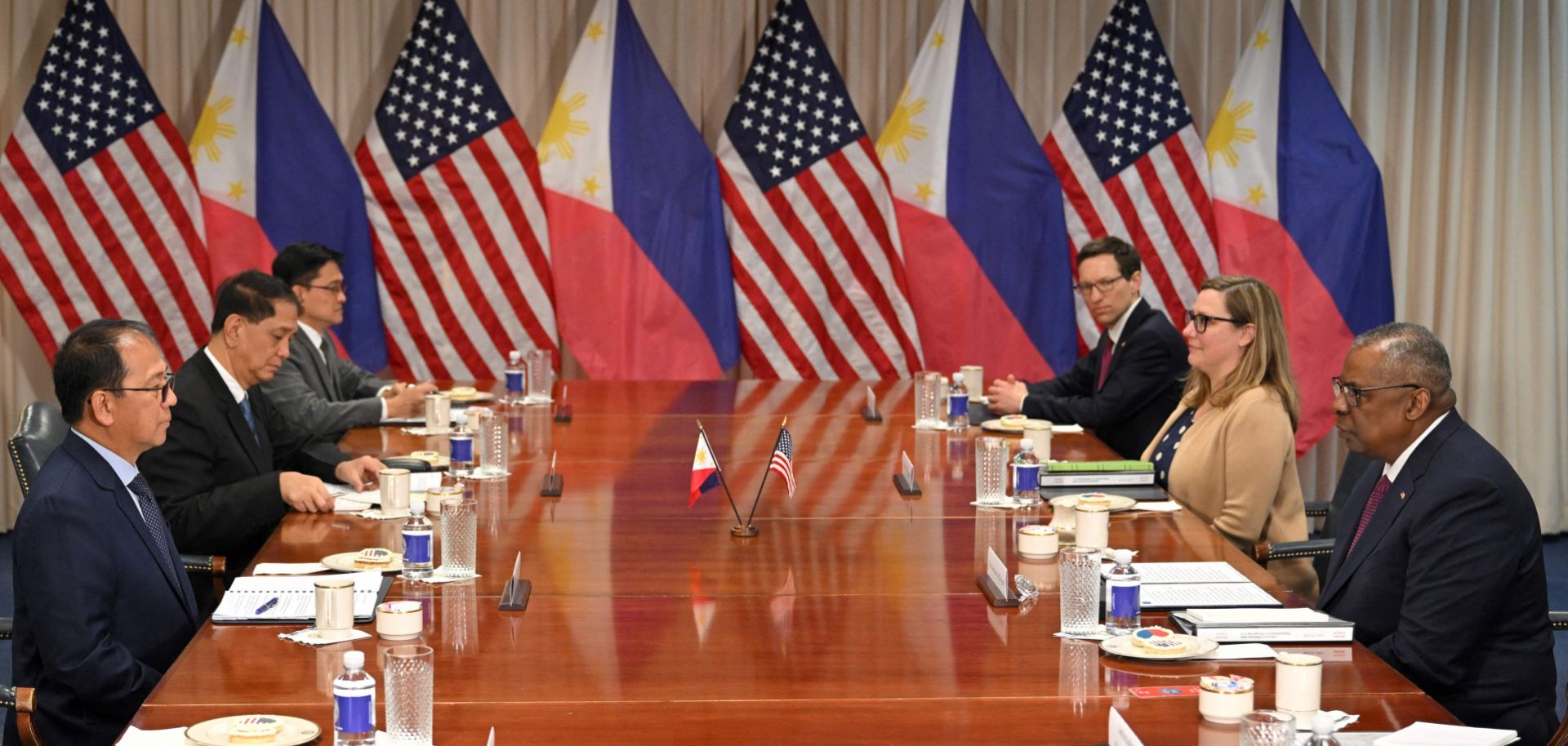
U.S. Defense Secretary Lloyd Austin (right) meets with his Philippine counterpart, Carlito Galvez (left), at the Pentagon in Washington, D.C., on April 12, 2023.
The reinvigorated U.S.-Philippines defense alliance will improve the United States' ability to counter China's military maneuvers in nearby waters, but will also exacerbate already rising regional tensions. Following their so-called ''2+2'' meeting in Washington, top foreign policy and defense officials from the United States and the Philippines issued a joint statement on April 11 in which they committed to completing a 10-year roadmap for delivering U.S. military equipment to the Southeast Asian nation, including ''priority defense platforms'' like drones, military transport aircraft and coastal and air defense systems. That same day, the United States and the Philippines also launched their largest and most technologically sophisticated joint military exercises, which are taking place in and around northern Luzon and Palawan, among other places, and will run through April 28. China strongly condemned the developments, with its foreign ministry spokesperson warning that the United States ''must not interfere in South China Sea disputes, still less harm China's territorial sovereignty, maritime rights and interests and security interests.''
- The United States and the Philippines have conducted their annual Balikatan (''shoulder-to-shoulder'') military drills for decades. A record 17,600 soldiers are taking part in this year's exercise, which also includes live-fire elements at sea for the first time and a small contingent of Australian military personnel. Prior iterations of the drill focused on counterterrorism, but the reorientation toward preparing to confront China requires far larger contingents from both armed forces.
The meetings and drills come amid growing Chinese threats near Taiwan and in the South China Sea. The U.S.-Philippine military drills were launched a day after China finished its own military exercises near Taiwan. Since January, Chinese and Philippine maritime forces have also had several dangerous encounters in the South China Sea, where the two countries have conflicting maritime claims. Recent South China Sea code of conduct negotiations failed to make progress, meaning more confrontations in the disputed waterway are likely, which will further raise the stakes — especially given the U.S. Navy's increased presence in Philippine waters.
- Between April 8-10, China conducted limited military activities around Taiwan, including a Taiwan Strait patrol and a naval voyage east of the island, in response to Taiwanese President Tsai Ing-wen's April 5 meeting with U.S. House Speaker Kevin McCarthy in California. China also conducted live-fire drills near Taiwan following Tsai's August 2022 meeting with McCarthy's predecessor, Nancy Pelosi, in Taipei.
- On Feb. 6, a Chinese coast guard ship shined a military-grade laser at a Philippine coast guard ship near the Spratly Islands' Second Thomas Shoal in the South China Sea, causing Philippine sailors' temporary blindness. On March 5, the Philippine coast guard also reported more than 40 Chinese vessels within 12 nautical islands of the Spratly Islands' Thitu island, and the vessels stayed in the area for several days.
The developments also reflect the United States and the Philippines' reinvigorated defense alliance following the recent revival of their Enhanced Defense Cooperation Agreement (EDCA), driven by the countries' growing concerns about China. In November, Philippine President Macros revived the EDCA, which his predecessor Rodrigo Duterte stalled during his 2016-2022 term. Signed in 2014, the EDCA allows the United States to constantly rotate troops in the Philippines, use Philippine bases for prolonged stays, and build and operate facilities in-country with its own personnel. In February, Washington and Manila then agreed to increase the number of U.S.-operated military sites in the Philippines under the EDCA from five to nine. On April 3, Manila announced that three of those new sites will be located in northern Luzon, within 250 miles (402 kilometers) of Taiwan, while the fourth will be located on Balabac island, which is just 160 miles (257 kilometers) southeast of Mischief Reef — a site of persistent territorial dispute between Manila and Beijing. This optimized strategic positioning of the four new EDCA sites highlights the United States and the Philippines' shared desire to oppose Chinese encroachment around Taiwan and in the South China Sea, as Beijing more assertively presses its territorial claims to both.
- The joint statement issued after the recent 2+2 meeting indicates the United States will also increase annual spending at its nine EDCA sites to more than $100 million by the end of 2023, up from the current $80 million.
- While both countries insist the EDCA is not a permanent basing agreement, the ongoing rotation of U.S. personnel and equipment in the Philippines under the deal nonetheless effectively enables the United States to maintain a constant military presence in the country.
- The Philippines and the United States have not held a meeting in the ''2+2'' format since 2016 — underscoring the two countries' renewed military relationship under Philippine President Macros, who took office in June 2022.
The revitalized alliance will bolster Washington's regional security architecture and Manila's capacity to defend its maritime claims. The new EDCA bases' locations unambiguously target China's core interests to secure two of its major territorial claims: over most of the South China Sea and over the island of Taiwan. For the United States, the new bases will improve its maritime monitoring and response capabilities in the event an armed conflict with China breaks out in the region. Such enhanced U.S. monitoring capabilities will be most immediately impactful in the strategically important Bashi Channel (a crucial waterway between the Philippines and Taiwan) and the Balabac Strait (another crucial waterway that could connect China to the Sulu Sea during a potential war). A larger U.S. military presence in the Philippines will also improve both countries' capacity to jointly patrol disputed waters in the South China Sea, where dangerous incidents with Chinese maritime forces are occurring with increasing frequency.
But it will also expose the Philippines to Chinese strikes in the event of an armed conflict over either Taiwan or the South China Sea. On April 10, Philippine President Ferdinand Marcos Jr. assured China that he will not allow the EDCA sites to be used for ''offensive action.'' But in a regional war scenario, the EDCA bases could nonetheless become legitimate military targets as Beijing would want to disrupt or destroy U.S. rapid response capabilities. For now, China will try to avoid seriously escalating tensions with the Philippines for fear of pushing it even deeper into the United States' orbit. However, Manila's efforts to deepen its defense ties with Washington will still risk placing it more frequently in China's crosshairs, increasing the risk of clashes and confrontations in disputed waters.
- On April 11, Beijing issued a veiled threat to Manila, stating ''We remind the relevant countries in the region that relying on extraterritorial forces will not only fail to maintain their own security, but will instead increase tension and will certainly harm themselves.''
