
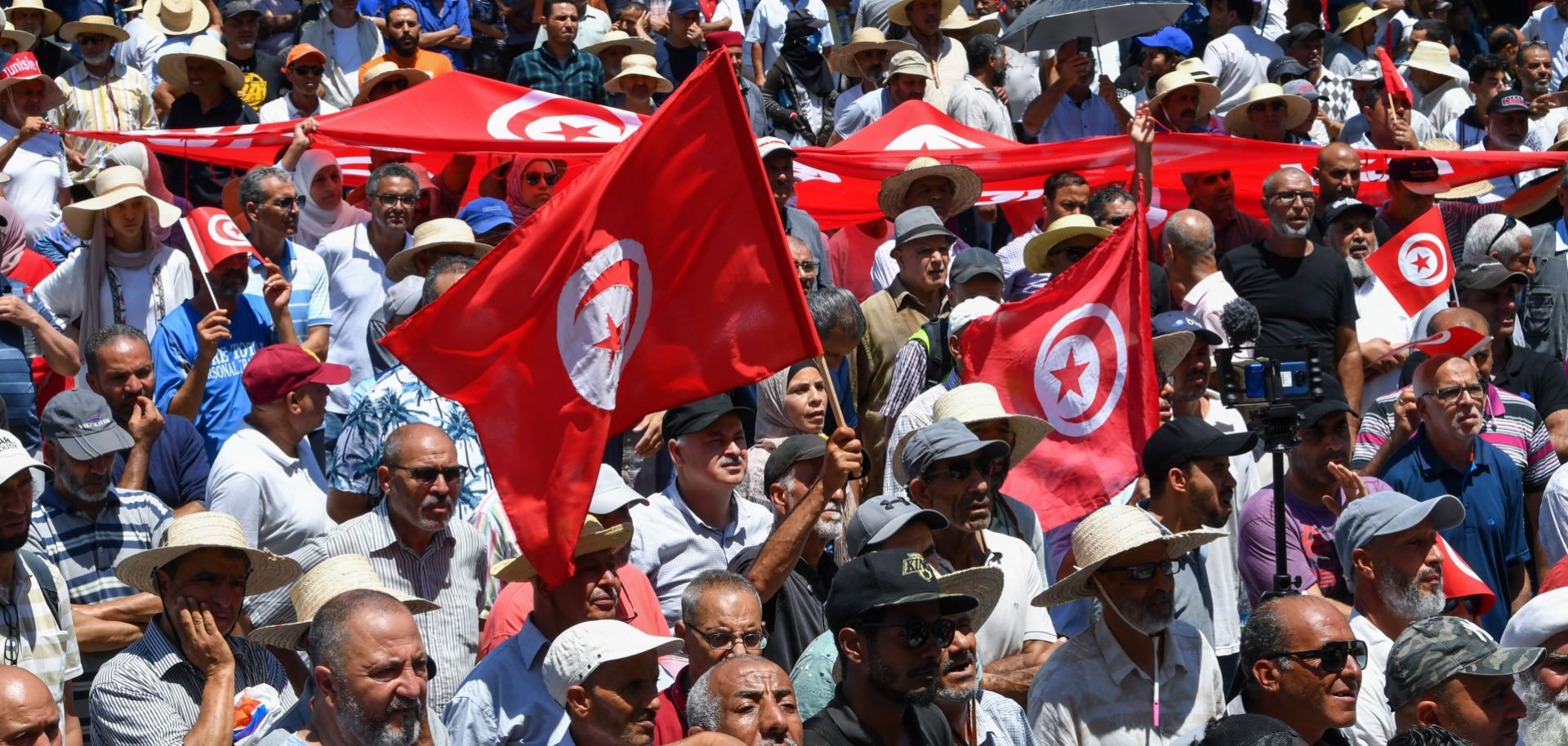
Demonstrators in Tunis, Tunisia, lift national flags during a protest on June 19, 2022, against President Kais Saied and the country’s upcoming constitutional referendum.
In Tunisia, the likely ratification of a new constitution portends a return to the largely unchecked presidential system that Arab Spring protesters ousted a decade ago. But while it will initially sow more discord, the consolidation of power under President Kais Saied could help stabilize the North African country’s economic and political crises in the long term. On July 25, Tunisians will vote on a new constitution that was drafted through a swift and controversial consultative process overseen by President Saied. The vote will be held a year after Saied froze parliament and gave himself greater executive powers. There is no minimum level of participation for the referendum, meaning the outcome will be considered legitimate regardless of how many Tunisians end up casting ballots. The president’s office also holds significant institutional power to direct government activities and influence the electoral council’s decisions. Given these factors, the constitutional referendum is widely expected to pass. The draft constitution Saied unveiled on June 30 — which largely reverts Tunisia's political system back to its pre-Arab Spring form by expanding executive powers while minimizing parliamentary powers — is thus poised to become the law of the land, whether most Tunisians like it or not.
- Saied unilaterally appointed his own advisory committee to draft the new constitution, which sparked an outcry from Tunisia's main opposition Islamist Ennahda party and the secular Afek Tounes party, as well as the country’s powerful General Labour Union (UGTT).
- Saied has ruled by decree since July 2021, when he suspended parliament and announced he would assume executive authority to help “safeguard Tunisia’s economy and society.” Late last year, he announced Tunisia would hold a constitutional referendum in July, followed by new parliamentary elections in December. Saied dissolved parliament in March 2022.
- As of July 6, 148 groupings in Tunisia (including political parties, associations and individuals) had officially registered with the country’s Independent High Authority for Elections (ISIE) to campaign for the referendum. 141 of those groups, mostly individuals, are expected to campaign for a “yes” vote. The remaining seven groupings are mostly political parties that are expected to campaign for a “no” vote. President Saied has a significant amount of oversight over ISIE and likely influenced this wide divide between expected “yes” and “no” votes.
The new draft constitution would grant Saied sweeping powers with very little oversight. Under the newly envisioned system, Tunisia’s parliament would be divided into two chambers: the people’s representatives (seemingly similar to what currently exists) and the assembly of regions and districts (a new chamber focused on local interests). The president, meanwhile, would propose draft laws, budgets and treaties — powers that are currently reserved for the parliament. The parliament would also not have the power to review those draft laws, omitting a key check on the executive branch. In addition, the prime minister would be both appointed by and answer to the president instead of the parliament (although a vote of no confidence in parliament that secures at least a two-thirds majority could still oust the prime minister and his government). Notably, the draft constitution does not outline a procedure for impeaching the president.
Such changes would codify the loss of the country’s Arab Spring gains by largely restoring the autocratic system that was ousted in the 2011 revolution. Tunisia’s post-Arab Spring 2014 constitution shifted the country from a presidential system to a parliamentary system. The writers of the document won a Nobel Peace Prize for including a broad spectrum of Islamic and secular leaders in the drafting process, as well as for establishing a strong checks and balances system that decentralized power across the country’s government institutions. But while more democratic, allowing for greater pushback between branches of government has also proven to be more chaotic, as evidenced by the policy gridlock that has since plagued Tunisia’s parliament. Tunisians have grown increasingly frustrated with parties’ near-constant bickering over the years, which has impeded the legislature’s ability to implement policies and respond to the country’s deepening economic crisis. This has led many to assert that the way the legislature is set up is inherently flawed — a belief echoed by Saied in his 2019 presidential campaign, which not only helped him win the election but also saw many Tunisians initially support his move to suspend parliament last year.
- Anecdotal evidence indicates many Tunisians are nostalgic for the pre-Arab Spring era under former President Zine El Abidine Ben Ali’s government, which was less democratic but in some ways had greater political and economic stability.
- When campaigning for president in 2019, Saied pledged to build a more grassroots-enriched democratic system of governance from the ground up. Some Tunisians believe he can still deliver this. But others, particularly the educated elite, are losing faith amid Saied's continued efforts to consolidate power, which the new constitution would enshrine.
The lack of checks on the president’s powers in the proposed constitution will likely stoke significant political opposition and a prolonged period of social unrest. Most political parties and many civil society organizations oppose President Saied’s vision for Tunisia’s political future, with some arguing the new constitution paves the way to authoritarian rule. The main opposition Ennahda party, the secular Afek Tounes party and the General Labour Union (UGTT), in particular, will likely continue to voice their disapproval of the constitutional referendum through and beyond the December parliamentary elections. This could see disruptive protests and nationwide strikes in the coming months, should the country’s largest parties and labor unions call on Tunisians to take to the streets — a risk that will likely increase if the constitution is approved in the July 25 referendum as expected.
- The UGTT is Tunisia’s largest labor union, with its members accounting for roughly 5% of the country’s population. The UGTT organized a nationwide strike on June 16 after Saied announced economic reform plans that would include cutting the country’s large public wage bill. The union has since threatened to stage more walkouts in the coming months amid the country’s deepening economic crisis. UGTT’s ability to organize a significant general strike and shut down public sector activity in recent weeks signals what the UGTT could do in response to Saied’s political reform efforts.
The initial backlash against Saied’s authoritarian turn will likely exacerbate Tunisia’s economic crisis and political paralysis in the near term. But the return to a more centralized system of governance could also ultimately free Saied to pass the reforms needed to stabilize the country’s financial situation. Tunisia's tourism-reliant economy is still reeling from the fallout from the COVID-19 pandemic, which the global economic shocks caused by Russia’s February invasion of Ukraine have only since exacerbated. This has resulted in a rising cost of living, which labor unions like the UGTT argue necessitate wage increases to ensure their members’ earnings keep up with inflation. But Tunisia also has one of the world’s highest public wage bills, as well as one of the world’s highest public debt-to-GDP ratios. To mitigate this growing debt burden, Saied’s government has devised a “national economic reform” program with the International Monetary Fund that includes spending cuts and other unpopular austerity measures. The UGTT’s ongoing opposition to such measures, along with the political chaos in the lead-up to the parliamentary elections, will likely continue to hamper Saied’s ability to pass his proposed economic reforms until at least after the December legislative ballot. However, if the new constitution is ratified in July, the new system of power could actually increase economic stability in the long term by tasking one office (the executive branch) with creating legislation, thus reducing the parliamentary and civil society debate that has slowed policymaking (and, in turn, Tunisia’s economy) in recent years.
- The majority of Tunisians consistently rank the economy as their most pressing concern in public opinion polls.
The weakening of Tunisia’s democracy under the new constitution would damage the country’s ties with Western countries, but could improve its regional relationships. The ratification of Saied’s new constitution would alienate Tunisia from Western countries and international institutions like the IMF, which both provide much-needed financial aid to the heavily-indebted country. Indeed, the United States and France have already expressed concerns over Saied’s recent power grabs, and will undoubtedly condemn the constitutional referendum if it passes. But by making it more difficult for Islamist political parties to come to power, the shift to a stronger and less accountable executive power would be welcomed by other autocratic regimes in the Middle East like Egypt, which could help Saied’s government obtain more direct financial aid from regional states.
- In early June, Saied announced the dismissal of 57 judges, accusing them of corruption and undue interference in terrorism cases. Such unilateral moves will only be easier in a system with even less oversight of Saied’s executive authority.
- Regional countries like the United Arab Emirates and Egypt who are strongly opposed to Islamist political parties like the Muslim Brotherhood have welcomed the weakening of Tunisia’s parliament, where the Islamist Ennahda party currently has the most seats.
