
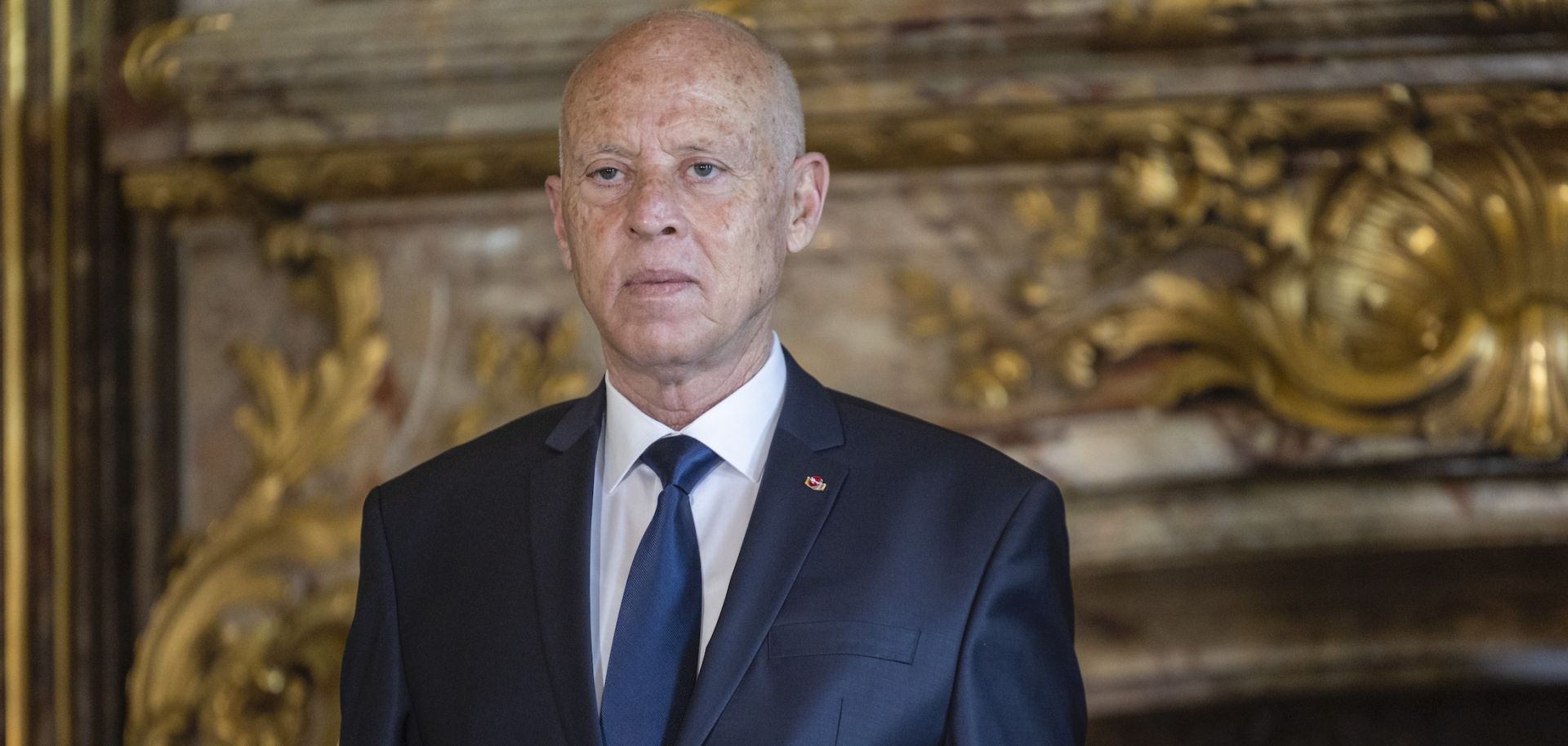
Tunisian President Kais Saied is seen at Belgium’s Royal Palace in Brussels on June 3, 2021.
Tunisian President Kais Saied’s move to indefinitely suspend parliament will give him more executive authority amid high public support, but will ultimately spark pushback from other political stakeholders and prolong the North African country’s economic crisis. On Aug. 23, Saied announced that he had indefinitely extended the month-long suspension of the legislature. The president did not offer justification for the move but did promise to give an address in the coming days.
- On July 25, Saied sent shockwaves through Tunisia after he suspended parliament for 30 days, fired the country’s prime minister and announced he would assume executive authority alongside a new premier who has yet to be named. In doing so, Saied invoked an article of Tunisia’s post-Arab Spring constitution that grants “exceptional” presidential powers when the state is in “imminent danger,” citing the need to “reset” the government in order to better address the country’s economic problems and surging COVID-19 cases.
- The continued delay in appointing a new prime minister and government, despite Saied promising July 25 to do so “soon,” has heightened political uncertainty in Tunisia in the wake of his apparent power grab.
In order to maintain his executive position without strong popular pushback, Saied will need to stay focused on rooting out corruption. Since taking office, Saied has overseen many anti-graft investigations, which Tunisians largely support. In keeping with this trend, judicial authorities in Tunisia — under the president’s authority — opened a series of investigations on July 28 into political officials, political parties, businessmen and former members of parliament over alleged corruption and abuse of power. The investigations appear to have since boosted Saied’s popularity: 94% of Tunisians said they approved of the president’s actions in a Sigma Conseil poll conducted in August compared with the 87% who said so in a July 28 poll conducted by Emrhod Consulting.
- Several of the Tunisian judges, politicians and businessmen facing pending corruption investigations recently told France24 that they had been arbitrarily denied the right to travel or leave the country in recent weeks.
- Saied’s 2019 presidential campaign promised widespread crackdowns on graft, which Tunisians largely support for fear that the promises of more freedom and economic opportunity from the 2011 Arab Spring will never be fully realized without mitigating systemic corruption in the country.
With executive authority and not much parliamentary oversight, Saied could technically rearrange Tunisia’s government as he sees fit. The country’s other political stakeholders, however, will likely work together to ensure the president doesn’t further consolidate his power. Much of the Tunisian political spectrum appears cautious to come out strongly for or against the president’s moves, given that it remains uncertain what exactly Saied wants to achieve. Tunisia’s wide range of political parties, civil society organizations and media organizations, however, will likely work to keep any potential aggressive power grabs in check. Now that 30 days have passed, the speaker of Tunisia’s parliament, Rached Ghannouchi (who’s also the leader of the Islamist Ennahda party) can legally question whether the “exceptional” circumstances Saied cited in triggering the July 25 measures are still, in fact, exceptional. But should Ghannouchi choose to question Saied, he will likely do so carefully, as coming on too strong against the president’s actions (which Tunisians widely support) would risk further tarnishing his own party’s reputation.
- Ennahda — which is the largest party in Tunisia’s now suspended parliament — has been increasingly scapegoated as the cause for the country’s persistent political and economic instability in recent years. On Aug. 12, Ennahda publicly admitted culpability in the country’s various crises and that the party’s “development achievements” had fallen short of the Tunisian people’s expectations.
The uncertainty created by an indefinite period of executive authority will exacerbate Tunisia’s economic long-term woes. Tunisia’s latest COVID-19 wave — which had exceeded that of any other North African country in terms of infections and deaths — has improved in recent weeks, which could provide a near-term boost to economic activity. But parliament’s continued suspension will hamper effective economic policymaking. And this political paralysis, combined with the raft of new anti-corruption investigations, will likely impede Tunisia’s long-term economic recovery by creating more uncertainty and business disruptions.
- Since assuming executive authority on July 25, Saied has overseen two exceptionally successful and efficient mass COVID-19 vaccination days in August, marking a sharp contrast to the chaotic vaccination drives seen earlier this summer. Tunisia’s summer COVID-19 spike, which the country’s health minister called “catastrophic” on July 8, has also begun to wane in the last few weeks. It’s not clear whether the reduction in infections is actually tied to Saied’s actions, but the timing will nonetheless help bolster public confidence in the president’s leadership.
- But economic indicators in Tunisia, including high inflation at 6.4% and high unemployment, have not improved since Saied assumed executive authority. After his July 25 announcement, Saied also hinted that external financial aid could be forthcoming, which has yet to materialize.
