
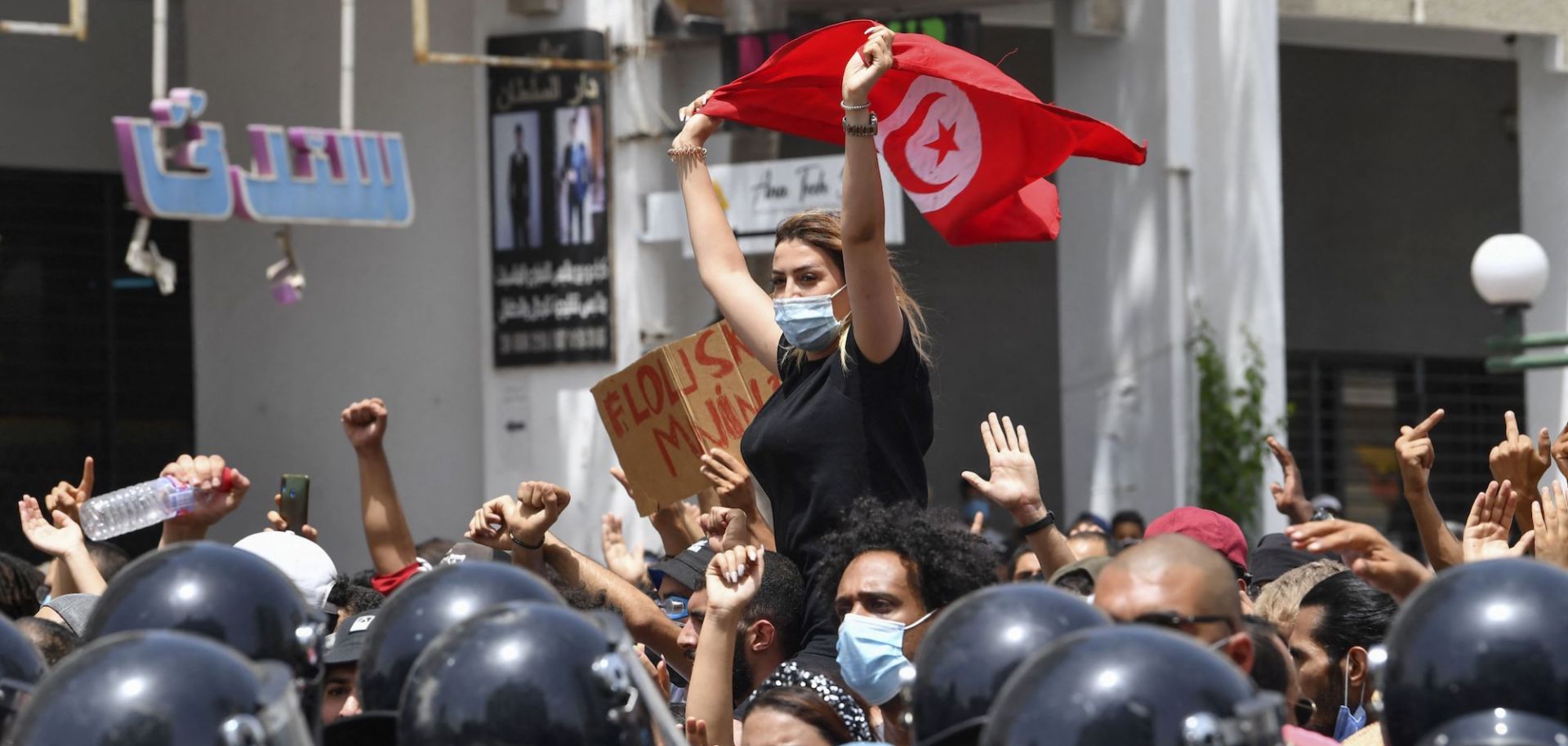
A protester lifts a Tunisian flag at a rally in Tunis on July 25, 2021.
Tunisia appears poised for a prolonged political crisis as a combination of domestic and foreign support enables President Kais Saied to make further disruptive moves as he sees fit. Tunisian politics are in disarray and they’re unlikely to quickly return to the status quo after Saied’s controversial 30-day suspension of parliament ends. But based on events so far, the upheaval is also unlikely to result in the dramatic overhaul of the country’s political system that Tunisians have demanded since the Arab Spring. Events over the last week instead indicate that the North African country is headed for something in between — that is, an extended period of political paralysis that shakes its fragile economy and undermines the power of the dominant Islamist Ennahda party.
- On July 25, Saied suspended parliament for 30 days, fired the prime minister, and announced he would assume executive authority alongside a new prime minister who still has yet to be named. In doing so, Saied invoked an article of Tunisia’s post-Arab Spring constitution that grants “exceptional” presidential powers when the state is in “imminent danger,” citing the need to “reset” the government in order to better address the country’s economic problems and surging COVID-19 cases.
Support from Tunisians and promised foreign aid will help Saied maintain control through the rest of the temporary transition. In a poll released on July 28, 87% of Tunisians said they approved of Saied’s recent move to freeze parliament and fire the country’s prime minister. Many Tunisians believe the change that emerged from the 2011 Arab Spring protests was important but incomplete, and have since demanded more anti-corruption measures and a further restructuring of the country’s political system. Saied’s moves align with those imperatives, even if they are worrying to members of the Tunisian political elite and external foreign observers who fear that the North African country’s democratic system could be altered in favor of a more executive, centralized system. In meetings with officials earlier this week, Saied also hinted that external financial aid could be forthcoming, likely from countries like Egypt, Saudi Arabia and the United Arab Emirates who would welcome a sidelining of the largest party in parliament. The promise of such aid is another reason why many Tunisians are welcoming Saied’s dramatic measures in the hopes that greater financial security in Tunis will help buoy their own personal finances.
- Tunisia was the only Arab country that emerged from the 2011 Arab Spring with a changed, democratic system of governance. The drafters of Tunisia’s 2014 constitution won a Nobel Peace Prize for imbuing the country’s new legal system with democratic principles unique in the broader region.
- Ennahda’s identity as an Islamist party has also put it at odds with powerful regional Sunni governments, including those in Egypt, Saudi Arabia and the United Arab Emirates.
A new rash of anti-corruption investigations is also likely to prove popular among Tunisians and could exacerbate the turmoil in Tunis by uprooting people in power. On July 28, judicial authorities in Tunisia opened investigations into three political parties, including the Islamist Ennahda party, over alleged corruption and abuse of power. According to the Tunisian Press Agency, prosecutors are also investigating several individual lawyers, businessmen and members of parliament, as well as the former head of Tunisia’s National Anti-Corruption Authority. This proliferation of anti-corruption investigations will stoke concern among Tunisia’s ruling elite, adding to the atmosphere of political chaos and uncertainty. The probes, however, are already being welcomed by the broader Tunisian public, many of whom blame corruption among the elite for their country’s current economic woes.
- Over the past week, Saied has also dismissed government ministers and replaced them with acting officials.
A prolonged period of political volatility would risk further shaking Tunisia’s already fragile economy and sidelining the powerful Ennahda party. As the largest party in Tunisia’s parliament, Ennahda has naturally been among the most vocal critics of Saeid’s move to freeze the legislature, which it’s called a coup. But thanks to its dominant role in Tunisia’s government, Ennahda has also found itself increasingly at blame for the country’s inefficient governance and mounting economic struggles. And this new political crisis is likely to prove no different, with Ennahda likely taking the brunt of any backlash.
- Tunisia has been struggling with worsening government finances for the last several years, which has helped create an environment of economic uncertainty and financial insecurity within the country.
- Tunisia’s fiscal deficit is equal to 10% of GDP. Its public wage bill also accounts for 17.5% of GDP. Between 2019 and 2020, Tunisia’s public debt increased from 72% of GDP to 87%.
To gauge the length of Tunisia’s transition, other key developments to watch in the coming weeks include:
- Political reappointments: The swift replacement of the political leaders Saied has dismissed over the last week, including the prime minister, would indicate a foreseeable end to the current political crisis, with delayed appointments likely to prolong it.
- Public support: Positive sentiments among the Tunisian public toward Saied’s decisions will enable him to continue taking unilateral actions that prolong the political crisis, while dimming support would put pressure on Saied to end it.
- Economic health: Sharp upticks in business activity and consumption in Tunisia would indicate confidence in Saied’s leadership, with downturns indicating the opposite.
- Political dialogue: The continuation of dialogue between other powerful Tunisian institutions, including parties like Ennahda and labor unions, would indicate leaders are proactively working to end the period of political uncertainty, whereas faltered negotiations would point to further paralysis.
