
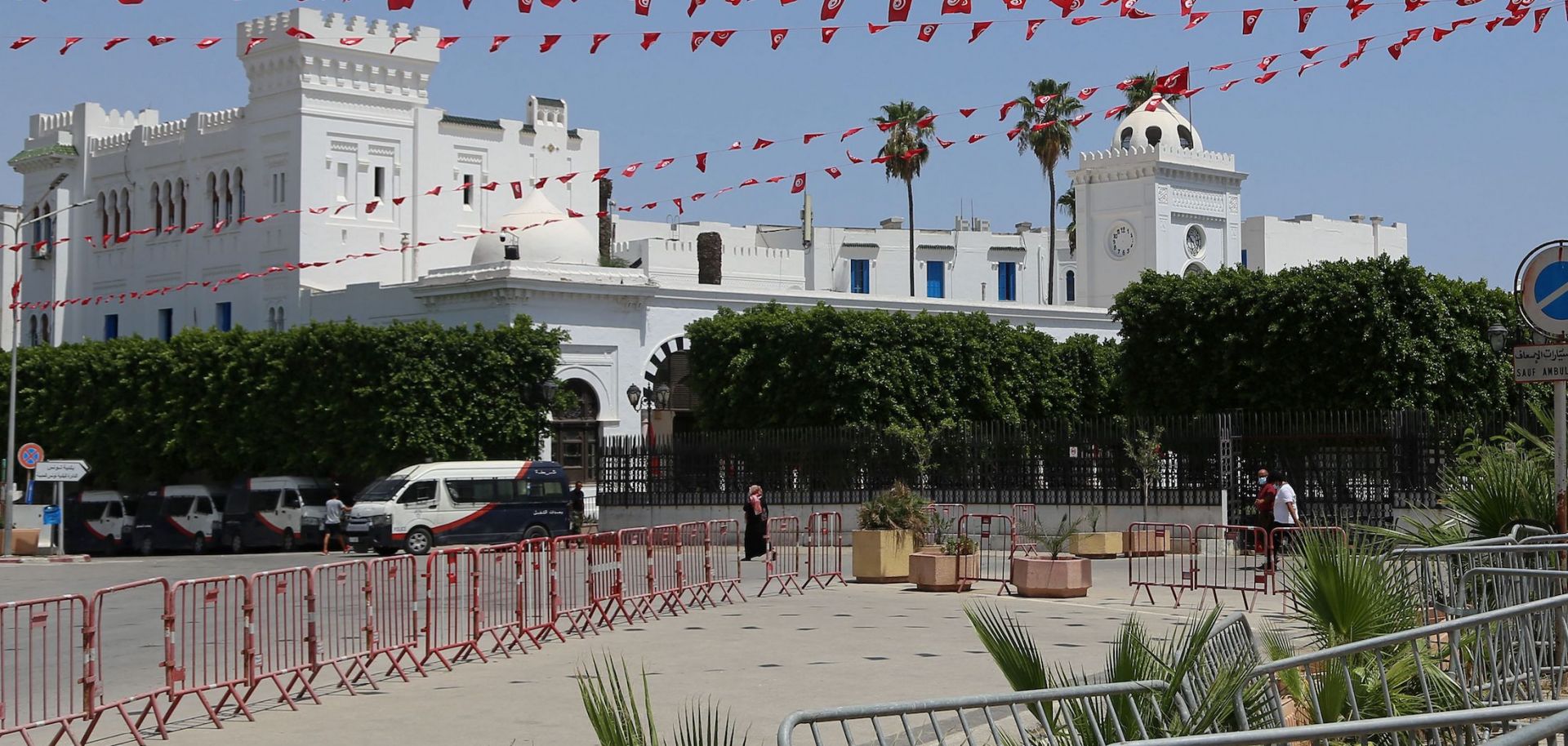
Barricades surround Tunisia’s government headquarters in Tunis on July 26, 2021.
Tunisian President Kais Saied’s move to freeze parliament and fire the prime minister has thrown the North African country’s democratic trajectory into question for the first time since the Arab Spring — ushering in a political crisis on top of Tunisia’s deepening economic and COVID-19 crises. On July 25, Saied suspended parliament for 30 days, fired Prime Minister Hicham Mechichi (along with his government), and announced he would assume executive authority alongside a new prime minister who has yet to be named. In doing so, Saied invoked Article 80 of Tunisia’s 2014 constitution (which allows for the president to take “exceptional measures” in the event of “imminent danger” to the state), pledging to use the 30-day legislative hiatus to focus on the country’s economic problems and surging COVID-19 cases. Saied also announced that most activities of public institutions will be suspended July 27-28, and that a nationwide curfew prohibiting people and vehicles from moving from 7 PM until 6 AM will be imposed beginning July 26 until Aug. 27.
- Saied’s move happened on Tunisia’s Republic Day and against the backdrop of anti-government protests in Tunis demanding Mechichi’s ousting and the dissolution of parliament. On the evening of July 25, supporters of Saied took to the streets in Tunis to celebrate the freezing of parliament.
- Saied has always been something of a political outsider, which helped him garner support behind his candidacy in 2019 after the death of former Tunisian President Beji Caid Essebsi.
Many Tunisians will likely support the dismissal of Mechichi and his government. Mechichi’s popularity had dropped in recent months amid a confluence of crises in Tunisia, including a severe COVID-19 resurgence that has exceeded that of any other North African country in terms of infections and deaths. Tunisians — who regularly take to the streets to voice economic and political grievances — will likely welcome the abrupt change in their country’s political trajectory in the hopes that a fresh start may help ease the challenges facing their debt-ridden country.
- Saied appointed Mechichi in September. Mechichi’s short tenure as prime minister was marred by continuous anti-government protests.
The controversial use of Article 80 in Tunisia’s constitution to remove a democratically-elected body from power, however, will risk further dividing the country’s political landscape. Saied claims Article 80 grants him the ability to deploy exceptional presidential powers during times of crisis. But the article also says the president must inform the country’s currently empty constitutional court of any such move. The court is also supposed to still have the final say on the legality of government decisions. The lack of the court has been widely discussed since the Constitution was drafted in 2014 as a liability that could lead to a constitutional crisis. Furthermore, the move to freeze parliament sidelines the body in a way Saied clearly believes is constitutional, but many parties within parliament and Tunisian observers believe is not. Moreover, it remains unclear how Saied will obtain approval for Mechichi’s soon-to-be-announced replacement — a power that would otherwise be reserved for Tunisia’s now-suspended parliament.
- Tunisia’s Islamist Ennahda party, which has the largest presence in parliament, has unsurprisingly staunchly condemned Saied’s July 25 announcement, which it views as a coup. This sentiment has been echoed by Ennahda’s coalition partner Qalb Tounes, as well as the Democratic Current party and the Workers’ Party. Parties like Attayar have said they disagree with Saied’s decision as well, but have not gone so far as to call it a coup.
- Some parties support the Saied’s decision, including the People’s Movement and the Coalition for Tunisia party. Ahead of its July 26 meeting with the president, the country’s powerful Tunisian General Labour Union (UGTT) also issued a statement of cautious support, but demanded guarantees on a time limit to parliament’s suspension and some understanding of how these moves impact the independence of the judiciary.
- There are many influential Tunisian parties and institutions that have to issue formal responses to the July 25 announcement, including Afek Tounes, Tanya Tounes and Machrou Tounes.
The following developments in the coming days and weeks will help determine whether Tunisia is passing through a momentary constitutional crisis or a larger trajectory shift toward a less democratic system that sees more power in the hands of the president.
- Saied’s behavior. Although Saied says he will respect the 30-day time limit in Article 30 for deploying exceptional presidential powers, many do not trust him and see parallels between these extraordinary moves and those of Tunisia’s former more autocratic presidents. Yet others have pointed to Saied’s lengthy career as a constitutional jurist prior to becoming president as an indication he’ll respect the law and stay true to his word.: It will thus be key to monitor Saied to gauge whether he is indeed attempting a larger power grab, or if he’s truly trying to reset and move forward with a different prime minister and cabinet in the hopes of easing the country’s political and economic crises.
- The appointment of a new prime minister. If Saied appoints a new prime minister in the coming days, especially someone technocratic and without overtly biased political ties, it should give us some confidence about Saied truly intending to share executive powers. But if the appointment of Mechichi’s replacement remains unclear for days, it will inject some doubt about maintaining the current democratic structure of the system. This would, in turn, likely lead to further political paralysis by pushing more parties and institutions to come out against Saied.
- Cooperation between the executive and legislative branches. If Saied successfully encourages dialogue between his office and parliamentary leaders, it will help dispel concerns about broadening executive power and help maintain Tunisia’s democratic structure. The extent to which parliament cooperates with the president’s plan to appoint a new prime minister will indicate the body’s overall willingness to conform to a short-term period of emergency executive authority. In this, parliamentary speaker Rached Ghannouchi will be especially key. Ghannouchi is currently deeply opposed to Saied’s decision and has been the loudest among those calling it a coup.
- Cooperation between political and civilian leaders. Political dialogue between major actors (i.e. parties, civil society organizations, unions, and politicians in and out of parliament and not in parliament) would help dispel concerns about this period of executive management lasting indefinitely. Tunisia’s democratic constitution has managed to survive several political crises since it was enacted in the wake of the Arab Spring. But if this latest test hamstrings political dialogue, it risks changing the country’s entire system of governance in the long term.
- Protests and the government’s response. Tunisia is likely to see disruptive public demonstrations in the coming days as supporters and opponents of Saied’s decision take to the streets. Police and military forces, currently under presidential control, have already been preemptively deployed in regions of the country to keep the peace. If a more forceful or sizeable deployment occurs, it will concern those worried about an expansion of state power and potential use of force against civilians, likely leading to more violent clashes and mounting opposition against Saied from Tunisians, as well as external countries worried about the country’s stability.
- The economic fallout. The current political crisis risks worsening Tunisia’s already poor economic situation by stirring uncertainty among both domestic businesses, as well as foreign investors who don’t yet know who will be leading the government in the near or long-term future. If the current situation then leads to yet more economically motivated protests, more political actors will likely turn against Saied — further aggravating the economic crisis that his move to reset Tunisia’s government was ostensibly aimed at solving.
