
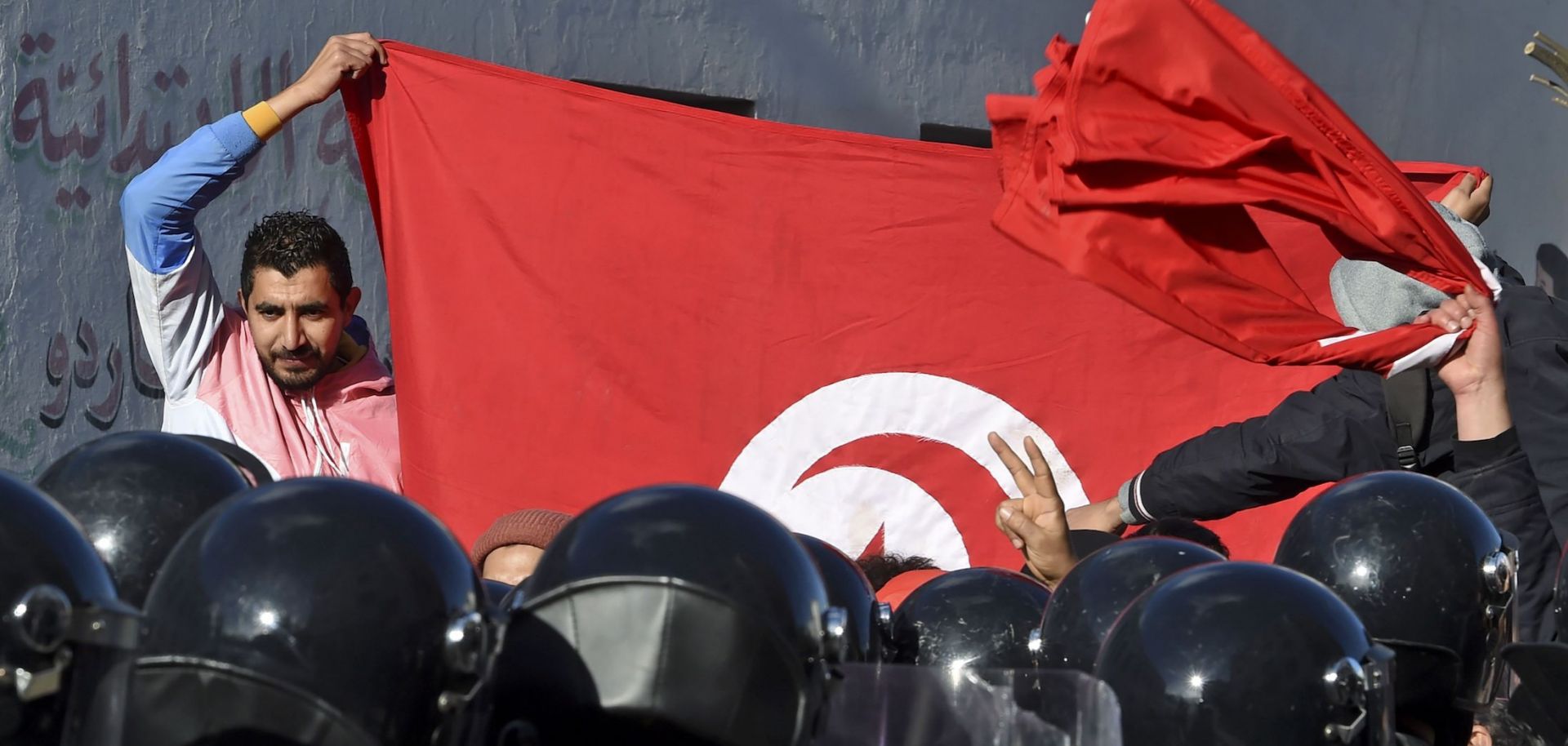
Police block protesters from accessing government buildings on Jan. 26, 2021, in Tunis, Tunisia.
A rash of protests in Tunisia could force the current government to step down, though any successor government won’t have the answers to the economic, social and political problems people are looking for. After only six months in office, Tunisian Prime Minister Hicham Mechichi’s government is already facing growing calls for its resignation. Since mid-January, Tunisia has seen persistent anti-government protests, with demonstrators demanding action on judicial reforms, government corruption and basic economic grievances. Anger over the Jan. 25 death of Haykl Rachdi, a young protester who was struck with a tear gas canister by Tunisian police, has since further galvanized participation in protests across the country, underscoring how the pressure on Mechichi’s government cuts across geographic and social lines.
- Anti-government protests and union strikes have been occurring sporadically since Mechichi took office. But the 10th anniversary of the Arab Spring has galvanized demonstrators seeking a response from the government.
- Amnesty International has called for an investigation into Rachdi’s death, which could exacerbate ongoing concerns shared among Tunisians about police brutality. So far, over 1,400 people have been arrested in ongoing demonstrations, a third of which are minors, according to the Tunisian Human Rights League.
Tunisia’s fragile financial situation, which shows little sign of improving, is driving protests across class lines. Economic inequality and instability ostensibly sparked the Arab Spring in 2011. Tunisia’s financial situation is now, in many ways, more unstable than it was then. The generation that demanded better economic opportunities a decade ago is still dissatisfied with their jobs, income and overall financial security. But they’re now joined by a newer generation of Tunisians who are also demanding the same opportunities previous generations used to enjoy in education and work.
- According to the World Bank, the Tunisian economy was already exceptionally fragile before the COVID-19 pandemic. But the country’s 21% economic contraction in 2020 was even “worse than anticipated.” Public debt is expected to reach 86% of GDP in 2020, up from 72.5% in 2019.
- COVID-19 has depressed tourism rates in Tunisia (with receipts down by 47% in 2020), along with the country’s crucial textile exports (which were down by 27% in 2020). Tourism and textile manufacturing are Tunisia’s two major economic contributors and sources of foreign currency.
- Tunisia’s national unemployment rate has risen from 15% to 18% over the past six years. The last time the unemployment was this high was during the 2011 Arab Spring protests.
The growing rift between Mechichi’s government and President Kais Saied underscores how infighting within Tunisia’s democratic system will continue to prevent any real solutions from taking hold. Saeid, who won his 2019 election on a populist platform and retains significant public support, has sided with protesters and critiqued Mechichi’s response to the unrest. Government coalitions in parliament, like the outspoken Soumoud, have also voiced their dismay with Mechichi and want him to resign.
- On Jan. 27, Tunisia’s parliament approved the appointment of 11 new cabinet ministers, which Mechichi said would hopefully help satisfy protesters’ demands for political change. Saied critiqued the lack of women included in the reshuffle, and said that the way in which it was conducted was unconstitutional.
- Tunisia’s post-Arab Spring 2014 constitution strengthened government institutions and allowed for greater pushback between branches of government, which is more democratic but often more chaotic in practice.
- Mechichi’s predecessor, Elyes Fakhfakh, resigned in July 2020 amid a corruption scandal and government infighting.
Social unrest is likely to be a constant and disruptive issue in Tunisia for the foreseeable future, as the country’s new constitution guarantees protection for most peaceful demonstrations. These social freedoms have granted Tunisians greater space to air their grievances about the promises made to them after the Arab Spring that their government has yet to fulfill. Over the past week, Mechichi’s government has argued that violent riots are not protected under the constitution. But Tunis has been careful not to broadly label all demonstrations “riots,” as clamping down too firmly on legal gatherings would risk only exacerbating public anger.
- Although Tunisia wrote a progressive new constitution in 2014, many aspects of it still have not been implemented or fulfilled, including filling the new constitutional court. This will keep motivating protesters to take to the streets.
- The drafters of the 2014 Tunisian constitution were awarded a Nobel Peace Prize for creating a document that not only contained historic civil protections, but brought together the country’s rival political factions into a comprehensive dialogue.
Mechichi and his government will likely succumb to the pressure to resign should protests sustain momentum. But the same structural economic and political quagmires will plague any new government, guaranteeing more political impasses to come in Tunisia. Tunisia will continue to struggle to find sustainable solutions to the country’s ingrained economic issues so long as feuding factions, now able to equally voice their opinions on what to do about them, are unable to agree on solutions. For Tunisia, this guarantees a return to the same political and economic questions at the elite level, as well as the continued existence of the drivers currently pushing Tunisians to take to the streets. Other countries grappling with civil society activists and protesters demanding more democratic governance, meanwhile, will also be viewing Tunisia’s political incoherence as a cautionary tale.
