
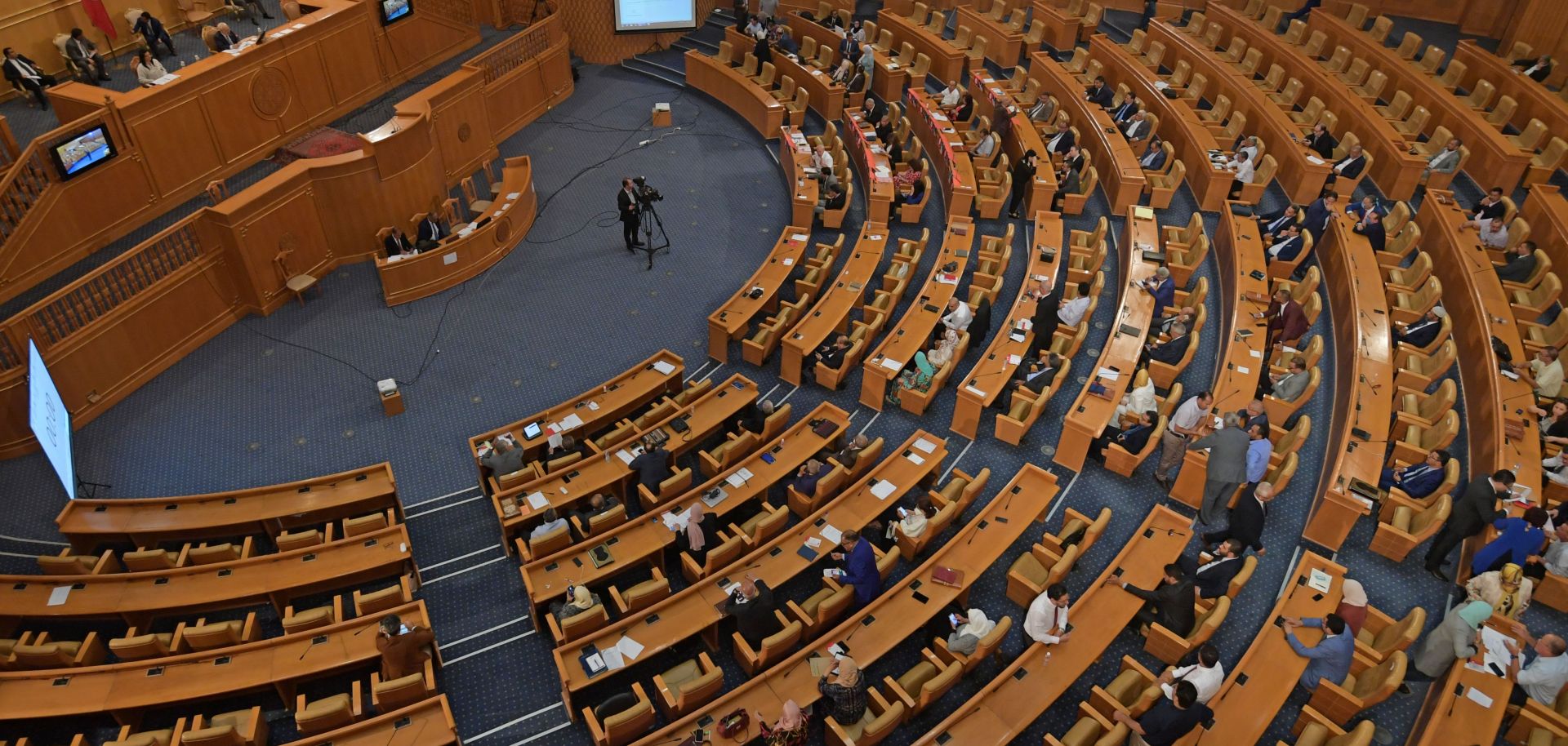
Legislators attend a plenary session in Tunisia's parliament on June 3, 2020.
Tunisia's third attempt to form a government in less than a year is unlikely to resolve the dysfunctional partisan infighting that saw the demise of its last two governments, leaving its leaders unable or unwilling to pass the reforms needed to mitigate the country's deepening economic crisis. Following his predecessor Elyes Fakhfakh's July 15 resignation, Tunisia's prime minister-designate Hichem Mechichi unveiled a new cabinet of independent technocratic ministers on Aug. 24, which will go to a parliamentary vote on Sept. 1. But even if Mechichi's proposed government is approved by the country's highly divided parliament, Tunisia's deep-rooted party rivalries ensure little actual governing will be done, weakening Tunisia's ability to secure much-needed external funding, as well as serve as a model democracy in the Arab world.
Tunisia's highly polarized political climate will leave its next government at risk of collapse, which would prompt yet another round of elections per Tunisia's constitution, in addition to more political logjams. The current power vacuum is the result of the split in Tunisia's political spectrum between secular and Islamist parties, which gives the latter more power than is typical in other Arab countries. Lawmakers have been divided over whether to pursue another government that falls along partisan lines, or a technocratic government focused on financial and economic reforms (which would risk upsetting some political parties in parliament who would feel left out of decision making).
- While reflective of the country's demographics, Tunisia's democratic political system stymies easy policymaking, which guarantees Tunis’s various factions will remain highly polarized.
- The Islamist Ennahda party used its power in parliament to force the last government's ousting and maintains the political strength to do so again with the next government.
- Ennahda's mostly secular opponents are currently forming an alliance to weaken the Islamist party's power, but disagree on the merits of ushering in a non-partisan, technocratic government.
Low growth, high inflation and rising unemployment will continue to plague the Tunisian economy as the government fails to push reforms through the country's divided parliament. Passing and implementing structural reforms, such as cutting the country's high public wage bill and increasing tax collection, will require buy-in and cooperation among the country's rival political factions. This, however, is highly unlikely as such reforms are unpopular among both Tunisian voters and labor unions. Tunisia's continued failure to pass structural economic reforms will also undermine its ability to land helpful financing from the International Monetary Fund (IMF).
- Tunisia has the highest public wage bill in the Middle East and North Africa, and the government continues to use public sector employment as a means of generating stability.
- Tunisia's public debt issues have grown so serious that Tunisia is seeking to reschedule its debt with major bilateral creditors, such as Saudi Arabia and France.
- The Tunisian government's budget deficit is now expected to reach 5 percent of GDP by the end of 2020 — up from the 3 percent forecasted prior to the COVID-19 pandemic, which has had a detrimental impact on crucial tourism and services revenue.
- Tunis was in discussions with the IMF for a new financing deal before the country's dual economic and political crises took a turn for the worse. In March, the IMF canceled an extended-fund facility agreement with the intent of beginning a successor agreement once the COVID-19 crisis subsides.
The government's lack of financial means and political will to fulfill its promise of creating more local-level jobs means a recurrence of destabilizing protests is likely in the near term as well.
- In 2017, protesters in southern Tunisia reached an agreement with the government to end their blockade of oil and gas fields in the region. In exchange, Tunis pledged to employ more locals in oil and gas projects or government jobs. But in the years since, the government has largely failed to live up to that promise, leaving open the potential for a resurgence of unrest among frustrated locals in southern and central areas in Tunisia, such as Kamour, Tataouine, Gafsa and Remada.
- Fulfilling the full scope of the 2017 agreement would have cost an initial $28 million. But the government also feared it would create a cyclical and growing cost, as future generations expect similar employment.
