
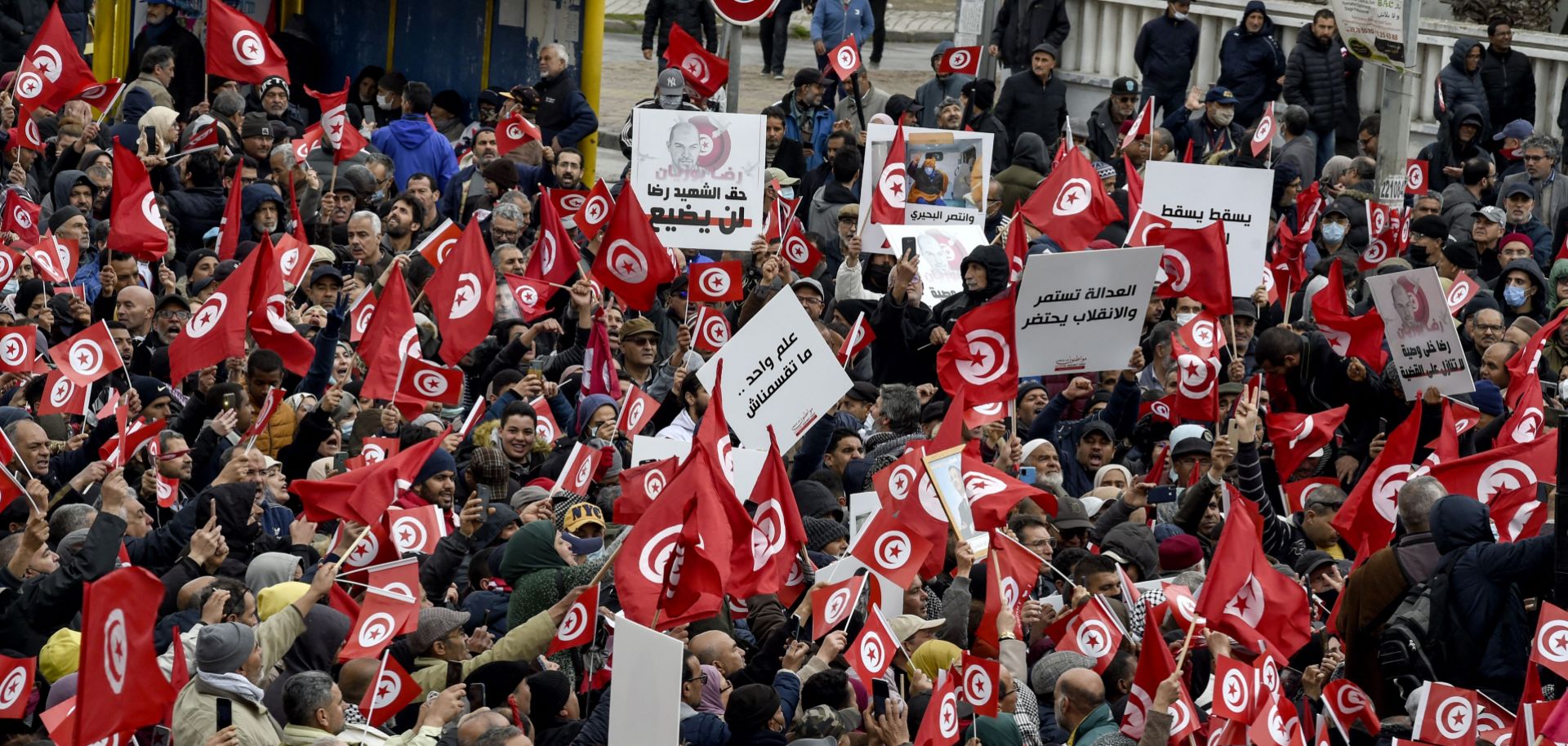
Tunisian protesters raise national flags during a demonstration against their president in the capital of Tunis on March 20, 2022.
Tunisian President Kais Saied's move to dissolve parliament will likely increase political instability and social unrest in the North African country by sparking pushback from opposition groups and impeding the passage of needed economic reforms. On March 30, Saied dissolved Tunisia's parliament after the body held a virtual session in defiance of his July 2021 order suspending the body. During the session, parliament voted to revoke Saied's declaration of a ''state of exception,'' which suspended the body. President Saied stated that the virtual meeting amounted to an attempted coup, and said that his previously announced plans for holding a referendum this July on a new constitution, followed by new parliamentary elections in December, would go on as scheduled. Under Tunisian law, when the president dissolves parliament he must hold elections within 90 days of the dissolution, but Saied ruled out doing so on March 31.
Parliament's meeting and Saied's dissolution of the body come amid growing opposition to the president's proposed economic reforms. Saied's initial suspension of parliament was quite popular, given the body's reputation for deadlock and corruption. Moreover, he justified the drastic action based on the need to enact economic reforms required for Tunisia to secure a loan from the International Monetary Fund (IMF). These reforms will likely include deeply unpopular policies, such as public spending cuts, that parliament was otherwise expected to block. On March 30, Tunisia's General Tunisian Labor Union (UGTT) said it may consider staging a general strike to oppose such economic reforms, although the union supported Saied's suspension of parliament as it viewed the measure as necessary to resolve political gridlock.
- Tunisia needs a multi-billion dollar IMF loan in order to pay its public debts; otherwise, it risks defaulting.
- The UGTT is the largest labor union in Tunisia and represents an estimated 1 million Tunisians (or approximately 5-10% of the country's workforce). The union played an important role in the 2011 Arab Spring uprising in Tunisia by mobilizing its members against then-President Zine El Abidine Ben Ali.
Saied's order will likely exacerbate opposition to his centralization of power and make it more difficult to pass economic reforms. While parliament hasn't been popular, neither have Saied's efforts to consolidate power, which spurred significant protests in December 2021 and January 2022 timed to coincide with the 11th anniversary of the start of the Arab Spring in Tunisia. Most recently, Saied has taken steps to place the judiciary under his control, including by dissolving the independent Supreme Judicial Council on Feb. 6 and appointing new members to it on March 7. He also stated that people who he refers to as ''conspirators'' (presumably individuals opposed to his initial parliament suspension) will be barred from running in December's parliamentary elections. Saied's dissolution of parliament will only strengthen opposition to his perceived power grabs, making political demonstrations more likely and possibly forcing Saied to initiate a security crackdown. This will, in turn, also make it that much harder for Saied to generate support to pass his proposed economic reforms, which are already unpopular.
The lack of reforms and increased political instability will worsen Tunisia's short-term economic outlook amid the global fallout from Russia's recent invasion of Ukraine. The COVID-19 pandemic hit Tunisia's tourism-reliant economy hard. According to World Bank data, the country's economy contracted by 8.8% in 2020, while unemployment in the country rose from 15.1% to 18.4% compared with 2019. But despite an improvement in the pandemic, tourism rates are unlikely to quickly rebound. Tunisia had hoped to attract more visitors from Eastern Europe and Russia, but people in those countries are unlikely to travel for leisure anytime soon amid the ongoing war in Ukraine. Additionally, the war and subsequent sanctions on Russia have caused a spike in global energy prices, as well as a sharp decline in Russian and Ukrainian wheat exports. Prior to the conflict, nearly half of Tunisia's wheat imports came from Ukraine; a prolonged disruption of that supply will thus, at a minimum, increase food prices — further fueling potential unrest in Tunisia.
If Tunisia's deepening economic and political crises spur widespread unrest, it could either make Saied reconsider his timetable for the constitutional referendum and elections, or undermine the legitimacy of the results. The Tunisian constitutional referendum is currently scheduled for July 25. Tunisians are almost certain to feel the strain of higher food and fuel prices during the Muslim holy month of Ramadan (which lasts the month of April) as they travel to see family and prepare meals for holiday gatherings. This increases the likelihood of significant economically-motivated unrest in the run-up to this summer's referendum, which could potentially turn violent as the Nov. 9 protests in Sfax did. An outbreak of violent protests could force President Saied to delay the vote, which would only further infuriate the opposition. Indeed, the fact that Saied has steadfastly refused to hold early elections following the parliament's dissolution points to the possibility of further delays. Alternatively, especially if protests are large but not violent, Saied could press forward with the referendum, but opposition boycotts or widespread unrest could serve to raise questions about the referendum's legitimacy. Any of these scenarios, however, would compound Tunisia's political instability and economic problems.
