
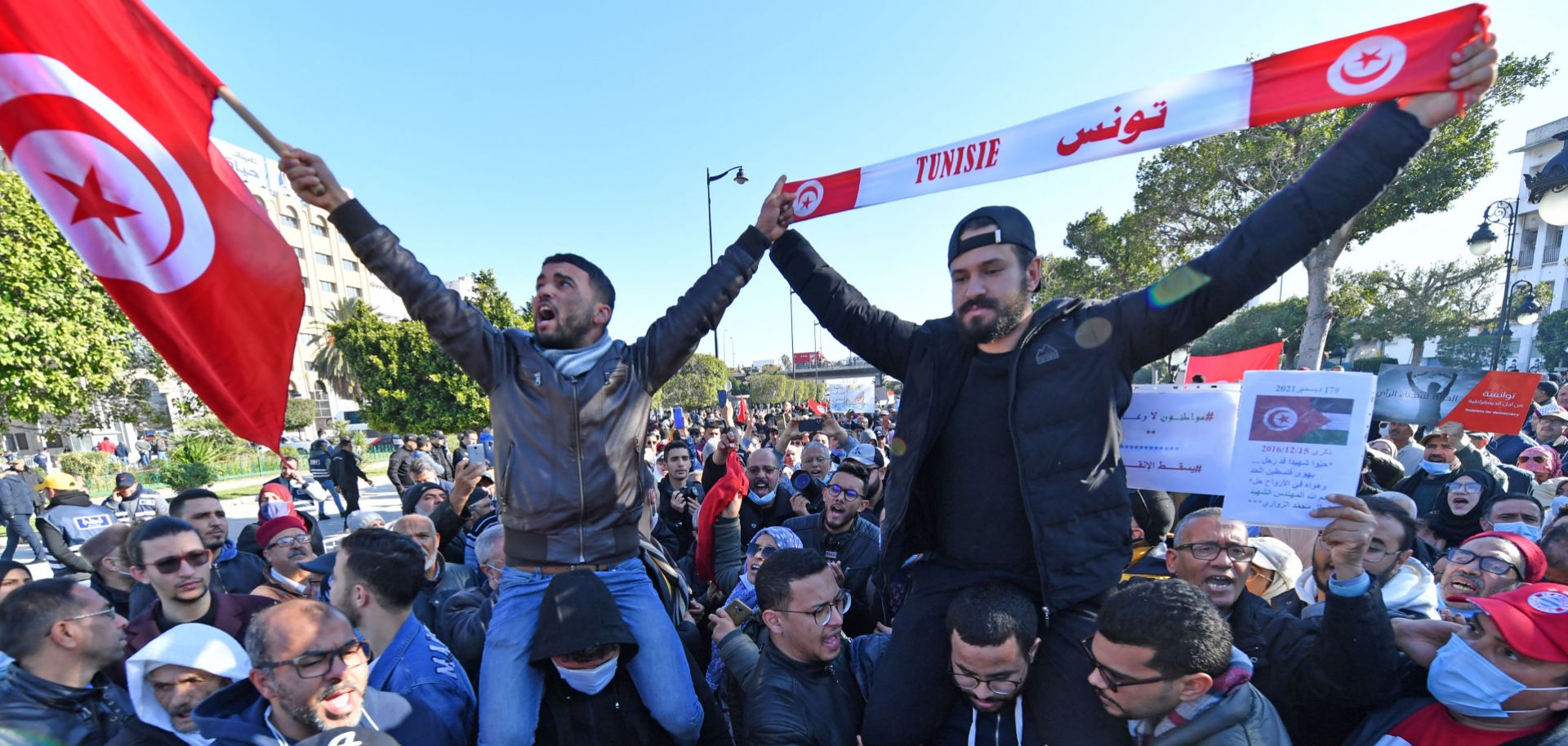
Protesters demonstrate against Tunisian President Kais Saied in the country’s capital of Tunis on Dec. 17, 2021 -- the 11th anniversary of the start of the 2011 revolution.
Institutional reforms in 2022 will increase political and economic instability in Tunisia and will likely influence other governments in the region to slow down their own democratic transitions. On Dec. 13, Tunisian President Kais Saied announced that a constitutional referendum would be held in July 2022 and that the country's legislature would remain suspended until new elections are held that following December. While these announcements establish a roadmap for institutional reforms over the next year, they also generate significant uncertainty about the country’s political and economic future.
- Saied’s long-awaited announcement follows the surprise executive authority decrees he issued on July 25, which froze parliament, beefed up presidential authority, and kicked off a number of anti-corruption trials focused on politicians and businessmen — all in the name of stabilizing Tunisia’s economy and improving the government’s performance.
Some of the main reforms will include changing the way that the Tunisian parliament works, which will result in a lack of clarity around the legislature’s power in the near term but could increase its efficiency in the long term. Judicial, constitutional and civil society councils will convene in the coming months to discuss possible constitutional amendments prior to the July referendum. It is almost guaranteed that the amendments will include changes to how the country’s popularly-elected parliament creates and debates policy to quell Tunisians’ growing frustration with the near-constant political infighting and legislative gridlock that has plagued the governing body since it was founded in 2014. While they may initially create some uncertainty, such structural changes could also pay off in the long run if they strengthen the parliament and, in turn, improve a political system that has struggled to govern efficiently under Tunisia’s post-Arab Spring constitution. But there’s a chance the reforms could also weaken the parliament’s influence on government policy, which risks having the opposite effect and further angering Tunisians.
- Tunisia’s popularly-elected parliament is a product of the raft of reforms passed in the wake of the country’s 2011 Arab Spring protests. But bickering between parties has since hamstrung the legislature’s ability to make decisions and implement policies. This has led to a growing consensus in recent years that the way the parliament is set up is inherently flawed and needs to be restructured to ensure lawmakers are more responsive to their constituents’ needs.
- Approval ratings for Tunisia’s parliament have decreased substantially in recent years, explaining why Saied’s move to suspend the body was so initially popular. Even Ennahda, the leading party in parliament, admitted this summer in the wake of Saied’s executive decrees that the legislature’s function could be improved.
The reforms could also lead to a more autocratic Tunisian political system should they include a broad increase in presidential powers, which would spur public backlash. With Saied at the helm of Tunisia's coming transitional period, it is possible he will expand his presidential power over more branches of government and state institutions. This likelihood grows as Tunisia's parliament remains suspended and thus unable to officially function. This would dramatically impact Tunisia's political stability by upsetting the carefully constructed balance of power between the country’s executive and legislative branches. Tunisia’s active civil society would likely push back against any attempts by Saied to expand executive authority and would probably try to expand other institutions’ power to counteract such changes.
- Domestic and foreign critics worry that Saied’s surprise July decrees indicate his intention to build a more authoritarian political system and weaken Tunisia's legislative check on executive power. Saied is a constitutional law expert and knows how to use the constitution’s text to grant himself more power.
The coming year’s political transition is likely to compound rather than solve Tunisia’s existing economic issues. In order for Tunisia's economy to grow sustainably, the government would have to introduce a mix of structural reforms to the country's underperforming private sector. The global economic climate would also need to improve before Tunisia could enjoy a resurgence in demand for its exports — namely, agricultural goods and minerals like potash — as well as for services like tourism. Lastly, Tunisia's business community would need to demonstrate wholehearted support for Saied’s proposed political path. None of these three prerequisites for Tunisian economic growth are likely to happen in 2022, which means that Saied has a limited time period during which he can lead the country through a political transition while retaining popular support, which hinges heavily on whether Tunisia’s economy is performing well.
- Saied said his July 25 measures and political changes were in part aimed at mitigating Tunisia's economic issues. But the period of structural experimentation, constitutional drafting and political transition that he’s initiated is much more likely to further prolong Tunisia's economic woes by postponing solutions in favor of setting up a new government.
- Popular polling indicates that Tunisians are more worried about the economy than the democratic nature of Tunisia's political system, which means that they are likely to gauge the success of Saied’s presidency on whether their country’s economic situation improves. In the likely case that Saied’s reforms and next year’s political trajectory do not address Tunisia’s economic problems, public trust in the entire government will fall, raising the risk for politically and economically motivated protests.
Other Arab governments transitioning from autocracies will be closely monitoring Tunisia’s reform push over the next year to gauge what kind of political change is realistic in their own countries. For years, foreign media and Western institutions have upheld Tunisia as the poster child for transitioning from autocracy to democracy. If Tunisia’s political system becomes more autocratic as a result of Saied's 2022 political reforms, it will render the biggest Arab Spring “success” — in terms of democratic transition — a failure. Such a failure could convince other Arab governments and populations of the futility of democratic reforms that aim to incorporate more popular and civil society voices in government.
- In the Middle East, civil society groups frequently pressure governments with centralized power centers, like Egypt, Jordan and the Arab Gulf states, to incorporate more democratic policies and introduce democratic reforms. But these governments will likely view a period of uncertain political transition in Tunisia as proof of such reforms' futility. Any negative developments in the Tunisian economy will further undermine the perceived value of democratic reforms to these governments, which heavily prize economic stability.
