
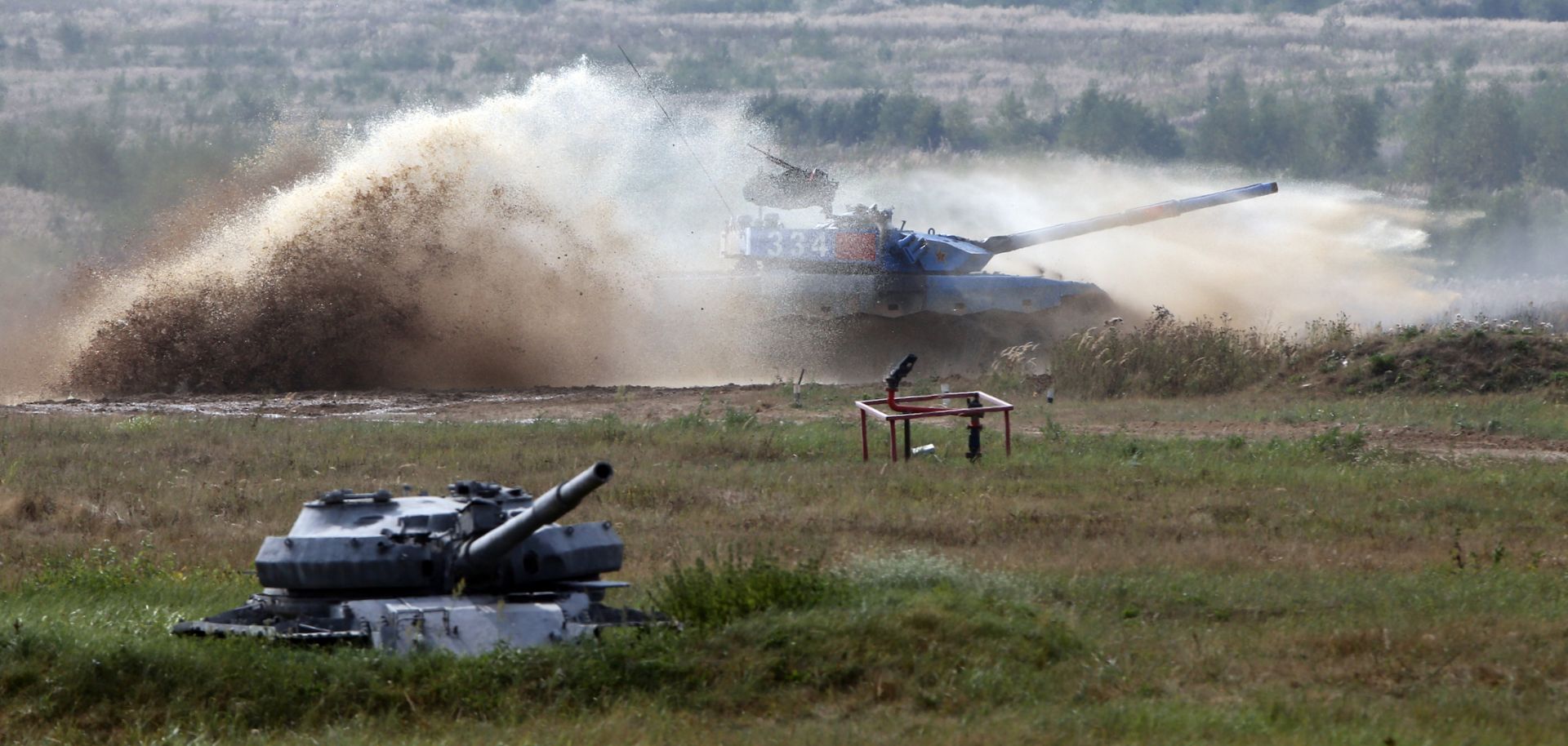
A Chinese battle tank competes in an event held by the Russian military on Aug. 27, 2022, outside of Moscow, Russia.
Editor's Note: This column is the first in a two-part series examining China's potential cost-benefit analysis for providing military assistance to Russia for its war in Ukraine. In part one, we broadly lay out why Beijing may (or may not) decide to provide such support and the implications of each scenario. In part two, which can be found here, we delve deeper into the historical, economic, social, political and security aspects that could inform China's decision on whether to send lethal aid to Russia.
Reports that China is considering providing Russia with lethal military aid in Ukraine provide a natural case for a cost-benefit analysis paired with scenario planning about what such aid would mean for the war, as well as China's development and its relations with the West. In the past two weeks, there has been a flurry of news reports that China is contemplating providing Russia with lethal aid (e.g. ammunition, weapons and/or weapons' parts) for its war in Ukraine. On Feb. 23, German news outlet Der Spiegel claimed, citing unnamed sources, that Chinese drone manufacturer Xi'an Bingo Intelligent Aviation Technology was planning to sell 100 ZT-180 kamikaze drones to Russia's defense ministry as soon as April, and would also help Russia domestically produce 100 of these drones each month. This came after U.S. Secretary of State Antony Blinken said on Feb. 18 that Washington had intelligence China was strongly considering providing lethal aid to Russia for its war effort in Ukraine. That same day, Blinken warned China's top diplomat Wang Yi that there would be ''serious consequences'' if Beijing provided such support to Moscow. Speaking with The Wall Street Journal and CNN, other U.S. officials familiar with the intelligence Blinken referred to claimed that in addition to drones, China would likely also provide artillery ammunition and other weapons to Russia, if Beijing decided to aid Moscow's war effort. Despite these claims, U.S. President Joe Biden on Feb. 24 said he doesn't ''anticipate a major initiative on the part of China providing weapons to Russia,'' and had previously stated the White House was working on declassifying relevant intelligence reports. Since this story broke, German Chancellor Olaf Scholz and senior EU officials have warned China not to provide arms to Russia as well, calling the issue a ''red line."
Scenario #1) China provides Russia with lethal aid.
A number of factors could drive China to provide Russia with lethal military aid in Ukraine, including Beijing's desire to preserve Russia as a strong strategic partner, an internal policy shift toward prizing national security over economics, and circumscribed information flows to China's top decision-makers. Russia is China's closest partner in its strategic and ideological competition with the West. Beijing views its partnership with Moscow as necessary to combat what it perceives as a U.S.-led containment effort against China's economic and military development. But a strategic failure in Ukraine could threaten that partnership by potentially leading to the downfall of Russian President Vladimir Putin's regime or a significant weakening of Russia's state power. To mitigate this risk, China could decide to support Moscow's war efforts by providing Russia with weapons. In doing so, Beijing would be wagering that Western trade retaliation is worth safeguarding the stability of Russia. In this scenario, China is more likely to provide significant lethal aid to Russia than it is to provide limited lethal aid. This is because while Western sanctions retaliation would certainly scale with the magnitude of China's aid, the consequences to China's economy and diplomatic standing in the world would be great either way — in for a penny, in for a pound. Domestically, China's choice to aid Russia could be a strong indicator that the Chinese Communist Party (CCP)'s internal debate about the relative importance of economic growth and national security to China's modern development had skewed decisively toward the latter. Such a decision could also be heavily influenced by President Xi Jinping's close personal relationship with Putin. Moreover, the increasingly ideologically tinged information flows reaching Xi's desk as he consolidates state and CCP power in his hands could present Xi with an incomplete cost-benefit analysis and lead him to make a suboptimal choice on weapons aid to Russia. This could mirror Putin's own circumscribed intelligence flows that led him to believe in February 2022 that the Ukraine invasion would be a month-long affair of rapid regime change in Kyiv — and not the prolonged conflict Russia now finds itself in more than a year after launching its ''special military operation.''
But while sending weapons to Russia could help secure Moscow's strategic objectives in Ukraine, it could also impede China's economic development as Western engagement with China plummets. Dwindling supplies are the biggest challenge that Russian troops are facing in Ukraine. Chinese weapons could thus help the Russian military fend off increasingly well-equipped Ukrainian forces and secure key Ukrainian territories to achieve Moscow's strategic objective of holding a land corridor to Crimea. This aid, however, would also effectively put the United States and China in a proxy war, with both sides competing militarily through intermediaries and attempting to shape the strategic landscape in distant lands — lending some credibility to media speculation about the possibility of a ''New Cold War.'' In response to China's aid, the West could either opt to double down on its own weapons aid to Ukraine or push for a peace process to keep the war from becoming a years-long frozen conflict, or worse, spilling beyond Ukraine's borders. Either way, the West's relations with China would take a sharp turn for the worse. The United States and Europe would no longer see China as a future military adversary (i.e. in the event of a Taiwan invasion) but as a present one, with Beijing helping reshape the borders of Europe. This could not only accelerate trade decoupling and significantly slow China's economic growth (which would escalate China's risks of domestic unrest) but spur a Western-aligned military build-up in Europe and China's near seas. Such a military build-up could take the form of expanded funding for and deployment of stand-off, counterstrike and rapid response capabilities by the United States, Europe, Japan and South Korea amid a heightened Chinese military threat. Should Beijing's support for Moscow catalyze a much more aggressive Western push to defend Taiwan, this escalating security environment could even prevent China from retaking the island and becoming the region's dominant military power. Together these risks mean that Chinese support for Russia in Ukraine could jeopardize the CCP's greater strategic goals of the last 40 years, which include turning China into a high-income country, fielding the predominant military in Asia, and maintaining political stability at home.
Aside from these strategic implications, China's aid to Russia could have a number of near-term tactical benefits for the Chinese military and certain sectors of the economy, but these would likely be offset over time. Russian use of Chinese kamikaze drones, artillery pieces or other military assets could provide the Chinese military with a rare opportunity to test its platforms in active combat, providing crucial field data for China's military modernization. It would also enable China to wield its deep industrial base and supply chain capabilities to drain Western militaries of their own assets and supplies in Ukraine. However, the Western response to China's actions — ramping up military-industrial production to a degree commensurate with Chinese aid and Western concern for a Ukrainian loss in the conflict — would offset this benefit. Nonetheless, Western capacity to match China's industrial production would likely take time to build. Russia's purchases could accelerate the development of China's domestic arms industry, supplementing economic growth in a tough year, although Western trade retaliation would weigh on China's broader economy.
Scenario #2) China doesn't provide Russia with lethal aid.
If China doesn't provide Russia with military aid, it could signal Beijing's desire to preserve economic growth and public stability, as well as the limits of Western intelligence on an increasingly closed-off China. If China opts against sending lethal aid to Russia, this could be a sign of Beijing's confidence that a Russian loss in Ukraine would have limited long-term impacts on its closest strategic partner. But it could also be a sign of pure self-preservation, with Beijing conceding that the fallout in relations with the West would be too much for China's economy to handle, especially amid its fragile post-COVID recovery. Closely linked to this would be Beijing's concerns for political stability following the anti-lockdown protests of late 2022, with the CCP perceiving that additional economic pain incurred by Western sanctions could spur a repeat of nationwide unrest and pose a direct threat to the CCP's (and Xi's) power. More broadly, China's decision to not provide arms to Russia would indicate continuity in Chinese policymaking long-term, with economic growth goals not yet subservient to national security concerns. It could also firm up President Xi's domestic political support base, as elite academics and even CCP cadres have (often anonymously) questioned China's decision not to condemn Russia's invasion and to maintain close relations with Russia amid the war. Alternatively, China may end up not sending weapons to Russia because it never intended to, which would indicate subpar Western intelligence capabilities regarding Beijing's policymaking. Though Washington's intelligence on Russia amid the Ukraine war has been top-notch, U.S. intelligence on China may be weaker due to Beijing's advanced counterintelligence capabilities and its world-class surveillance network — both in society at large and especially within the CCP.
China's restraint in Ukraine would preserve Beijing's ability to limit the decline in relations with the West, though a proper rapprochement remains unlikely. Opting against sending weapons to Russia would leave some room for Beijing to limit trade decoupling with the West and the deterioration of China's attractiveness as an investment destination. One recent example of this sort of damage control is China's recent move to slowly restore its trade relations with Australia after Canberra's calls for an international inquiry into the Chinese origins of COVID-19 prompted Beijing to ban key Australian imports in 2021. But regardless, China's relations with the United States and Europe would likely still continue on their slow downward trajectory — with Western concerns persisting about China's human rights abuses and technological development, as well as the threat China poses to the stability of the Indo-Pacific.
Next: A Cost-Benefit Analysis of China Providing Military Aid to Russia, Part 2
