
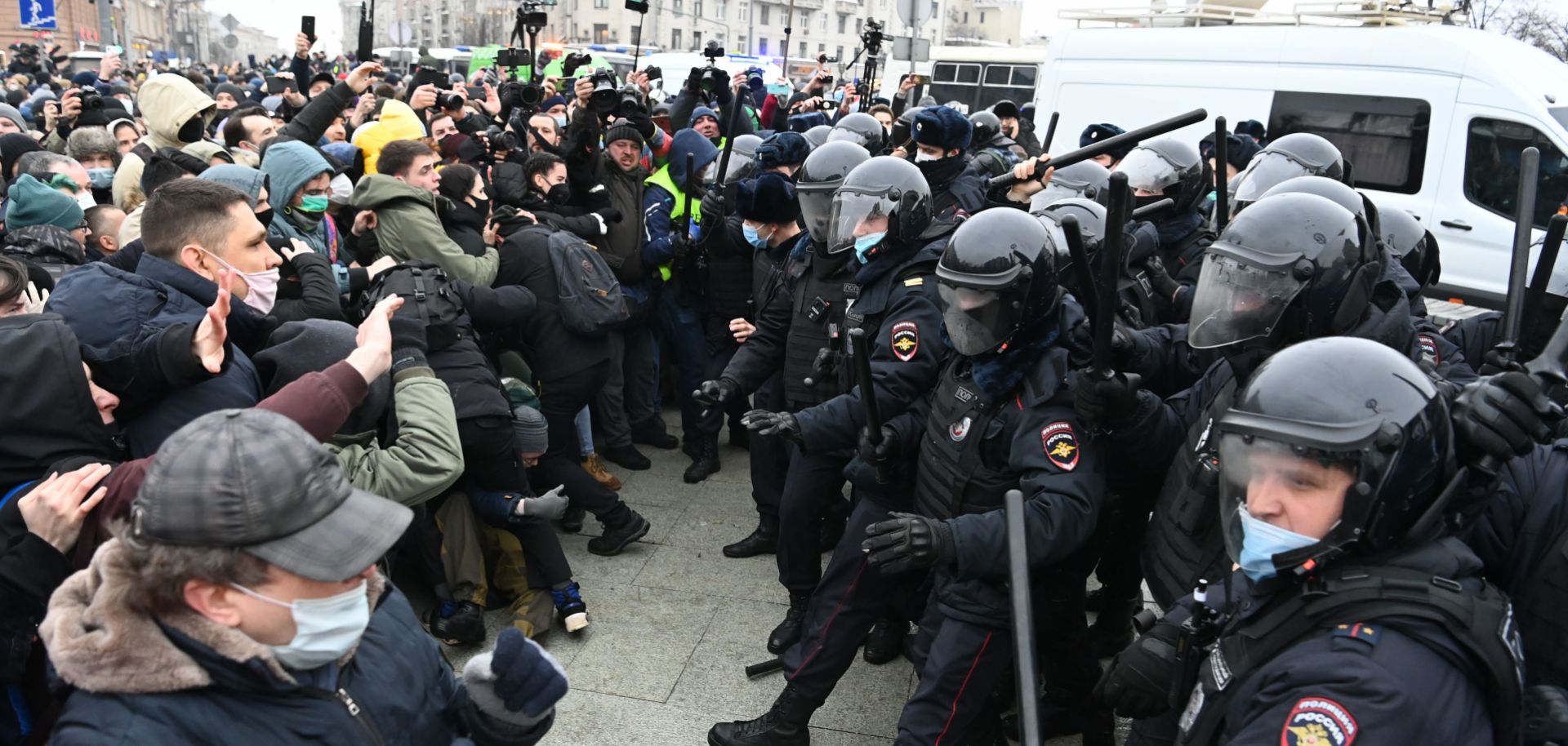
Protesters clash with riot police during a rally in support of jailed opposition leader Alexei Navalny in Moscow, Russia, on Jan. 23, 2021. Navalny was detained upon returning to Moscow after spending five months in Germany recovering from a near-fatal poisoning.
Since the beginning of 2021, high-profile protests in diverse locations across the globe have called attention to the tactics governments are using to try to deter, disrupt and reduce the influence of mass demonstrations. Russia’s response to the widespread protests triggered by the arrest of opposition leader Alexei Navalny, in particular, provides a poignant case study on how authorities are increasingly using a wider array of counter-protest tactics beyond physical repression, with implications for security and stability in places where there is significant protest activity.
The Downsides of Cracking Down
Authorities across the globe increasingly are finding that there are pitfalls to using force to suppress mass demonstrations. Although violence will remain a sometimes necessary tool to deter and disrupt large protest movements, there are clear drawbacks for governments that rely on force alone to quell unrest.
- Attacks can permanently undermine legitimacy. While violence typically harms authorities’ near-term reputations, in some cases it can also cause enduring damage that provokes a sustained collapse in public trust. Following numerous allegations of misconduct during protests in 2019, Hong Kong police suffered a massive reputational loss that will complicate Chinese authorities’ ability to use local police to quell future protests, as many Hong Kongers now see officers as adversaries supported by mainland China.
- Repression can elicit damaging sanctions. Indiscriminate crackdowns often catalyze penalties from Western countries concerned with human rights. Between 2018 and 2020, Canada, the European Union and the United States imposed financial and travel sanctions on various Nicaraguan entities and individuals linked to the country’s national police force after officers killed more than 300 people during protests in that time period.
- Aggressive tactics can lead to damaging hesitance later. Following counter-protest actions that are critiqued as heavy-handed, authorities can be too reticent to respond with necessary measures to subsequent incidents. U.S. law enforcement agencies are widely seen as remaining too reluctant to confront the violent mob that stormed the U.S. Capitol on Jan. 6, in part because they wanted to avoid charges of using excessive force similar to those they faced in confronting Black Lives Matter protests this past summer.
- Force can transform specific protests into larger confrontations. Violence can shift the goal of demonstrations from seeking redress for a particular grievance to fighting for larger ideological goals that are harder to resolve. In India, what began as rallies against the government’s introduction of a controversial citizenship law in 2019 turned into a much deeper fight over national identity during protests in late 2019 and early 2020 after police were widely criticized for injuring unarmed student demonstrators.
- Violence can entrench opposition. Rather than decisively breaking protesters’ resolve, using force can entrench demonstrations for a sustained period. Excessive violence committed by Belarussian authorities against protesters after a disputed presidential election in August 2020 helped to unite disparate members of the opposition and spurred them to use the winter months to coalesce and prepare to resume mass rallies in Spring 2021.
- Unrestrained force can provoke revolution. In the most extreme cases, overwhelming violence can completely backfire on a government by catalyzing its overthrow. Although numerous grievances contributed to Ukraine’s revolution in 2014 that toppled the ruling government, authorities’ lethal and indiscriminate suppression of initially peaceful protests is widely considered to have helped spark the government’s final demise.
Broadening Counter-Protest Tactics
Although authorities, particularly in authoritarian countries, will continue to rely on physical force, increasingly they are turning to other means to try to deter, disrupt and reduce the influence of mass demonstrations. Based on a review of Russian counter-protest actions since the start of the year, we have identified six general categories of tactics that are proliferating worldwide.
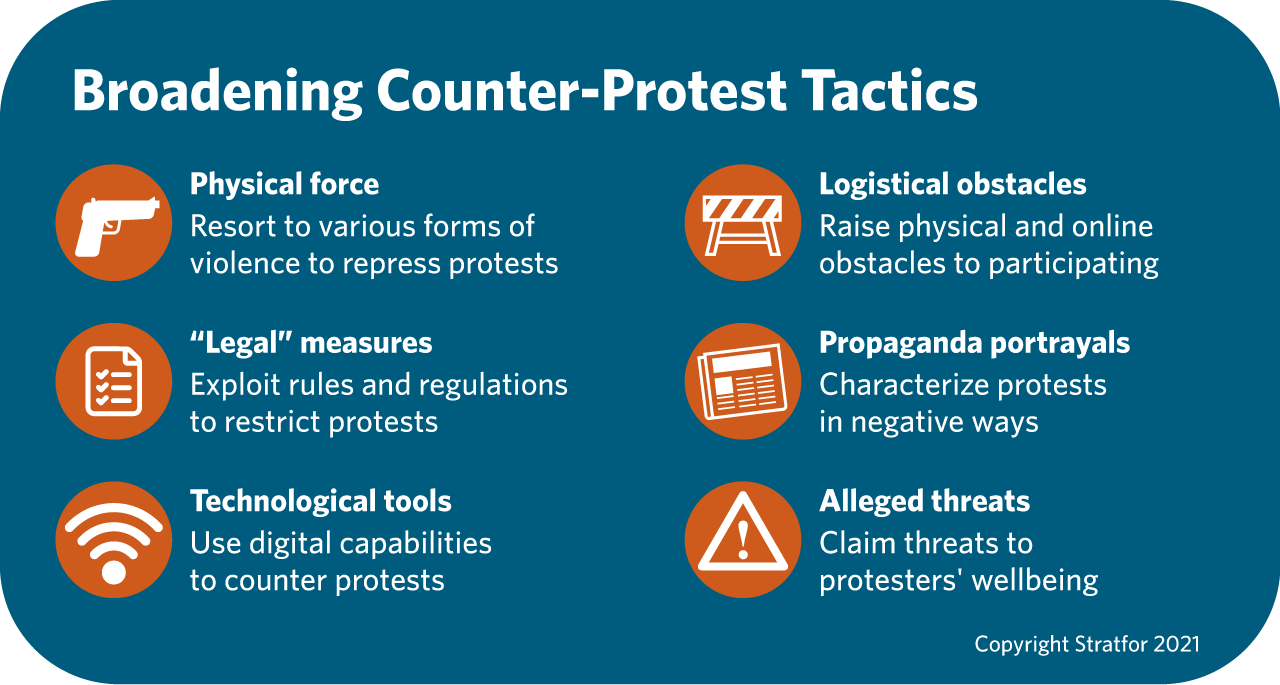
1) Physical force: Attacking demonstrators remains a reflexive response, even as governments expand their counter-protest toolkit. Having honed their skills over time, Russian security forces tend to use violence in more calculated and calibrated ways, which has probably increased its effectiveness, or at least minimized its drawbacks. These measures go beyond long-standing and still-prevalent activities that involve physical confrontations, such as forcibly threatening or detaining key leaders before planned demonstrations.
- In contrast to Belarussian security forces’ excessive violence, particularly their use of live ammunition against protesters in the fall of 2020, their Russian counterparts have avoided such tactics and instead relied on non-lethal weapons, such as stun guns, tasers and batons when confronting recent protesters. These devices generate comparatively less public outrage and present less risk of unintended blowback, yet are still effective.
- Russian security services intentionally sought to avoid confrontations with large packs of protesters and instead focused on targeting small groups and single individuals. Social media posts and monitoring groups’ reports document many instances of police officers splitting mass gatherings into smaller groups and chasing down lone protesters. These tactics seek to ensure numerical superiority and avoid large encounters that could spill out of control; they also serve as a warning to discourage other potential protesters who might otherwise join rallies if they believe they are safe in a mass gathering.
2) “Legal” measures: Governments increasingly are putting the law to work for them by using ostensibly legal means to prevent and break up mass demonstrations. Russian authorities, like those elsewhere, have couched their counter-protest activities in legal language, pointing to a raft of regulations that legally enable suppression. This has included requiring protest permits that inevitably are not granted, threatening fines and jail time for participants, and using pandemic-related restrictions on mass gatherings, among other measures. While such machinations are common, recent Russian actions have demonstrated even more creative uses of “legal” means.
- In an attempt to dissuade young men from joining rallies (who, from the government’s perspective, are arguably the most concerning demographic of protesters), Russian authorities announced in advance of recent demonstrations that they would check if anyone detained is subject to the military draft. Although military service is compulsory in Russia, many draftees are able to defer or completely avoid the widely unpopular draft. In the past, officials have also checked if detained protesters had outstanding debts, another potential deterrent to participation.
- State schools in Russia scheduled exams and various festivities during the times of recent protests as a way to require or induce students to not attend. In addition, under a 2018 law prohibiting adults from encouraging minors to protest, Russian authorities also threatened to fire teachers and expel students for participating in demonstrations.
3) Technological tools: Security forces across the globe are steadily expanding their digital capabilities to repress demonstrations. In a move that has become a common tactic, authorities frequently shut off internet access — both across wide areas and in targeted locations — as a means to stymie protesters’ frequent reliance on the internet to coordinate activities. Russian authorities, however, have shown even more advanced digital means to hinder political activism and could draw on new capabilities going forward.
- Russian officials have used the reportedly 105,000 cameras set up across Moscow to identify and detain participants in recent mass rallies in the city, despite the original claimed intention of the surveillance system to find missing children and fugitives. On Feb. 25, local media reported that Moscow officials intend to install video surveillance cameras that can auto-focus, shoot in high definition and recognize faces at 85 metro stations. Although a spokesperson said they would not be used to track specific individuals, there is cause for skepticism amid disclosures of city cameras being used for that purpose. Reportedly, there are already 5,000 working facial recognition cameras in Moscow’s metro system.
- Russian authorities have also revived a draft law giving police access to individuals’ mobile location data without a court order. Although the proposal ostensibly is meant to find missing people, watchdogs have warned that the information could easily be used to identify protesters in real-time; even the mere implication of its use for that purpose could significantly stifle protests. In addition, Russia could build on its prior use of “astroturfing” — an online technique to make it seem that a cause has widespread, grassroots support — in other disinformation campaigns to undermine future protests by falsely making it appear that the masses are highly critical of the demonstrators.
4) Logistical obstacles: Authorities are more frequently using logistical hurdles to depress turnout at protests, while also improving their ability to identify and detain those who do attend. As demonstrated recently in Russia, officials can raise barriers to participation not only in the physical world, but also online.
- In an unprecedented move, Moscow city officials effectively locked down the city center in advance of recent protests, limiting pedestrian access and closing subway stations, bus routes, streets and businesses near the demonstrators’ planned meeting point. Such moves not only increase the difficulty of taking part in demonstrations, but also raise the likelihood of being intercepted by authorities who have to monitor fewer access points.
- Drawing on existing digital regulations, Russia’s communications regulator threatened to fine social media sites that did not remove content promoting the times and locations of recent protests. Doing so makes it more difficult for people, especially those outside of major cities, to find relevant information and can make them reconsider participation.
5) Propaganda portrayals: More governments now recognize that controlling the media narrative around mass demonstrations can be just as, if not more, important than limiting protest activity itself. Officials frequently try to cast protesters in a negative light, often by characterizing them as violent instigators, criminals or backed by foreign powers. Doing so can be even more effective when such portrayals are made by ostensibly independent media outlets and public figures, even if they are known government supporters, because they at least appear to be making such judgments of their own volition. Russian authorities have displayed these tactics and have shown how to incorporate messaging tailored to take advantage of specific, local concerns.
- Russian government officials and state-backed media outlets prominently accused the leaders of recent protests of “political pedophilia.” This descriptor taps into historic government efforts to equate homosexuality with pedophilia, and in so doing, portray opposition protesters as “Western” and at odds with traditional Russian values (and, thus, supposedly unnatural and perverse). This cynical framing also harnesses ongoing Kremlin accusations that protest leaders trick minors into joining, and thus harm Russian families. Such narratives, even if they do not resonate broadly, can influence key audiences — in this case, older, conservative Russians — to oppose demonstrations, even if they might otherwise agree with protesters’ grievances.
- Taking advantage of a major divide in Russian politics between urban and rural areas, pro-government propagandists also sought to characterize recent protesters as spoiled urban elites who are out of touch with wider society. This narrative also exploited the idea that demonstrators are Western-backed youth who have been manipulated into joining, even if recent protests brought out diverse demographics across all of Russia. In combination, officials also sought to take advantage of recent police violence in the West to portray the Russian police response to recent mass rallies as much more restrained.
6) Alleged threats: When all else fails, officials can resort to fear-mongering as a way to deter turnout. Although in some cases these warnings may have some veracity, at other times they appear to be completely without merit. Russian authorities have illustrated examples of using both more reasonable and dubious threats.
- Aside from using pandemic-related restrictions on social gatherings to justify bans on mass rallies, Russian authorities also specifically warned that attendees could attract the virus or face other health risks due to freezing temperatures across the country. They also tried to exploit recent violent protest activity in the West, such as the Jan. 6 U.S. Capitol riot, to suggest that attendees could be harmed in violence instigated by other protesters. Although there may be some legitimacy to these warnings, they also serve as further deterrents to participation, particularly to those who are uncommitted to the cause.
- In advance of one recent protest, state-run news agencies in Russia, citing anonymous sources, claimed that an unnamed Syrian terrorist group was training operatives to conduct possible attacks “at locations of mass rallies.” Although such opaque threats may not deter committed protesters, they may dissuade others who might otherwise attend — particularly when combined with other deterrents, such as the threat of fines and imprisonment.
