
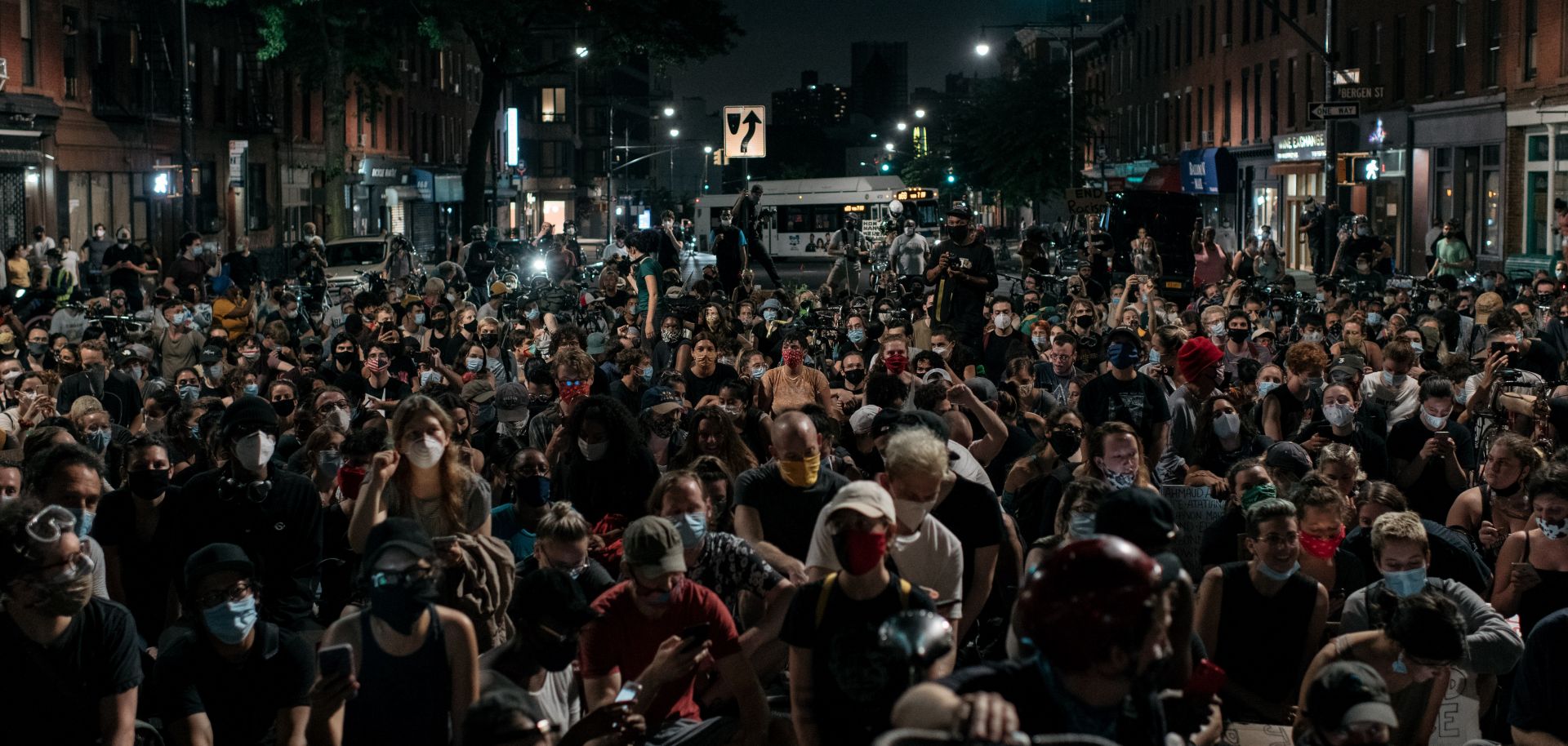
Protesters in New York City kneel at an intersection to demand an end to systemic racism and police brutality on June 11, 2020. Mass demonstrations have continued across the United States since the May 25 killing of George Floyd by a Minneapolis police officer.
Global U.S. allies are increasingly condemning the White House’s heavy-handed response to the nationwide protests following George Floyd’s death, suggesting a further erosion of U.S. leadership that could compromise Washington’s ability to find consensus on its controversial agenda of multilateral economic and security issues. Commentary from reputable news outlets and elite opinion-makers in Europe over the past week have questioned whether American internal polarization and discord would weaken its ability to function as a reliable ally.
- In a rare statement, the European Union's foreign policy chief, Josep Borrell, said he was “shocked and appalled” by the killing of George Floyd, an unarmed black man, while in police custody. Borrel termed the incident as an “abuse of power,” and called on the United States to act “in full respect of the law and human rights.”
- German Foreign Minister Heiko Maas, when asked by the German newspaper Bild about his thoughts on the Trump administration’s response to the protests and violence in the United States, said he believed it was “wrong to threaten further violence in a very tense situation,” and that democratic leaders should “always reconcile and not divide.”
- Australia’s prime minister recently called for an investigation into the use of the violent force against Australian journalists who were reporting live behind the White House when federal law enforcement personnel moved to rapidly disperse protestors in the area, producing jarring video footage that rapidly went viral worldwide on social media.
Increasingly irritated with the White House’s break from long-standing diplomatic norms, European governments appear to be translating opinion into policy action by challenging Trump’s proposed adjustments to the Group of Seven (G-7) summit and U.S. military posture in Europe. European countries have rejected the Trump administration’s unilateral move to extend this summer's proposed G-7 meeting to include the leaders of Russia, Australia, South Korea and India, as allies push back against White House initiatives that they perceive to be departures from normal diplomatic practice, which historically involves private debate over contentious issues. Meanwhile, the White House’s June 5 announcement that it had ordered a reduction in U.S. military personnel based in Germany by 9,500 troops has also frustrated German NATO officials, who said the withdrawal decision had not been discussed in previous bilateral forums with the United States.
- In May, Trump announced he was considering rescheduling this year’s G-7 summit, which he was initially scheduled to host before it was canceled due to the COVID-19 pandemic.
- On May 30, German Chancellor Angela Merkel publicly announced that she would not attend Trump’s proposed G-7 meeting due to her continued concerns about COVID-19. But on June 2, a senior German official told the New York Times said the real reason Merkel refused to attend was that she “did not want to be seen as interfering in American domestic politics.” The official also cited Trump’s move to invite Russian President Vladimir Putin to the summit without first consulting Washington’s European allies as further impetus not to attend (in 2014, Russia was expelled from what was previously the G-8 due to its involvement in the eastern Ukraine conflict and its controversial annexation of Crimea).
- On June 2, U.K. Prime Minister Boris Johnson and his Canadian counterpart Justin Trudeau also released an unusually blunt statement that they would not allow the inclusion of Russia in the G-7, citing the lack of progress in both Crimea and eastern Ukraine since the last meeting in 2014. It is unprecedented to see the leaders of these two countries — who, according to Trump, the United States has “special relationships” with — publicly stating they would veto a U.S. president’s public invitation to an extended multilateral forum.
As global leaders seek to deny Trump political wins ahead of the U.S. election, they will also continue to work to ensure that core security and economic issues are still addressed following the November vote.
- Tensions over White House’s handling of the protests will probably reduce the impetus for any quick progress toward a U.S.-EU trade deal, but it will not lead to a new round of tariffs between Washington and Brussels.
- Europeans will be further incentivized to take a strong stance against the United States when it likely moves to invoke “snapback sanctions” against Iran in August or September, accusing the Trump administration of undermining the U.N. Security Council’s legitimacy by driving a wedge between its five permanent members (China, France, Russia, the United Kingdom and the United States).
Cooperation on issues where there is a clear consensus between the United States and its allies, such as the desire to contain Chinese influence, will be less affected.
- On June 6, the United States, United Kingdom and Australia issued a strongly worded statement condemning China’s new Hong Kong security law, saying it undermined the city’s autonomy.
- In the wake of London’s policy shift against Chinese tech giant Huawei, the United Kingdom also recently proposed a grouping of ten like-minded democracies — including several EU members, as well as the United States, Japan, South Korea, Australia and India — to coordinate on the development of 5G wireless networks. This move complements Washington’s major goal of excluding Chinese firms from its allies’ 5G and emerging technology markets, which is unlikely to change regardless of who wins the U.S. election in November.
