
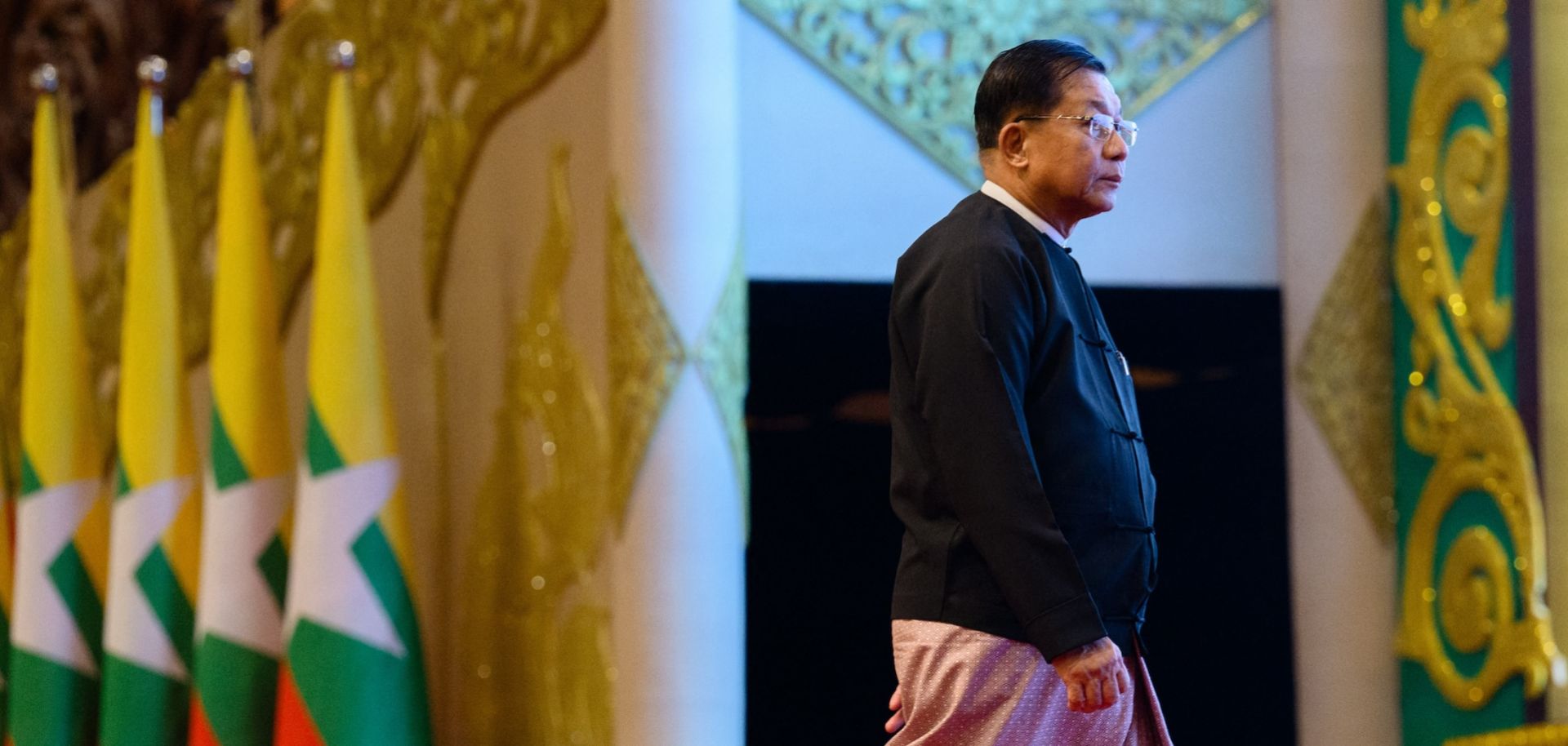
Myanmar's nominal shift to civilian governance will entrench military control under a democratic facade while sustaining a protracted territorial stalemate, enabling limited regional engagement but leaving the civil war fundamentally unresolved. On April 3, Myanmar's newly convened parliament elected now-former Senior Gen. Min Aung Hlaing as the country's president. Days before the election, on March 30, Min Aung Hlaing stepped down as the Myanmar military's commander in chief and officially transitioned to civilian status, a constitutional requirement for entering the presidential selection process. Also on March 30, Min Aung Hlaing officially handed command of the armed forces to former military intelligence chief Gen. Ye Win Oo, completing a leadership transition at the top of the military. He is a close ally of Min Aung Hlaing and has held senior roles within the military governing body State Administration Council since the 2021 coup, now superseded by the nominally democratically elected civilian government.
- Min Aung Hlaing led the Feb. 1, 2021, military coup that ousted the democratically elected government of Aung San Suu Kyi, detained senior civilian leaders and triggered a nationwide uprising that has since escalated into an ongoing civil war. He has remained Myanmar's de facto leader since then, first as commander in chief and head of the State Administration Council.
- Ye Win Oo was promoted to commander in chief of the army in March, but his latest appointment makes him the official leader of all branches of Myanmar's armed forces.
The political transition reflects the military's attempt to repackage its rule through civilian institutions after repeated delays caused by battlefield losses while preserving internal cohesion and control as the war remains stalemated. The move toward a civilian government follows multiple delays to the junta's promised electoral roadmap, which initially targeted an August 2023 general election before deteriorating security conditions caused repeated postponements. Since late 2023, coordinated offensives by ethnic armed organizations and allied resistance forces have eroded the military's territorial control across large parts of the country, particularly in border regions and key trade corridors, forcing the junta to prioritize battlefield stabilization over political timelines. Although the military has since slowed some resistance gains through increased use of airstrikes, drones, militia mobilization and new conscription measures, it has not come close to regaining decisive control nationwide. In that context, the December 2025-January 2026 controlled election and subsequent parliamentary process that elevated Min Aung Hlaing to the presidency represent an effort to reestablish a formal governing structure without fundamentally altering the balance of power. At the same time, the transition serves an internal function within the military establishment. By shifting from direct rule under the State Administration Council to a nominally civilian government, Min Aung Hlaing can redistribute formal authority across institutions aligned with the regime while retaining influence over both the political and military hierarchies. Ye Win Oo's promotion to commander in chief, for example, reinforces continuity within the armed forces and reduces the risk of internal fragmentation at a time when battlefield pressures and prolonged conflict have strained morale and exposed divisions, thereby limiting the likelihood of factionalism or even mutiny within the armed forces. The process also aligns with the military's longstanding reliance on the 2008 constitution as a mechanism for maintaining control through institutional design, enabling it to frame the transition as a return to constitutional governance while preserving its entrenched political role.
- The December 2025-January 2026 election delivered an overwhelming victory for the military-backed Union Solidarity and Development Party, which won the vast majority of contested seats, with those lawmakers then propelling Min Aung Hlaing to the presidency. Voting was limited to 263 of Myanmar's 330 townships, and opposition forces were excluded or boycotted.
- A major coordinated offensive launched by resistance forces in October 2023 seized multiple towns and at least a dozen border crossings in northern Shan state, disrupting key overland trade routes with China. China intervened diplomatically in early 2024 to broker temporary ceasefires along parts of the northern border, particularly around areas hosting Chinese-backed infrastructure and trade corridors, helping freeze some front lines without resolving the broader conflict. Resistance forces have expanded operations into central Myanmar, marking a geographic broadening of the conflict beyond traditional ethnic insurgency areas. As such, the military is widely assessed to control less than half of Myanmar's territory while retaining authority over major urban centers and a larger share of the population.
The transition will lead to a civilianized system in which Min Aung Hlaing assumes the presidency while continuing to rely on the armed forces to secure Myanmar's geographic center and maintain control, improving institutional durability but not substantially altering battlefield dynamics. Min Aung Hlaing's presidential administration will further consolidate power under the guise of civilian government, reinforcing Myanmar's military-controlled institutions and thereby enhancing political stability. However, this government transition will not substantially change the situation on the battlefield. The military establishment will likely retain major cities, administrative hubs and airpower advantages while failing to reestablish control over large parts of the periphery, sustaining a fragmented conflict with no clear path to either decisive victory or negotiated settlement in the short to medium term. Continued instability in northern and northeastern Myanmar will disrupt trade corridors and strategic resource zones, particularly heavy rare earth areas in Kachin state that are critical to Chinese supply chains, reinforcing Beijing's focus on localized stability through ceasefires and pressure on both the military establishment and armed resistance groups to achieve narrow gains that forward its own interests, rather than broader conflict resolution.
- China helped broker at least two ceasefires in 2024 and 2025, including one that returned the key border city of Lashio to junta control, underscoring Beijing's willingness to intervene selectively where border stability and trade routes are at stake.
- Meanwhile, Myanmar's economic crisis is still worsening. Diesel shortages driven by the Iran war have forced rationing, pushed fuel prices sharply higher and threatened harvests.
Diplomatically, Myanmar's political transition will enable the regime to claim a return to constitutional governance, but Min Aung Hlaing's direct elevation to the presidency will make many countries reluctant to engage with the new government, limiting Myanmar's ability to break free of international isolation. Myanmar's nominally civilian framework will lower the political cost of engagement for neighboring countries, enabling India and Thailand to sustain and incrementally expand cross-border projects such as the Kaladan corridor and Thai energy and trade links, while Bangladesh will continue limited engagement focused on Rohingya repatriation. However, Western governments and most members of the Association of Southeast Asian Nations (ASEAN) are unlikely to formally engage with Myanmar's new government (and in the latter case remain unlikely to lift its suspension from participating in official ASEAN functions), as Min Aung Hlaing's personal leadership — as opposed to governing via proxy — will further undermine the already tenuous legitimacy of the transition. The result is likely to be a more institutionalized but still externally constrained regime that remains reliant on coercion domestically, selective alignment with China and Russia and pragmatic engagement from neighbors focused on managing, rather than resolving, the conflict.
- Nearly half of the world's heavy rare earth supply is extracted from mines in Kachin state and shipped to China for processing, meaning conflict in northern Myanmar already creates intermittent disruptions to production and transport. Further escalation would increase the risk of sustained supply shortfalls and price spikes for downstream industries such as magnets, electric vehicles and wind turbines.
- ASEAN neither sent observers to Myanmar's December 2025-January 2026 election nor certified the poll, limiting the regime's ability to use the presidential transition to secure broad regional recognition.
- The United States lifted sanctions on a limited number of Myanmar's business leaders and companies in July 2025, reflecting an effort to maintain pressure on the junta while preserving limited flexibility for commercial and strategic engagement, including in sectors relevant to critical minerals supply chains. However, U.S. officials stated the move did not signal a broader policy shift. Core sanctions on military leadership remain in place, limiting the likelihood of direct U.S. engagement with the Min Aung Hlaing-led government, including on strategic resources such as heavy rare earths, though such engagement with the nominally democratic civilian government remains possible in theory.
