
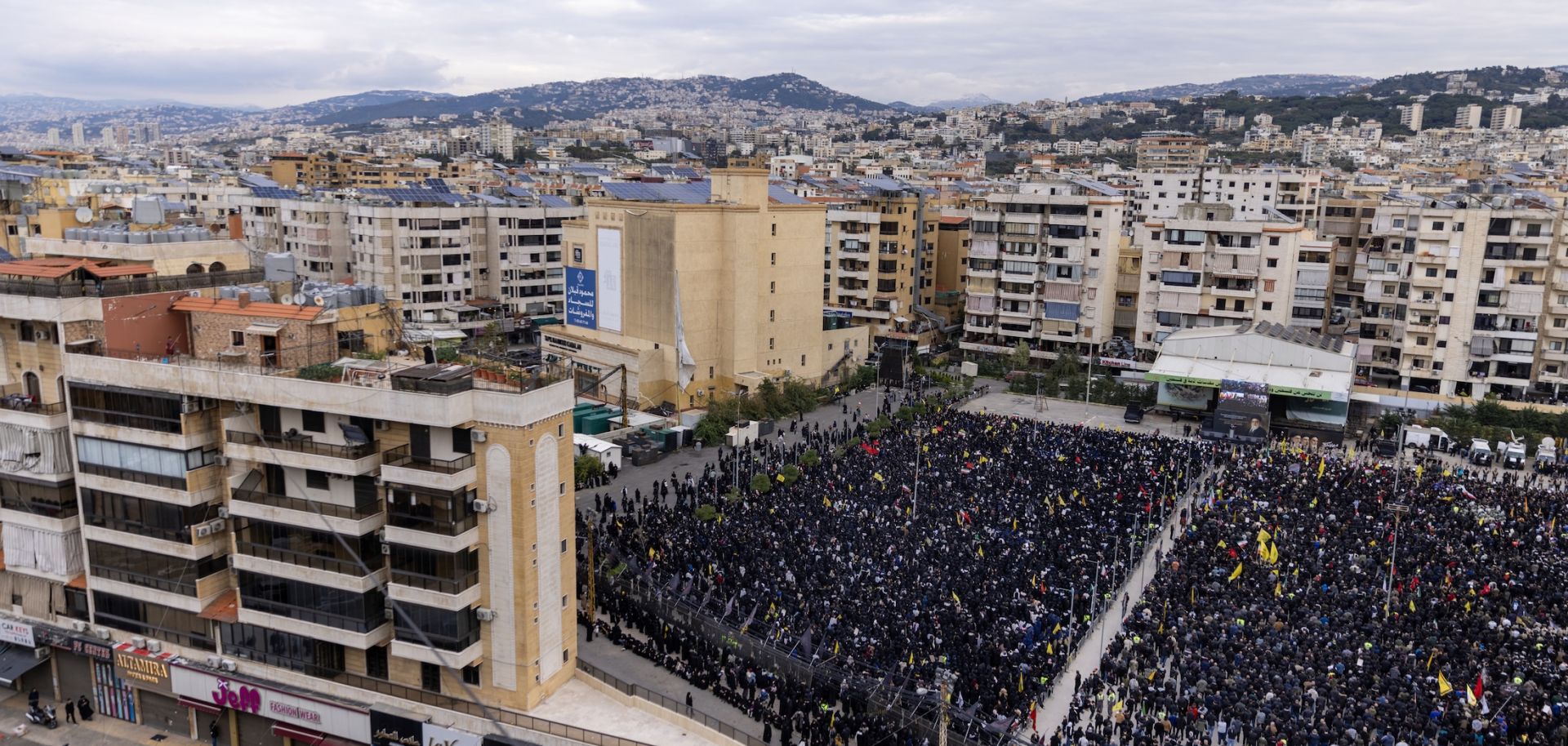
The U.S. and Israeli attacks on Iran will likely further delay government formation in Iraq and lead to the postponement of elections in Lebanon, prolonging both countries' political stalemates. The outbreak of another war between the United States, Israel and Iran continues to reverberate across the region. While the most immediate impacts involve expanding physical security threats, the resumption of high-intensity conflict has also put a spotlight on political tensions in Iraq and Lebanon. Over the past few weeks, Iraq's dominant Shiite political bloc — the Shiite Coordination Framework, or SCF — has reportedly edged toward sidelining former Prime Minister Nouri al-Maliki (2006-14) as its nominee for prime minister amid mounting internal divisions over his nomination and sustained pressure from the United States. In internal deliberations, coordination meetings have repeatedly been postponed as factions debate whether to push al-Maliki aside in favor of a compromise candidate more acceptable to both rival Shiite parties and the U.S. Trump administration. The indecision over al-Maliki's nomination is part of broader government formation paralysis, with the National Assembly still unable to elect a president due to disputes among Kurdish parties, a necessary step before a new prime minister can be appointed. Meanwhile, in Lebanon, Hezbollah's attacks on Israel early on March 2 in support of Iran have prompted a new Israeli offensive against the group, increasing security risks that will likely delay the upcoming parliamentary elections scheduled for May. Delays are particularly likely considering that, according to numerous reports in Lebanese media prior to the Hezbollah attack, Lebanese officials backed by foreign stakeholders were already considering postponing elections.
- On March 3, Lebanese media outlet LBCI reported that the president, parliament speaker and premier had agreed to extend the National Assembly's term for an additional two years, if 65 lawmakers submit a request for extension. Meanwhile, Lebanese media reports suggested that some domestic political elites and representatives from the Quintet Committee — ambassadors from the United States, France, Saudi Arabia, Egypt and Qatar — were advising Lebanese leaders to delay the vote given current tensions within Lebanon and the wider region. Additionally, Lebanese opposition political parties have been leveraging legal and technical obstacles, particularly over expatriate voting mechanisms, to push for an electoral delay, arguing that the current law must be amended before the vote can proceed. However, long-serving Lebanese parliament speaker Nabih Berri, who is a central Shiite figure aligned with Hezbollah's political bloc, has publicly reaffirmed his commitment to holding parliamentary elections on schedule.
- Meanwhile, U.S. officials have privately signaled to key Iraqi political figures that continued U.S. support — including security cooperation, financial assistance and sanctions relief — is contingent on al-Maliki not returning to the premiership. The United States has also threatened various Iraqi politicians with sanctions if al-Maliki forms a government that does not appease the United States.
- Pro-Iranian factions in Iraq are actively participating in missile and drone attacks against U.S. bases in Iraq, as well as the wider region, during the ongoing conflict.
Key political actors in Lebanon and Iraq have been increasingly calibrating their stances, rather than pursuing major structural changes, while the regional balance of power remains unsettled. Over the past two years, Iraq and Lebanon have undergone noticeable domestic shifts. In Iraq, following parliamentary elections in November 2025, Iranian-aligned militias — whose political parties gained a large number of seats — have sought to reassert influence within state institutions with support from Tehran, particularly amid concerns in Iran about losing strategic depth in Baghdad after its setbacks in Lebanon and Syria. That effort, however, has coincided with a firmer U.S. posture toward Iraq, including warnings over sanctions exposure, financial restrictions and a decline in security cooperation should Baghdad tilt too decisively toward Iranian-aligned leadership, particularly if al-Maliki returns to lead the country. By comparison, in Lebanon, the economic collapse and Hezbollah's battering in its 2024 war with Israel have led a pro-Western president and prime minister to take office, with a Cabinet calling for state control over arms (a direct rebuke of Hezbollah), less involvement in regional confrontations and a more pragmatic engagement with Western and Gulf states. While Hezbollah remains embedded within the political system and refuses to disarm, and has even undermined state authority with its attack on Israel, parts of the Lebanese establishment have increasingly signaled interest in policies that stabilize relations with the United States and international financial institutions, particularly to unlock financial aid and reconstruction. The result in both countries has been a political stalemate, as key domestic stakeholders and their external backers await the consequences of the broader U.S.-Iran standoff that has now escalated into a region-wide conflict. Neither Baghdad nor Beirut, nor their foreign backers, appear prepared to undertake structural political realignment while the war is ongoing and the regional balance remains unsettled.
- In Lebanon and Iraq, Iranian-backed militias like Hezbollah and Kataib Hezbollah remain highly influential. Although both countries have come under increasing pressure from Israel, the United States and other regional stakeholders like Gulf countries to disarm these militias — particularly since Israel's severe blow to Hezbollah in late 2024 and its June war against Iran in 2025 — this process has hit a wall.
In Iraq, the conflict between the United States, Israel and Iran will likely further stall the government formation process, and even al-Maliki's removal as the leading prime ministerial candidate would not necessarily lead to a breakthrough in government formation. Government formation in Iraq has been stalled for weeks, largely due to the controversy regarding al-Maliki. This delay will likely continue as Shiite factions delay decisions regarding their prime ministerial nominee pending greater clarity on the trajectory of the war between the United States, Israel and Iran. If Tehran emerges from the confrontation with its regional security posture intact — particularly in its ability to support regional allies and proxies — Iranian-aligned actors in Iraq would have stronger incentives and capabilities to advance al-Malki or another candidate who safeguards their strategic interests and resists U.S.-aligned policy. Conversely, if Washington's pressure campaign significantly weakens Iran's leverage, the same factions may seek to moderate their alignment with Iran and accommodate U.S. preferences, potentially by pivoting to a different prime ministerial nominee. Removing al-Maliki could ease some U.S. pressure on Iraq, but Iranian-aligned militias would still retain significant influence in coalition negotiations, meaning any other candidate the SCF deemed acceptable would be unlikely to form a government that meets the United States' main demand: alienating Iranian-backed Iraqi militias and their parties. Additionally, such a candidate would not appease opposition parties that accuse the Shiite bloc of seeking to sideline other minority groups. As a result, a leadership reshuffle alone would be unlikely to break Iraq's broader political deadlock in the coming months. However, Iraq might be able to successfully form a government and avoid further stalemate if Iran offers the United States concessions that end the war, as U.S. pressure on Iraq's Iranian-aligned actors would likely ease, and key political stakeholders in Iraq would have a stronger incentive to settle on a consensual candidate and move forward with government formation.
Meanwhile, the Iran war is making Lebanon's political elites and their external backers increasingly likely to postpone parliamentary elections, which would delay the passage of legislation that pressures Hezbollah to disarm, as well as key economic reforms. The longer the U.S. and Israel-Iran war and, by extension, Hezbollah's war with Israel persists, the more likely Lebanon will be to postpone its parliamentary elections due to the unstable security environment, as the country has done in the past. Additionally, none of Lebanon's major blocs or external stakeholders appear confident that elections, should they be held in May, would meaningfully shift parliamentary arithmetic, as Hezbollah and its allies are structurally positioned to retain significant representation, while opposition forces remain fragmented and electorally uncoordinated. As a result, both domestic and foreign actors may support an electoral delay until a more transformative outcome is possible, likely after regional dynamics surrounding the Iran war become clearer. A postponement could range from a few months to several years. A shorter delay could enable Lebanon to quickly rebalance domestic power dynamics via elections if U.S. and Israeli attacks significantly impair Iran's regional influence and ability to support its allies and proxies. However, even if Iran weakens, Lebanon may struggle to hold elections while Hezbollah remains armed, as security issues related to fighting between Hezbollah and Israel in southern Lebanon would create logistical and technical challenges for organizing elections there. This issue would be difficult for Lebanon to address, as the National Assembly would be unlikely to use its extended mandate to move on contentious issues such as Hezbollah's disarmament, despite the government's March 2 decree banning Hezbollah's activities. Therefore, Lebanon's elections may face longer delays even after the Iran war ends. In the meantime, Lebanon's parliament would be unlikely to pursue major economic reforms that could unlock large-scale foreign investment, prolonging the country's economic crisis.
- On March 2, Hezbollah conducted its first attack against Israel since their ceasefire took effect in November 2024 in retaliation for the killing of Iranian Supreme Leader Ayatollah Ali Khamenei on Feb. 28 during U.S. and Israeli strikes against Iran. Hours later, the Lebanese government issued a decree outlawing Hezbollah's military and intelligence activities, while instructing the army to enforce the second phase of the group's disarmament. Despite the announcement, Israel launched an offensive against Hezbollah that will likely last at least weeks.
- Lebanon has repeatedly postponed elections or prolonged political vacancies during periods of internal and regional turbulence. Parliamentary elections were extended twice between 2013 and 2017 due to security concerns linked to the Syrian war, internal political deadlock and geopolitical tensions. The presidency remained vacant from 2014 to 2016 amid regional polarization between Saudi Arabia and Iran, until a broader political compromise, sponsored by those actors, led to the election of Michel Aoun. These precedents demonstrate that Lebanon's electoral timelines and institutional transitions are frequently contingent on broader regional settlements rather than purely domestic calculations.
