
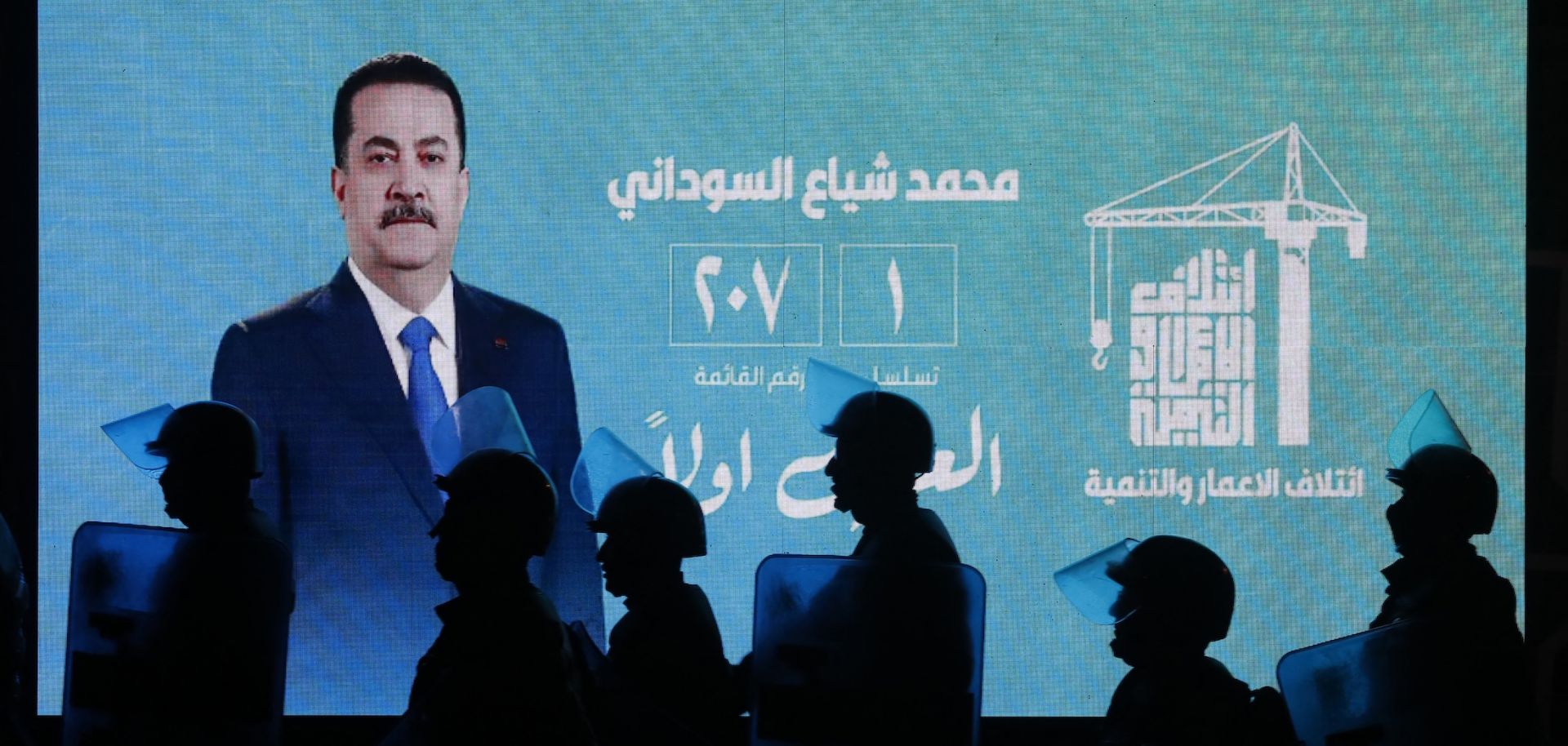
The results of Iraq's election portend a highly contentious government formation process in the coming months that could create power vacuums in the interim, hamper policymaking and trigger violence among armed groups. On Nov. 17, Iraq's election commission announced the final results of the Nov. 11 parliamentary elections. Iraqi Prime Minister Mohammed Shia al-Sudani's political alliance, the Reconstruction and Development Coalition, secured the largest number of seats in the 329-member legislature, winning a total of 46. Former Prime Minister Nouri al-Maliki's State of Law coalition came in second with 29 seats, followed by the Shiite Islamist party Al-Sadiqoun with 27 seats, the Sunni-led Taqaddum Party with 27 seats, and the Kurdistan Democratic Party (KDP) with 26 seats. After the results were announced, the ruling Shia Coordination Framework (SCF) — a loose alliance of Shiite parties that includes the top three vote-getters — declared itself the largest overall parliamentary faction with 157 seats and said it would put forward a nominee for the premiership during government formation negotiations.
- Al-Sudani's bloc secured roughly 1.3 million ballots, the highest individual tally, though this figure only constituted about 10% of the total votes cast. The KDP exceeded expectations, winning around 1.1 million votes, the highest ever for a Kurdish party.
- While the SCF is primarily a political alliance, it also includes and is deeply intertwined with several powerful Iran-aligned armed groups. The militant wing of SCF member al-Sadiqoun, for example, is a U.S.-designated terrorist group.
- The Sadrist Movement, led by Iraqi nationalist and cleric Muqtada al-Sadr, boycotted the November 2025 elections, claiming participation would legitimize a corrupt system. But despite this, voter turnout nationwide reached 56.11%, surpassing the approximately 43% participation seen in the 2021 elections.
Iraq's elections took place amid economic mismanagement and as Iranian-backed militias aim to counter increasing U.S. pressure on Baghdad to further curtail Iran's weakening regional influence. Years of economic mismanagement have severely strained Iraq's public services, fueling popular discontent with the political elite, including some Iran-backed factions. This frustration is particularly pronounced among the country's youth, who perceive a widespread lack of opportunity. Adding to these challenges, in March 2025, the administration of U.S. President Donald Trump ended the sanctions waiver that had allowed Iraq to purchase Iranian electricity exports. Although intended to cut off a major revenue stream for Tehran, the U.S. decision has caused severe power shortages in Iraq, triggering widespread outages and protests that have forced Baghdad to accelerate negotiations with Qatar and Oman for alternative gas supplies. This followed years of escalating U.S. financial pressure on Iraq, with regulators tightening the country's access to the dollar, including by barring several Iraqi banks from conducting transactions in the U.S. currency due to concerns over money laundering and sanctions evasion. Since taking office, the Trump administration has also increased pressure on Iran-backed armed groups in Iraq, including a September 2025 decision to designate several prominent militias as Foreign Terrorist Organizations, sharply increasing political and financial risks for any entity engaging with them, including the Iraqi government. Additionally, the White House has directly called on Prime Minister al-Sudani to curb the influence of powerful Iran-backed militia factions in Iraq. Those militias, however, have publicly rejected any disarmament unless U.S. forces fully withdraw from Iraq, and al-Sudani himself has stated that dismantling these groups is only feasible once American troops have left the country.
- The United States is currently in a phased drawdown rather than a full withdrawal from Iraq, with negotiations ongoing over the future U.S. presence in the country. In early 2025, Washington and Baghdad agreed to restructure the U.S. military mission from a combat role to an advisory and training posture, in accordance with a September 2024 agreement that stipulates the United States would withdraw its troops incrementally, leaving behind a small contingent of a few hundred soldiers. The United States has closed or handed over several military facilities, but maintains a limited operational footprint in Erbil in Iraqi Kurdistan focused on countering the Islamic State. No timeline has been set for a complete withdrawal, and the United States has signaled it will keep forces in Iraq as long as the government requests support, even as Iran-aligned militias demand their immediate and total exit.
The government formation process will likely be highly contentious, elevating the risk of a power vacuum in the coming months that will limit policymaking and lead to violent clashes between various armed factions as the SCF exerts its influence. Iraq's political blocs have started negotiations to confirm the largest parliamentary alliance, nominate a prime minister and assemble a governing coalition. However, the final seat distribution means that no single group can achieve a majority without the participation of parties from the Iranian-aligned Shia Coordination Framework (SCF), whose numerical weight (due to their parliamentary seat count) and coercive power (due to their armed wings) guarantee them a decisive role in selecting the next prime minister and securing key portfolios. Despite U.S. pressure to exclude hard-line, militia-linked parties, these groups are thus likely to enter negotiations emboldened, as the electoral math ensures their influence and participation in the government formation process. That said, the SCF is also facing significant U.S. pressure, domestic backlash and a weakened Iran that is currently more interested in stability rather than upheaval in its near-abroad. This means the alliance will likely push for a premier who will maintain al-Sudani's efforts to balance between the United States and Iran, as opposed to someone more overtly aligned with Iran. Al-Sudani — who is trying to position himself as the frontrunner — obviously fits the profile. However, the SCF will likely initially push for a different candidate as it seeks a leader with less overt ties to the United States. If that person fails to gain sufficient support, al-Sudani may be selected, though he would need to concede major portfolios and policy decisions to Iran-backed factions, which may anger the United States and stall government formation talks. Meanwhile, Iraq's Federal Supreme Court still needs to ratify the final election results, which could take weeks and face legal challenges, further complicating the early negotiating process. This sets the stage for highly contentious negotiations and increases the risk of a power vacuum in the coming months, which would hamper policymaking and could trigger clashes among various militias, particularly in major cities like Baghdad and Basra.
- After winning the most seats in the 2021 election, the Sadrists attempted to build a "national majority" government that excluded the SCF, but this ultimately proved to be both politically infeasible and mathematically impossible due to the Iranian-aligned bloc's large presence in the legislature.
- In recent years, Iraq has endured multiple bouts of political violence due to simmering sectarian divisions and popular grievances. Amid a prolonged inability to form a stable government after the last parliamentary elections in 2021, there were multiple episodes of violent unrest in Baghdad, including clashes in the Green Zone (where most key government buildings and diplomatic missions are located) that resulted in dozens of casualties.
- A future Iraqi government that is similar to al-Sudani's would likely continue to condition the disarmament of Iran-backed militias on a negotiated framework and a U.S. troop withdrawal. It would also sustain efforts to reduce Iraq's reliance on Iranian electricity by expanding ties with regional partners like Turkey and the Gulf states.
