
Iraq's electricity crisis will worsen following the halt of Iranian electricity imports and could escalate sharply if Iranian gas supplies are disrupted, further undermining electricity generation, disrupting businesses and triggering protests. Numerous protests, ranging in size from dozens to hundreds of participants, have erupted across Iraq's central and southern provinces in recent weeks, in response to electricity outages and allegations of insufficient service provision. These demonstrations, observed in areas including Najaf, Karbala, al-Diwaniyah, Babil, Basra and Dhi Qar, have so far largely remained peaceful. But at times, protesters have blocked roads, burned tires and scuffled with Iraqi security forces. Many Iraqis are currently enduring up to six hours of daily blackouts, with limited access to private generators. The Iraqi Ministry of Electricity has blamed the outages on a combination of factors, including fuel shortages, deteriorating electricity infrastructure and overconsumption. But the expiration of the U.S. sanctions waiver in March that had allowed Iraq to import Iranian electricity has also exacerbated the crisis by cutting Iraq off from those Iranian supplies.
- On March 8, the administration of U.S. President Donald Trump did not renew the waiver that allowed Iraq to directly purchase Iranian electricity imports without incurring U.S. sanctions. This decision was part of the White House's ''maximum pressure'' campaign on Iran, aimed at compelling Tehran to engage in nuclear talks by deepening the country's economic isolation.
The loss of direct Iranian electricity imports following the expiration of the U.S. sanctions waiver has forced Iraq to seek alternative suppliers in recent months. Despite increases to its electricity generation capacity, Iraq does not generate enough power to meet domestic demand — especially during peak times, such as in hot summer months when cooling and air conditioning needs surge. The electricity deficit is further worsened by Iraq's inefficient infrastructure, which loses a significant portion of the power generated. This has made Iraq reliant on electricity imports, which it has historically sourced from Iran, Turkey and other regional countries. In recent years, Iraq has sought to reduce its reliance on Iranian energy supplies due to their unreliability, with abrupt cuts to Iranian gas exports (which are used in power generation) having previously caused widespread power outages in Iraq. However, according to the U.S. embassy in Baghdad, direct electricity imports from Iran still accounted for roughly 4% of Iraq's total electricity supply in 2023. The cessation of those imports following the expiration of the U.S. sanctions waiver in March has thus further strained Iraq's power supplies. To make up for the deficit, Iraqi Prime Minister Mohammed Shia al-Sudani has reportedly discussed pursuing alternative suppliers, including Jordan and Turkmenistan. The Iraqi government has also sought to increase imports from Turkey, as evidenced by the deal it signed with Turkish company Alfirin Energy in June to double the capacity of the Turkey-Iraq transmission line from 300 to 600 megawatts, which will enhance electricity provision in northern Iraq once the extra capacity is expected to come online in July. But while it will help, this increase in Turkish electricity imports will not fully offset the loss of Iranian supplies. Iraq's problem of insufficient electricity supply during peak demand times also persists.
- Prior to the expiration of the U.S. sanctions waiver permitting Iraq to import Iranian electricity, al-Sudani had urged the United States for an extension, arguing that his country needed more time to gradually shift to alternative energy sources and build out its domestic power generation capacity.
- Despite government investments, Iraq's electricity sector faces significant challenges. Corruption and an inefficient transmission network have hindered electricity provision, resulting in the country producing only a fraction of its potential capacity.
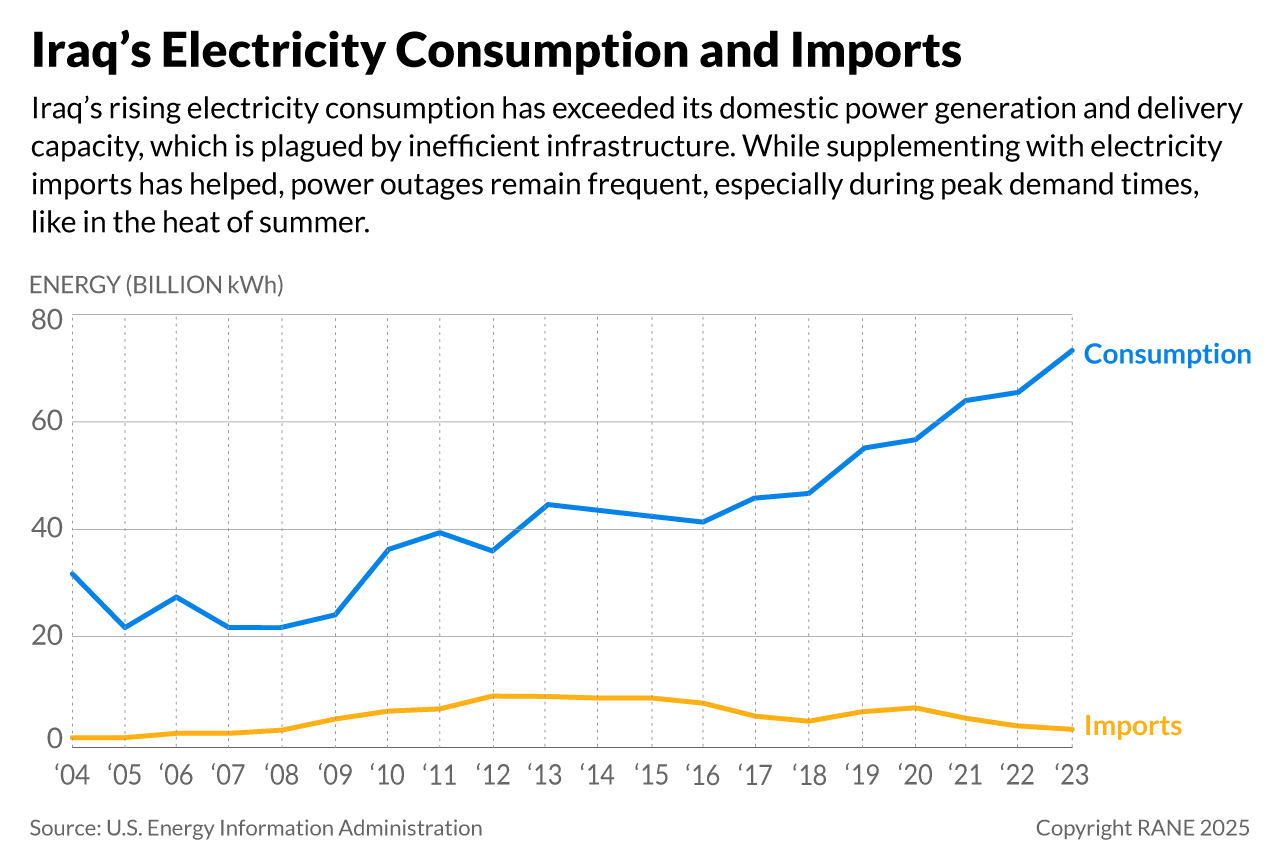
Any disruption to Iraq's access to Iranian gas imports could trigger deeper blackouts in the coming months, fueling larger — and potentially more violent and disruptive — anti-government protests. Although Iraq is engaged in discussions with other countries to increase electricity imports, such negotiations often take months, and Iraq has few good options to address its current energy shortfall in the meantime. Baghdad will likely also struggle to secure the funds needed to purchase extra imports amid the drop in global oil prices, given that oil exports constitute roughly 90% of Iraq's state revenue. Additionally, Iraq's electricity crisis could severely worsen if the country also loses access to Iranian natural gas supplies, which, according to some estimates, generate as much as 40% of Iraq's electricity. There are two scenarios in which this could happen. In the first, the Trump administration cancels the sanctions waiver that currently allows Iraq to directly purchase Iranian gas, in an effort to increase pressure on Iran to re-enter nuclear talks (the waiver that expired in March only applied to Iraq's direct electricity imports from Iran, not gas). In the second, Iran's own energy shortages force it to reduce or halt gas exports to Iraq. Both scenarios are plausible in the coming months, given Trump's stated interest in restarting nuclear talks with Iran and Iran's frequent past actions of cutting gas exports to Iraq to meet domestic demand, as it most recently did earlier this month. In either case, the loss of crucial Iranian gas supplies would sharply exacerbate Iraq's electricity shortage, very likely resulting in extended power blackouts that limit Iraqis' electricity to a few hours per day. As a result, the protests seen in recent weeks would likely grow in size and scope, since the current daily blackouts have already stoked anti-government sentiment. These larger demonstrations would likely also be more disruptive to business operations in Iraq, with road blockades that impede traffic and a greater risk of clashes with security forces. They could turn violent as well, with the longer and more frequent power outages compounding Iraqis' other grievances with Baghdad, including inadequate access to clean water, delayed public sector salary payments and high unemployment levels. Iraqis' growing anger with their government and its failure to provide basic services will likely become salient issues ahead of the country's November 2025 parliamentary elections. However, the next Iraqi government will face the same infrastructure and corruption challenges in addressing these issues, making short-term change unlikely.
- In early July, Iranian gas exports to Iraq dropped by more than half, from 55 million cubic meters per day to 25 million cubic meters per day. This forced several Iraqi gas-fired power stations to stop operations and reduced electricity generation capacity by 3,800 megawatts.
- In 2019, violent protests erupted in the southern Iraqi city of Basra in response to power shortages, insufficient public service provision and allegations of government corruption. However, the protest movement lost momentum during the COVID-19 pandemic due to the restrictions on large gatherings, and the government ultimately made few concessions to address protesters' concerns.
