
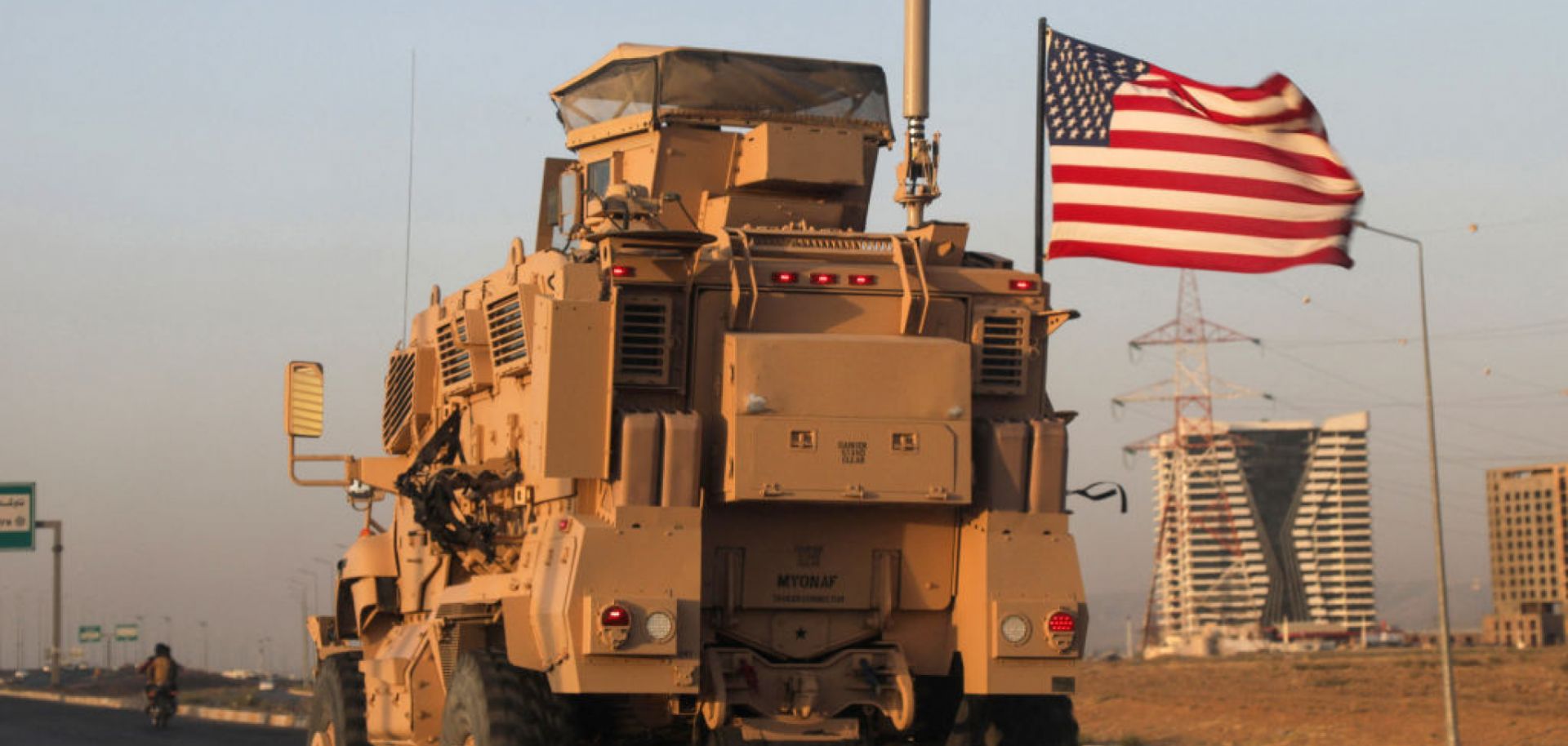
The U.S. drawdown from Iraq will weaken Washington's direct influence while creating space for Turkey to expand economically and Iran to gradually reassert itself through political and militia networks, leaving Iraq's stability increasingly shaped by regional power competition. The phased U.S. troop withdrawal from the Ayn al-Asad and Victory bases in Iraq is set to be completed within weeks, with some U.S. forces relocated to military bases in Arbil in Iraqi Kurdistan. In September 2024, former President Joe Biden's administration reached a deal with Baghdad to end the U.S.-led counter-Islamic State coalition by September 2025, at which point bilateral U.S.-Iraq military cooperation would transition to a strategic partnership. A limited number of U.S. forces will remain in Iraq to provide technical support to Iraqi security forces.
- The jihadist group Islamic State seized swaths of territory in Iraq and neighboring Syria in the first half of 2014, including the city of Mosul in June 2014. The U.S.-led coalition was established to combat the Islamic State in September 2014. Around the same time, the Iraqi Popular Mobilization Forces, or PMF, an umbrella organization of dozens of militias, many pro-Iranian, was also established to combat the Islamic State. At its peak in late 2014, the Islamic State held around 40% of Iraqi territory. However, by March 2018, the U.S.-led coalition announced that it had recaptured 98% of Islamic State-held territory in Iraq.
- Prior to the start of the withdrawal, the United States had around 2,500 troops stationed in Iraq, around 2,000 at the Ayn al-Asad base.
The U.S. troop drawdown comes as the United States reduces its long-term military presence in the Middle East and as Iran and its proxy network have been weakened. Even though the deal to end the coalition's mission was finalized under Biden, President Donald Trump's follow-through came amid Iraqi media speculation that the timeline would be extended due to instability in Syria following the December 2024 collapse of Bashar al Assad's regime and the threat of an Islamic State resurgence. Trump campaigned on the promise to end the United States' longstanding presence in the Middle East, especially in Syria and Iraq. The U.S. military presence was not only to prevent the resurgence of the Islamic State but was also intended to counterbalance Iranian influence due to the Iraqi government's reliance on U.S. military support and defense cooperation. However, as both Iran and its regional ally and proxy network have weakened, pro-Iranian Shiite militias have prioritized their survival while Iran scaled back its regional proxy strategy. Reports that some of these militia groups were considering disarmament even predate the June 2025 Israel-Iran war.
- In addition to the U.S. troop drawdown in Iraq, the United States has drawn down hundreds of troops from Syria in recent months, with plans to keep a military presence in one base in the northeast of the country. This is part of a broader regional strategy to reduce the United States' long-term military footprint in the Middle East and reduce the security risk to troops in the region.
- Iran's war with Israel significantly weakened Iranian air defenses and set back its long-range ballistic missile and nuclear programs. Since then, Iran claims to have restored the damaged systems, but the war demonstrated Iran's vulnerabilities to Israeli attacks and the depth of Israeli penetration of the country. Iran's refusal to intervene to support its proxies in conflicts with Israel has further strained its strategy in the region. For instance, Iran did not support Hezbollah during the late 2024 Israeli invasion of Lebanon, even after Israel assassinated the group's leader, Hassan Nasrallah, in September 2024. Furthermore, Iran has constrained the Iraqi militias' activities, including ahead of the now-collapsed U.S.-Iran nuclear talks, as a confidence-building measure.
- Many of these Iranian-backed militia groups have affiliated political parties running in the November 2025 parliamentary elections. Their success will determine the pro-Iranian leanings of the government. In addition, many of the ardently pro-Iranian parties have opposed U.S. military presence in the country and pressured Iraqi Prime Minister Mohammed Shia al-Sudani to reach the agreement to end the U.S.-led coalition.
The U.S. troop drawdown will reduce U.S. influence in Iraq, but the Trump administration will still be able to use the threat of sanctions and, to an extent, further reduced military cooperation, to compel the Iraqi government to avoid pro-Iranian policies. The remaining U.S. military forces' presence will be centralized in the semi-autonomous Kurdistan Region of Iraq. As such, the troop drawdown will decrease U.S. influence in Iraq. Nevertheless, the United States will try to use military and economic leverage over the Iraqi government to pressure it to change policies to prevent expanded Iranian influence, such as preventing the reorganization of the PMF in a way that expands its autonomy, especially as it relates to Iranian influence. Years of bilateral military cooperation and capacity building have made Iraq reliant on Washington's support for spare parts compatible with U.S. systems. As a result, U.S. threats to further reduce or sever military cooperation would likely risk inhibiting Iraqi security forces from obtaining compatible parts for their equipment. Iraqi security forces' ability to combat the Islamic State would be weakened, risking a broader deterioration of the security environment. In the worst case, jihadists could reentrench themselves, destabilizing regional security. As such, a less risky option for U.S. security is threatening sanctions or the revocation of existing waivers, which risks isolating Iraq financially and worsening its economic situation. The United States recently used the threat of reduced military cooperation and sanctions against PMF factions and Iraqi political groups to have a bill on the reorganization of the PMF withdrawn. Concerns over U.S. sanctions and the effects on Iraq's economy will increase domestic pressure on the Iraqi government to avoid pro-Iranian positions, such as strengthening the PMF.
- As part of the United States' "maximum pressure" campaign against Iran, in March, the United States allowed the waiver that permitted Iraq to directly purchase electricity from Iran to expire, though purchases of natural gas for power generation are still permitted. To further pressure Iran by limiting energy exports, the United States could cancel Iraq's gas waiver, at the cost of worsening Iraq's ongoing electricity crisis.
- In 2016, the PMF was formalized under a law that recognized the militia organization as part of Iraq's security forces. However, the legislation included gaps, such as the command hierarchy and budgetary oversight. The withdrawn legislation aimed to clarify these parameters. However, the proposal would have increased the PMF’s financial independence and legal authority within the country, raising concerns in Washington that Iranian influence would increase through the PMF.
Turkey and, over time, Iran, will likely look to capitalize on decreasing U.S. influence in Iraq to expand their economic and regional security interests in Iraq. As U.S. influence wanes, Turkey will continue to try to expand its own influence in Iraq. Historically, Turkey has prioritized a stable, secure Iraq to reduce potential threats to its own national security, including threats from the Kurdistan Workers' Party (PKK) in northern Iraq and the Islamic State. Recent agreements have further expanded security cooperation and intelligence sharing. In addition, Turkey has expanded efforts to increase economic integration with Iraq through the ambitious Iraq Development Road project and deals with Baghdad to increase electricity provision to Iraq. In the near term, Iran will likely remain weak and unlikely to expand its influence through significantly increased material support to the Shiite militias. However, these militias' survival and political entrenchment, especially through electoral success and increased PMF autonomy, mean that in the future, if Iran strengthens, it will likely be able to tap into these networks and try to expand its influence. However, Tehran still faces its own security challenges with risks of a renewed war with Israel, meaning that taking advantage of the U.S. military withdrawal to expand its influence in Iraq would be more likely to occur over a period of years.
- Iraq declared the PKK a "banned" organization in July 2024, aligning itself with Turkey's position. However, despite the rhetorical shift, Iraq took few significant steps to crack down on the group.
- In June, Turkish company Alfirin Energy inked a deal with the Iraqi government to double the capacity of the Turkey-Iraq transmission line from 300 to 600 megawatts.
