
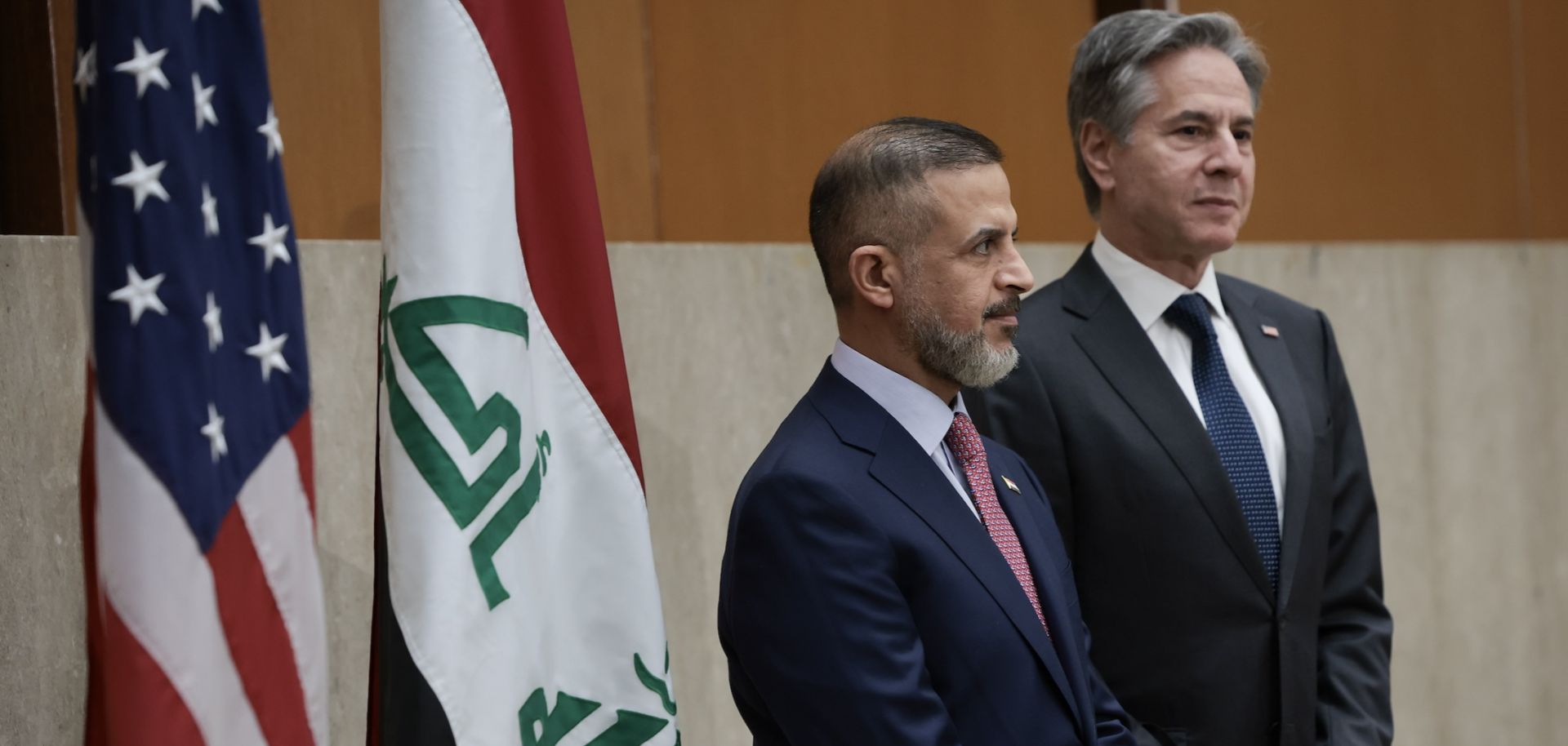
Although a U.S. troop drawdown from Iraq and a consequent decrease in U.S. influence there is unlikely to lead to a resurgence in the Islamic State or to have significant economic impacts, tensions between Iraqi nationalists — especially Shiite nationalists — and Iranian-backed pro-Tehran Shiites could cause violence in the event of growing Iranian influence. On Aug. 15, the Iraqi Foreign Ministry announced a delay in revealing the date of the U.S. troop drawdown in Iraq amid heightened regional tensions following the assassinations of a senior Hezbollah official in Lebanon and former Hamas leader Ismail Haniyeh in late July. Even though the United States and Iraq were reportedly close to releasing a timeline for the U.S. drawdown, details regarding the timeline and the type of security arrangement that could emerge were sparse. Prior to the assassinations, media reports emerged in July citing Iraqi security sources as saying that Baghdad wanted U.S. troops to begin a gradual withdrawal in September 2024 with a formal end to the presence of the U.S.-led coalition in Iraq by September 2025, though some U.S. forces would likely remain to provide advisory support. In mid-August, however, a U.S. Department of State spokesperson said that Iraqi and U.S. officials had not discussed a withdrawal of forces from Iraq but rather a shift toward a bilateral security partnership focused on cooperation and regional stability. Most recently, Sept. 6 media reports cited U.S. and Iraqi officials as saying they had agreed on a troop drawdown beginning with hundreds of troops in 2025. The remainder reportedly would leave by the end of 2026, though some could remain in an advisory capacity.
- Reports on the timeframe for a U.S. troop drawdown have varied. When negotiations began Jan. 27, 2024, the United States reportedly proposed a troop withdrawal within two to five years. In July, however, media reports speculated that Baghdad proposed ending official coalition activities within a year.
- The U.S.-led coalition previously had more troops stationed in Iraq from 2014-2021 to combat the Islamic State in Iraq and Syria. In that capacity, the United States and other coalition forces directly targeted the Islamic State and provided technical support to Iraqi military forces. After the end of the anti-Islamic State combat mission in 2021, troop numbers decreased; about 2,500 U.S. military members currently participate in the coalition in Iraq to assist, train and provide military aid to Iraqi security forces.
Since early in the Israel-Hamas War, domestic Iraqi calls for U.S. troops to withdraw have grown amid tit-for-tat strikes between the U.S. military and Iranian-backed Shiite militias that have resulted in the deaths of several high-ranking militia members. Domestic pressure on the Iraqi government for a U.S. withdrawal from Iraq has mounted since the United States launched airstrikes from within Iraq to target members of the Popular Mobilization Forces, an umbrella of militias with varying ideologies and ethnicities, some of which are backed by Iran — such as Kataib Hezbollah — in retaliation for attacks targeting U.S. troops in Iraqi military bases. A late December 2023 U.S. airstrike that killed an Iraqi security service member and wounded more than a dozen more drew condemnation from Baghdad. Weeks later, a Jan. 4 airstrike on the Harakat Al-Nujaba headquarters in Baghdad targeting Mushtaq Talib al-Saidi strengthened domestic calls for a U.S. troop withdrawal. As a result, protests occurred in Baghdad, including outside the U.S. Embassy. The surging domestic pressure within Iraq led Prime Minister Mohammed Shia al-Sudani to call for discussions between U.S. and Iraqi senior military officials to determine a timeline for a U.S. troop withdrawal. In February, the Iraqi parliament drafted a resolution mandating the withdrawal of the U.S.-led coalition forces, putting additional pressure on the al-Sudani government and mainstreaming the push for troop withdrawal.
- Domestic support for a U.S. troop withdrawal surged in Iraq and the Iraqi parliament voted to expel foreign troops, including U.S. troops, from Iraq following the January 2020 U.S. killing of Iran's Islamic Revolutionary Guard Corps Gen. Qasem Soleimani. The United States did not immediately draw down troops following the parliamentary vote, but a few months later began to withdraw troops as its combat mission in Iraq concluded.
- Many of the militias in the Popular Mobilization Forces were formed in 2014 as part of a domestic Islamist response to combat the Islamic State, but some have roots dating further back. The PMFs have since largely been incorporated within Iraqi security forces under the 2016 Hashd al-Shaabi Law.
- While the Iranian-backed Shiite militias' attacks on U.S. targets slowed significantly after Kataib Hezbollah paused attacks following the fatal Tower 22 attack in Jordan that killed three U.S. service members, attacks in Iraq have increased, but have not reached the pace seen earlier in the Hamas-Israel War.
An agreement between Baghdad and Washington would likely see a significant reduction in U.S. troops, with some remaining to provide advisory support; alternative security agreements would involve increased security risks. Al-Sudani will likely face additional pressure to finalize an agreement for a U.S. withdrawal by mid-2025 ahead of the next parliamentary elections in 2025. In the most likely scenario, the United States would draw down most of its forces, but maintain technical and advisory support for the Iraqi military. U.S.-Iraqi military relations would remain intact, allowing ongoing U.S. guidance to counter the resurgence of the Islamic State and to provide military equipment and replacement parts for which there are no alternatives. In a second, but less likely scenario, Iraq could push for a complete withdrawal of U.S. coalition forces. Iraqi security would increasingly rest on Iraqi military and security forces, which have been increasingly professionalized since 2014 when the Islamic State took control of Mosul. While the Iraqi military is better equipped to counter terrorist attacks from the Islamic State than in 2014, it sometimes has strong differences with factions of the PMF. A complete withdrawal could increase protests by Iraqi nationalists who oppose growing Iranian influence since the United States is a counterweight to Iranian influence in Iraq. A third and similarly unlikely scenario would see restructuring of the coalition to develop a new multinational force to include regional countries and alter the dynamics away from a Western-centric force. This would require buy-in from regional allies, such as Gulf Arab countries or Turkey, which are interested in stabilizing Iraq but would not necessarily want to build a deeply entrenched military presence there. It would also heighten the risk of protests due to anti-foreign sentiment among nationalist Iraqis.
- Al-Sudani has formed "flexible" alliances with various Shiite factions in the Iraqi political system. An agreement to draw down U.S. troops would likely strengthen these alliances, boosting al-Sudani politically.
- Following the 2020 Iraqi protests, the United States began to withdraw some of its combat forces, and in December 2021 the Biden administration ended the U.S. combat mission in Iraq, with remaining forces now acting in an advisory and assistance role.
- U.S. Secretary of Defense Lloyd Austin said that the decision to begin discussions for an end to the U.S.-led coalition predated the Oct. 7, 2023, Hamas attack on Israel, and stemmed from an August 2023 agreement with the Iraqi government intended to "transition to an enduring bilateral security partnership between Iraq and the United States."
Iraqi security forces would likely be able to counter the threat posed by the Islamic State, but a troop drawdown — even without a complete withdrawal — increases the risk of Iraq's security situation deteriorating amid clashes between nationalists and Iranian-backed Shiite militias over growing Iranian influence. If the United States maintained a small presence while drawing down the majority of its forces, Iraqi security forces would likely be able to counter the Islamic State threat thanks in part to their improved training. Even in the case of a stronger resurgence of the Islamic State in Iraq — which would be more likely if ethnosectarian tensions between Shiite and Sunni Muslims once again swell — remaining U.S. troops as well as military aid from neighbors including Turkey and Iran would likely contain the Islamic State. This is because all regional countries, despite their political differences, have an interest in a stable Iraq and countering the Islamic State. A troop drawdown would naturally reduce U.S. influence in Iraq, a counterweight to Iranian influence. This may trigger renewed factionalism between Iraqi nationalists, especially Shiite nationalists, opposed to Iranian influence in Iraq and to pro-Iranian Shiite groups. Disagreements between Shiite factions meanwhile would likely result in political paralysis within Iraq's parliament, also portending escalated violence. Clashes between Shiite nationalists, like al-Sadrites, and rival Shiite groups backed by Iran — like many within the Shiite Coordination Framework — have previously escalated into violence. Any effort to either minimize or increase Iranian influence within Iraq would likely be met with similar violent protests.
- In July 2024, U.S. Central Command reported that the Islamic State claimed 153 attacks in Iraq and Syria within the first six months of 2024. This was on pace to double the number of attacks in 2023, when the Islamic State claimed 121 attacks, though many of these attacks likely occurred in Syria. The Counter Extremism Project, which monitors extremist attacks including those by Islamic State, reported that fighters conducted 69 attacks in Syria in March, indicating that the threat is likely more prevalent there than in Iraq. U.S. Central Command also estimates that there are 2,500 Islamic State of Iraq and Syria fighters remaining; even so, the Islamic State remains weaker than during the height of the caliphate.
- The United States has provided $1.25 billion in Foreign Military Financing to Iraq from 2019 to 2023. The United States has also provided around $3.5 billion in humanitarian aid since 2014 to assist in recovery and development efforts after the major Islamic State insurgency.
- Though the U.S. military has a relatively small presence in Iraq, a further drawdown would weaken the constraints on Iranian-backed Shiite militias, which are largely incorporated into the Iraqi security services. As a result, Iranian influence via the militias in the Iraqi security structure will likely increase as the U.S. physical presence decreases.
A U.S. troop drawdown alone is unlikely to impact Iraq's business environment significantly, but large-scale escalations and violence risk impeding business operations and weakening investor confidence. A U.S. troop drawdown is unlikely to significantly alter the business and investment environment in Iraq since most economic activity is centered in Basra, where the U.S. military has had a minimal presence. As a result, a U.S. military drawdown alone is unlikely to alter the security calculations of international companies significantly. Even in the case of escalating violence within the country, international companies in Basra are likely to be insulated by their geographic distance from centers of violence (northern Iraq in the case of an Islamic State resurgence, and likely central Iraq in the case of intra-Shiite violence). If violence expands geographically toward Basra and overwhelms the capacities of Iraqi security forces, however, international companies will likely reduce or halt business operations out of concern for the safety of employees and facility security. Furthermore, if clashes over foreign influence arise, companies based in Kirkuk and Baghdad are more likely to see violence, and could be targeted if they are viewed as symbols of U.S. or Western influence. Expanded and more intense violence could disrupt overland supply chains and impede business operations, although Basra's access to maritime supply chains would likely be unaffected due to its proximity to the Persian Gulf. In the medium to long term, the violence could also reduce investor confidence, making Iraq less attractive and hampering Iraq's economic diversification efforts.
If former U.S. President Donald Trump wins reelection, an assertive U.S. foreign policy to counter Iranian influence threatens to increase business risks and hinder cooperation with Iraq. Perceptions of growing Iranian influence in Iraq would be a large driver of economic change. While Vice President Kamala Harris would likely follow the Biden administration's policy precedent on prioritizing a stable Iraq through its economy and security were she to be elected, a Trump administration — and especially if Trump follows through with a hard-line approach to Iran — may consider extending sanctions targeting Iran to Iraq as he threatened to do in 2020. If so, the United States would likely demand Iraqi companies cut off ties with Iran to avoid sanctions. A second Trump administration could also revisit the electricity waiver policy in which the U.S. government has issued waivers to the Iraqi government that enable it to purchase Iranian electricity and fuel for power generation. Even though Iraq's energy infrastructure has significantly improved and efforts to reduce Iranian energy have paid off, power outages in mid-2024 have sparked protests against the Iraqi government. Eliminating the electricity waiver risks further outages that could lead to more domestic unrest. A more assertive U.S. approach to Baghdad could thus significantly worsen U.S.-Iraqi relations.
Though regional U.S. allies may be interested in countering Iranian influence in Iraq, individual foreign policy concerns and disinterest in becoming entrenched in Iraq will push regional countries away from trying to fill the gap formed by waning U.S. influence. While countries in the region may seek to mitigate growing Iranian influence and stabilize Iraq after a U.S. withdrawal, their foreign policy imperatives will likely dissuade them from directly intervening there. While the United States may look to regional allies to act as a counterweight to Iran, the involvement of regional allies — even in the unlikely scenario of a new multinational regional coalition — would likely appear as the United States seeking to wield influence over Iraq through third parties. Although Turkey has recently inked a bilateral security agreement with Iraq to combat the Kurdistan Workers' Party, or PKK, in northern Iraq and establish a security corridor, if Turkey asserted influence beyond the extent of the agreement, would risk stirring up lingering resentment in Iraq regarding Ottoman colonialism. Assertive attempts by Ankara to counter Iranian influence in Iraq risk also isolating Baghdad, possibly causing it to reduce joint efforts to combat the PKK. Gulf Cooperation Council countries including Saudi Arabia and the United Arab Emirates have meanwhile provided investment and development aid in Iraq, especially in regions liberated from Islamic State control. But GCC countries are interested in maintaining the benefits of improving ties with Iran, and would want to avoid confrontation with Iran — to which seeking greater influence in Iraq could give rise. But if the security situation in Iraq significantly deteriorates, regional allies may increase military aid to Iraq to prevent backsliding from progress made with the U.S.-led coalition regardless of Iran's wishes. In such a case, assistance from regional U.S. allies may become more politically palatable for al-Sudani as he seeks to contain unrest and improve the security situation in Iraq in the event of rising anti-U.S. sentiment in Iraq ahead of the Middle Eastern country's 2025 election.
