
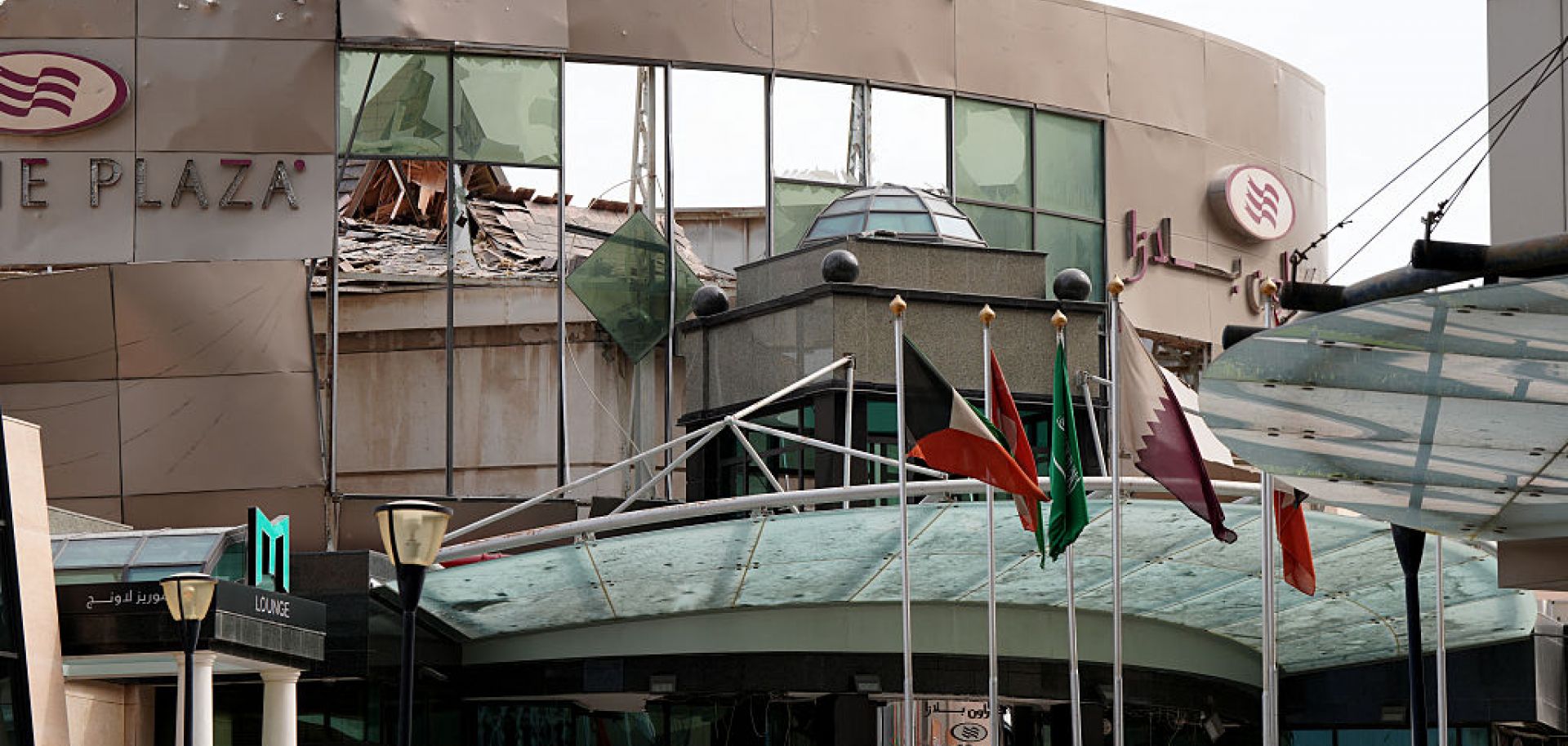
Continued Iranian strikes on U.S. bases and Gulf territory are likely to bring Gulf states closer to Washington's security umbrella and accelerate their investment in diversified military capabilities, and to undermine the Gulf's image as an investment destination. For a second day, Iran launched a barrage of missiles and drones across the Gulf region. It targeted U.S. military bases in several Gulf states, including Qatar's Al Udeid Air Base and the U.S. Fifth Fleet headquarters in Bahrain, and civilian targets, including residential buildings in Bahrain, airports in Dubai and Kuwait, and downtown Dubai. Some countries' air defense systems intercepted many of the incoming threats, though debris and several direct impacts have caused numerous casualties across Gulf countries like Bahrain, Kuwait, Oman and the United Arab Emirates.
- The spillover effects have manifested in disruptions to shipping and travel. Commercial vessels transiting the Strait of Hormuz have been targeted by Iranian projectiles, leading to temporary rerouting, increased insurance costs. International airlines, especially in the Gulf, have meanwhile halted many flights.
Despite years of Gulf-Iran rapprochement and Gulf efforts to remain neutral by restricting U.S. use of their territory, Iran's regional retaliation has drawn the Gulf directly into the confrontation. Particularly since 2023, Iran and key Gulf states, most notably Saudi Arabia, have invested considerable diplomatic effort in repairing relations with Iran after years of confrontation. The Saudi-Iran rapprochement reduced direct tensions and reflected a broader Gulf preference for de-escalation and regional stability rather than confrontation with Tehran. While Gulf governments remained concerned about Iran's regional activities and security posture, they have also approached the prospect of direct military confrontation with caution. Since the onset of the Gaza War in 2023, Israel's subsequent escalation with Hezbollah in 2024, and the June 2025 Israeli and U.S. strikes on Iran, many Gulf countries increasingly assessed that Israel had become a principal driver of regional escalation. They worried that a U.S. and Israeli attack on Iran could lead to immediate retaliation by Tehran impacting them, and about political uncertainty within Iran that could follow a major strike, including the possibility of regime instability or the emergence of a more hard-line leadership. The killing of Iranian Supreme Leader Ali Khamenei has now intensified these concerns. Gulf states had sought to insulate themselves from the conflict by signaling neutrality. Several governments publicly indicated that they would not allow U.S. forces to use their territory or airspace to launch offensive operations against Iran, hoping this would shield them.
Iranian attacks on U.S. bases and Gulf territory will continue in the next few weeks, something that could end Gulf neutrality and push it toward increased security cooperation with the United States — in turn causing Iran to set its sights even more broadly on the Gulf. By widening the battlefield to include U.S. facilities and adjacent Gulf infrastructure, Iran apparently hopes the Gulf will eventually press the United States to de-escalate its offensive against Iran. But as long as U.S.-Israeli strikes on Iran continue, further Iranian missile and drone attacks against regional bases and critical civilian and energy infrastructure will persist. These attacks affecting civilian or commercial targets may see Gulf leadership conclude that restraint no longer shields them from retaliation, and they may gradually permit expanded U.S. operational access from their territory, including providing greater use of their airspace or even logistical support. A transition toward active participation rather than reluctant hosting could prompt Tehran to intensify its attacks on the Gulf, perhaps targeting higher-value economic assets, including airports, energy facilities, ports and maritime infrastructure. This would significantly disrupt energy production and shipping routes, while increasing insurance premiums.
- Gulf countries may at first only allow gradual use of their airspace for defensive purposes to avoid giving justification for expanded Iranian attacks on the Gulf, and particularly its oil and gas sector. But if Iran attacks Gulf countries and their energy infrastructure anyway, then Gulf countries will likely become more inclined to allow the use of their airspace for offensive operations against Iran.
Iran's strikes on Gulf territory are likely to erode Gulf neutrality and pull Gulf states closer to the U.S. security umbrella, even if Iran experiences regime change, while simultaneously accelerating Gulf investment in military capabilities and diversified arms procurement. Over the longer term, Iran's decision to target Gulf territory is likely to push Gulf states back toward closer alignment, especially security alignment, with the United States. As Gulf leaders will continue to view Israel as a destabilizing actor, given its role in initiating and lobbying for military action, Gulf states will be unlikely to embrace full political alignment with the United States. The performance of the U.S.-linked air and missile defenses in intercepting incoming threats reinforces Washington's role as the most credible security backstop in a crisis. That is likely to translate into deeper operational coordination, intelligence sharing and defense integration with the United States. But Gulf states will also accelerate diversification of arms procurement, including with partners like South Korea and/or France. They will expand their investments in layered air and missile defenses, advanced fighter aircraft, strike capabilities and domestic defense-industrial capacity, regardless of Iran's internal political developments.
- A Feb. 28 call regarding the Iran crisis between Saudi Crown Prince Mohammed bin Salman and UAE President Mohammed bin Zayed was their first substantive engagement since the recent high-profile divergences over Yemen and Sudan strained their relations, highlighting a nascent recalibration in Gulf coordination amid escalating regional conflict.
- Even as they shift toward security alignment with the United States, Gulf countries will still seek stable relations with any government or regime that emerges in Iran to safeguard their security and prosperity.
- Gulf hawkishness toward Iran is likely to vary by country. Oman and Kuwait will probably remain the most cautious; Qatar may sharpen its rhetoric; Saudi Arabia will remain the most balanced; while Bahrain and the United Arab Emirates are more likely to adopt firmer security-aligned stances given prior tensions and deeper defense integration with the United States.
Over the long term, sustained conflict and repeated attacks on Gulf territory risk undermining perceptions of the region as a stable and secure investment destination. Even if Gulf infrastructure proves resilient and air defenses are effective, the normalization of missile exchanges, drone strikes and recurring airspace disruptions introduces a structural risk that could influence business planning and investor decisions across the region. Targeted strikes on major urban and economic centers, including downtown Dubai, residential hubs and commercial districts, generate concerns about operational continuity, security and the safety of personnel and assets. These security risks, combined with the potential for periodic escalation, could increase insurance and financing costs, slow megaproject timelines and reduce tourism and foreign direct investment. Over time, such patterns of conflict may hinder Saudi Arabia, Qatar, and the United Arab Emirates' ongoing efforts to diversify their economies away from oil dependence, slow their integration into global financial and commercial networks, and reinforce investor caution regarding long-term commitments in the region.
