
The United States is rapidly assembling a significant military buildup of air and naval assets near Iran as U.S. President Donald Trump weighs options for military action against the country. The USS Gerald Ford Carrier Strike Group is currently transiting the Atlantic Ocean toward the Middle East, where it will join dozens of fighter jets and at least six E-3 Sentry command-and-control aircraft that have recently relocated to U.S. bases in the area — marking the largest accumulation of U.S. air power in the region since the 2003 Iraq invasion.
Alongside the show of force, the United States and Israel have also been taking a number of steps to prepare for potential retaliation from Iran and/or its proxies. On Feb. 11, the U.S. State Department issued an "Ordered Departure" for non-emergency personnel and their families at the U.S. embassy in Baghdad, citing the immediate risk of regional retaliation. The following day, the U.S. Defense Department authorized "voluntary departure" for military dependents from Bahrain, Kuwait and Qatar — a step typically taken just before major military operations. On Feb. 18, Israel's Home Front Command declared the highest level of readiness, issuing nationwide instructions for emergency services and civilian centers to prepare for a "multi-front war" scenario. Concurrently, the Israel Electric Corporation and Ministry of Energy conducted "blackout drills" on Feb. 16-17 to test the national power grid's resilience against potential Iranian cyber and missile attacks. As of Feb. 19, major international airlines, including Lufthansa and KLM, had expanded flight cancellations at Israel's Ben Gurion Airport. The U.S. virtual embassy in Iran also issued a final alert on Feb. 18, urging remaining American citizens in the country to depart immediately by land to Turkey or Armenia due to imminent airspace closures.
These measures do not necessarily indicate that war is a foregone conclusion, as the U.S. military buildup is likely aimed at coercing Iran into making concessions in ongoing nuclear talks. However, they are consistent with preparations for a major U.S. or Israeli attack on Iran, and grant Trump significant leeway to conduct such action should he so choose. The moves are also eerily similar to, and even surpass, the steps taken in the days before the June 2025 Iran-Israel conflict, which eventually drew in the United States. However, the United States cannot indefinitely sustain this intense military build-up and will eventually face a "use it or lose it" dilemma.
Deployed U.S. Assets and Their Potential Use
The current U.S. military buildup in the Middle East is unusually large in both scale and diversity of assets. It includes naval forces operating in the eastern Mediterranean and the Persian Gulf, alongside combat aircraft deployed across regional bases, such as Muwaffaq Salti Air Base in Jordan and Al Udeid Air Base in Qatar. This configuration provides the United States with both defensive capabilities — such as air and missile defense coverage — and a wide variety of offensive options, including long-range precision strikes, sustained air campaigns and even ground infiltration and targeted raid operations.
Open-source flight-tracking data also indicates a significant surge in U.S. strategic airlifts into the region since mid-January, with over 80 C-17 Globemaster III flights reportedly observed. Precise numbers cannot be independently verified through official disclosures, given the sensitivity surrounding this deployment and those flights. However, large-scale C-17 deployments are typically associated with the pre-positioning of munitions, spare parts, maintenance equipment and logistical infrastructure — all things that would be required to sustain high-intensity air operations.
Parallel to the airlift surge, there have been similar signs of an activated aerial refueling "bridge" involving KC-46A Pegasus and KC-135 Stratotanker aircraft operating across the Atlantic and Mediterranean corridors. Like airlifts, tanker aircraft are central to sustained combat operations. Their movement at scale is not characteristic of routine rotations. Tankers enable extended combat air patrols and repeated long-range strikes without relying solely on forward bases in the region, particularly as most of these are close to Iran and in reach of Iran's missiles and drones.
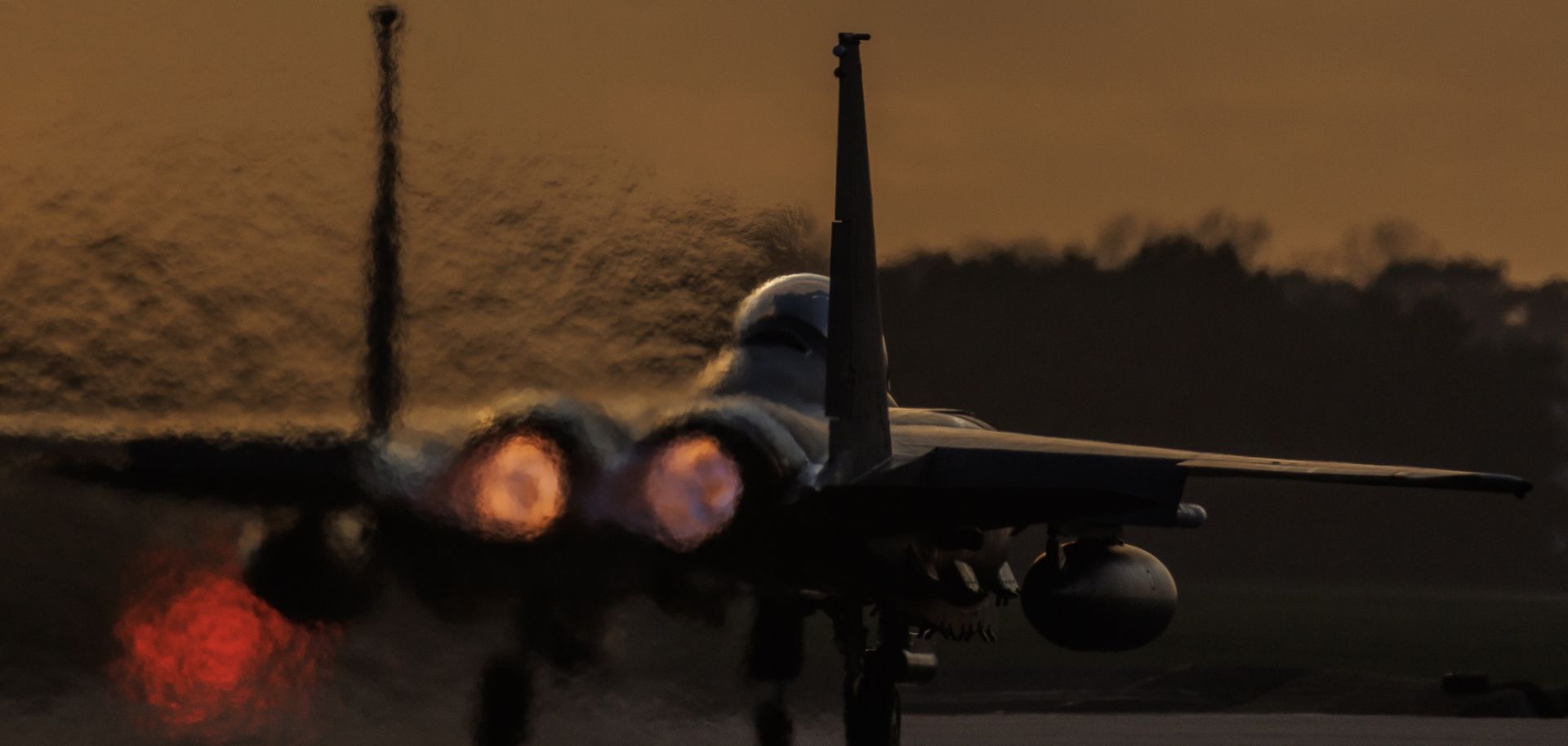
More significantly, in recent days, there has been a visible surge of advanced combat aircraft into the region. These include F-22 Raptors, F-35 Lightning IIs, F-15E Strike Eagles, F-16 Fighting Falcons, aerial refueling platforms and, in the past 48 hours, airborne command-and-control aircraft. The presence of such a broad mix of platforms suggests that Trump may be considering sustained military operations, rather than just a single punitive strike.
In any potential attack against Iran, each aircraft type would serve a distinct role. For instance, F-35s are well-suited for the suppression and destruction of enemy air defenses, particularly in the opening gambit of any attack. They can identify and target radar systems, as well as Iran's remaining surface-to-air missile systems. F-35s could thus degrade whatever remains of Iran's air defenses, thereby enabling other military assets to conduct follow-on attacks with reduced risk.
For their part, F-22s would likely be deployed to ensure uncontested control of the airspace over and around Iran, by intercepting and deterring Iranian fighter aircraft before they pose a threat to strike packages. While there is uncertainty over Iran's precise aerial capabilities, they are not advanced and were severely degraded in the June 2025 war. Air dominance — a factor Israel recently has achieved in the region — is foundational to any sustained air campaign, as it gives the attacker the ability to maintain operational freedom over regional airspace.
F-15Es function as heavy-payload strike platforms. Likely, once air defenses are degraded, they can deliver large precision-guided munitions against command centers, logistics hubs, hardened military facilities like Iran's missile cities, and strategic infrastructure.
Trump has also hinted at the readiness and possible usage of the B-2 stealth bombers, which carried out the U.S. strikes against Iran's hardened nuclear facilities in June 2025. However, their deployment this time around would likely be contingent on the need to use them, as well as the availability of GBU-57 bunker-busting munitions (approximately 30,000-pound bombs designed to target hardened and/or deeply buried facilities), which the United States mostly used up last year in its strikes on Iran.
Meanwhile, naval assets, including hidden submarines and surface-water destroyers, provide additional stand-off strike capabilities, and were already used during various attacks on Iranian facilities back in June. Operating offshore, these platforms would likely target radar installations, missile depots and fixed infrastructure. Cruise missile strikes often precede or complement air operations in order to degrade fixed targets and create operational openings.
Another noteworthy development observed in open-source reporting is the presence of MC-130J Commando II aircraft and combat rescue helicopters in the region. These platforms are associated with special operations capabilities, including low-altitude infiltration, extraction and direct action missions. Some of these assets have also been identified as the same used in the attacks against Venezuela in January 2026 that led to the capture of former Venezuelan President Nicolas Maduro. Their deployment does not mean ground operations are a certainty, but it expands the range of military options available to planners and presented to Trump. Such capabilities could, in theory, support the seizure of sensitive material, targeted raids on specific facilities or even targeted attacks against leaders of Iran's Islamic Revolutionary Guard Corps (IRGC).
Options for U.S. Military Action
The variety and size of the U.S. military buildup give Trump a breadth of options and, compared with last June, suggest a wider, longer-lasting campaign is more plausible this time around. Broadly speaking, there are three buckets of possible U.S. military action, ranked in order of operational scope:
The first option is a coordinated, multiday air and maritime campaign involving numerous airstrikes against Iranian military headquarters, leadership, nuclear-related facilities, radar systems, air defenses, missile infrastructure and elements of Iran's broader security apparatus. Such a campaign would seek to destroy the Iranian government's security apparatus and its broader military capabilities to create a security vacuum and lay the foundation for a regime transformation. The operational logic would be to first suppress and degrade what remains of Iran's air defense capabilities, then systematically strike command-and-control centers, logistics hubs and strategic facilities. The strategic objective would likely be coercive: to impose sufficient military and economic costs to force Tehran into political concessions akin to capitulation, whether on the nuclear program, missile program or support for regional proxies. At its most ambitious, this approach could also aim — particularly if it involves Israel — to severely weaken the Iranian regime's coercive capacity by degrading the IRGC's paramilitary militia, the Basij. Given Iran's existing economic and military strains, sustained degradation of the security apparatus could, in theory, gradually build domestic pressure against the regime — either from the population or due to internal splits — and lead Iran to eventually implode. However, this scenario would likely require the United States to conduct a longer campaign. There is also a risk that Iran's strategic and geographic depth would prevent the United States and/or Israel from achieving their objectives, thus enabling the IRGC to harden its posture even further following the campaign. This would undermine U.S. goals regarding Iran's regional behavior and its military capabilities, not to mention likely carry high political costs for Trump.
A second option is a limited strike conducted with speed, precision and overwhelming force, designed to deliver a sharp strategic message without entering a prolonged campaign. This would align with Trump's preference for decisive, rapid action that avoids bogging down U.S. forces in an extensive foreign campaign. Targets in such a scenario could include specific high-value military assets or IRGC leadership, missile facilities or key operational headquarters. The goal would be to coerce the current Iranian regime quickly and forcefully. Such an operation would rely heavily on stealth aircraft, precision-guided munitions and stand-off naval assets, minimizing exposure time and attempting to control escalation. For Trump, this action would offer the political advantage of delivering a visible outcome without committing to an open-ended operation, which could be especially alluring ahead of U.S. midterm elections in November, with polls revealing warning signs for Republicans. However, this strategy may still be insufficient to change Iran's behavior. Iran's firepower advantage would also give it greater capacity to launch counterattacks against U.S. assets, potentially resulting in American casualties.
A third option is a more focused attempt to decapitate elements of Iran's leadership, particularly within the IRGC, in order to create operational paralysis and/or, at some point in the future, infighting within Iran. This could involve precision strikes that pave the way for special operations targeting key commanders or sensitive infrastructure, like an underground facility that houses ballistic missiles. The objective would be to generate a leadership vacuum that weakens coordination and creates space for internal shifts, similar to the operation carried out by the United States against Venezuela. In theory, removing senior IRGC leadership could create short-term instability within the security hierarchy, but it could also backfire by strengthening the IRGC's hold on power and intensifying crackdowns on internal dissent — not to mention deeply imperil any U.S. forces operating on Iranian soil. Additionally, leadership decapitation does not guarantee regime collapse or compliance, especially in a highly institutionalized and proud country like Iran. Iran's command structure is layered and has established succession mechanisms, which have been improved since the June 2025 war. Targeted killings also risk unifying factions internally rather than fragmenting them — and they carry high escalation potential, as leadership targeting is often perceived as existential.
Lying somewhere between these three options are others with a more narrow tactical focus. For instance, the United States could decide to focus solely on further degrading Iran's nuclear program by conducting targeted attacks against enrichment facilities, centrifuge production sites, research infrastructure and even individual nuclear scientists. In this scenario, the aim would not necessarily be regime change or systemic dismantlement, but rather resetting technical progress to make it almost impossible for Iran to even consider a nuclear weapon at any point in the next decade. Another option would expand the target set to include not only nuclear infrastructure but also missile and drone capabilities, which would involve striking Iran's production facilities, storage depots, launch infrastructure and elements of the command structure overseeing those programs. The logic here would be to reduce Iran's retaliatory capacity and its threat to Israel. And finally, a more escalatory option would extend attacks beyond military infrastructure to Iran's energy infrastructure — a tactic that could be accompanied by a U.S. blockade of the Strait of Hormuz, similar to the current U.S. blockade near Venezuelan waters. The objective here would be to significantly increase economic pressure on Iran by targeting its vital oil and gas production, and/or its refining or export infrastructure. However, this option carries higher escalation risks, as it would directly impact global energy markets and likely trigger stronger countermeasures from Iran.
However, all of these options risk Iranian retaliation and are not guaranteed to succeed, as Tehran possesses various response options that could blunt U.S. aims or expand the conflict beyond its intended scope.
Iran's Retaliation Options
If the United States decides to conduct military action against Iran, Tehran would likely seek to retaliate proportionately in political and strategic terms, rather than purely on military grounds — in part because Iran cannot match U.S. conventional power. That likely means targeting U.S. bases in Iraq, Jordan and/or the Gulf, as well as potentially attacking Israel (a near certainty if Israeli forces join in on U.S. attacks), using a mix of ballistic missiles, drones and cruise missiles, alongside more asymmetric responses that play to Iran's comparative strengths.
Even after the June 2025 exchanges, Iran likely retains sufficiently large stockpiles of missiles and drones to retaliate beyond a one-off and instead over a longer period of time, particularly because much of its arsenal is mobile and dispersed. However, U.S. and Israeli air superiority, layered missile defenses and Iran's own desire to avoid regime-threatening escalation will constrain the scale and tempo of its response. Thus, the most likely Iranian retaliation is not an all-out conventional war, but phased, dispersed and calibrated retaliation designed to impose costs while stopping short of uncontrolled escalation.
One of the most immediate and plausible responses would involve activating Yemen's Houthi rebels, who have already demonstrated the capability and willingness to launch drones and missiles toward strategic maritime corridors and shipping lanes. In the event of U.S. military action against Iran, increased Houthi activity in the Red Sea would be a predictable pressure point. This could involve attacks on commercial shipping, attempted strikes against vessels perceived to be linked to U.S. or allied interests, or efforts to disrupt transit flows in ways that raise global economic costs.
Following U.S. military action, increased Houthi attacks on commercial shipping, U.S./allied vessels, or transit disruption—raising global economic costs—would be predictable. Houthi strikes on Gulf energy facilities are a further escalation risk.
Finally, Iran's retaliation does not need to mirror a U.S. strike symmetrically to be effective. Even if Iran avoids a direct conventional fight — whether due to a political and strategic decision, or to technical and logistical constraints of deploying its weapons — it can still respond through other means. This includes launching ballistic missiles and drones against regional military bases housing U.S. troops, placing mines, targeting commercial vessels or offshore energy facilities in and around the Strait of Hormuz, and conducting cyberattacks or other covert actions designed to impose costs. Therefore, the central question is not whether Iran will retaliate, but rather how quickly it can organize and execute that retaliation — and whether it leads the United States to further escalate or de-escalate.
Decision vs. Posture
Overall, U.S. posture today reflects a clear readiness for high-intensity military operations, defensive preparations for Iranian retaliation and the capability to escalate if desired. The U.S. military buildup alone does not indicate that Trump has already decided to attack Iran, as posture and decision are not the same. But it is creating more options for him to choose from, and increasing the credibility of those options. The deployment also does not confirm that war is imminent, though it does raise the probability of confrontation — particularly given the failing state of nuclear negotiations and the parallel military signaling and defensive preparations from Tehran.
The upshot is that some form of U.S. military action is more likely than not in the coming weeks. The United States is currently operating a dual-aircraft carrier posture in the region, a rare occurrence. When the U.S. military deploys two carrier strike groups simultaneously, it is not typically configured for a single punitive strike.
Washington appears to be presenting Tehran with a direct framework: agree to U.S. demands in a nuclear deal, or face a large-scale and hurtful U.S. attack that may threaten the regime's existence. There is still a limited space for de-escalation if both sides can identify an off-ramp. For Trump, that would require a deal strong enough to justify the visible military buildup without appearing to retreat from stated red lines. For Iran, it would require preserving core strategic positions, particularly regarding uranium enrichment and its ballistic missile program. But publicly available indicators suggest Tehran remains unwilling to fully abandon enrichment, while Trump has said any enrichment is unacceptable; thus, the current evidence points to another (and, at least compared to June 2025, probably more expansive) U.S. campaign against Iran.
