
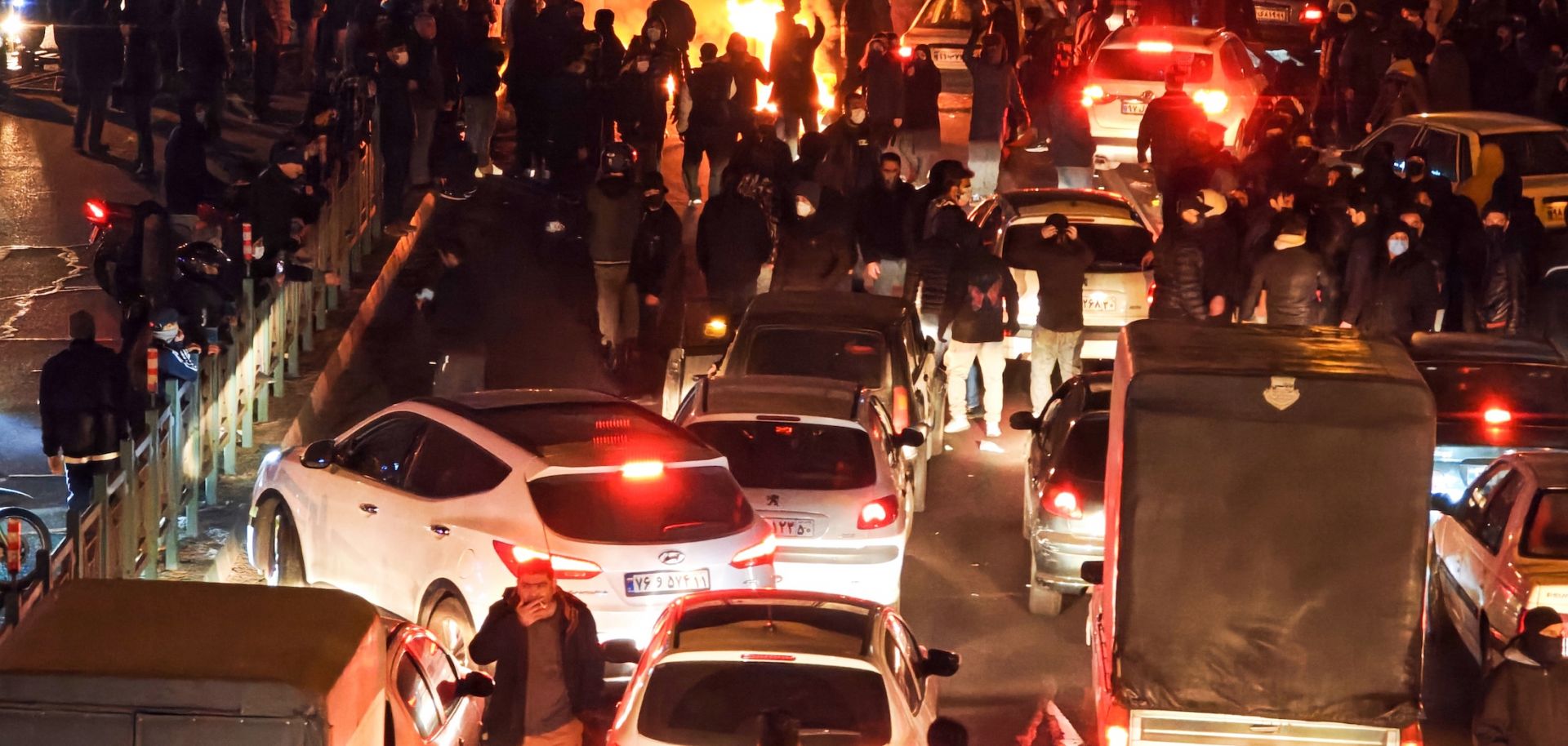
The risk of a U.S. attack on Iran will remain high in the coming days and weeks, with Tehran likely to calibrate its response to the severity of U.S. action while avoiding uncontrolled escalation unless the regime faces an existential threat. The deadly protests in Iran continue to rage on, raising the prospect of U.S. intervention. Internet connectivity has been largely shut off inside the country since Jan. 8, making it difficult to ascertain the size and scope of the protests and crackdowns. However, the Oslo-based Iran Human Rights Group reported on Jan. 13 that at least 648 people have died since the unrest began on Dec. 28, and that the death toll may reach as high as 6,000. U.S. President Donald Trump has repeatedly threatened to attack Iran if peaceful protesters continue to be killed. On Jan. 13, he was briefed on kinetic and non-kinetic options — including targeted strikes, cyberattacks, information operations and, least escalatory, announcing military movements like carrier deployments — regarding a response to Iran's violent crackdown on the demonstrations. On Jan. 12, Trump also announced plans to impose 25% tariffs on any country involved in trade with Iran.
- On Dec. 28, the Iranian rial hit a record low of 1.45 million to the U.S. dollar, prompting merchants in Tehran to take to the streets in protest of the country's worsening economic situation. The demonstrations have since evolved into a broader, nationwide anti-government movement, particularly in recent days.
- The Islamic Revolutionary Guard Corps (IRGC) has released numerous statements accusing the United States and Israel of leading the protests, vowing to crack down on rioters and so-called "agents."
Iran is trying to prevent or at least postpone a U.S. attack by offering to restart negotiations with the Trump administration. Trump said on Jan. 11 that Iran had "called to negotiate" on its nuclear program. While Iranian officials have not confirmed the outreach, Foreign Minister Abbas Araghchi also recently said that Tehran was ready to restart talks with Washington. Indirect U.S.-Iran talks over a new nuclear agreement have stalled since the United States and Israel launched attacks on Iranian nuclear facilities in June 2025. By signaling renewed openness to negotiations, Iran is attempting to deter another confrontation, particularly U.S. or Israeli strikes under the guise of supporting the current protests. However, these overtures coincide with a shift in the United States' position — reportedly under Israeli pressure — to broaden talks beyond nuclear issues to include Iran's ballistic missile program. If Iran were to offer substantial concessions on its nuclear program and agree to discuss its ballistic missile program, it would significantly reduce the risk of U.S. military action in the coming days and weeks. However, this currently appears highly unlikely, first, given that Trump on Jan. 13 announced that he had canceled all talks with Iran, and given that Tehran has long insisted that its ballistic missile program is not up for negotiation.
- Iran has continued to insist that its nuclear program remains peaceful. However, following the June 2025 war, it has offered limited transparency regarding the program's status and the extent of the damage incurred, fueling uncertainty in the United States and Israel around Iran's breakout time for a nuclear bomb.
In the coming days and weeks, the risk of a U.S. attack on Iran will remain high, with the United States likely resorting to non-kinetic options while keeping the option of a military attack on the table. The severity of Iran's crackdown on protesters makes it highly likely that Trump will authorize some form of action. He has publicly supported the protesters and threatened consequences, meaning that backtracking now could damage his credibility. The Trump administration may also see the unrest as an opportunity to use force to extract concessions from Iran in future negotiations (regardless of whether the regime ultimately survives the protests), as the domestic instability provides a political justification to the U.S. public. Trump's potential options range from escalatory measures — such as targeted strikes, assassinations of IRGC- or Basij-linked figures or broader airstrikes against military infrastructure and the command centers of security forces responsible for the crackdown — to less escalatory methods like major cyber operations and expanded, targeted sanctions. However, Iran's recent claims that the situation is coming under control could narrow the window for U.S. action. However, on Jan. 12, Iranian Foreign Minister Abbas Araghchi stated that the protests were under control and that authorities would "soon" restore internet access across the country. Should this prove to be the case, it may narrow the window for U.S. action.
- The Iranian regime has also organized pro-government demonstrations nationwide in a show of defiance against the protest movement and U.S. support for the movement.
Iran's response to a U.S. attack would be proportional to the attack's severity, ranging from cyber and covert retaliation to missile and drone strikes against U.S. assets in the region and, less likely, Israel. Iran's response to any U.S. action will be calibrated to the type and scale of that action, and the level of damage inflicted. If Washington opts for non-kinetic measures (such as cyber operations or expanded economic sanctions), Iran will likely avoid overt military retaliation, particularly as it faces domestic pressure from ongoing protests. Instead, Tehran would more likely respond through cyberattacks against U.S. and/or Israeli assets and businesses across the region, alongside covert activity abroad, with the hope of limiting escalation and avoiding blowback by Israel and the United States. However, kinetic U.S. military strikes would likely prompt Iranian counterstrikes. Attacks that kill Iranian leaders or target major military and security installations, in particular, would significantly raise the risk of Iran using drones and ballistic missiles against U.S. regional assets. A lower-escalation scenario could see Iran launch a telegraphed, limited strike on a U.S. diplomatic or military target in Iraq or harass a commercial and/or military vessel in the Strait of Hormuz, in an effort to restore deterrence and signal restraint. A more escalatory scenario could see Tehran launch telegraphed strikes on U.S. military assets in Gulf states to reassert credibility, heightening regional risk levels. While less likely, an untelegraphed Iranian retaliation against U.S. assets or a Strait of Hormuz blockade also cannot be ruled out, especially if the regime feels existentially threatened by the U.S. attacks, which would increase the potential for American casualties. Additionally, Iran might retaliate against Israel directly, possibly with unannounced ballistic missile attacks. However, all of these options would risk inviting severe U.S. and Israeli counterstrikes that could further degrade the Iranian regime and threaten its survival.
Potential Scenarios and Their Impact on the Iranian Regime
Depending on the severity of U.S. attacks against Iran, the domestic social and political repercussions for the regime would differ:
A limited U.S. response — such as increased sanctions pressure or a one-off military strike — would likely initially help stabilize the Iranian regime by enabling it to fully suppress the protests without having to make political concessions. If the United States confines its response to non-kinetic measures like cyber operations and expanded sanctions, protests would likely persist for a few more weeks or months before ultimately being suppressed by increasingly violent security crackdowns. A limited U.S. or Israeli kinetic strike would likely accelerate this dynamic, weakening the protest movement by fragmenting public support, validating regime claims of foreign orchestration and providing Tehran with greater justification to intensify repression. In both cases, demonstrations may initially continue but would likely lose momentum as exhaustion, fear and securitization take hold, enabling the regime to reassert control in the near term. However, neither approach would address the regime's underlying legitimacy crisis or Iranians' deep-seated economic grievances. Instead, repression — reinforced by external pressure or military action — would further widen the gap between state and society in Iran, entrench hard-line political dominance by further marginalizing moderates, and sustain Iran's defensive yet more aggressive security posture. As a result, the risk of renewed and potentially more destabilizing waves of future unrest would remain high — particularly as Iran's economy continues to crumble under the weight of sanctions, and as the ongoing threat of future U.S. or Israeli strikes continues to shape regime behavior.
A targeted U.S. strike against IRGC or Basij leadership would create a brief period of internal disruption and command uncertainty, but would unlikely alone trigger meaningful negotiations or a decisive shift in regime stability. Tehran would also likely move quickly to replace commanders and restore operational control, similar to the 12-day war in June, limiting the duration of the shock and quickly re-establishing control. During this window, protests may endure in a more violent and confrontational form, but they would still fall short of posing an existential threat to the regime unless accompanied by broader elite defections or sustained degradation by the United States that eventually erodes the regime's ability to control security, both of which are unlikely. A U.S. attack that kills senior IRGC leadership would also be more likely to create a sense of nationalism among Iranians, as seen in the aftermath of the June war, in addition to playing into the regime's and Shia's martyrdom culture. Finally, state repression would intensify against any remaining protesters once command structures are restored. But while this would reinforce the regime's survival, it would also deepen its long-term instability.
In a low-probability, high-impact scenario, the United States may also attempt to assassinate Iranian Supreme Leader Ayatollah Ali Khamenei. Such an attack would create a short-term shock, given that it would remove the regime's central symbolic authority. However, Iran is highly institutionalized, and the IRGC would be in a position to move in and consolidate control alongside some of the clerical-security elite. The IRGC would likely either elect a pre-selected successor to replace Khamenei, or assume de facto guardianship of the regime in a transitional period. Domestically, the assassination would trigger a short-term rally around the flag effect among hard-liners. Given Khamenei's unpopularity, protests would likely continue for a while longer before eventually dying down as the IRGC assumes power and expands its repression.
A sustained U.S and possibly Israeli military campaign against Iran would destabilize the regime, whose survival depends on intra-IRGC unity. If the United States (potentially with the direct backing of Israel) launches a wider and more sustained campaign against Iran targeting its military infrastructure, security apparatus and political leadership over an extended period of time, it would be destabilizing for the regime and threaten its survival. In the immediate aftermath, the attacks would not only degrade Iran's offensive and defensive military capabilities, but also its coercive capacity at home by disrupting security forces' command and control structures. This security vacuum, compounded by further economic strain, could empower the anti-government movement and bring more protesters to the streets. However, a sustained U.S. and/or Israeli bombardment may also backfire if it creates a sense of nationalism in Iran, in addition to deterring people from organizing protests for fear of their safety. Over time, the regime's survival would hinge on its ability to maintain the cohesion of its security apparatus and prevent defections from undermining its ability to maintain power and repress anti-government protests. If splits within the IRGC do not occur, the regime would likely survive in a weaker but more securitized and militarized form. However, if there are visible splits within the regime's elite, and especially if they are compounded by external support to minorities and/or armed factions within the country, it would open the door to structural political changes in Iran.
