
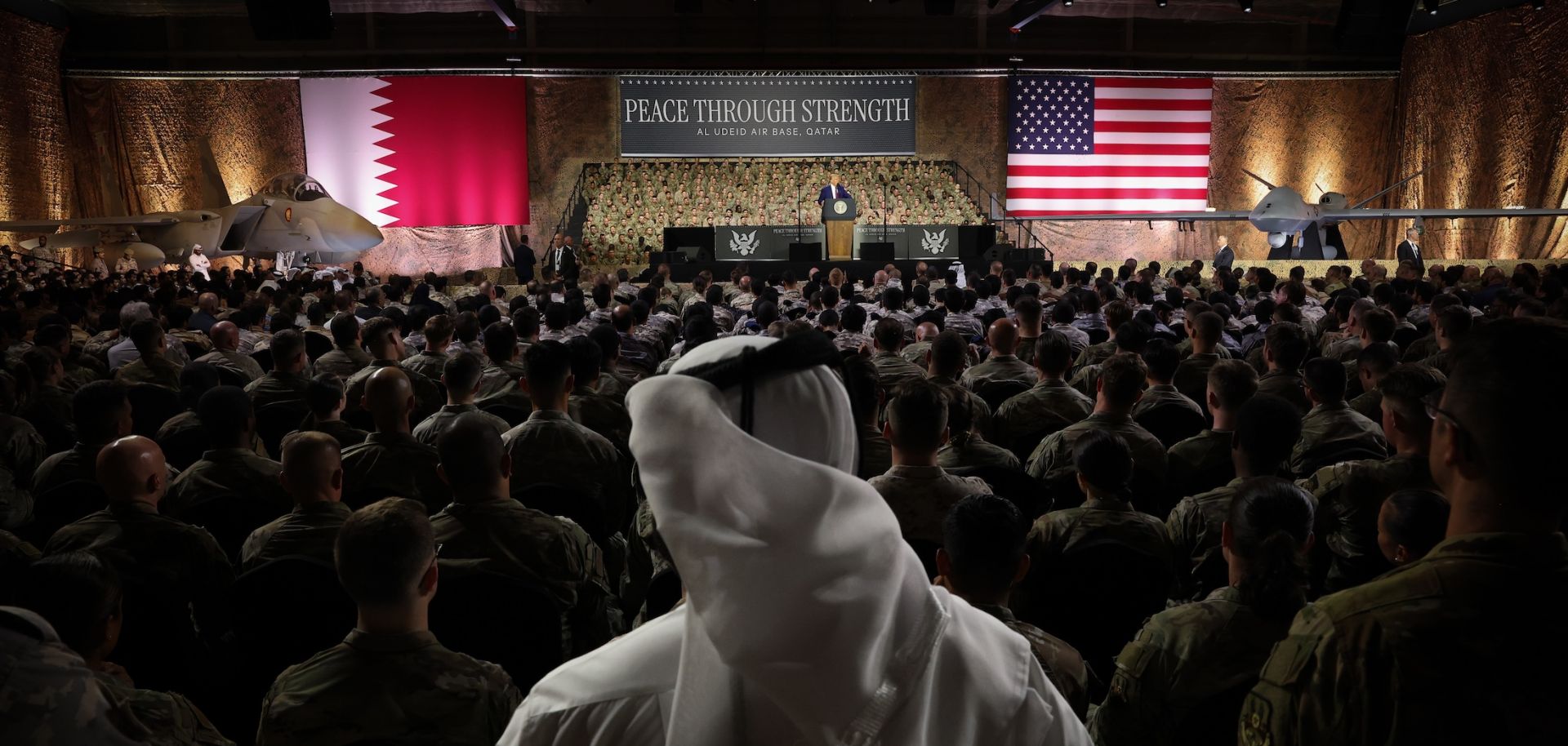
The United States' move to grant Qatar unprecedented security guarantees will deter future Israeli attacks on the country, but it is unlikely to deter Iranian aggression; it will also prompt other Gulf states to demand similar commitments, while ultimately doing little to halt their long-term efforts to diversify security partners. On Oct. 1, the White House announced that U.S. President Donald Trump had signed an executive order, dated two days earlier, to provide Qatar with an upgraded U.S. security commitment. The directive, formally titled ''Assuring the Security of the State of Qatar,'' states that any armed attack on Qatar's territory, sovereignty or critical infrastructure will be treated as a threat to U.S. peace and security, and vows that Washington would respond to such an attack with ''lawful and appropriate measures,'' including diplomatic, economic and, if necessary, military action. The directive also requires joint contingency planning between U.S. and Qatari authorities to ensure rapid, coordinated responses to external aggression. But while Trump has presented the order as a security guarantee, it stops short of pledging automatic defense, with its language leaving room for executive discretion and future interpretation. The order was signed during Israeli Prime Minister Benjamin Netanyahu's recent trip to Washington, where he called Qatar's prime minister to apologize for the failed Sept. 9 Israeli airstrikes targeting Hamas members in Doha.
- Executive orders are generally unilateral directives issued by the U.S. president; they are not legally binding across administrations and can be quickly revoked or modified by successors. In contrast, a treaty, once negotiated and approved by a two-thirds Senate vote, carries the weight of law and persists across U.S. administrations, giving it far greater durability and international credibility.
- Qatar has been designated a Major Non-NATO Ally (MNNA) of the United States since January 2022. This status enhances defense cooperation and access to U.S. military technology, training and financing opportunities, but it does not include mutual defense obligations like those under NATO's Article 5.
The executive order seeks to not only recompense Qatar for Israel's recent failed attempt to kill Hamas leaders in Doha, but also reassure Qatar (and other Gulf states) of Washington's ongoing commitment to the region's security following Iran's June 2025 attack on the Qatari capital. Israel's unprecedented Sept. 9 attack targeted Hamas members in Doha, but it ended up killing a Qatari security officer instead of any leaders of the Palestinian militant group. The attack was also the second assault on the Qatari capital in recent months, after Iran launched dozens of ballistic missiles against U.S. forces stationed at Doha's Al Udeid Air Base in June, in retaliation for U.S. airstrikes on Iranian nuclear facilities during the 12-Day War between Iran and Israel. Both the Israeli and Iranian attacks have alarmed Gulf states about the effectiveness of their security and defense relationship with the United States. The recent Israeli attack on Doha, in particular, has also raised doubts in the Gulf Cooperation Council (GCC) about Washington's ability and/or willingness to restrain its closest regional ally, Israel, especially given Qatar's MMNA status and hosting of U.S. forces. Against this backdrop, Trump's executive order is as much about rebuilding trust with GCC partners as it is about protecting U.S. assets and military presence in the region. By extending explicit commitments now, even if short of a Senate-approved mutual defense treaty, the United States is signaling to regional allies that it remains committed to their security in the face of ongoing threats from Iran and Israel, and that it intends to reassert a stabilizing role at a moment when Gulf states are questioning U.S. reliability.
- Qatar's domestic security has historically been insulated from regional conflicts. It was never directly attacked during the Iran-Iraq War in the 1980s or the Gulf Wars in 1990-91, and has generally avoided spillover violence. The only major incident prior to the recent Israeli strike was a rare 2005 suicide bombing in Doha, making the Sept. 9 attack unprecedented in its direct targeting of the Qatari capital.
The executive order will very likely deter Israel from conducting overt attacks in Qatar in the short term, but it is unlikely to deter Iranian attacks on the Gulf country; covert Israeli operations will also remain a low-probability, high-impact risk that could strain U.S.-Israeli ties. The enhanced U.S. security commitments will very likely raise the threshold for any future Israeli attacks on Qatari territory by signaling that such actions would trigger a U.S. diplomatic, economic or even military response, potentially in the form of arms cutoffs or new sanctions on Israel. This will, in turn, likely deter further Israeli airstrikes on Hamas targets in Qatar in the short term, particularly given the severe U.S. diplomatic backlash Israel faced following its failed assassination attempt in Doha, including reportedly from Trump himself. However, in the event of another armed conflict between Iran and Israel, the order is unlikely to stop Iranian attacks that take place in the backdrop of a cycle of retaliation, though it will serve as an extra layer of deterrence against an overt Iranian strike or proxy attack on U.S. targets in Qatar in such a scenario. This is because such an attack would now carry a much higher probability of U.S. retaliation against Iran — either through expanded targeted sanctions, cyberattacks or direct military action, given the large U.S. military presence in Qatar and the broader Gulf region. Still, there remains a low-probability but high-impact risk that Israel, especially given its growing risk tolerance in the past two years, may test Washington's resolve by conducting a more covert operation against Hamas members in Qatar, if they do not comply with Israel's demands to leave the country. Such a move would almost certainly further strain the U.S.-Israeli relationship and undermine Washington's credibility as a security guarantor to the GCC.
- Before Netanyahu apologized to Qatar for the Sept. 9 Doha attack, Israeli leaders, including Netanyahu, all threatened further attacks against Hamas members, whether in Qatar or elsewhere. In recent months, Qatar has also come under pressure from Israel and the United States for hosting Hamas members, though given Doha's role in mediating the Gaza conflict, Hamas members are unlikely to leave before any ceasefire deal in Gaza is agreed.
The enhanced U.S. security guarantees to Qatar will likely push nearby Bahrain, the United Arab Emirates, Kuwait and, eventually, Saudi Arabia to demand similar commitments, as these countries also all host U.S. troops and face similar risks from both Iran and Israel. For each of these Gulf states, the presence of U.S. forces on their soil simultaneously offers protection and creates potential targets. This duality increases the likelihood that these nations will seek stronger bilateral security agreements with Washington to deter potential Iranian attacks, such as the one on Doha in June. Bahrain and the United Arab Emirates are especially likely to press for comparable assurances, as both have normalized ties with Israel, making them more exposed to covert or retaliatory actions by Iran and its proxies in a future Israel-Iran conflict. Bahrain also hosts the U.S. Fifth Fleet, while the United Arab Emirates has faced numerous attacks from Iran-backed Houthi rebels in Yemen. Kuwait, being home to one of the region's largest U.S. bases, is likewise vulnerable to such spillover violence and will thus probably demand similar security commitments as well. However, Riyadh has continued to seek closer ties with the Trump administration and would presumably also want stronger U.S. security support. But in response to such pressure, the United States is more likely to supply these countries with more air defenses, rather than provide greater security commitments across the region.
- GCC countries have varied security relationships with the United States, mainly built on defense ties. Qatar hosts Al Udeid Air Base, the region's largest U.S. base; Bahrain houses the U.S. Fifth Fleet headquarters for Gulf maritime security; Kuwait serves as a major logistics and troop staging hub; Saudi Arabia accommodates U.S. forces at Prince Sultan Air Base with a focus on air defense; the United Arab Emirates grants the U.S. military access to its Al Dhafra Air Base for advanced aircraft and intelligence operations; and Oman provides the United States strategic port access at Duqm without large permanent bases.
- The reimposition of U.N. sanctions on Iran on Sept. 28, along with stalled progress in U.S.-Iran nuclear talks, raises the risk of another Israeli-Iran war breaking out in the coming months, as Israel seeks to capitalize on a closing window of opportunity to further degrade Iran's nuclear, missile and drone programs following the June war. Any escalation would almost certainly draw U.S. involvement, whether through direct military support to Israel, expanded sanctions or regional force deployments, raising risks of broader conflict spillover across the Middle East.
- For years, the Israel Defense Forces and Iran's Islamic Revolutionary Guards Corps have also been engaged in a covert conflict involving espionage, cyberattacks and targeted killings across the region. This led to the November 2024 assassination of an Israeli rabbi in the United Arab Emirates, which regional officials and media attributed to Iranian-linked operatives — highlighting the elevated risk of spillover violence even in Gulf states not directly involved in the conflict.
The U.S. promises to Qatar are unlikely to halt the broader trend of Gulf states diversifying defense ties with other powers, especially as the United States is likely unable and/or unwilling to provide expanded security commitments across the region. Israel's strike on Doha, coupled with Washington's reluctance to restrain Israel over the past two years, has already eroded regional trust in U.S. reliability. Even with the new commitments to Qatar, they stop short of a NATO-style Article 5 commitment and contain deliberately vague language, leaving Gulf states uncertain about the depth of U.S. resolve in a crisis. Moreover, the United States is unlikely to extend Qatar-style guarantees broadly unless states face imminent threats or provide Washington with significant strategic or economic incentives. This is because the United States cannot afford to overcommit in the region, with the Trump administration seeking to shift U.S. security priorities away from the Middle East and draw down American troops in countries like Iraq and Syria. This dynamic will reinforce Gulf hedging strategies, ensuring that diversification of defense ties remains a core feature of their security posture. GCC members will thus almost certainly continue to pursue parallel security arrangements with other powers — both within the region and elsewhere — to reduce overdependence on Washington. The recent Saudi-Pakistan defense agreement exemplifies this pattern, and similar pacts between Gulf states and Turkey or even European countries are likely to occur over time.
