
Iran's initial response to the snapback of U.N. sanctions will likely be pragmatic, but over time, the economic fallout from the sanctions could prompt Tehran to double down on its relationships with Russia and China, fuel social unrest within Iran, and strengthen the political influence of Iranian hard-liners who are calling for more aggressive action against the West. Wide-ranging U.N. sanctions against Iran were formally reimposed on Sept. 28. This action followed months of unsuccessful negotiations between Iran and the West, and also came after a last-ditch effort by China and Russia to delay the sanctions was defeated in a U.N. Security Council vote two days prior, with the United States and European powers opposing the delay. The reimposition of U.N. sanctions was widely anticipated after Europe's so-called E3 countries — France, Germany and the United Kingdom — triggered the sanctions snapback provision in the 2015 Iran nuclear deal, formally called the Joint Comprehensive Plan of Action (JCPOA), on Aug. 28, citing Iran's failure to meet several demands concerning its nuclear program. Iranian officials have strongly condemned the move to reimpose U.N. sanctions, with Iran's parliament discussing a potential withdrawal from the Nuclear Non-Proliferation Treaty in a closed-door meeting on Sept. 28, though no decision has been announced. The European Union has since announced plans to reimpose various sanctions on Iran, including travel bans for a number of individuals, asset freezes on designated individuals and entities (including the Central Bank of Iran), sanctions targeting Iran's financial and transport sectors, and a trade embargo on its energy sector, precious metals and a handful of other goods. Similarly, the United Kingdom announced on Sept. 29 that it added more than 70 individuals and entities linked to Iran to its sanctions list.
- U.N. sanctions on Iran include the reinstatement of an arms embargo, a ban on all Iranian uranium enrichment and reprocessing activities, and a ban on ballistic missile development that could be used to deliver a nuclear weapon. Countries are also authorized to stop and inspect cargo traveling from Iran, including oil tankers, for prohibited activities.
- Both Iranian and Russian officials have described the sanctions as ''null and void,'' arguing that efforts by the E3 to revive them were unlawful. Chinese officials have also criticized the decision, but have not matched the level of rhetoric of Iranian and Russian officials.
- The JCPOA was established between Iran and the five permanent members of the U.N. Security Council (China, France, Russia, the United Kingdom and the United States), plus Germany, in 2015. It aimed to place limits on Iran's nuclear activities and cap its uranium enrichment at 3.67%. In 2018, then-U.S. President Donald Trump withdrew the United States from the deal, leaving only Iran and the five other members as participants. Unlike the United States, the E3 countries (France, the United Kingdom and Germany) retained the ability to trigger the JCPOA's snapback provisions, because they were still party to the deal. However, in recent months, these European powers faced a use-it or lose-it moment, as many provisions — including various sanctions and the snapback mechanism under U.N. Security Council Resolution 2231 (which implemented the JCPOA) — were set to expire on Oct. 18.
Nuclear talks between Western powers and Iran have effectively been halted since the United States and Israel conducted strikes on Iran's nuclear program in June, and remain highly unlikely to resume in the near future. Since the June conflict, which saw the United States drop more than a dozen GBU-57A/B MOP 'bunker busters' on Iran's Fordow and Natanz nuclear facilities, Iran has not allowed inspectors from the International Atomic Energy Agency (IAEA) to visit its nuclear sites. This has made it impossible for the U.N. nuclear watchdog to verify the size and location of Iran's highly enriched uranium stockpiles. It has also impeded Western powers' ability to determine the extent of damage sustained by Iranian nuclear stockpiles and enrichment capabilities during the June war — information that is essential for estimating a nuclear breakout timeline (i.e., when Iran could possess enough weapons-grade uranium to produce a nuclear device). Against this backdrop, the E3 countries threatened to trigger the snapback of U.N. sanctions if Iran did not reinstate IAEA inspections, resume nuclear talks with the United States, and disclose the location and status of its highly enriched uranium stockpiles by the end of August. But Iran largely rejected these demands, arguing that talks with the United States were unwarranted since Israel's initial June 13 attack on Iran occurred just days before U.S. and Iranian officials were scheduled to hold a sixth round of nuclear negotiations. On Sept. 9, Iran reached an agreement with the IAEA for nuclear site inspections to resume. However, the deal did not include a clear timeline and instead said inspections would only restart after Iran issued reports on the status of nuclear facilities and equipment, and after its Supreme National Security Council approved IAEA visits. E3 officials deemed this agreement insufficient to meet their demands.
- The Trump administration has also demanded that Iran turn over all of its enriched uranium stockpiles to secure a three-month reprieve from U.N. sanctions, which he described as ''absolutely unacceptable.'' But Iranian officials have described this U.S. demand as unrealistic, with Iranian President Masoud Pezeshkian calling it ''absolutely unacceptable'' on Sept. 27.
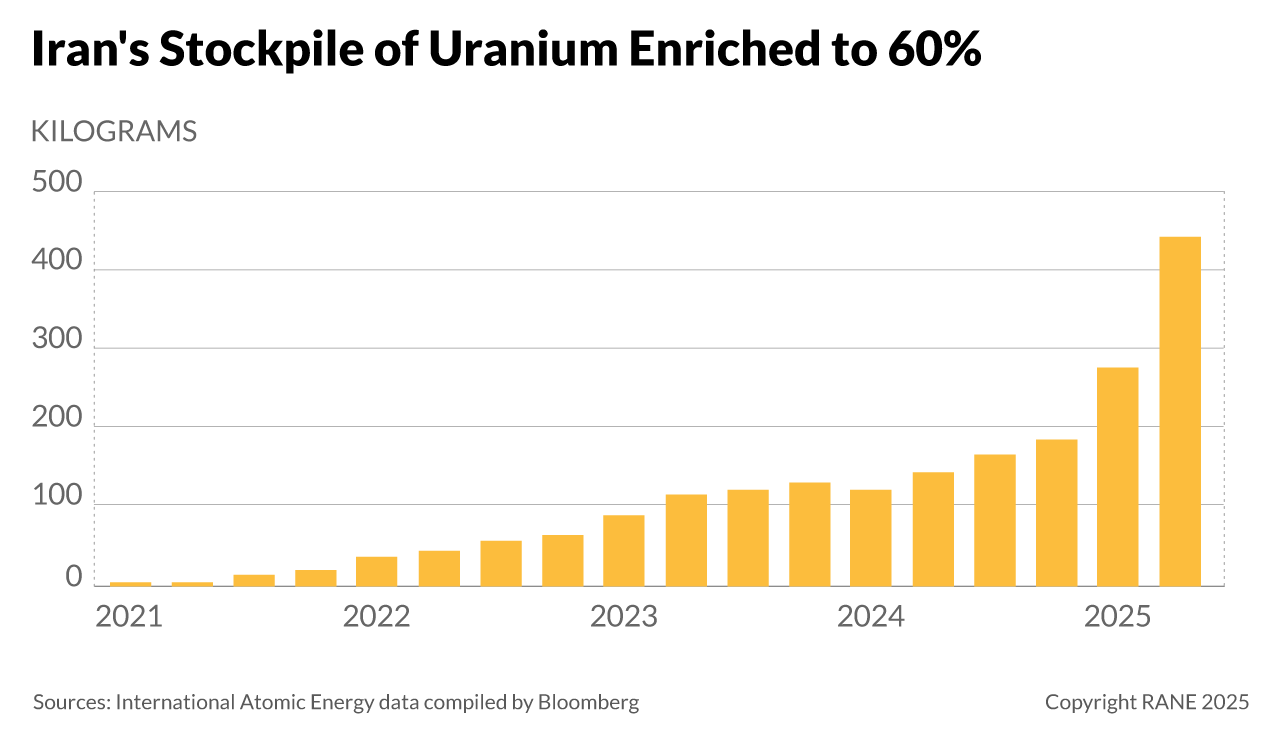
- Prior to the June conflict with Israel and the United States, the IAEA reported Iran possessed approximately 441 kilograms of uranium enriched to 60% U-235, which is close to the 90% level considered weapons-grade and sufficient for 10 nuclear bombs. The current status of this highly enriched uranium remains unclear, with some speculating it may have been hidden away from the sites targeted by the United States and Israel in June. Similarly, the status of Iran's enrichment capabilities and centrifuges, necessary for enriching uranium to weapons-grade, is also unknown. However, the strikes on Isfahan are believed to have destroyed Iran's uranium metal production capabilities, a crucial step for converting highly enriched uranium into metal that can be used in a weapon.
In responding to the U.N. sanctions, Iran will seek to remain pragmatic, avoiding any actions that could trigger another costly confrontation with the United States and Israel. Iran's response to Israeli and U.S. strikes on its soil in June, as well as the E3's triggering of the JCPOA's snapback sanctions provision, has so far been pragmatic. While some Iranian officials have made provocative and bellicose statements, the government has avoided taking any drastic measures, such as aggressive attacks on U.S. military assets in the Middle East, let alone more escalatory actions like attacks on Gulf energy infrastructure. Tehran will maintain this strategy in the coming weeks, as it serves both strategic and tactical objectives. For one, Iran has sought to maintain cordial relations with U.S. partners in the Gulf (including Qatar, the United Arab Emirates and Saudi Arabia) by arguing that Israel, not Iran, is the primary threat to regional stability — an argument that has only gained credence following Israel's Sept. 9 airstrikes targeting Hamas leaders in Doha, Qatar. Iran also does not want to take action that could trigger another round of Israeli strikes — particularly as Israeli Prime Minister Benjamin Netanyahu appears emboldened by the tactical military successes he has had against Iran and some of its proxies over the past nearly two years, and also appears to have a window of opportunity to carry out such strikes with Trump in the White House. The June conflict, as well as previous Israeli attacks on Iran in 2024, decimated Iran's air defense systems. Iran's stockpiles of short- and medium-range ballistic and cruise missiles are also likely running low due to the high volume of missiles it used in June strikes against Israel and the damage inflicted on many of its missile production facilities during the same period.
- While Iran has reportedly begun rebuilding some of its missile production facilities, the Associated Press reported in late September that Iran was struggling to acquire the mixers needed to mix and produce solid fuel for its missiles. Solid-fueled missiles are crucial for Iran because they enable its military to quickly set up and launch missiles. Liquid-fueled missiles, by contrast, must be fueled immediately before launch, and are thus more susceptible to being detected, targeted and destroyed before being launched.
Over time, however, Iran will become increasingly likely to adopt a more aggressive response amid mounting pressure from hard-liners in its government, whose political strength will grow the longer sanctions remain in place. While the government's overall response will likely remain pragmatic, Iranian hard-liners will continue to push for more aggressive retaliatory action against the West. Iran's parliament is already discussing proposals that call for Iran's exit from the Nuclear Non-Proliferation Treaty. Earlier this month, 70 lawmakers also signed a letter advocating for a ''change in the defense doctrine'' and the pursuit of nuclear weapons. While Iran's parliament ultimately has little real power over foreign policy (which is set by the Supreme National Security Council and Supreme Leader Ali Khamenei), it has previously passed laws that have constrained the government's ability to negotiate with Western powers. For instance, a 2020 law aimed at countering U.S. sanctions compelled Iran to increase its enrichment activities, which complicated negotiations to revive the JCPOA with the administration of former U.S. President Joe Biden. It is thus possible that Iran's parliament could pass a law compelling the government to consider exiting the Nuclear Non-Proliferation Treaty, though in practice, compliance with such a law and its full implementation may be slow or non-existent. However, the longer that sanctions remain in place, the more politically empowered Iran's hard-liners will become, as they frame Pezeshkian's efforts to reach out to the West and negotiate sanctions relief as futile. And as hard-liners' political influence grows, so too will the likelihood of a more aggressive Iranian response — especially if diplomacy continues to fail and/or Iran begins to rebuild its air defenses, missile stockpile and other parts of its military power destroyed in the Israeli and U.S. strikes.
- For much of the last decade, Iran's political system has been dominated by hard-liners who were empowered after the United States' 2018 exit from the JCPOA. However, Pezeshkian's surprise victory in the 2024 presidential election, after he campaigned on a promise to negotiate a new nuclear deal with the West to ease sanctions, has since weakened their influence. This is especially true as Supreme Leader Ayatollah Ali Khamenei has shielded Pezeshkian from criticism. Nevertheless, future developments will likely expose Pezeshkian to increased criticism that forces Khamenei, or his successor, to more squarely support the hard-line elements within the Iranian political system, which currently dominate the clerical establishment, the parliament and the judiciary.
In the meantime, Iran will rely more heavily on its relationships with China and Russia for economic and defense cooperation, respectively. Given the current state of geopolitical competition and their own relationships with the United States and the West, neither Russia nor China appears likely to fully adhere to the U.N. sanctions on Iran, particularly as Moscow, like Tehran, has declared them null and void. Compared with China, Russia is far more likely to overtly violate the U.N. arms embargo on Iran, which has become a key supplier of drones and other defense articles for Russia's war in Ukraine. Iran will likely also seek Russia's assistance in rebuilding missile production facilities and delivering conventional arms and defense articles. The Kremlin is less likely to support the military dimensions of Iran's nuclear program (having little desire for another nuclear state on its southern periphery), but Moscow will probably maintain some level of civilian nuclear cooperation with Tehran as well. China, meanwhile, will likely maintain economic ties with Iran, including through its smaller, non-state-owned oil refineries purchasing Iranian oil. But China's support will likely manifest as tolerance from government officials for ongoing trade with Iran, rather than a concerted effort to prop up the Iranian economy. This is because strongly supporting Iran would risk undermining China's relationships with both the United States and Gulf Arab nations. Similarly, China is unlikely to violate Western sanctions to an extent that it could expose its major corporations to being targeted by U.S. sanctions. In the currently unlikely event that the United States tries to impose a tariff on Iran's oil customers as it did on India's oil customers in August over purchases of Russian oil, China would also likely decrease its Iranian oil imports. However, China would probably still continue to trade with Iran in most consumer and dual-use goods.
- Compared with security ties, Russo-Iranian economic ties are more limited. This is partly due to the fact that Russia's economy, outside of the oil and gas sector, is relatively small and, like Iran's, is subject to significant sanctions. However, Tehran and Moscow have recently initiated some economic projects, such as the 2024 integration of their payment systems, enabling Iranian bank cards to be used in Russia.
The U.N. sanctions will further strain Iran's economy, which is already struggling with frequent fuel, electricity and water shortages, raising the likelihood of mass protests that hard-liners could exploit to weaken Pezeshkian. The practical economic impact of the reimposed EU and U.K. sanctions, on their own, is marginal. But when coupled with an increasingly hard-line U.S. strategy and a likely increase in sanctions enforcement activities by the United States and now European countries, these developments will further restrict Iran's already limited access to hard currency and imported goods. This will increase pressure on the Iranian economy, which is already reeling from the 2018 reimposition of U.S. sanctions. Iran's annual inflation rate surpassed 40% in July and August for the first time in over two years, and the Iranian rial depreciated to a new record low of about 1.12 million to the dollar on Sept. 28. Many Iranian cities have also experienced significant power shortages this year, which have at times forced Iranian officials to implement government shutdowns in order to conserve electricity. Worsening economic conditions will spur more protests in Iran, which, according to ACLED, has already seen over 2,000 protests this year alone — primarily driven by economic issues (38%), wages and labor disputes (26%), and water or environmental concerns (10%). From May-June 2025, Iran also saw a nationwide truckers' strike prompted by rising fuel, insurance and other costs, which marked the broadest protest activity this year. These demonstrations have so far not escalated into widespread anti-government movements similar to the 2022-23 women's rights protests or the 2019-20 fuel protests. However, sustained economic pressure on Iran, coupled with little progress in nuclear negotiations that could secure sanctions relief, will erode public support for Pezeshkian's government and, over time, raise the likelihood of another round of nationwide protests. This would be in line with the historical patterns of Iranian protests, in which smaller issues eventually converge to spark national protests. Precedent also suggests Iranian authorities would heavily crack down on such protests, and that hard-liners would exploit the unrest to sideline Pezeshkian and push for more aggressive responses to future sanctions snapbacks.
- To mitigate the economic impact of the U.N. sanctions, the Iranian government will likely double down on its so-called ''Resistance Economy'' policies, which include supporting domestic industries, minimizing imports and providing subsidies for low-income Iranians — initiatives that have all been plagued by mismanagement in past years.
