
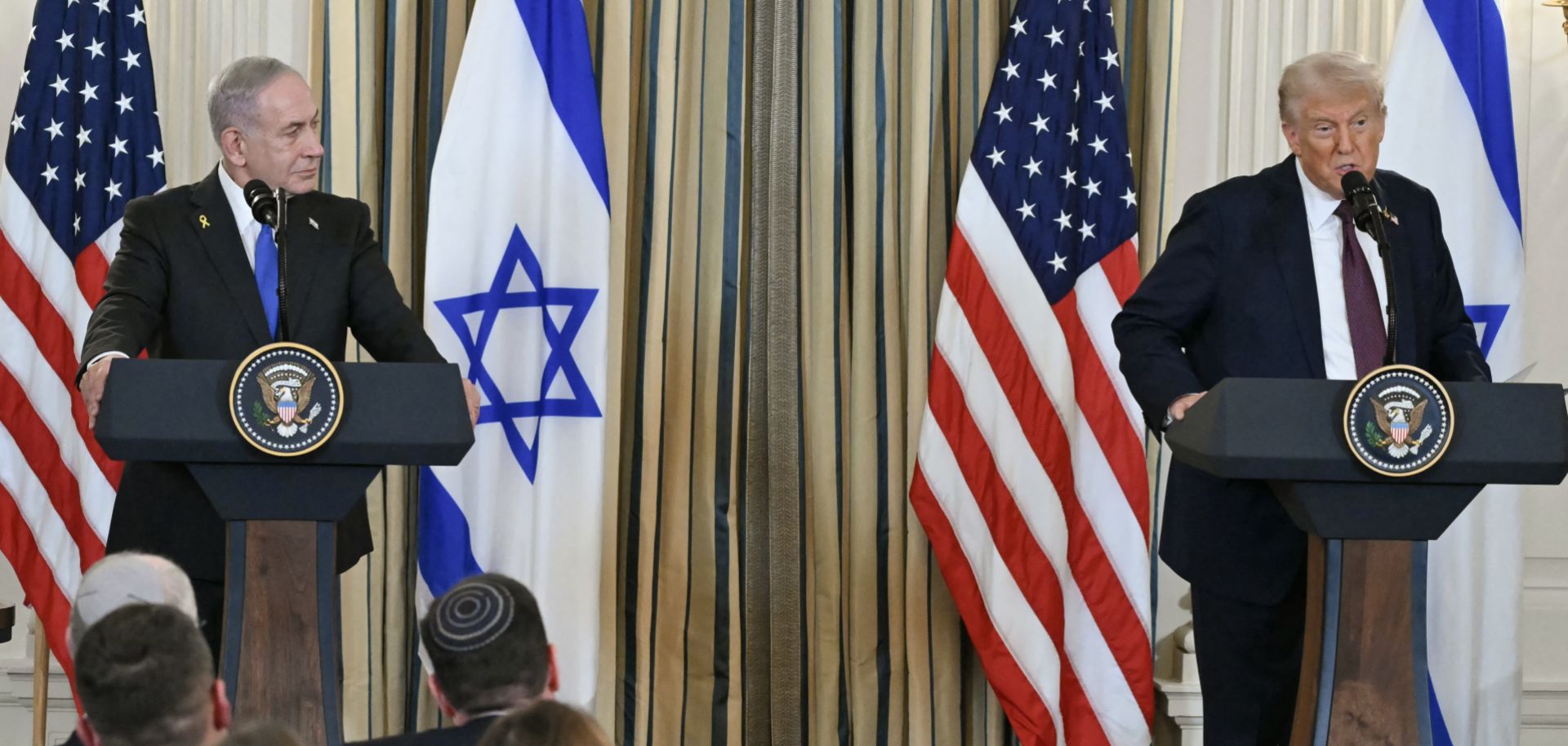
Israel's Sept. 9 airstrike on Qatar targeting Hamas leaders has exposed new fissures in Israeli-American relations. In the wake of the attack, U.S. President Donald Trump said he was "very unhappy" about the strike and reportedly reassured Qatar, a major non-NATO ally, that it would not be subject to an open-ended air campaign conducted by a fellow U.S. ally, though he resisted meaningfully sanctioning Israel in response.
The U.S.-Israeli alliance remains strong, anchored by close political links and the still-overlapping security imperative of the threat from Iran. But beneath the surface, the picture is shifting. American opinion of Israel has undergone a significant and lasting change beginning in the late 2010s, a process that has only been deepened by the ongoing Israel-Hamas war. Factions in both parties, though still a minority, have begun to openly criticize Israel in a way that would have been unthinkable a generation ago, underpinned by young voters in the United States who hold sharply different attitudes toward Israel to their parents and grandparents.
These undercurrents have already produced tensions. In July, a majority of Democratic senators voted to block arms sales to Israel, a first for the party, though they were overruled by pro-Israel Republicans and Democrats. Last year, under former President Joe Biden, the United States even briefly held up arms deliveries to Israel for the first time since 2014 to force a tactical shift from Israel during its Rafah offensive. On the Republican side, Rep. Marjorie Taylor Greene, a strong Trump supporter who nonetheless has some differences with the president, has called Israel's actions in Gaza "genocide." Meanwhile, right-wing podcasters such as Tucker Carlson have taken aim at the alliance with Israel with increasing frequency.
The world is changing. Iran is becoming a bigger problem for Israel than it is for the United States, which is increasingly looking to Europe and Asia, the true centers of global geopolitical power, and can ill-afford to be pulled into Middle Eastern conflicts. As a result, it is just a matter of time before the close era of Israeli-American cooperation comes to an end.
An Alliance Built on Sound Fundamentals
A fundamental shift in the U.S.-Israel relationship is some way away. The alliance is underpinned by strong geopolitical imperatives. In the security pillar, both have a mutual adversary in Iran. Joint Israeli-U.S. strikes set back, though did definitely not destroy, Tehran's nuclear program in July. Israeli intelligence sharing and military cooperation remain extremely valuable to the United States. Socially, although younger Americans have become much more critical of Israel, older generations continue to hold largely positive views of the country and remain critical of anti-Israel militant actors like Iran, Hamas and Hezbollah. In the political sphere, ideological factors also play a role. As Israel has shifted toward becoming a right-wing, national-religious country over the past few decades, it has found a counterpart movement in the United States, where Christian nationalism is also a rising factor in American domestic politics, particularly within the ruling Republican Party.
The United States remains in Israel's court in many significant ways. It intervened decisively on Israel's behalf during the Israel-Iran war in June and has not suggested that it would impose any meaningful sanctions or penalties for the Qatar strike. Even as a growing number of states accuse Israel of committing genocide in the Gaza Strip and U.S. and Israeli allies recognize a Palestinian state, Washington neither agrees with these criticisms nor is prepared to act to change Israel's military strategy. And despite budding criticism within both parties, a supermajority in favor of maintaining U.S. military aid to Israel is almost certain to survive past the 2026 midterms. These are enough to hold together a pro-Israel consensus in America's political system, for now. But there are clear signs that the relationship is overdue for a shift.
The Tyranny of Distance
Until the 1960s, geography limited the extent of U.S.-Israeli ties. Israel is small and far away from the United States. Until the United States needed to secure the Middle East's energy and its trade routes, the region was geopolitically irrelevant to Washington. After the 1967 Six-Day War (and the United Kingdom's withdrawal from the region beginning that same year), Israel overcame this constraint by leveraging its role in the Cold War as its Arab rivals — Egypt and Syria chief among them — drifted into the Soviet camp. After the fall of the Berlin Wall, Israel pivoted to becoming an effective anti-Iranian partner. The only liberal democracy in the region, it was a natural ally of the United States as Washington, after 9/11, sought to impose democracy on the Muslim world as a solution to extremism. Trade flourished, buoyed by Israeli tech innovation. Social ties thrived, pushed by the American Jewish population, the largest in the world after Israel.
But even as ties seemed to be closer than ever, the relationship was undergoing subtle but meaningful shifts. Israel has, since the start of the century, been drifting into a right-wing, national-religious identity that has seen the rise of an Israeli far right anathema to many Americans. A values gap with the United States, and in particular with the Democratic Party and many American Jews, has been steadily growing. Meanwhile, younger Republicans have grown up with a nuclear-armed Israel that is unquestionably the most powerful state in the region rather than the David surrounded by an Arab Goliath older generations of Americans saw it as. Even if they see Israel as an ally, some question why billions of U.S. taxpayer dollars should subsidize the military of a first-world country with no regional rivals.
Nor has Israel overcome the tyranny of distance. Israel has a deep, existential interest in what happens with the Palestinians, who live next door; the United States, an ocean away, does not. So long as America's interests in energy, trade and combating extremism were assuaged, the Palestinian question was only secondary. For many years, Israel's slow-creeping strategy of changing "facts on the ground" was acceptable. Israel contained Hamas in Gaza with short, relatively predictable wars. It expanded settlements in the West Bank, making the prospect of a Palestinian state ever more remote. The United States would sometimes condemn these developments on letterheaded paper, but being local in impact and remote to U.S. interests, they did not seriously strain the relationship.
But on Oct. 7, 2023, Israel's strategy of containment of Hamas spectacularly failed. The successive wars and conflicts that followed the Hamas attack — from Gaza to Lebanon and Qatar — have for the first time in many years demonstrated that Israel's regional strategy threatens America's core interests. Israel's remote geography no longer afforded America the luxury of light-touch diplomacy. The United States became an active military participant, bombing Iran's nuclear facilities, Yemen's Houthi rebels and Iranian-backed militias in Syria, all while militarily supporting Israel's war effort and giving it the means to defend itself from attacks by Iran and its proxies. At home, the values gap became impossible to ignore as parts of the Democratic base became disillusioned by what they saw as the Biden administration's all-but-unconditional support for a state committing war crimes against an oppressed population. They began demanding a notable change in the relationship — to force Israel to end the war in Gaza well short of its stated goals.
Biden resisted those calls, partially out of personal preference for the old Israeli relationship (and its accompanying politics in the American electorate) and partially because Iran remained adversarial to the United States. Despite their other foreign policy differences, Trump has demurred pressure on Israel in a similar way and for similar reasons. Even as he campaigned on ending wars, he's been shy to use America's substantial leverage over Israel to force a swift conclusion to the conflict.
At the same time, it was clear other security imperatives were growing. After Russia's invasion of Ukraine in 2022, the United States started looking at Moscow and Beijing as not mere "near peers" but as active threats against which war materiel must be carefully rationed. These concerns were not hypothetical. The United States used up to a quarter of its advanced anti-ballistic THAAD missiles to defend Israel during the Israel-Iran war, and before that had struggled to supply both Israel and Ukraine with 155 mm artillery shells. Now, despite Trump's clear pro-Israel position, war planners in Washington must confront a reality that major escalation in Asia, Europe or the Middle East would force the United States to prioritize where to distribute aid and war materiel.
The Paths to a Loosening
The Israeli-American relationship could change in at least three ways. The first is as the result of electoral dynamics. The 2026 midterm elections will probably not produce a majority critical of Israel in Congress, but later cycles might. Each vote will push out more politicians who prefer Israel and empower new leaders able to adjust the relationship without political blowback. Views critical of Israel are growing in prominence in both parties. Democrats have become more critical of Israel because of the values gap. Some Republicans criticize the alliance out of neo-isolationism and strategic restraint, voicing concern about the open-ended nature of diplomatic and military support. They also argue U.S. support for Israel diverts military resources away from the strategic competition with China and Russia. The end of a reliably pro-Israel Congress, or even presidency, may be relatively close at hand.
The second is that another major geopolitical crisis forces the United States to come to terms with Israel's burden on America's defense strategy. Scenarios like a Chinese invasion of Taiwan, Russian conventional victory in Ukraine or second Korean War could force the United States to suddenly divert resources to another major front. Finally, the third path is that of domestic political volatility hampering the United States' ability to pass significant pro-Israel legislation. A prolonged recession or period of sustained domestic unrest that produces rapid political realignment, like the 1960s and 1970s, could cause the pro-Israel political consensus to break down much faster. In the context of a strained political and fiscal situation, aid to Israel could become a "nice-to-have" rather than a "must-pass."
What the Future Holds
How the relationship will evolve depends on why it loosens. Should it be because of political cycles, Israel will have time to adjust and adapt to less American aid and more regional pushback. Netanyahu recently suggested as much, calling for Israel to be a "little Sparta" that would stand on its own indefinitely. Already, the Israelis are trying to build similar 2,000-pound bombs to the ones Biden held up during the Rafah offensive. There are limits to this strategy. Israel remains a relatively small country with a small economy compared to the United States. It could cope with the end of American aid, but at a cost. It could develop deeper defense relationships with partners like India and the United Arab Emirates, but these would not compare to the depth and breadth of technology, intelligence and sheer scale offered by the world's sole superpower.
On the other hand, should U.S. ties with Israel be suddenly downgraded due to a geopolitical emergency elsewhere, Israel would be more caught in the lurch. It would need to stabilize its frontiers faster, which could involve concessions to the Palestinians and moving away from the hawkish foreign policy that has alienated key Arab and Muslim partners, as it seeks a stronger foundation of regional security. It would also try to maintain relations with the United States by shifting some of its defense policies to appease Washington, either through intelligence cooperation to manage the geopolitical crisis, offering air defenses, training or even, in the most extreme case, sending forces abroad to take part in a U.S.-led coalition. The latter would be unprecedented in Israeli history, but might be worth it to keep the United States from giving up on the relationship with Israel in the face of a global crisis.
The last option, a domestic crisis that renders America unable to support Israel in the same way, would also force Israel into a more conciliatory position. But this scenario would not have an appeasement option for Israel. The United States would no longer be a partner it could count on. Israel would find itself in a position similar to the 1960s, when France abandoned its close relationship with the country in favor of the Arab states. Then, Israel cast about and eventually found the United States. This time, the Israelis might have to ally with an array of states to offset the impact of the loss of U.S. support. In an extreme scenario, Israel could align with U.S. rivals like Russia or China, viewing them as the only states left able to project power.
The era of close Israeli-U.S. ties is coming to a close. Israel's future geopolitical strategies will have to find new ways to chase the country's imperatives without the full backing of the United States. Israel has adapted before, pivoting out of the era of European power politics in the 1950s successfully into that of the U.S.-led world order. But as that order erodes, Israel will have to adapt again; the speed of that change will likely influence which powers Israel aligns with and how much it must offset its relationship with the U.S. How much will it look inward to self-sufficiency or outwards to new partners that doubtless will have their own demands on Israel? How future Israeli governments answer that question will define the country's own security and prosperity as it finds itself going at it alone.
