
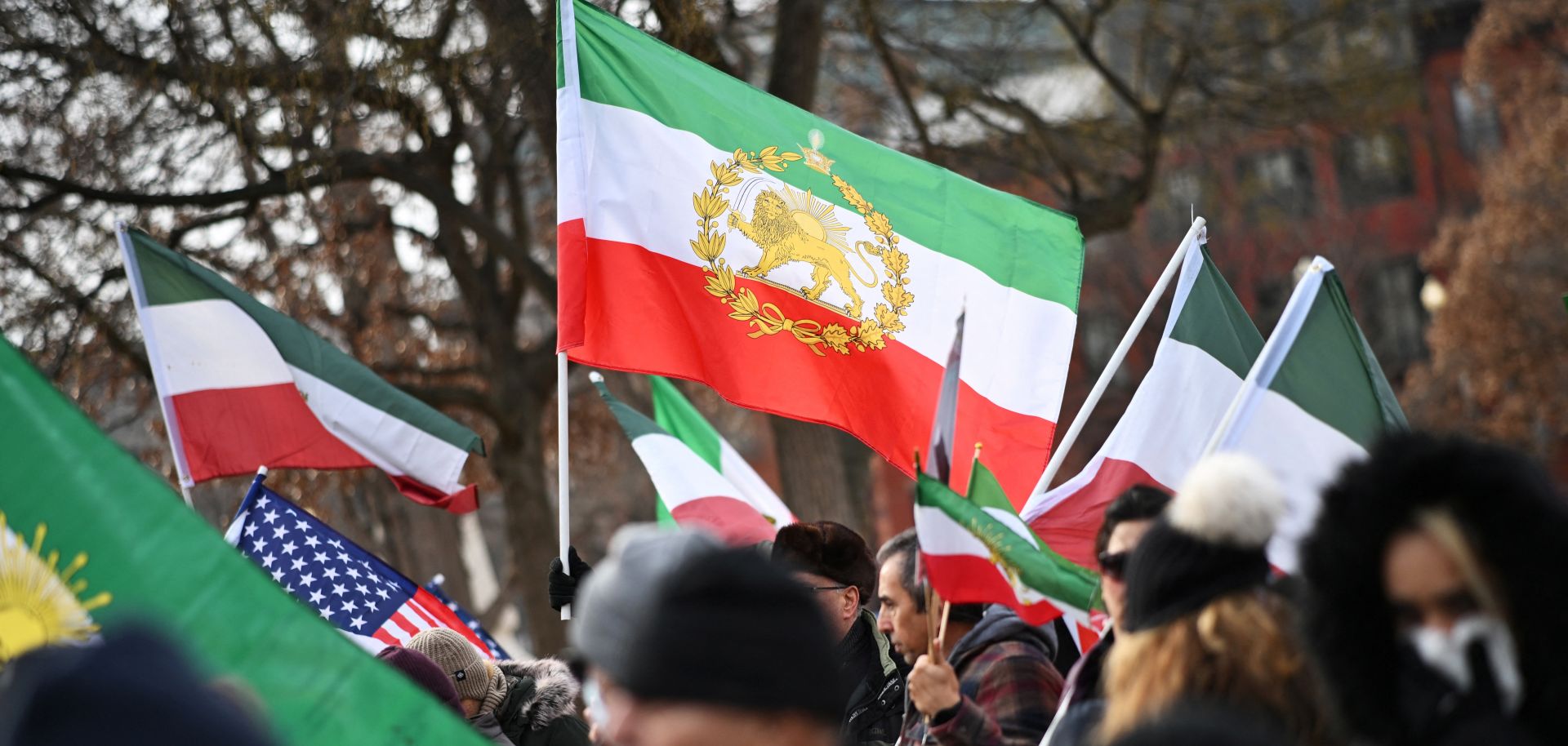
The latest round of mass protests in Iran could endure for several more weeks or months before they are likely suppressed by crackdowns, creating a window of opportunity for risky Israeli and/or U.S. military or covert action against Iranian senior leadership. Iran's most serious protests in at least two years entered their eleventh day on Jan. 7, with no clear end in sight. The U.S.-based NGO Human Rights Activists in Iran reported on Jan. 6 that protests over the country's deteriorating economic situation have occurred in at least 285 locations across 27 provinces, and that 34 protesters have been killed and more than 2,000 arrested in the resulting security crackdown. On Jan. 7, Vice President Mohammed Jafar Ghaempanah claimed that President Masoud Pezeshkian ordered security forces to avoid violence unless national security is compromised. However, Chief Justice Gholamhossein Mohseni Ejei said the same day that there would be "no leniency" for protesters who "help the enemy against the Islamic Republic," referencing remarks recently made by U.S. President Donald Trump supporting the protest movement and threatening Iran if any protesters were killed; this suggests there has been no real change in the government's crackdown orders to security and law enforcement officers. On Jan. 6, Iran's exiled crown prince Reza Pahlavi, who is the eldest son of the shah overthrown in the 1979 Iranian Revolution, also released a video from Washington calling for protesters to take to the streets on Jan. 8 and Jan. 9, saying "based on…this action, I will announce the next calls to you."
- In an apparent response to Trump's remarks supporting the protesters, Iran's Defence Council, a body set up after the Israel-Iran conflict in June 2025 to streamline defense and national security planning, released a statement on Jan. 6 saying preemptive strikes were legitimate ways to defend Iran. Similarly, Iran's army chief, Maj. Gen. Amir Hatami, on Jan. 7 threatened military action over rhetoric against the Islamic Republic.
The protests have been driven by worsening economic conditions in Iran and uncertainty over how the Pezeshkian-led government will address these concerns. The unrest was initially triggered in part by the Iranian rial hitting a record low of 1.45 million to the U.S. dollar on Dec. 28, prompting shopkeepers in Tehran's Grand Bazaar and other commercial districts in the city to take to the streets to protest the worsening economic situation, with Iran's annual rate persisting above 40%. While first concentrated among the merchant class in the Iranian capital, the demonstrations quickly spread to other commercial centers across the country. The movement has since expanded to include activists, students and, most notably, truck drivers, whose strikes can inflict severe economic damage in Iran. Iranians' economic frustrations have been simmering for years amid ongoing U.S. sanctions. Pezeshkian was elected president in 2024 on the promise of negotiating a new nuclear deal with the United States that would ease those sanctions. But talks have faltered due to the Trump administration's maximalist demand that Iran abandon its claimed right to uranium enrichment, with the U.S. and Israeli strikes on Iranian nuclear facilities in June 2025 only compounding the deadlock. With little hope for near-term sanctions relief, the Iranian government's capacity to address the grievances of the merchant class is limited. Even before the current protests, Iran's political elite frequently squabbled over economic concerns, with various political factions pointing fingers at each other for the crisis. This was most notably seen in March 2025, when then-Economy Minister Abdolnaser Hemmati was impeached over cost-of-living concerns and inflation. In an initial attempt to appease protesters, Pezeshkian on Dec. 31 replaced the central bank governor with Hemmati, who is generally viewed as a technocrat capable of limiting the impact of Iran's economic crisis due to his previous experience as the central bank leader from 2016 to 2018, when then-President Hassan Rouhani's government introduced legitimate reforms to strengthen Iran's monetary policy framework. However, Hemmati's appointment merely demonstrates how the country's elite constantly shuffles long-entrenched leaders in and out of government, as they try to appease the population while having few viable options to actually improve the economy. In another piecemeal attempt to appease protesters, the Iranian government also announced on Jan. 4 that each Iranian citizen would receive a 1 million toman (about $7) in deposit credits each month for the next four months. But this is a paltry amount, even by Iranian living standards, further highlighting the country's precarious finances and limited capacity to address popular economic concerns.
- During his first term, Trump launched a maximum pressure campaign against Iran, effectively signalling the end to the 2015 nuclear deal that his predecessor, Barack Obama, had negotiated. The agreement provided Iran with significant sanctions relief in exchange for limiting its nuclear activities. Since the nuclear deal's collapse and the subsequent re-imposition of extensive U.S. sanctions, Iran has experienced major protests roughly every two years. These include the 2017-2018 economic protests, the 2019-2020 fuel protests, the 2022 protests over the death of Mahsa Amini and, most recently, the current economic protests.
While the protests may persist for months, there have so far been no signs of internal fracturing within the ruling elite that would suggest the unrest could lead to the Islamic Republic's demise. The Islamic Republic and its influential military branch, the Islamic Revolutionary Guard Corps (IRGC), have spent decades developing an extensive internal security apparatus designed to suppress protest movements and other domestic threats to the regime, even at the expense of strengthening the national defenses against external threats. In order for the current protests to truly endanger the regime, this massive apparatus would need to fall apart, which would require the emergence of fissures within the IRGC, national security apparatus and the rest of the ruling elite. But there has so far been little evidence of such fissures emerging; even the presidency has supported some crackdowns, despite Pezeshkian's reported order against using violence against peaceful protesters. Moreover, even if such internal divisions did emerge, it would likely result in only a partial transformation of the current Iranian regime, rather than its complete collapse, given the sheer size of the internal security apparatus, at least in the short to medium term.
- Iran's internal opposition movements have largely been co-opted by the state. Its most prominent opposition leaders are in exile, like Pahlavi. The many opposition figures living outside Iran have historically been extremely divided, composed of communists, republicans and monarchists like Pahlavi who share little in common apart from their opposition to the Islamic Republic; these individuals also have limited support and institutional strength within Iran itself.
While unlikely to collapse the regime, the ongoing unrest could open the door for Israel or the United States to conduct covert or overt activities aimed at further destabilizing the Iranian government, either indirectly by encouraging the protests or directly via military action against Iranian leaders. Emboldened by its military successes in the past two years against Iran and its regional proxies, Israel will certainly seek to take advantage of the current protest movement to further destabilize the Iranian regime. During previous protests in Iran, Israeli-linked threat actors have launched cyberattacks targeting the country's economic infrastructure, such as the card payment system for subsidized fuel, to exacerbate economic hardship and drive more people onto the streets. The United States may also try to intervene, such as by covertly helping to organize the protesters and/or by pressuring members of the security establishment (via threats or financial incentives) to refrain from suppressing the demonstrations. Still, Israel and the United States have few tangible ways to directly support the Iranian protesters, despite pledges by Trump and other White House officials that Washington will stand behind them. Fresh off the heels of the Jan. 3 U.S. military operation that seized Venezuelan leader Nicolas Maduro, the United States or Israel might consider similar military action targeting key Iranian leaders. Such an operation would aim to destabilize the Iranian regime and compel remaining elements to negotiate, paralleling the current U.S. strategy in Venezuela with the rump Maduro-led regime and interim President Delcy Rodriguez. However, pursuing this strategy in Iran carries inherent risks. For one, the Islamic Republic is far more ideologically aligned and entrenched than the Venezuelan government. This means that any kinetic attack that kills or removes a figure like Supreme Leader Ali Khamenei or a senior military official would play into Iran's and Shiite Islam's martyrdom culture, likely galvanizing the regime's unity against cooperation with the West. Crucially, renewed military strikes on Iran would also likely put an end to the current protest movement by leading instead to a wider display of Iranian nationalism and unity, a pattern observed after U.S. and Israeli strikes in 2025. Furthermore, any new Israeli and/or U.S. strikes would invite Iranian retaliation that would likely be far more significant than any response Venezuela could muster.
- Any overt U.S. or Israeli military action against Iran's ruling elite, beyond assassination strikes, would face immense challenges. An exfiltration mission similar to the U.S. helicopter operation that seized Maduro in Caracas, for example, would be exponentially more difficult in Iran, as U.S. or Israeli helicopters would need to refuel inside Iranian territory due to the distance from friendly airspace and the Persian Gulf. This refueling challenge is precisely what led to the failure of Operation Eagle Claw in 1980, which sought to rescue U.S. embassy staff held hostage during the Iranian Revolution.
