
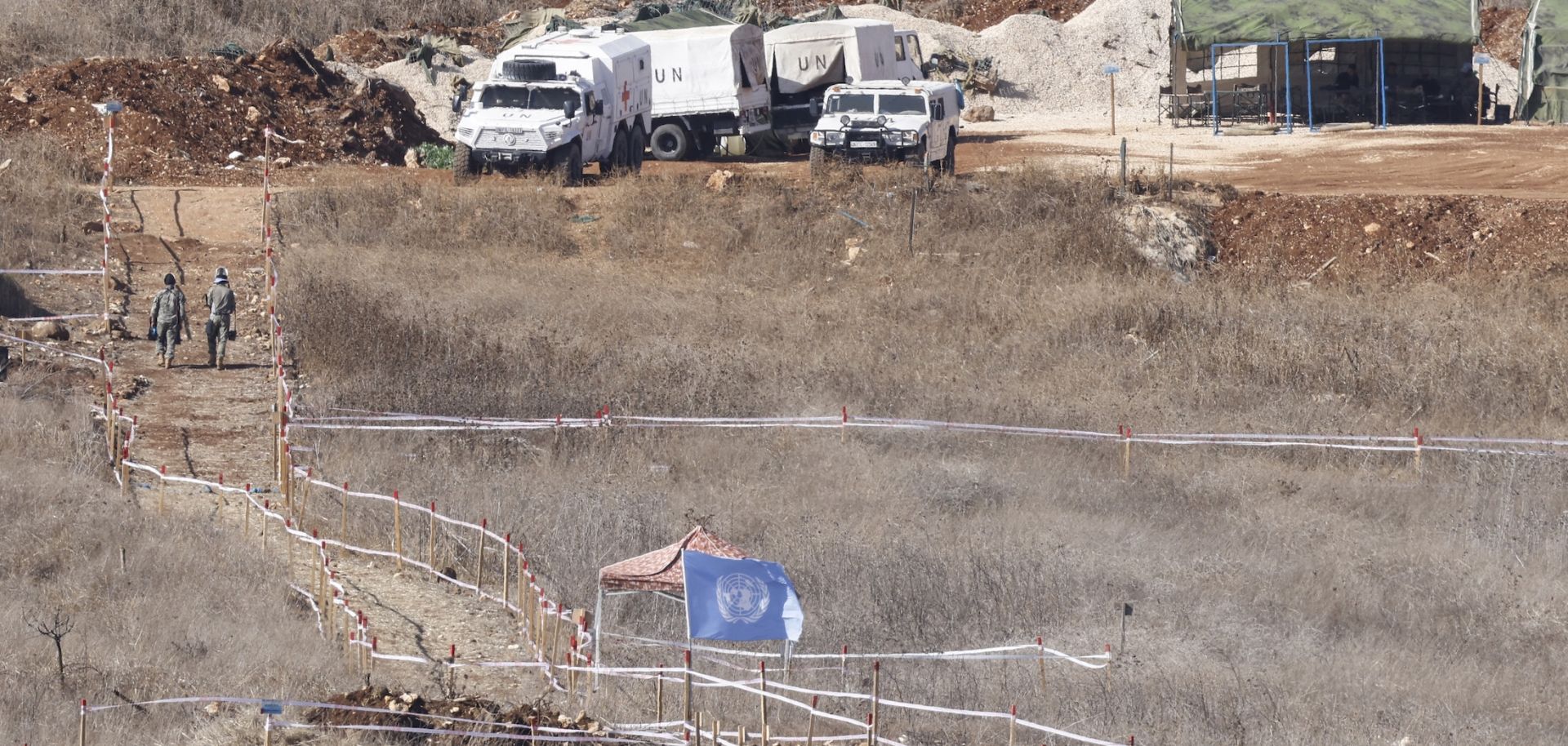
Talks between Lebanon and Israel will probably continue despite Hezbollah's obstructions, but Israel's likely refusal to offer meaningful concessions will sustain a high risk of renewed conflict in the coming months. On Dec. 3, Lebanese and Israeli civilian representatives held direct talks for the first time in four decades to establish a political and economic foundation for ties between the two countries. The talks occurred under the monitoring mechanism established to oversee the November 2024 Israel-Hezbollah ceasefire, and were held at the U.N. peacekeeping force headquarters in the Lebanese town of Naqoura, near the border with Israel. Israeli Prime Minister Benjamin Netanyahu sent a representative from the Israeli National Security Council, while Lebanese President Joseph Aoun sent Lebanon's former ambassador to the United States, Simon Karam, to head their respective delegations. Senior U.S. envoy Morgan Ortagus also attended the meeting.
- The last time Lebanon and Israel engaged in direct talks was in 1983, following Israel's invasion and partial occupation of Lebanon. These U.S.-mediated negotiations led to the May 17 Agreement, which aimed to formalize security arrangements, establish a framework for normalizing relations and secure an Israeli withdrawal. But Lebanon's parliament never ratified it due to intense opposition from Syria and its allied Lebanese factions, which viewed the deal as a threat to Lebanese sovereignty. As a result, the agreement collapsed, marking one of the closest but ultimately unsuccessful attempts to formalize Lebanon-Israel relations.
- Israel and Lebanon have technically been at war since 1948, when Lebanese forces attacked the nascent Jewish state as part of a larger Arab coalition. Given the absence of a peace treaty or formal diplomatic relations, the two countries operate under longstanding ceasefire arrangements rather than a legally binding end to hostilities.
- On Nov. 27, 2024, Hezbollah and Israel signed a U.S.-brokered ceasefire, ending their year-long conflict. The confrontation began in late 2023 when Hezbollah launched drones and rockets into Israel in support of Hamas in Gaza. The conflict then sharply escalated in late 2024 after Israel launched a major air and ground offensive that destroyed much of Hezbollah's military infrastructure and killed nearly its senior leadership, including Secretary General Hassan Nasrallah.
- The United Nations Interim Force in Lebanon (UNIFIL) has been deployed in southern Lebanon since 1978. Following the 2006 Israel-Hezbollah war, the mission's mandate was expanded to monitor the cessation of hostilities, support the Lebanese military between the Litani River in southern Lebanon and an area known as the Blue Line (a de facto frontier between Israel and Lebanon), and facilitate Israel-Lebanon coordination and de-escalation through tripartite meetings. The peacekeeping force includes roughly 10,000 personnel and conducts daily patrols across its area of operations. In August 2025, UNIFIL's mandate was renewed for an additional year, but it will end by the end of 2026.
Lebanon is seeking to deter further military escalation by reassuring Israel and the United States of its willingness to advance Hezbollah's disarmament, while Israel is seeking to showcase its openness to negotiations amid pressure from Washington and its war-weary population. By engaging in rare direct talks with Israel, Lebanon is seeking to reassure the United States (and Israel) of its commitment to advancing Hezbollah's disarmament as part of the November 2024 ceasefire. Beirut is also hoping to convince Israel to curb its ongoing attacks on Hezbollah targets in the country, and to revive stalled discussions on long-standing security issues (e.g., an Israeli withdrawal from border positions) — thereby creating the necessary political space to persuade Hezbollah to lay down its arms. Furthermore, though holding talks with Israel, the Lebanese government is attempting to further corner Hezbollah, which is now facing pressure from a more critical Lebanese state pushing for disarmament, an Israeli threat of elimination for any retaliation, rising domestic opposition, a hostile Syrian government willing to align with the United States, and an Iran that has struggled to revive its supply lines to Hezbollah and currently appears more interested in negotiations than another war. For Netanyahu, the meeting provides a symbolic diplomatic win that will help ease domestic political pressure from Israel's war-weary population ahead of elections next year. It also sends a message to the United States that Israel remains open to dialogue with its neighbors amid mounting U.S. criticism over recent Israeli strikes in Syria, including a Nov. 28 attack that killed dozens of people, including civilians. Additionally, the meeting positions Israel to later justify future military action should the negotiations fail.
- Over the past year, Israel has continued to conduct airstrikes on sites in Lebanon allegedly being used by Hezbollah to rebuild its military capabilities in breach of the ceasefire. Since the end of the Israel-Hezbollah conflict in November 2024, the Israeli military has also killed hundreds of Hezbollah fighters in strikes, claiming they were violating the terms of the ceasefire. Most recently, on Nov. 23, Israel conducted an airstrike in southern Beirut that killed Ali Tabatabai, Hezbollah's acting chief of staff and a key figure in Hezbollah's efforts to regroup.
- Amid the ongoing Israeli attacks, President Aoun has continuously urged the United States to persuade Israel to come to the negotiating table, expressing Lebanon's readiness for talks and to upgrade the level of representation of the ceasefire monitoring mechanism from military representatives to civilian ones. Initially, Israel rejected Aoun's pleas for dialogue and launched more attacks against Lebanon. But on Dec. 3, Lebanese media reported the government had received a message indicating Israel's agreement to send a civilian representative for direct talks.
- According to Lebanese Prime Minister Nawaf Salam, prior to the Dec. 3 meeting, Beirut had been receiving messages through friendly countries of an impending Israeli military escalation, in addition to direct Israeli threats of military action aimed at undermining Hezbollah's efforts to rearm.
- For the administration of U.S. President Donald Trump, the Israel-Lebanon talks represent both progress in restarting truce talks and an early, albeit modest and ambitious, step toward potential normalization between the two long-standing adversaries.
Israel is unlikely to offer meaningful concessions in the negotiations and will condition any troop withdrawals on demands it knows Lebanon cannot meet, making renewed escalation with Hezbollah likely in the coming months. The Dec. 3 meeting sought to relaunch diplomatic talks concerning Hezbollah's stalled disarmament and ongoing Israeli military operations. However, unless the United States applies significant diplomatic pressure, Israel is unlikely to offer the concessions needed to achieve meaningful progress. Given its stronger strategic position over Hezbollah, which has been severely weakened after two years of Israeli attacks, Israel will almost certainly impose preconditions on Beirut — such as expanding the disarmament process — before agreeing to any troop withdrawal. Israel knows that Hezbollah will not disarm unless Israel takes steps that strengthen the Lebanese state's position, such as withdrawing from parts of the south, permitting reconstruction or halting strikes. However, Israel's hawkish regional foreign policy makes it unlikely to provide any of these concessions. Knowing Lebanon cannot meet its demands, Israel will instead use the talks to placate the United States and pave the way for expanded military action against Hezbollah if negotiations fail, as Washington is unlikely to significantly pressure Israel to concede. Therefore, while the talks may minimally delay conflict, they will probably not prevent Israel from escalating against Hezbollah or Lebanon, sustaining the risk of a renewed military confrontation in the coming months as Hezbollah continues to re-arm.
- According to recent Israeli and U.S. intelligence reports, despite facing major setbacks, Hezbollah has accelerated its rearmament efforts, outpacing Israel's airstrikes against the group. Iran has also reportedly smuggled over $1 billion in the past year, despite expanding U.S. sanctions on the group and domestic measures to prevent smuggling into Lebanon.
Hezbollah will likely tolerate the Israel-Lebanon talks, limiting its response to rhetoric and minor protests. The Dec. 3 meeting is unlikely to deepen Lebanon's internal political divisions or further alienate Hezbollah, as the group likely at least tacitly approved the move. Hezbollah probably understands the negotiations will be futile, calculating that the talks will buy it more time to continue rearming in preparation for what it sees as an increasingly likely future confrontation with Israel. As a result, Hezbollah will probably limit its response to publicly condemning the dialogue, orchestrating protests in its strongholds within Lebanon (i.e., the Beirut suburbs and Bekaa Valley) and potentially boycotting cabinet meetings. However, more drastic measures, such as withdrawing the ministers it indirectly sponsors from the Lebanese government, are unlikely.
- Hezbollah has repeatedly warned the Lebanese government that negotiations with Israel are a trap, yet the group has avoided drastic domestic actions to preserve its image as not obstructing the state. This posture enables Hezbollah to claim it is giving the government space to defend Lebanon's interests — even as it insists that the state will be unable to withstand Israeli demands, in turn helping the group justify its refusal to disarm.
However, there is a chance that Hezbollah will view the talks as crossing a red line, potentially prompting it to either conduct a limited military response or mobilize massive street protests in Lebanon, either of which would carry significant risks for the group. In the unlikely case that Hezbollah sees President Aoun's decision or his government's stance against it as crossing a red line, it may decide to escalate to prevent talks from progressing. This could take the form of a limited military action against Israel, potentially in retaliation for the recent assassination of Hezbollah's Chief of Staff. However, such action would risk triggering a major confrontation with Israel that would further degrade Hezbollah's military capabilities, embolden its domestic and regional adversaries, and expose the group and its support base to the devastation seen in Gaza. Given these risks, Hezbollah may instead decide to stage mass protests in Lebanon, mobilizing its Shiite base by capitalizing on anti-Israel sentiment and public anger over the state's neglect in reconstruction efforts. Such protests would specifically target Prime Minister Nawaf Salam, who has been more vocal in pushing for Hezbollah's disarmament. But this strategy would also carry risks for Hezbollah. If the unrest collapses the Lebanese government, it could provoke internal violence and armed clashes between Hezbollah and other sectarian-based armed groups in Lebanon, like the Maronites and Sunnis.
- Hezbollah has many ways it can escalate against Israel, with the most likely being attacks against Israeli military outposts in southern Lebanon and northern Israel. Alternatively, a more escalatory scenario would involve barrages of rockets and drones against northern Israeli cities like Haifa, Nahariyya and Acre.
