
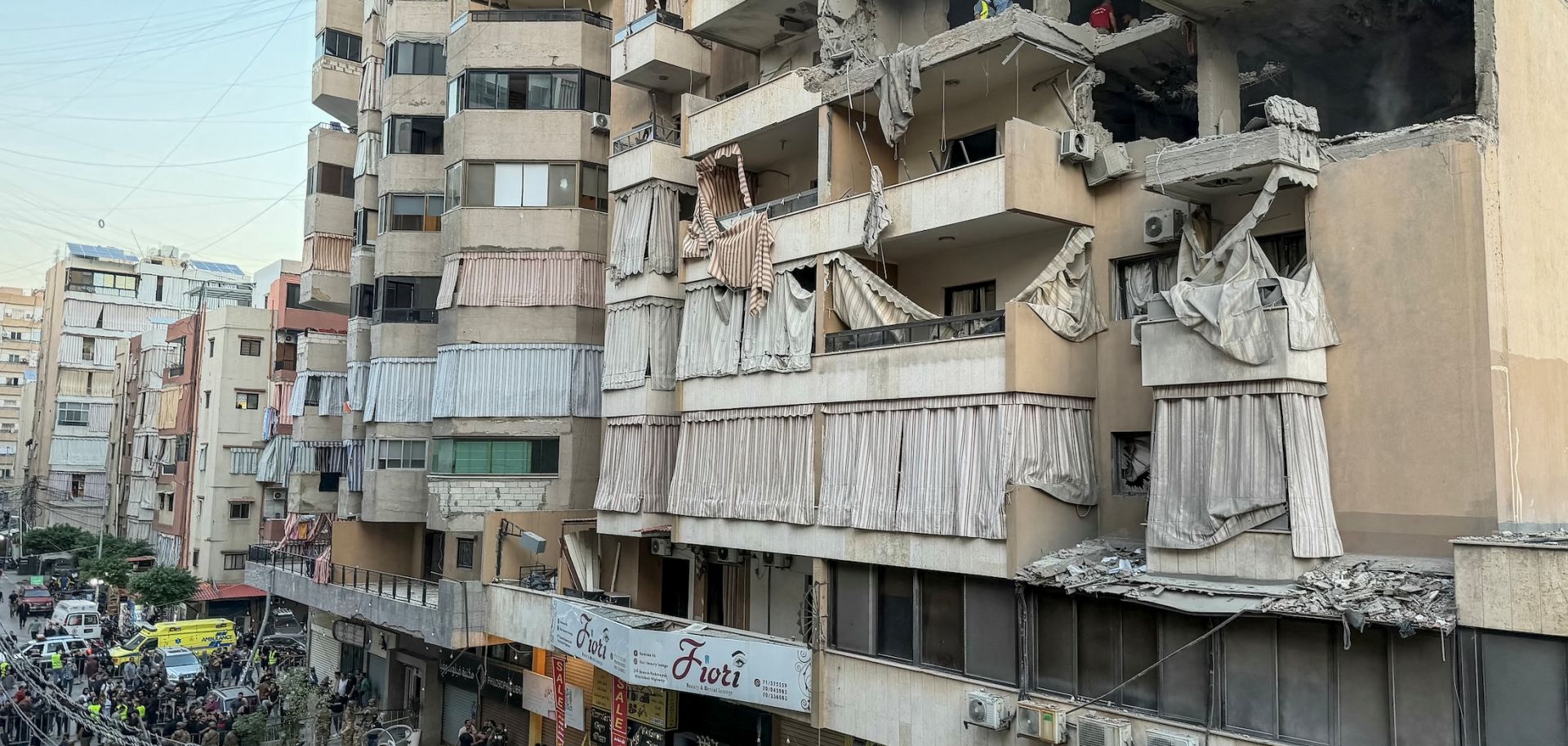
Israel will likely opportunistically escalate airstrikes against Hezbollah and Hamas to further weaken the militant groups and push them toward disarmament without ending shaky ceasefires, but a miscalculation or an opportunity for Israel to significantly set back Hezbollah would increase the likelihood of a return to major fighting. Israel conducted an airstrike Nov. 23 targeting an apartment building in the Haret Hreik suburb of Beirut, killing at least five people — including Ali Tabatabai, Hezbollah's acting chief of staff and a key figure in Hezbollah's efforts to regroup — and injuring more than two dozen others. The attack marks the first time in months that Israel has targeted Beirut. In response, senior Hezbollah official Mahmoud Qmati said that Israel had crossed a "new red line" by killing Hezbollah's second-in-command to its top leader, Naim Qassem, and that the Lebanese political and militant group was weighing its response. The Israel Defense Forces, or IDF, on Nov. 24 reportedly reinforced their positions and air defenses along Israel's northern border with Lebanon in preparation for a potential Hezbollah response. The Nov. 23 attack against Hezbollah came as the IDF has been conducting airstrikes against Hamas in the Gaza Strip despite the first phase of the Hamas-Israel ceasefire largely remaining intact. Most recently, Israel's Nov. 22 airstrikes in Gaza reportedly killed at least 22 people, according to the Hamas-run Gaza Ministry of Health.
- The Israeli Foreign Ministry released a statement that the Nov. 23 airstrike was due to "Hezbollah's repeated violations of U.N. Security Council Resolution 1701 and the 2024 ceasefire understandings, as well as the threat [Tabatabai] posed to Israel and to regional stability."
- An unnamed senior U.S. official told Israeli media, "We are pleased with the elimination of the number two in Hezbollah."
In recent weeks, Israel has become increasingly impatient with the disarmament process for both Hezbollah and Hamas, turning to airstrikes to raise the pressure on the militant groups and at risk of fragile ceasefires with each group. Hezbollah and Israel reached a ceasefire agreement in November 2024 after more than a year of cross-border fighting and devastating attacks against Hezbollah — such as the high-profile pager sabotage attacks and the assassination of Hezbollah's leader Hassan Nasrallah in September 2024 — which significantly weakened the group. In early August 2025, the Lebanese government agreed to a U.S.-backed plan to disarm Hezbollah. But there was no clear timeline attached to disarming Hezbollah completely, and the Shiite militant group conditioned its disarmament on a halt to any additional Israeli attacks against it, Israeli withdrawal from positions in southern Lebanon, Israel's release of Hezbollah prisoners and the start of the reconstruction process. Amid steep challenges to doing so — not least the logistical constraints to the Lebanese army's ability to forcibly disarm Hezbollah — Israel has reportedly become increasingly frustrated with the lack of progress and in recent weeks has conducted a series of airstrikes in Lebanese territory to increase pressure on the Lebanese government and the militant group. Lebanese President Joseph Aoun has said that Lebanon is willing to negotiate with Israel to end the intermittent airstrikes and get Israel to withdraw from Lebanese territory, but Israel has thus far not agreed. Meanwhile, negotiations have stalled for the second phase of the Hamas-Israel ceasefire, originally inked in October, in which Hamas is supposed to disarm. Israel has conducted airstrikes in the Gaza Strip to pressure Hamas to disarm, accusing the group of dragging its feet and not following the terms of the ceasefire.
- In May 2025, Lebanese Prime Minister Nawaf Salam claimed that the Lebanese army had achieved about 80% of its objectives to disarm Hezbollah militias south of the Litani River. The Lebanese army has had less success since then in disarming Hezbollah militants in other parts of the country, including the Hezbollah stronghold in the Bekaa Valley. In October 2025, U.S. and U.N. officials suggested disarmament south of the Litani had remained virtually unchanged since Salam's statements.
- According to the Hamas-run Gaza Ministry of Health, Israeli attacks have killed more than 300 Palestinians since the Oct. 10 start of the ceasefire.
Israel will likely opportunistically increase the frequency of its airstrikes against high-profile Hezbollah and Hamas targets to pressure them to disarm while avoiding ending the ceasefires, though multiple triggers exist for a more aggressive and sustained Israeli campaign that could restart major fighting. Ahead of Israel's 2026 parliamentary election, Prime Minister Benjamin Netanyahu still faces pressure from displaced northern Israelis and his far-right coalition members, and will likely try to score political victories by continuing to weaken — if not disarm — Hezbollah and Hamas as Israel maintains a hawkish regional policy. Although Hezbollah is under pressure to retaliate for the assassination due to Tabatabai's importance in the group, its weakness and inability to significantly rearm due to disrupted supply chains running from Iran through Syria since the December 2024 collapse of the al-Assad regime and the weakness of Hezbollah's main backer, Tehran, following the latter's June war with Israel will limit the militant group's response. This will likely embolden Israel to escalate airstrikes and assassinate more Hezbollah leaders to weaken the group or help usher in leaders more amenable to disarmament. Similarly, Israel will likely capitalize on Hamas' weakness in the Gaza Strip to continue airstrikes in order to degrade the remaining insurgency in the strip and pressure Hamas to disarm. But while Hamas and Hezbollah's degraded capabilities mean that they are both unlikely to mount major responses to Israel's airstrikes, a miscalculation in response to an Israeli attack — such as a reprisal that caused major casualties or an attack that underscores a major security threat — could provoke a stronger Israeli military response that could result in the ceasefire's collapse. If Israel has intelligence that Hezbollah is sufficiently weakened that the IDF could mount a short-term major military campaign that substantially degrades Hezbollah's remaining capabilities, potentially setting Hezbollah back by several years, Israel would likely seize the opportunity to do so. And if polling shows Netanyahu lagging in support as elections approach next year, he may become even more risk-tolerant for a major Israeli campaign on either front to try to rally additional support.
- The Houthis are unlikely to resume their attacks against Israeli territory or Israeli-linked shipping over the assassination of Tabatabai or the latest strikes on Gaza. While the Houthis have tied their military campaign to Israel's military actions in Gaza, previous ceasefire violations have not caused the Houthis to resume attacks. Were the ceasefire to collapse and major military operations resume in the Gaza Strip, the Houthis would, however, be increasingly likely to resume their attacks.
