
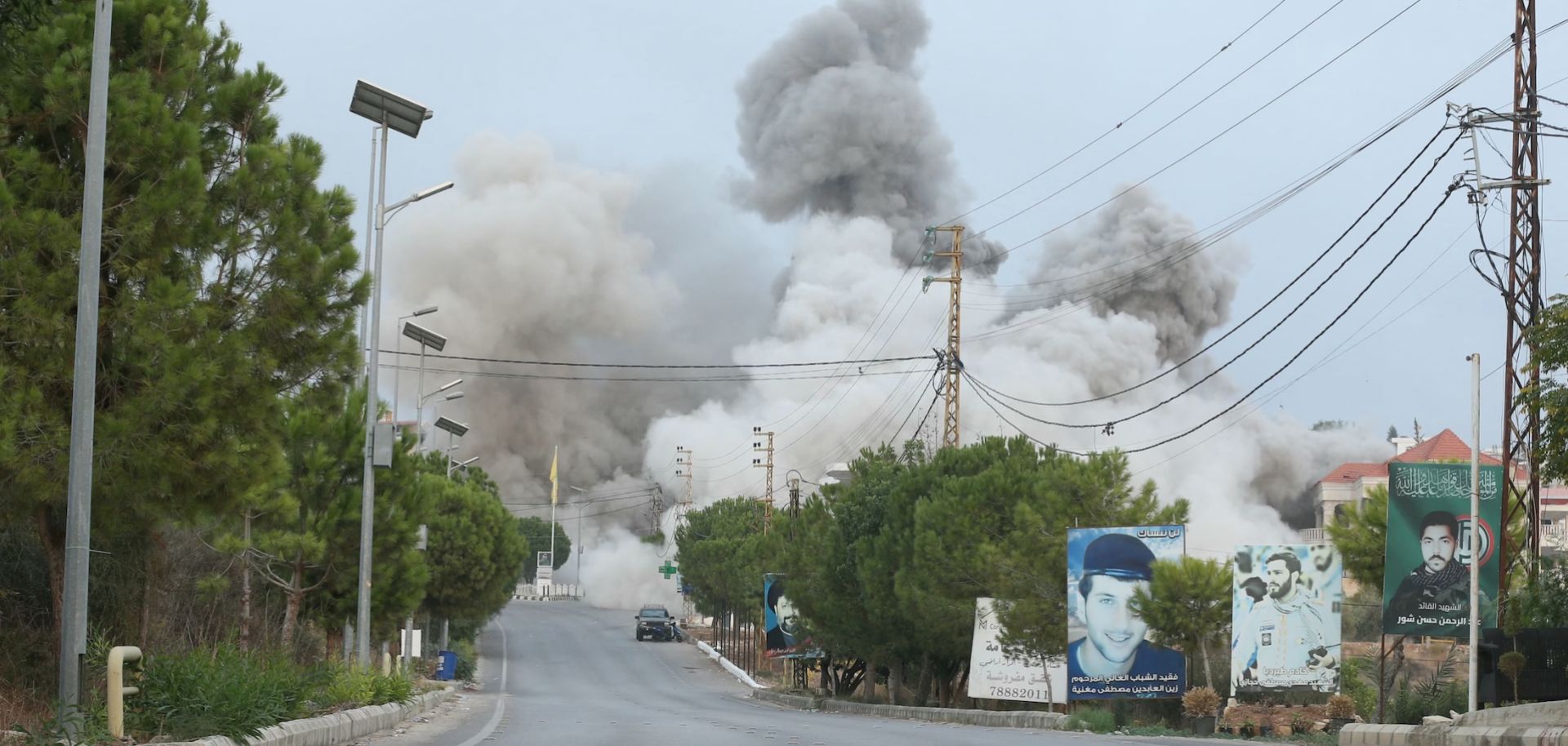
Under mounting pressure, Lebanon will pursue limited negotiations with Israel to buy time and avoid escalation over Hezbollah's disarmament, but stalled progress and the group's efforts to rebuild its military capabilities make it highly likely that Israel will intensify its aerial attacks, raising the risk of another war that would almost certainly collapse Lebanon's government and indefinitely delay elections. On Nov. 6, Israel conducted airstrikes on several residential buildings in southern Lebanese towns after issuing evacuation orders. Israel claimed the targeted sites were being used by the Lebanese and political militant group Hezbollah to rebuild its military capabilities, in violation of the ceasefire agreement the two sides signed nearly a year ago, on Nov. 27, 2024. Such strikes have become increasingly frequent in recent weeks, which the Israel Defense Forces (IDF) has framed as enforcement of the ceasefire. Israel maintains that Beirut is not taking concrete steps to disarm Hezbollah and that the group is rearming, breaching the truce. Against this backdrop, U.S. Special Envoy to Syria Tom Barrack on Nov. 1 accused Lebanese authorities of stalling disarmament efforts and warned that concrete progress was urgently needed to avert another Israeli armed escalation against Hezbollah and Lebanon. Israeli Prime Minister Benjamin Netanyahu echoed this during a Nov. 3 cabinet meeting, stating that Israel would "act as necessary" if the Lebanese government failed to disarm the militant group. Faced with this mounting pressure, Lebanese President Joseph Aoun declared on Nov. 3 that negotiations with Israel were Lebanon's only option to resolve the issue of disarming Hezbollah and, in turn, end Israeli attacks on Lebanon and secure the withdrawal of Israeli troops from the country's south. Aoun went on to say that this diplomatic route — referring to his call for negotiations — had also been accepted by Prime Minister Nawaf Salam and, notably, Speaker Nabih Berri (who is Hezbollah's main Shiite ally), hinting at a tacit endorsement from Hezbollah itself.
- On Nov. 3, Israeli Defence Minister Israel Katz accused the Lebanese government of stalling on its pledge to dismantle Hezbollah, warning that Israel's military campaign would intensify until the group is removed from the border region. Katz's remarks came shortly after the IDF confirmed an overnight airstrike in southern Lebanon that reportedly killed four members of Hezbollah's elite Radwan Force as part of Israel's ongoing strategy to degrade the group after the 2024 war.
- Israel has reinforced its military posture and forces near its northern border with Lebanon, running large-scale military exercises on Oct. 19 that simulated combat inside Lebanese territory.
- During the 2024 war, an estimated 5,000 Hezbollah fighters were killed and 13,000 were wounded, while the IDF claimed to have destroyed up to 80% of the group's military capabilities. In parallel, the Lebanese army reportedly dismantled hundreds of Hezbollah positions south of the Litani River, seizing thousands of rockets and hundreds of missiles and launchers in the process. The December 2024 collapse of President Bashar al Assad's regime in Syria also severed Hezbollah's direct supply route with its main ally, Iran.
- Since the end of the Israel-Hezbollah conflict in November 2024, the IDF claims it has killed over 330 Hezbollah fighters in strikes, claiming they were violating the terms of the ceasefire.
Israel and the United States are growing impatient with the Lebanese government's inability and/or unwillingness to disarm Hezbollah, amid the group's ongoing efforts to rearm. Despite repeatedly committing to restoring state control over all weapons and adopting plans to disarm Hezbollah in early August 2025 (albeit without a specific timeline), the Lebanese government has struggled to fulfill these promises. As of October 2025, U.S. and U.N. officials claimed that roughly 80-85% of militia arms had been cleared from areas south of the Litani River near the Israel-Lebanon border. However, disarmament efforts elsewhere in Lebanon have stalled. This is partially due to Hezbollah's insistence that it will only give up its weapons once certain preconditions are met, including an Israeli withdrawal from border positions, the release of Lebanese detainees, and the start of the government-led reconstruction process in Lebanon. It is also partially due to logistical limitations within the Lebanese Armed Forces, such as a lack of explosives experts and insufficient manpower, which have impeded Lebanon's ability to dismantle Hezbollah's capabilities north of the Litani River. Meanwhile, Israel continues to conduct near-daily strikes across southern Lebanon and into the Bekaa Valley, citing a clause in the November 2024 ceasefire that allows Israel to carry out attacks if it perceives that the truce is not being enforced. Recent media reports that Israel may have intelligence indicating that Hezbollah is rearming in preparation for a future conflict have only compounded this volatile situation, raising concerns in Beirut about another potential Israeli escalation.
- The United States' failure to persuade Israel to uphold its end of the ceasefire with Hezbollah and enact confidence-building measures has also further eroded the Lebanese government's ability to convince Hezbollah to disarm.
Under pressure, Lebanon will pursue limited, low-yield negotiations with Israel to defuse tensions over Hezbollah's disarmament and try to halt ongoing Israeli attacks. Lebanese President Anoun is pushing for negotiations with Israel as a means to de-escalate tensions and implement confidence-building measures to halt Israeli attacks. Anoun's push to hold negotiations with Israel seeks to buy time for de-escalating tensions and establishing confidence-building measures that would halt Israeli attacks. As a measure of goodwill, Lebanon will likely expand the level of representation in the ceasefire monitoring mechanism to also include Lebanese civilians, in addition to military or security officials. Such an unprecedented step would seek to signal political legitimacy and diplomatic intent in negotiations with Israel, framing the talks not as mere tactical de-confliction over a narrow security issue but as part of a broader, state-to-state negotiation process. It would also offer Israel a symbolic diplomatic victory by potentially being seen as a precursor to normalization with Lebanon. However, any tangible breakthrough on Hezbollah's disarmament will hinge on Israel offering concessions that would politically empower the Lebanese government to gradually dismantle the group's military infrastructure, beginning with an Israeli withdrawal from the five occupied border positions. But such concessions are unlikely due to Israel's perception of its enhanced strategic position after the 2024 war and Netanyahu's pattern in recent years of leveraging conflicts for his own political survival. This means that even if direct Israel-Lebanon negotiations take place, they will yield limited results and will likely eventually stall.
- Unless the United States exerts sustained diplomatic pressure on Israel, as it has done in Gaza, Israel is unlikely to adjust its approach to perceived Hezbollah threats. But even that U.S. leverage appears limited, with Washington's attention now divided between enforcing the Gaza ceasefire and brokering a separate Israel-Syria security pact.
Regardless of whether Lebanon-Israel talks materialize, Israel is highly likely to intensify its attacks in Lebanon in the coming months, while stalled progress on Hezbollah's disarmament will risk internationally isolating Lebanon and collapsing its government. Israel will pursue the forceful disarmament of Hezbollah strictly on its own security terms, waging a war of attrition against the group. This will involve further expanding the geographic scope, frequency and intensity of its attacks in Lebanon, with those strikes likely extending beyond the south to include Beirut and the Bekaa Valley. Hezbollah will be unwilling to retaliate, for fear of triggering another war that the group cannot sustain after being weakened by the last one. Meanwhile, Lebanon's government will struggle to advance any genuine internal plan for disarmament or reform, likely leading to policymaking paralysis in Beirut and increased political pressure on the government from anti-Hezbollah groups, such as the Saudi-backed Lebanese Forces. Such a situation would raise the risk of a government collapse, which could occur if key ministers resign, thereby making the government illegitimate along sectarian lines, or if Prime Minister Nawaf Salam, frustrated by the stalled progress, decides to step down. In this scenario, Lebanon's 2026 parliamentary elections would probably be canceled. The international community, including the United States, France and Gulf States, would also likely withhold foreign investments and funds, thereby prolonging Lebanon's economic crisis and hindering its capacity to enact key reforms.
- Hezbollah's current military capabilities are diminished compared to what they were before the 2024 war, despite reports that the group still has hundreds of missiles and thousands of short-range rockets and that it is actively trying to rearm. This reduced strength is largely why Hezbollah has avoided retaliating against Israel's repeated attacks and assassinations of its fighters following the November 2024 ceasefire.
If Israeli military efforts and diplomacy fail and/or if Hezbollah decides to retaliate, Israel would then wage a new war against the group, almost certainly collapsing the Lebanese government and indefinitely delaying elections. There are two pathways for a renewed widescale confrontation between Hezbollah and Israel. First, if Hezbollah's rearmament efforts exceed Israel's intensified attrition campaign, the Israeli government will likely be compelled to expand the scope of military operations to a wider confrontation with the group that involves not only airstrikes but also ground incursions. Second, while Hezbollah generally seeks to avoid escalation and large-scale retaliation, a small risk remains that the group might choose a significant response to Israel's expanding attacks rather than accepting progressive degradation. Should Hezbollah retaliate in a meaningful way, the situation would rapidly spiral into a full-scale war reminiscent of 2024. In this scenario, Israel, having spent the past year fortifying its northern defenses, would likely move to widen the buffer zone deeper into southern Lebanon — accompanied by heavy bombardment targeting Hezbollah positions across the country, including in Beirut and the Bekaa Valley. In addition, since Israel has established military positions on Mount Hermon, which overlooks the Hezbollah stronghold of the Bekaa Valley, there would also be an elevated risk of Israel launching targeted aerial and land-based military operations against Hezbollah bases there, effectively surrounding the group's strongholds and further curbing its capabilities. Such a conflict would not only cripple Lebanon's already weakened infrastructure but also directly target government and army assets, further eroding the state's authority. A wider war would almost certainly collapse the Lebanese government, push the country into deeper political and economic chaos, and force the indefinite postponement of parliamentary elections originally anticipated for mid-2026. The resulting vacuum would leave Lebanon under caretaker rule, vulnerable to both internal sectarian infighting.
