
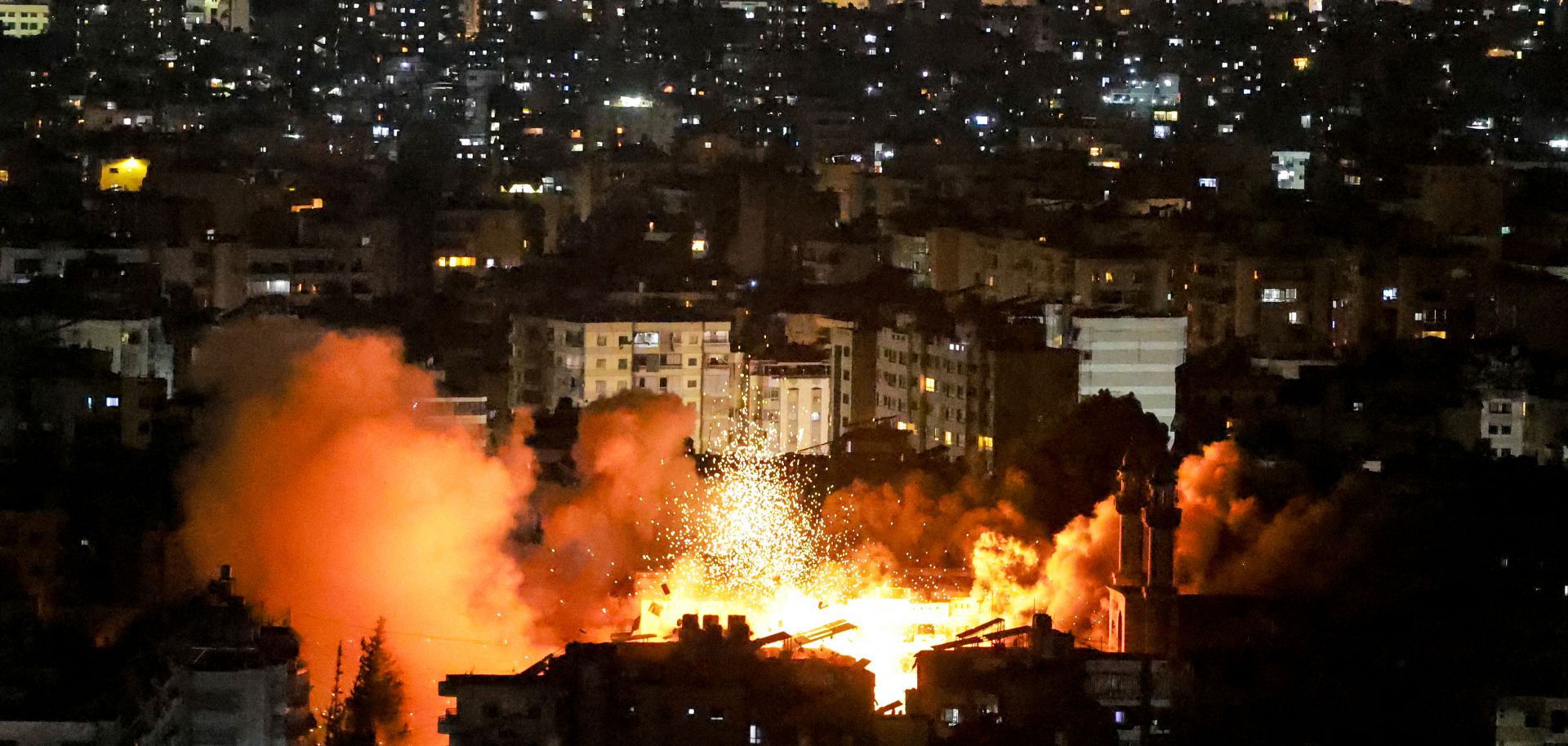
Israel's airstrikes against alleged Hezbollah targets in the suburbs of Beirut, Lebanon, indicate a growing impatience with the pace of Hezbollah's disarmament, but such military pressure instead risks hardening the group's stance, hampering the Lebanese government's influence and leaving the door open to a return to wider conflict. On June 5, the Israel Defense Forces (IDF) carried out at least 10 airstrikes against multiple buildings in Dahiyeh, a suburb located south of the Lebanese capital of Beirut. The IDF alleged that the targeted buildings held underground drone production sites for Hezbollah's aerial unit. However, a Lebanese security source told Reuters that the Lebanese Armed Forces had received prior notice about alleged military equipment in Dahiyeh and conducted an inspection, but found no such materials. Meanwhile, on June 6, the Lebanese Armed Forces issued a statement condemning Israel's airstrikes, warning that such actions undermined the army's credibility and could compel Lebanon to suspend its participation in the committee tasked with monitoring the November 2024 Israel-Hezbollah ceasefire.
- The ceasefire monitoring committee was established on Nov. 27, 2024, to ensure the implementation of the ceasefire agreement that ended the Israeli invasion of southern Lebanon. The committee is composed of Lebanon, Israel, the United States, France and the United Nations.
- In the aftermath of the strikes, Israeli Defense Minister Israel Katz warned that the IDF would continue attacking Lebanon until Hezbollah was disarmed.
- Lebanese President Joseph Aoun condemned the Israeli attacks on Beirut and hinted that Israel was sending a message to the United States that it was against Washington's "policies and initiatives."
Israel's June 5 attacks appear designed to keep Hezbollah weak, while pressuring the Lebanese government to take quicker and more aggressive steps toward the group's disarmament. The ceasefire agreement with Hezbollah has offered Israel tactical advantages, such as the ability to continue attacking Hezbollah infrastructure that Israel deems a threat. However, Israel has also indicated it is concerned that the ceasefire is allowing Hezbollah to regroup and rearm under relative calm, which would explain Israel's decision to conduct preemptive strikes designed to reassert deterrence and disrupt any Hezbollah military buildup. Additionally, the Lebanese government has so far sought to avoid quick and aggressive steps to pressure Hezbollah to disarm due to Lebanon's fragile and highly contentious domestic political environment, in which Hezbollah still has significant, albeit diminished, influence. With this in mind, the June 5 attacks also serve as a clear and deliberate indication that Israel's patience with Lebanon is quickly wearing thin, and that Israel is unlikely to tolerate extensive timeframes for dismantling Hezbollah's military infrastructure.
- Some reports indicate that Hezbollah still possesses around 30,000 rockets and drones, and has been attempting to rearm through Syria in the past few months and ramp up local production for drones. Hezbollah also still has tens of thousands of fighters despite losses in the war with Israel in 2024.
In addition to frustration with the pace of Hezbollah's disarmament and the Lebanese government's pressure on the group, simmering regional tensions and uncertainty over U.S. policy may also explain the timing and intensity of Israel's latest strikes on Lebanon. The June 5 attacks came amid recent signs that the administration of U.S. President Donald Trump's full-throated support of Israel may be weakening. On June 1, Trump's deputy Middle East envoy, Morgan Ortagus — widely seen as a staunch supporter of aggressive Israeli policy — announced her resignation. Ortagus's work had been focused on Lebanon and the disarmament of Hezbollah; her removal thus likely cast doubt in Israel on the White House's stance on both issues, especially as it remains unclear who will replace her, and likely adding to Israeli concerns in the recent that the U.S. is sidelining Iran hawks within the Trump administration. Over the past week, several international media outlets have reported that officials opposed to Trump's push to reach a new nuclear deal with Iran are being kept out of key foreign policy and national security positions. Against this backdrop, Israel may have conducted the June 5 attacks on Lebanon to demonstrate its continued intent to proactively defuse perceived threats emanating from Lebanon, even in the face of potentially wavering U.S. support for an open-ended campaign. The strikes also come amid heightened regional tensions and speculation that Israel is preparing for the possibility of a direct confrontation with Iran, should U.S.-Iran nuclear talks collapse, a confrontation in which it would want Hezbollah weak to prevent it from attacking Israel effectively.
Israel will likely increase the frequency of attacks on Hezbollah to accelerate its disarmament, though this is more likely to harden the group's opposition to disarmament rather than facilitate it. Israel's campaigns against Hamas and Hezbollah, along with the collapse of former Syrian President Bashar al Assad, have weakened Iran's influence in the region. But while this has emboldened Israel, the country is also concerned about uncertainties in U.S. foreign policy under President Donald Trump, especially as the White House pursues nuclear talks with Iran. Against this backdrop, Israel may calculate that there is a narrowing window to assert the current favorable balance of power along its northern front, potentially viewing Hezbollah as the next strategic target ahead of a possible confrontation with Iran. This would align with the ambitions of Israel's current far-right leadership, which has exhibited a growing willingness to pursue maximalist military goals, as evidenced by the IDF's ongoing campaign to eliminate Hamas in Gaza and occupy the Strip. Amid the ongoing lack of progress on Hezbollah's disarmament, it thus remains highly likely that Israel will more frequently conduct targeted airstrikes against alleged Hezbollah sites in and around Beirut, as well as sites in regions north of the Litani River, and critically, the Bekaa Valley, where Hezbollah is smuggling in advanced weaponry from and rebuilding capabilities. An escalation in Israeli strikes on Hezbollah targets in Lebanon would substantially diminish the U.S.- and Arab-backed Lebanese government's ability to execute necessary reforms or engage Hezbollah in credible disarmament negotiations. Under this scenario, the ceasefire would not outright collapse, as Hezbollah's operational, logistical and domestic constraints would continue to deter it from retaliating militarily to Israeli attacks. But the ongoing strikes would also not coerce Hezbollah into disarming quickly, and would only harden the group's position.
- In the past decade, Israel launched a so-called "war between the wars" campaign in both Syria and Gaza. In Syria, the IDF attacked the former Iran-backed al Assad regime with airstrikes on military assets, as well as precision airstrikes aimed at degrading Hezbollah infrastructure while avoiding direct escalation. In Gaza, despite the ongoing war with Hamas, Israel maintains a parallel strategy of intermittent tactical strikes and intelligence operations aimed at preempting the Palestinian militants' rearmament efforts and eliminating key operatives.
- For Hezbollah, negotiating disarmament amid persistent Israeli military strikes would significantly undermine the group's credibility among its support base and the broader Lebanese population, potentially triggering internal divisions or even fractures within Hezbollah over the group's strategic direction.
If Israel increases the pace and intensity of attacks against Hezbollah in the coming months, it could reignite a wider conflict, collapse the Lebanese government and derail U.S.-Iran nuclear talks. If Israeli escalations become more regular and sustained rather than limited and occasional, Hezbollah will face mounting pressure to respond. In such a scenario, the group is more likely to choose retaliation rather than restraint. From Hezbollah's perspective, remaining passive in the face of systematic Israeli strikes would amount to allowing its disarmament by attrition, a move that would severely damage its credibility as a resistance force both domestically and among its regional allies. Retaliation would then serve not only as a military response but as a political necessity, aimed at asserting new rules of engagement and deterring the further erosion of its operational capabilities. If this tit-for-tat dynamic spirals into open conflict, the consequences for Lebanon would be severe. The already weakened, U.S.-backed Lebanese government could face institutional paralysis or even complete collapse under the dual pressure of domestic instability and external military aggression. A renewed war between Israel and Hezbollah would also carry regional implications: namely, it could derail any progress in U.S.-Iran nuclear negotiations, as Hezbollah is widely viewed as Iran's foremost regional proxy, even though its capabilities have been significantly degraded. Such a breakdown in diplomacy would raise the risk of a direct confrontation between Israel and Iran, particularly if Israel perceives that neutralizing Hezbollah is a prerequisite for dealing with the Iranian threat.
- Israel maintains control over five strategic hilltops in Lebanon's south and refuses to withdraw. These military outposts are also targets for Hezbollah in the case of an escalation between the two sides.
