
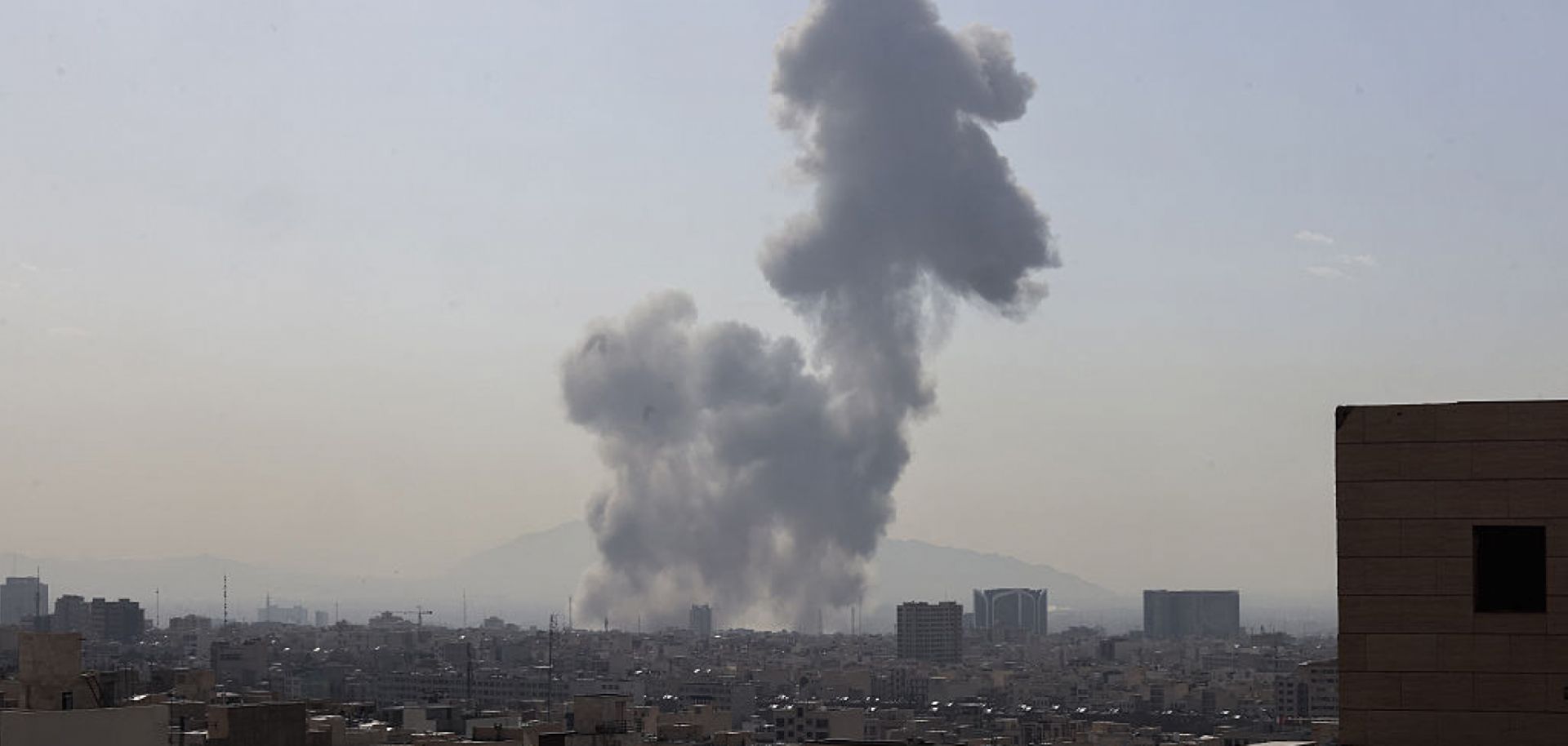
Joint U.S.-Israel military operations Feb. 28 against Iran have already escalated into a broader regional confrontation and mark the onset of a sustained, multitheater conflict, but even this level of escalation remains unlikely on its own to trigger near-term regime collapse in Tehran. The United States and Israel jointly launched military operations against Iran on Feb. 28. Israel described the opening strikes as preemptive and aimed at degrading Iran's ballistic missile capabilities, air defense systems and leadership. U.S. President Donald Trump on Feb. 28 announced that the United States had begun a "massive" military campaign against Iran, stating that the objective is to eliminate imminent threats to the American people by destroying Iran's missile forces, missile production industry, naval capabilities, nuclear program and proxy networks. Trump added that Iran can never possess a nuclear weapon, accused Tehran of attempting to rebuild its nuclear program and acknowledged that U.S. casualties are possible, signaling expectations of Iranian retaliation and framing the operation as a broad, sustained effort rather than a limited strike. Explosions have been reported in and around Tehran and other strategic locations, including the Presidential Palace, the Supreme Leader's compound and other ministerial buildings in Tehran and in other Iranian cities. Israel, for its part, has declared a state of emergency and closed its airspace in anticipation of retaliation. Iran has since closed its airspace, and some officials reported that Tehran is preparing for a major retaliation.
- Israel has announced that its decapitation strikes have targeted Iran's President Massoud Pezeshkian, Supreme Leader Ali Khamenei and other senior political and security officials from the Islamic Revolutionary Guard Corps, including senior adviser Ali Shamkhani.
U.S.-Iran negotiations had reportedly made progress in recent days but had not bridged fundamental divergences. The strikes are taking place after weeks of indirect negotiations between the United States and Iran, the most recent of which was held Feb. 26 in Geneva. The most significant sticking points centered on Iran's refusal to expand talks beyond the nuclear file to include its regional proxy networks and ballistic missile program, which the United States has raised as a concern, and which Israel has said are red lines that must be addressed in any deal between Washington and Tehran. Tehran maintained that both issues fall within its sovereign defense doctrine and are nonnegotiable, framing external demands as attempts to constrain its deterrence architecture rather than merely limit its nuclear capabilities. On the nuclear file itself, Iran signaled flexibility but stopped short of meeting core U.S. red lines. While offering partial concessions — including discussions on monitoring mechanisms — Tehran resisted measures such as transferring enriched uranium stockpiles abroad or dismantling key facilities such as Natanz and Isfahan, arguing that such steps would compromise national sovereignty and long-term strategic leverage. At the same time, Iran attempted to shift negotiations toward economic incentives, signaling openness to commercial engagement and sectoral access as inducements for de-escalation with the Trump administration. But the gap between both sides remained wide, and talks stalled. Trump has recently expressed frustration with the process, culminating in his decision to attack Iran jointly with Israel.
The U.S. and Israeli attacks will continue for several days, with Iran retaliating against both Israel and U.S. regional military bases. Israeli and U.S. operations appear structured to degrade not only specific nuclear or missile assets, but also elements of Iran's broader military, security and political apparatus, including IRGC infrastructure and command nodes and Iran's naval capabilities. That suggests a sustained effort to reduce Iran's strategic capabilities and to weaken the regime. Iran will respond with its remaining ballistic missiles, drones and shorter range missile arsenal, and is highly likely to center on ballistic missile launches toward Israel, consistent with the patterns of escalation seen in recent years. Given the U.S. participation and the goals of regime change that Trump declared, Tehran has already broadened the scope of its retaliation against the United States. Iran possesses short-range ballistic missiles capable of targeting U.S. bases in Iraq, Jordan and across parts of the Gulf, and some have already done so. By attacking U.S. regional military bases, Iran will aim to increase the costs of the confrontation for the Trump administration. At the same time, the risk of proxy activation is likely to rise, particularly if Tehran opts to attack U.S regional bases. The Houthis are the most likely actor to escalate quickly, potentially through missile or drone launches or maritime disruption. Kataib Hezbollah in Iraq remains a possible, though less certain, escalation channel depending on internal Iraqi political calculations and Tehran's guidance. Hezbollah in Lebanon is less likely to engage immediately in large-scale action, given the risks of a broader regional war, but a limited, calibrated involvement cannot be ruled out if escalation intensifies.
- There are still no reports of U.S. and or Israeli military attacks against Iran's economic and energy infrastructure, which means Iran is unlikely — at least for now — to attack Gulf energy infrastructure or harass maritime vessels in and around the Strait of Hormuz, particularly given that the United States also maintains a large naval presence in that area.
- Israel has reportedly deployed the 91st division and called up reservists along the borders with Lebanon as concerns grow that Hezbollah may opt to join the confrontation. Hezbollah officials have recently made clear, however, that the group is unlikely to participate in a limited attack on Iran.
- Kataib Hezbollah warned the United States on Feb. 26 that the group would attack U.S. bases if Iran is attacked, and urged its fighters to prepare for a war of attrition. Meanwhile, the Houthis in Yemen were reportedly preparing missile launch pads in several locations in al-Hudaydah province in recent days.
Despite these attacks, the Iranian regime is likely to endure in the near term, though a collapse remains a lower probability alternative contingent on several reinforcing shocks. Despite the coordinated strikes by the United States and Israel and strong rhetoric from Trump and Netanyahu, Iran's highly institutionalized political system (centered on the supreme leader, the IRGC and a dense internal security apparatus) is likely to prove resilient, at least in the short term. In fact, external attacks tend to generate a "rally-around-the-flag" effect that boosts regime legitimacy; the state retains strong coercive capacity through loyal security forces capable of suppressing unrest; opposition groups remain fragmented and lack unified leadership; and the regime has decades of experience managing crises through repression, patronage networks and relative ideological cohesion. A regime collapse would require a convergence of destabilizing factors that go well beyond external airstrikes, including a meaningful degradation of the state's coercive capacity, visible splits among elite factions (especially within the security forces) and sustained, large-scale domestic uprisings that persist despite repression. Even then, such a collapse would likely lead to a volatile, uncertain transition rather than a smooth, stable transfer of power.
