
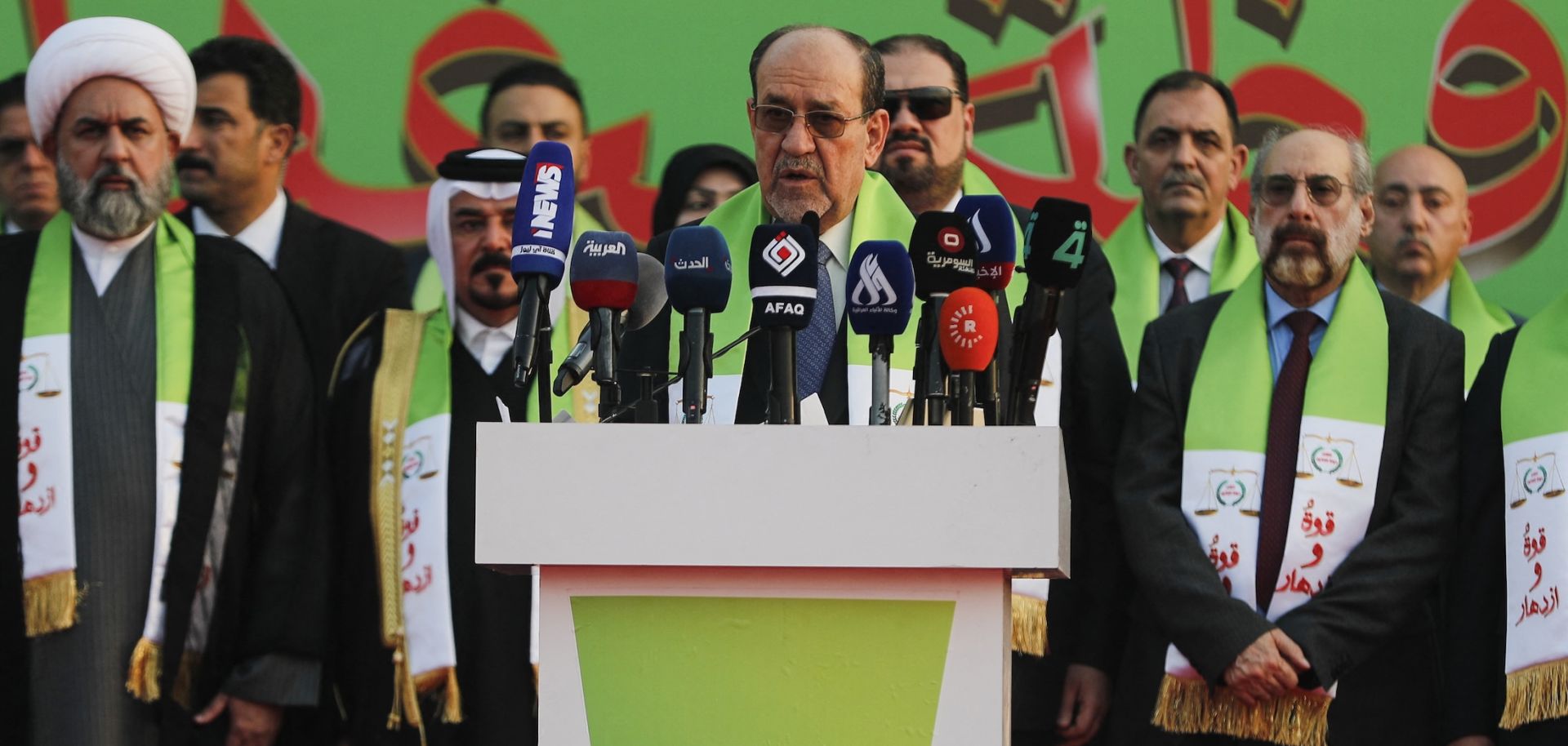
If former Iraqi Prime Minister Nouri al-Maliki overcomes challenges to form a new cabinet, it would likely deepen internal divisions, strain relations with the United States, embolden Iran-backed militias and increase Iraq's exposure to U.S. economic pressure and U.S. and/or Israeli military strikes. On Jan. 27, U.S. President Donald Trump warned against the Jan. 24 decision of the Shiite Coordination Framework, or SCF, an umbrella organization of pro-Iranian Shiite political parties, to nominate former Iraqi Prime Minister Nouri al-Maliki to form the next Iraqi cabinet. Trump posted on Truth Social that "Last time Maliki was in power, the Country descended into poverty and total chaos. That should not be allowed to happen again," threatening to halt all U.S. aid to Iraq. According to the Iraqi constitution, once the parliament elects a president, a process which is ongoing, he will need to formally name the next prime minister within 15 days of his election. However, the new president is almost certain to task al-Maliki with forming the new government as long as he has the backing of the powerful SCF, by far the largest parliamentary bloc, and because caretaker Prime Minister Mohammed Shia al-Sudani withdrew his second-term bid on Jan. 12.
- Pro-Iranian Shiite parties have been able to exert tremendous influence over the selection of the new prime minister, since Shiite lists won 187 of the 329 seats in the Nov. 11 polls, even though there are some disputes among parties and, at times, divergent policies. This has given the SCF, which is by far the largest coalition of Shiite parties, the most sway of any other coalition.
- Under Iraq's power-sharing agreement among the country's main ethno-sectarian groups, the parliamentary speaker is always Sunni Arab, the president is always Kurdish, and the prime minister (who has the most political power) is always Shiite Arab. On Dec. 29, Iraq's parliament convened for the first time following the Nov. 11 elections and elected Haibat al-Halbousi as the parliamentary speaker.
- Al-Maliki previously served two terms as Iraq's prime minister between 2006 and 2014. During his tenure, he balanced Iraq's ties between the United States and Iran. However, domestically, he fueled sectarian policies by sidelining many Sunni Muslims from the government and cracking down on Sunni politicians and protesters who criticized his government's policies. Many critics blame al-Maliki's sectarian policies for helping to fuel the rise of the Sunni jihadist Islamic State. Indeed, just months after the fall of Mosul to the Islamic State, al-Maliki resigned due to the widespread loss of both domestic and international support, including from both the United States and Iran. He has also been embroiled in allegations of corruption and mismanagement of economic reconstruction funds from his previous terms.
- On Feb. 3, al-Maliki said that he would welcome a decision to replace his candidacy for the premiership amid U.S. pressure. However, Shiite political parties have continued to show support for al-Maliki as their candidate.
The government formation process comes as Iraq faces U.S. pressure to reduce ties with Iran, as well as increasing domestic economic and political pressures. The United States has been increasingly pressuring the Iraqi government not only to reduce ties with Iran but also to disarm Iran-backed Iraqi militias, most of whom are incorporated into the Iraqi security forces under the Popular Mobilization Forces (PMF) and whose affiliated political parties are part of the SCF. Furthermore, the government has been facing domestic pressure from longstanding sectarian tensions, lingering economic grievances and stalled reforms to improve fiscal consolidation. U.S. sanctions against Iran and pressure on Iraq's energy sector have caused widespread power cuts and subsequent social unrest, while the government's mismanagement of public finances and the lack of economic reforms have caused widespread protests among public sector employees.
- The United States previously threatened to impose additional sanctions and suspend security cooperation with Iraq in response to the latest Shiite-led effort to reform the PMF, which would have expanded the PMF's autonomy and financial resources. Kurds and Sunni Arabs expressed concern that the controversial reform efforts would alienate the United States and impede bilateral cooperation. Under U.S. pressure, the Iraqi government withdrew the reform effort.
- Low global oil prices have constrained Iraq's state revenues and put pressure on its annual budget, especially since Iraq has a high public wage bill, which, according to the International Monetary Fund, consumes just under 25% of GDP.
Al-Maliki's nomination will not guarantee cabinet formation and is more likely to trigger a prolonged, contested process shaped by internal Shiite divisions and external pressure, potentially leading to the selection of a consensus candidate. Al-Maliki is unlikely to secure an easy, quick path to forming a government. Instead, his nomination is set to kickstart a complex bargaining phase driven by domestic power calculations, widening fissures within the SCF and mounting international scrutiny. Indeed, there are already reports that key Shiite parties in the SCF oppose al-Maliki's nomination, including Asaib Ahl al-Haq and Ammar al-Hakim's movement, which together control a considerable 55 seats in parliament. Meanwhile, Sunni leader Mohammed al-Halbousi, alongside the dissatisfied Shiite factions, could coalesce into a parliamentary opposition exceeding 100 seats, a dynamic that would closely resemble Iraq's monthslong government formation process in 2020 and significantly constrain al-Maliki's room to maneuver. Influential nationalist cleric Muqtada al-Sadr and his supporters (known as Sadrists) are also highly likely to reject al-Maliki's nomination. Clear opposition from the Trump administration will further weaken al-Maliki's prospects as well. Unless al-Maliki succeeds in assembling a broad consensus cabinet designed to appease all major stakeholders (which appears unlikely given the current dynamics), the process will likely be obstructed. Since al-Maliki has a 30-day deadline from the time he is formally appointed by the president to form a government, failure to do so could force him to withdraw. If he is unable to form a government within the timeframe, the Iraqi president would then appoint another prime minister to try to form a government, opening the door to the selection of a compromise candidate.
- Iraq's constitution requires a two-thirds quorum (220 of the legislature's 329 lawmakers) to elect a president and trigger a prime ministerial nomination. This means just 110 lawmakers can indefinitely block al-Maliki's government formation process. As is, intra-Kurdish disputes between rival Kurdish parties have obstructed the presidential election. But in addition, opposition from Ammar al-Hakim's National State Forces and Asaib Ahl al-Haq's Sadiqoun bloc, in particular, would immediately fracture the SCF. If joined by Halbousi's Taqaddum bloc, this would create an anti-Maliki core that could reach a blocking third with either support from the Kurdistan Democratic Party, alignment with outgoing Prime Minister al-Sudani's bloc and/or informal Sadrist influence over independents and Tishreeni lawmakers. This stalemate would prolong political paralysis and likely result in a consensus candidate.
- In 2020, deep fragmentation among Shiite blocs, combined with Sunni, Kurdish and Sadrist opposition, repeatedly blocked a parliamentary quorum and stalled government formation for months. This ultimately forced the selection of a consensus compromise candidate, Mustapha Kadhemi, as prime minister.
- Speculation suggests that if al-Maliki cannot form a cabinet, former Prime Minister al-Sudani and Intelligence Chief Hamid al-Shatri would be the consensus candidates.
- Muqtada al-Sadr, the highly influential Iraqi cleric and politician, has not yet publicly commented on al-Maliki's nomination. However, he is highly likely to reject the nomination because al-Maliki remains his main political rival. During al-Maliki's first term as prime minister (2006-2014), his government conducted military operations against the Sadrist movement's armed wing, removed Sadrists from key political posts and promoted a centralized, Iran-aligned governance style that al-Sadr opposes.
If al-Maliki succeeds in forming a cabinet, it will likely be Shiite-dominated and more accommodating toward Iran, which would very likely prompt the United States to reduce aid, stalling economic reforms and risking renewed sectarian violence. Should al-Maliki overcome the challenges of forming a government (like securing support from Shiite factions within the SCF opposed to his nomination), the SCF would likely gain key cabinet posts, such as the defense and foreign ministries. The outcome of the November election — with Shiite lists winning 187 seats and Sunnis and Kurds winning a combined 133 seats in the 329-seat legislature, with few gains for other minorities — means that al-Maliki could form a government with the requisite majority and largely sideline minority groups. Such a government would likely be seen as more pro-Iran than the current al-Sudani government, which has tried to balance ties with both Washington and Tehran. This would anger the United States, potentially prompting it to curtail security cooperation, military aid and financial flows (e.g., oil revenue mechanisms) due to perceived boosted Iranian influence, especially over militias and Iraq's foreign policy. Economic reforms could stall amid political infighting and risks of U.S. sanctions, complicating investment and reconstruction funding at a time when Iraq is facing fiscal pressures amid regional instability. With limited minority representation in government, al-Maliki would also have greater flexibility to pursue a sectarian agenda similar to that of his first term. This could involve centralizing power by undermining judicial independence, targeting Sunni politicians with criminal allegations and/or deploying security forces to minority-led communities. Such an agenda would risk fueling Sunni radicalism and sectarian infighting, potentially aiding an Islamic State resurgence.
- On Jan. 24, the Sunni Political Council released a statement rejecting the SCF's nomination of al-Maliki due to his controversial past and called on Shiite political leaders to select a candidate that better reflects the entire nation's interests. However, some Sunni parties, including the Azm Alliance and the National Resolve Alliance, later distanced themselves from the statement, saying it did not reflect the position of all Sunni groups.
- On Jan. 26, Iraq's spy chief warned that the number of Islamic State fighters in neighboring Syria has surged from 2,000 to 10,000 in the last year due to unrest in the country's northeast. The United States has started transferring thousands of Islamic State prisoners from Syria to Iraq after fighting between Syrian government forces and the Kurdish-led Syrian Democratic Forces, who guarded the prisons, created security gaps.
- Iraq's Sunni-led Taqaddum Party, led by former parliament speaker Mohammed al-Halbousi, signaled on Jan. 27 that it would not join any future government led by figures it believes would reignite sectarian divisions — an implicit rejection of al-Maliki.
An al-Maliki-led government would likely embolden Iran-backed militias, ultimately raising the risk of U.S. and/or Israeli military action inside Iraq, alongside escalating U.S. economic pressure. Given al-Maliki's inclination toward Iran and support from many key Iran-backed factions, a government led by al-Maliki would likely harden the posture of Iran-aligned Iraqi militias, further emboldening them to resist disarming and reintegrating under state authority. This could lead the United States to increase financial pressure, including tightening restrictions on dollar flows to Iraq — especially if Iran-backed militias also gain formal roles in the government. Concurrently, if these militias participate in any future Iranian retaliation against new U.S. and/or Israeli attacks, it would increase the likelihood of direct U.S./Israeli strikes against militia targets in Iraq, particularly if these groups expand regional activities or pose direct threats to U.S. personnel. Such strikes raise the risk of retaliatory militia attacks against Western assets in the country, potentially turning Iraq back into an active battlefield in the broader confrontation between Iran, Israel and the United States.
- For months, the Trump administration has been pressing the Iraqi government to disarm militias, warning that Israel was preparing attacks against their leaders, bases and military capabilities.
- While the Iran-backed Kataib Hezbollah militia did not participate in the June 2025 war between Iran and Israel that drew in the United States, there is still a moderate risk that the group could participate in a future confrontation — especially if it believes Iran is facing an existential crisis that would threaten the militia's own survival, or if the United States or Israel attacks the militia first. Kataib Hezbollah recently urged its fighters to prepare for a coming war.
