
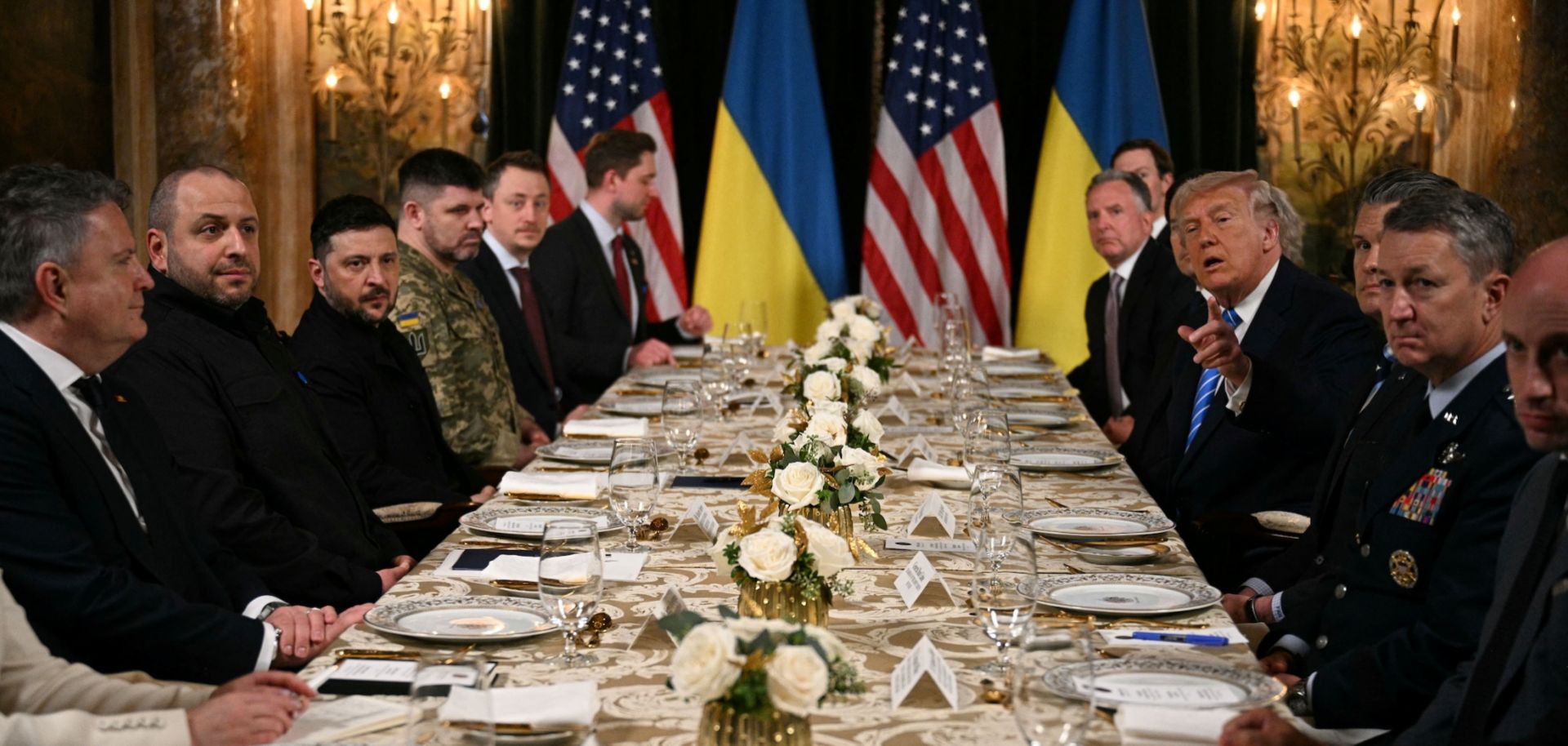
Despite the recent progress toward a U.S.-backed peace plan for Ukraine, the negotiations will risk stalling or collapsing as Russia's unchanged maximalist demands and unresolved disputes over security guarantees and territorial concessions continue to block a durable settlement. On Dec. 28, Ukrainian President Volodymyr Zelensky met U.S. President Donald Trump at Mar-a-Lago in Florida to advance negotiations on a peace plan aimed at ending the war with Russia. Both leaders held a joint press conference and reported substantial progress, with Zelensky stating the plan was "90% agreed" and U.S. security guarantees for Ukraine "100% agreed." Trump said the parties were "very close" to a peace deal, though "thorny" issues remained, particularly over territorial questions such as the Donbas, the region of eastern Ukraine comprising Donetsk and Luhansk provinces. On Dec. 29, Zelensky added that the United States was currently offering security guarantees to Ukraine for 15 years, but Kyiv wants Washington to "consider the possibility of 30, 40, 50 years." Zelensky also confirmed that the issue of the future of the Zaporizhzhia Nuclear Power Plant remained unresolved. Separately, on Dec. 29, Kremlin spokesman Dmitry Peskov insisted that Ukraine should withdraw its troops from the parts of the Donbas still under its control in order to achieve peace.
- Shortly before his meeting with Zelensky, Trump spoke with Russian President Vladimir Putin by phone. Trump described the call as "good" and "very productive" but did not disclose the exact content. Trump and Putin held a second call on Dec. 29, which the White House described as "positive."
The Trump-Zelensky meeting was part of an intensified diplomatic push to end the war, with negotiators narrowing a peace framework even as Russia continues military pressure and signals little willingness to compromise on its core demands. The Mar-a-Lago meeting occurred against the backdrop of intensified U.S., Ukrainian and European diplomatic efforts aimed at ending the war. Weeks of talks in Berlin, Miami and Geneva saw U.S. and Ukrainian teams revise and refine an original peace plan drafted by the United States and Russia (which was very favorable to Moscow) and reach a 20-point framework that emphasizes U.S. and European security guarantees, demilitarized zones in disputed territories and foreign funding for postwar reconstruction. However, Russia has continued its offensive operations in Ukraine, including drone and missile strikes on Ukrainian infrastructure and urban centers. Russia has also made slow territorial progress along the contact line, including the capturing of the critical logistics hub of Pokrovsk (in Donetsk) in early December. The Kremlin has also repeatedly signaled that it views full territorial control of the Donbas and rejection of significant foreign military presence in Ukraine as non-negotiable requirements for a deal.
- In mid-November, U.S. Special Envoy Steve Witkoff and Russian sovereign wealth fund chief Kirill Dmitriev drafted a 28-point plan to end the war. The draft called for the de facto recognition of Crimea, Donetsk and Luhansk as Russian territories and the freezing of the conflict in the provinces of Kherson and Zaporizhzhia along the current line of contact. Crucially, it required Ukraine to withdraw from the parts of the Donetsk province it still holds. According to the proposal, Ukraine would be barred from NATO membership and forced to amend its constitution to enshrine permanent neutrality, its armed forces capped at 600,000 personnel (from more than 800,000 at present) and no NATO troops stationed on its soil. Following pushback from Ukraine and Europe, the United States and Ukraine worked together on the revised 20-point plan.
- For months, the United States has spoken in favor of establishing "free economic zones" in the contested territories in eastern Ukraine along the contact line. On Dec. 24, Zelensky said that U.S. negotiators had proposed a plan whereby Ukrainian troops would withdraw from certain areas of the Donbas and Zaporizhzhia in exchange for the creation of an internationally monitored economic zone that would receive substantial international funding. While Zelensky did not rule out the idea, he said that for Ukrainian forces to withdraw from these zones, Russian forces should also withdraw.
While diplomacy will intensify in early 2026, deep disagreements over security guarantees, territorial concessions and Russia's unchanged maximalist demands will continue to complicate and potentially stall progress toward a viable peace deal. Diplomatic efforts to end the war will continue in the coming weeks. Another call between Trump and Putin is possible in the coming days, while Ukraine hopes to host a meeting of U.S., European and Ukrainian officials in Kyiv in early January. But while the United States and Ukraine seem to be making progress in the drafting of a peace plan, there are several obstacles to a deal. The first is that so far there are scant details over what exactly the security guarantees for Ukraine involve, both in terms of U.S. and European involvement and duration. Additionally, Ukraine remains reluctant to give up the parts of the Donbas still under its control, while Russia insists that it wants full control of the region either by negotiation or by force. Finally, the United States seems to be coming to terms with the fact that its proposal to have Russia, Ukraine and the United States run the Zaporizhzhia Nuclear Power Plant together is unviable, which means that Washington and Kyiv will need to find an alternative solution. Even if the United States and Ukraine reach a deal on all of these outstanding issues, there is a bigger problem: at least officially, Russia has not abandoned any of its maximalist positions. The Kremlin insists on controlling all of the Donbas, rejects any meaningful foreign military presence in Ukraine and wants full control of the Zaporizhzhia Nuclear Power Plant. Russia is unlikely to meaningfully change its position on these issues without increased American pressure, which could come in the form of tighter sanctions enforcement, additional sanctions or greater U.S. military assistance for Ukraine. While in recent weeks the White House has not explicitly threatened the Kremlin, the Trump administration may toughen its rhetoric if it perceives that Moscow is stalling the peace process.
- In recent weeks, Zelensky has said that if the final peace agreement forces Ukraine to make painful concessions, he may need to put the plan to a referendum. This proposal is highly problematic for several reasons. To begin with, a countrywide vote would require a ceasefire during the campaign and the day of the vote, something that Russia has repeatedly rejected (Moscow prefers a comprehensive peace deal without a preceding ceasefire.) The issue of whether the Russian-occupied areas of Ukraine should participate in the vote would also be problematic, as Kyiv may refuse to accept the results there out of mistrust of the local authorities. More importantly, an eventual popular rejection of the peace plan in the referendum would demolish the entire peace process and give Russia a pretext to resume the war and open the door for the United States to end all support for Ukraine and, in an extreme scenario, impose sanctions and other punitive measures on Ukraine.
- On Dec. 17, Bloomberg reported that the United States was working on a fresh round of sanctions against Russia in case Moscow rejected a peace deal. According to this report, which quotes unnamed sources, the White House is considering targeting ships in Russia's so-called shadow fleet of oil tankers as well as the traders who facilitate these transactions.
