
Editor's Note: The following summary is part of the Stratfor Center for Applied Geopolitics' report on how the Russia-Ukraine war has highlighted how drones are changing warfare, which can be found in its entirety here.
The Russia-Ukraine war has highlighted how accessible, cost-effective technologies, particularly drones, are reshaping modern warfare. Drones have become central instruments of cost-imposition, allowing Ukraine to inflict disproportionate damage on a materially stronger adversary at a fraction of the cost of traditional weapons systems. Far from the rapid win Russia hoped to impose, Ukraine has demonstrated that smaller states can leverage these technologies to survive, adapt and even impose sustained costs over the long term.
The case of the Russia-Ukraine war has also shown that technology alone is not enough. Ukraine's technological capabilities have been successful only because they were embedded within enabling conditions, choices made in peacetime and wartime, that made them scalable and sustainable. Fiscal and industrial capacity enabled development and replenishment, organizational flexibility shortened procurement cycles, political will allowed for sustained effort and geography allowed drones to showcase their potential in the battlefield. These non-technological attributes, often associated with more traditional understandings of warfare, remain indispensable even in an era of rapid technological advances. This article moves beyond technical performance and operational outcomes, to look at Ukraine's success as being less about drones and emerging technologies than about the conditions that allowed them to be replaced, innovated and integrated even under the pressures of warfare.
Ukraine's success in the ongoing war with Russia illustrates how a state can not only defend but impose costs on a larger power using cheaper technologies, rather than non-modernized but functional legacy systems. Though the lack of an established defense industrial base, as seen with the size and maturity in comparison to Russia, traditional defense procurement and lack of nuclear weapons may have constituted an automatic loss for a state in their position decades ago, Ukraine has shown great resilience, patriotism and the ability to rapidly innovate. By decentralizing and leveraging technology faster and more cheaply than its opponent, Ukraine has managed to defend itself and impose significant costs on Russia. The war vividly demonstrates that a nation doesn't need the most expensive, advanced weapons to impose heavy costs on a bigger opponent. Ukraine's use of readily available and manufacturable drones has offset many of Russia's traditional advantages in tanks, aircraft and artillery. Indeed, inexpensive unmanned systems and digital tools are shifting the balance of power, giving the opportunity for agile defenders to contest, harass and impose asymmetric costs on even the largest militaries.
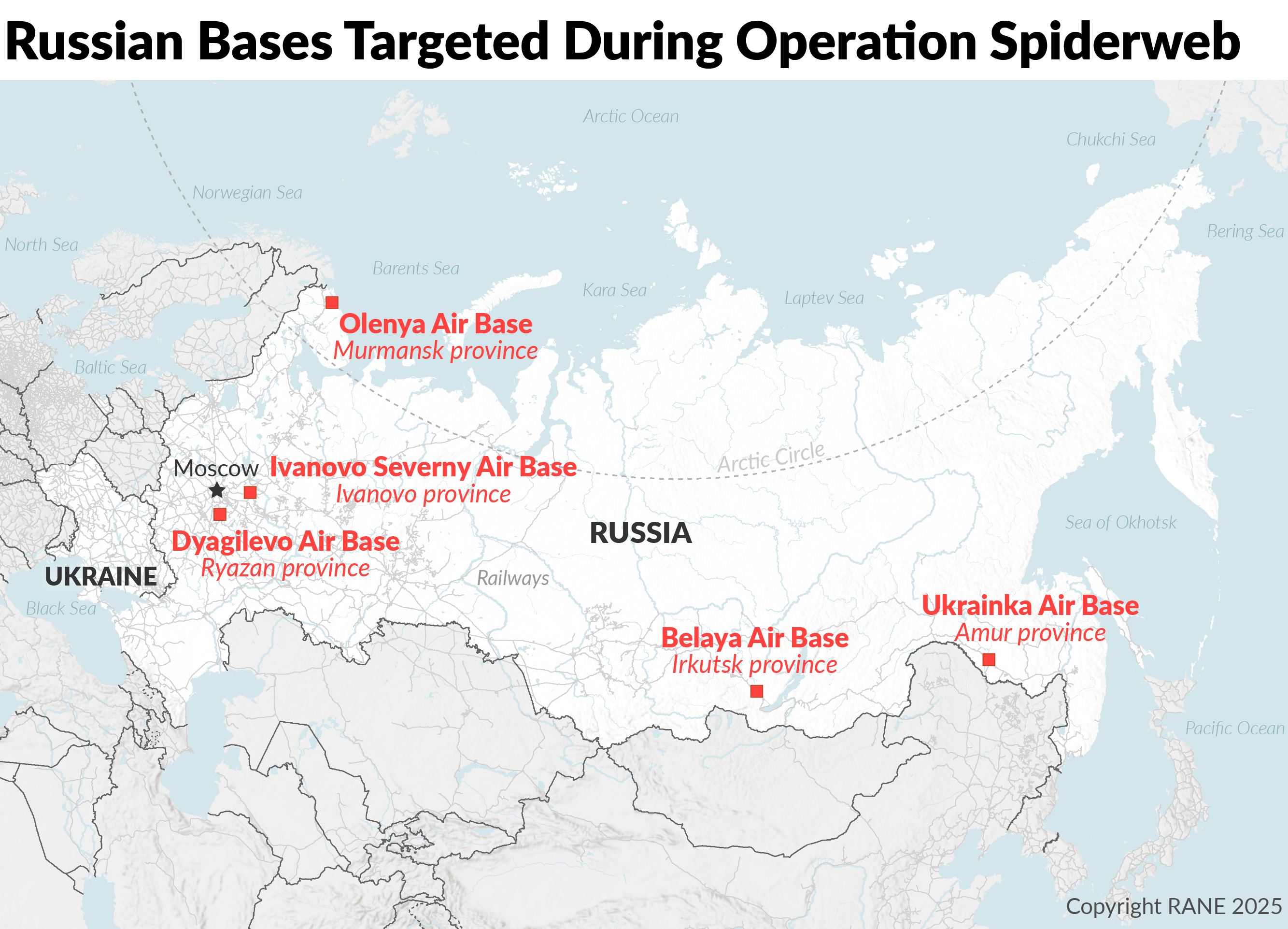
Operation Spiderweb illustrates how Ukraine converts inexpensive technology into outsized strategic effect. On June 1, 2025, the Security Service of Ukraine (SBU) executed coordinated long-range drone strikes against five Russian air bases across five time zones, reportedly employing 117 Osa FPV quadcopters, platforms that cost roughly $600 to $1,000 a unit, totaling a cost of $70,000-$117,000 (exclusive of logistics, clandestine staging and operator support). U.S. officials estimated around 20 aircraft were hit and about 10 destroyed. Ukrainian claims were higher but even conservative tallies represent a severe blow to a bomber fleet of roughly 126 strategic aircraft. Crucially, the operation was able to impose significant damage even with the use of cheaper systems. By contrast, a single Ukrainian FP-5 Flamingo cruise missile costs on the order of $360,000 to $850,000 for the airframe alone, with a full strike package running into the millions. A basic Tomahawk missile for a stationary land target costs roughly $1.4 million. The operation reiterated that the cumulative use of simple, affordable, manufacturable drones can inflict damage on par with precision missile strikes.
Despite the diffusion of advanced and accessible technologies, war remains a fundamentally human event. Drones, software and other cost-effective platforms may provide new means of imposing costs on a stronger adversary but they cannot substitute for the determination of those who operate, adapt and sustain them. Political will and societal commitment remain the foundation upon which technological advantage rests. A government's decision to fight does not automatically translate into the willingness of society to bear the sacrifices of a prolonged conflict and without such support, the capacity to mobilize resources, innovate solutions and replace losses quickly declines. Civilian innovators, volunteer networks and communities across the country have contributed directly to the adaptation and scaling of drone technologies, filling gaps that state capacity alone could not meet. Accessible technologies may therefore narrow the material power gap but their effectiveness depends on the collective will to fight, endure losses and sustain adaptation over time.
This political will translated into a whole-of-society mobilization, one of Ukraine's most significant advantages. Unlike Russia's top-down approach, Ukraine's resistance was driven by a mostly decentralized network of grassroots organizations and citizens. In the early weeks of the invasion, around 1,700 new local aid groups formed to fill critical gaps in the military supply and aid chains. This horizontal mobilization is not only a vital characteristic of the Ukrainian effort but a strategic benefit as their speed and flexibility often outpaced formal state channels, ensuring frontline units received critical equipment when it was needed most. The state then institutionalized this will through initiatives like UNITED24's "Army of Drones," which scaled from crowdfunding campaigns into a national procurement and production program. By 2023, drone procurement and output were reportedly up 100-fold from 2022 levels.
Much of the discourse surrounding the diffusion of affordable military technologies emphasizes their disruptive potential — specifically how even low-cost tools can impose outsized costs on traditional heavy systems. Unlike traditional weapon systems, drones are deliberately designed as attrition-focused tools with inherently high loss rates. Yet the cost-imposition depends less on the individual unit price but rather on the ability to sustain their acquisition, replacement and integration at scale. Fiscal capacity — the ability of a state to mobilize and allocate resources effectively under conditions of high attrition — thus becomes a critical component. Fiscal capacity is both a material and institutional characteristic. It encompasses the macroeconomic stability that enables a government to continue funding defense during a prolonged conflict, the necessary allied financial support and the procedural frameworks that channel money quickly to frontline needs. Ukraine's experience illustrates that the affordability of emerging technologies is only relative. Thus, it becomes the decisive attribute that determines whether these "cheap" technologies can generate sustained cost-imposition during war and alter an adversary's coercion cost-value projection to shift the strategic balance of power.
Ukraine has translated this attrition logic into budgetary practice by making drones a central pillar of its defense financing. In January 2025, the Defense Ministry announced an additional 2.5 billion hryvnia ($60 million) per month dedicated to drone procurement, following an earlier 2.1 billion hryvnia allocation in December 2024, funds that ensure continuous replenishment at the brigade level. In March 2025, Kyiv announced plans to acquire 4.5 million FPV drones in a single year, with the Defense Ministry allocating over $2.6 billion toward this objective — more than doubling the previous year's rate of acquisition. By April, Ukraine committed to devoting roughly one-third of its entire defense budget to high-tech systems, prominently including drones, with more than 165 billion hryvnia allocated to capabilities outside of the traditional defense-industrial base. Based on state budget allocations, reallocated funds from local budgets and volunteer-supported procurement, commercial technologies make up nearly half of defense acquisition spending.
Ukraine's wartime industrial adaptation is most clearly reflected in the rapid expansion of drone production, which grew 120-fold in 2023 and by early 2024 included multiple firms capable of manufacturing long-range strike systems. By October 2024, official projections placed national output at up to four million drones produced per year.
Innovation frameworks and external partnerships have driven this transformation. The launch of the BRAVE1 defense-tech cluster in 2023 linked startups, engineers and combat units, accelerating development across hundreds of electronic warfare projects. By 2025, over 1,500 companies and 3,500 projects were on the platform. Partnerships with Western firms and the establishment of local repair and assembly hubs have shortened supply chains and embedded greater production capacity inside Ukraine, as battlefield feedback has accelerated rapid adaptation cycles. Nonetheless, structural limits persist. Between 2020 and 2024, Ukraine was the world's largest importer of major arms. It continues to rely on external supply for complex platforms, specialized explosives and propellants and critical electronic components. Even with impressive wartime adaptability, the defense sector will remain partially dependent on foreign inputs and investment for the foreseeable future.
Organizational flexibility has proven as critical as technological innovation in allowing Ukraine to narrow the power gap with Russia. While drones have become the centerpiece of Ukraine's cost-imposition strategy, their effectiveness has depended on a defense establishment that adapted quickly to the battlefield's uncertainty. Unlike traditional militaries that rely heavily on rigid procurement cycles and centralized control, Ukraine's system evolved to absorb new ideas, mobilize civilian expertise and exploit opportunities in real time. Volunteers consisting of drone hobbyists and tech experts began working on creating Ukrainian-made drones in 2014 with one hobbyist drone unit, Aerorozvidka, developing a drone system that was used by the military by 2022. This gave Ukraine a risk-tolerant prototyping culture that the state translated into adaptability, ensuring that inexpensive technologies could be scaled into decisive tools, rather than waiting on legacy program procurement cycles.
Equally important was the collaboration between state and society. Public-private partnerships connected engineers, university labs, volunteer makers and small domestic and international startups with the military, creating an innovation ecosystem that has blurred the boundary between civilian and defense sectors. By acting as an "enabler, not a bottleneck," the government shortened procurement cycles and cut red tape, allowing promising ideas to reach the battlefield faster, for example, with the establishment of BRAVE1. This broad mobilization of talent meant that Ukraine could compensate for its relative lack of traditional defense capacity, producing a steady stream of low-cost and effective drone solutions.
In the context of Ukraine, these elements intersect, creating both vulnerabilities and opportunities for resilience through the use of technology and adaptive strategies. Unlike small powers protected by distance or natural barriers, its long, flat 2,000-kilometer frontier with Russia allowed rapid mechanized incursions in the opening weeks of the 2022 invasion. Ukraine's major population centers, industrial hubs and critical infrastructure remain within range of Russian artillery and airpower, creating vulnerability and reinforcing Moscow's capacity for coercion. Ukraine cannot rely on geographic depth to delay a conventional assault or facilitate external reinforcement. This same lack of geographical barriers, which favor the invader, have been a persistent concern for Russia as it sees NATO's borders moving east over the decades as too close for comfort, particularly considering the proximity and openness of the European plains connecting Eurasia, posing a perceived existential threat for Russia.
Geography, while a liability in many respects, has also given Ukraine opportunities to turn the tables. Its proximity to NATO countries keeps supply lines short enough to sustain a steady flow of weapons and equipment, even under heavy fighting. At the same time, Russia's reliance on fixed and concentrated assets, such as the Black Sea Fleet in Crimea or strategic bomber bases deep inside its territory, has created valuable targets for Ukrainian long-range strikes. The use of uncrewed surface vessels (USVs) and loitering munitions in the Black Sea has been especially effective. The sea's enclosed geography leaves little room for Russia to maneuver, allowing Ukraine to chip away at naval dominance without needing to field an equivalent fleet. Likewise, drones able to strike hundreds of kilometers into Russia have inverted the traditional distance premium, demonstrating that inland areas are no longer sanctuaries. In this sense, geography interacts with technological range to allow weaker states to transform vulnerabilities into cost-imposition opportunities.
Can the spread of accessible low-cost technologies change the cost assessment of larger powers, either altering their decisions about when and how to use coercion or force or extending the amount of time a small power can resist coercion? The Ukraine war suggests the answer is yes. These technologies do not erase asymmetry but they can increase strategic autonomy for smaller states by narrowing the power gap, complicating invasion or coercion and raising the price of aggression. While that narrowing may only be temporary, even temporary shifts can carry significance for regional power dynamics and growing multipolarity.
Ukraine offers the clearest example. These technologies have not reversed Russia's material advantage but they have imposed real costs, disrupted logistics, forced Moscow to adapt and extended Ukraine's capacity to resist. Operation Spiderweb is evidence of how low-cost capabilities imposed significant costs that traditional weapons could not at a comparable price. The measurable outcome has been Russia's need to devote greater resources to air defenses, electronic warfare and procurement. These adaptations illustrate that the bounds of power have not been permanently transformed but that Ukrainian innovation has forced Russia to adjust its operations at a significant cost, buying Ukraine both time and bargaining leverage.
These technologies matter most because they are affordable and scalable. Unlike high-cost platforms that require years to procure and field, drones and loitering munitions can be deployed in large numbers and resist high attrition rates. This dynamic alters the calculus of risk for larger adversaries, forcing them to defend across more domains and at greater expense. The result is a tangible narrowing of the power gap, even if only temporarily. This effect, however, is not absolute. These systems must be sustained by political will, organizational flexibility, fiscal commitment and industrial resilience. Technology alters the balance but whether that change endures depends on how effectively states integrate innovation into their broader structures of resilience.
Accessible, low-cost technologies can significantly shift the relative balance of power between a small and a large-power state, though the stability and durability of this shift remain uncertain, partially due to the limitation of exploring the case of Ukraine since the full-scale invasion in 2022, which doesn't allow for sufficient time to collect enough empirical evidence on the evolution of these dynamics. Further work is needed to assess how long such advantages can be sustained before larger adversaries adapt. One line of inquiry concerns the industrial and organizational cycles required to keep these systems effective under wartime conditions: manufacturing, repair and doctrinal learning are as critical as the technologies themselves. Another avenue is the role of alliances in amplifying or substituting for domestic capacity. Ukraine's experience suggests that external partners are central to scaling production and innovation. Whether similar dynamics apply elsewhere remains an open question. Another interesting aspect of the role that these technologies play in changing the dynamics between small and large power states is what happens with non-state actors, either between them, such as in the case of drug cartels in Mexico or between states and non-state actors, like in the case of counterterrorism operations in many parts of the world. These aspects fell outside of the scope of this research but relevant findings are likely waiting to be explored in those areas.
Looking ahead, the emergence of accessible technologies allows states with limited resources to impose costs at scale, complicate adversary planning and credibly threaten retaliation. These gains, however, are not guaranteed to last. Larger powers retain the ability to replicate innovations and develop countermeasures, meaning the advantage may shift over time, producing diminishing returns. Still, as long as the power gap is significantly reduced, albeit at a slower rate as time progresses, the effect will continue to be net positive for the smaller power state capitalizing on these opportunities.
