
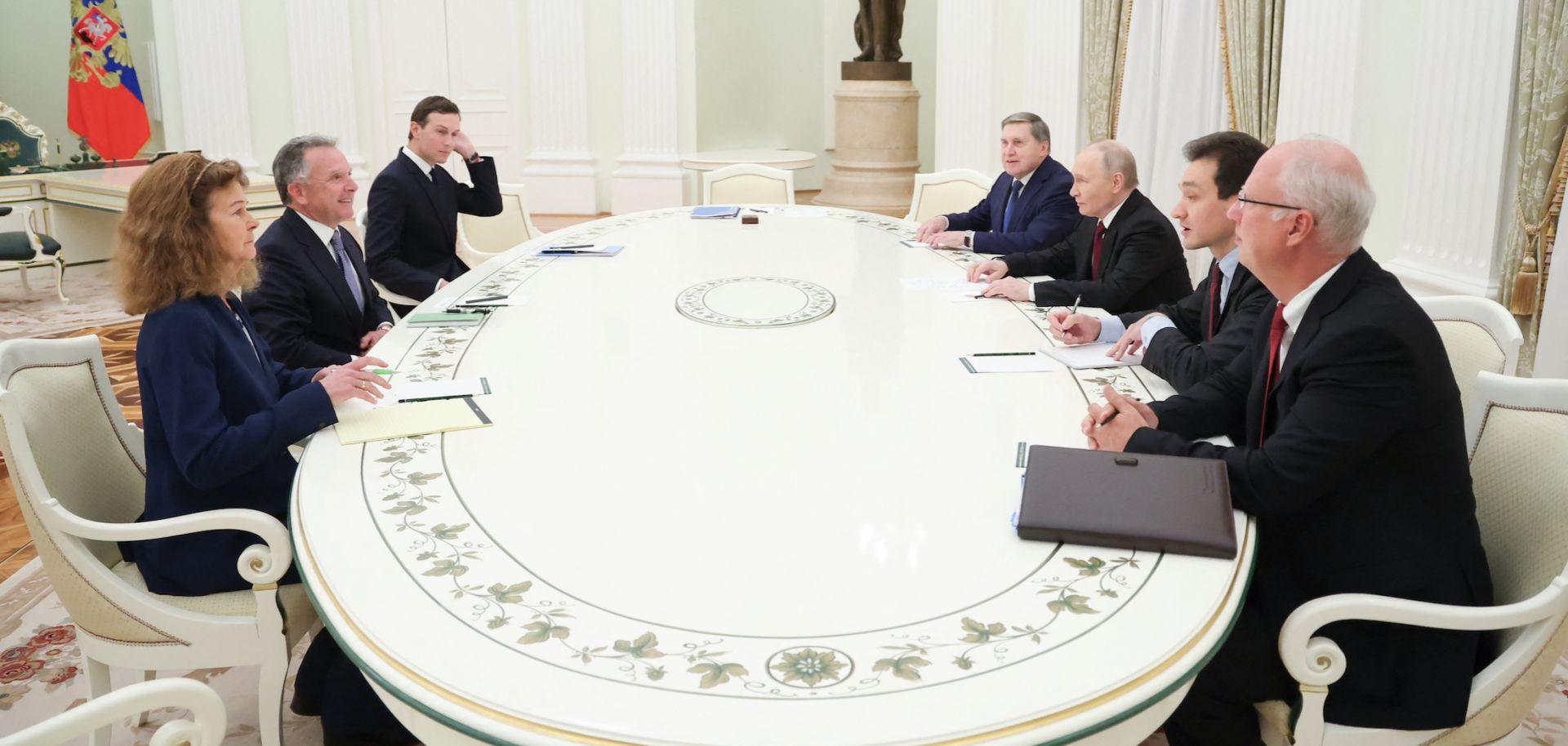
Despite ongoing diplomatic efforts to end the war in Ukraine, core disputes over territory, security guarantees and frozen assets remain unresolved. As a result, negotiations over the coming weeks are likely to continue with limited progress, though other outcomes could range from a fragile revised deal or a tenuous ceasefire to a complete collapse of talks. On Dec. 2, U.S. envoys Steve Witkoff and Jared Kushner met with Russian President Vladimir Putin in Moscow. While the Kremlin described the meeting as "very useful," the two sides failed to reach an agreement on a peace plan. Following the talks, U.S. Secretary of State Marco Rubio said that the talks had made "some progress, but we're not there yet." The meeting happened after international media leaked a peace plan drafted by U.S. and Russian officials, largely favorable to Moscow, in late November. A few days later, U.S. and Ukrainian delegations worked on amendments to make it more palatable to Kyiv.
- On Nov. 21, international media leaked a 28-point peace plan that representatives from Russia and the United States drafted together. The plan stated that Ukraine must cede the entirety of the provinces of Luhansk and Donetsk (which collectively are known as the Donbas) and Crimea (which Russia annexed in 2014) to Russia. Control in the provinces of Kherson and Zaporizhzhia would be frozen along the existing lines of conflict. The plan also called on Ukraine to reduce the size of its army to 600,000 troops from 880,000. Kyiv would not be allowed to join NATO but would be eligible to join the European Union. No NATO troops would be deployed to Ukraine, but European fighter jets would be stationed in Poland. Finally, the plan said that $100 billion in frozen Russian assets would be invested in U.S.-led efforts to rebuild and invest in Ukraine, while sanctions against Russia would be progressively lifted and Moscow would be reinvited to the G8.
- Many of the provisions in the Nov. 21 proposal are unacceptable for Ukraine and its European partners, especially ceding Ukrainian-controlled land to Russia. On Nov. 30, Ukrainian and U.S. delegations met in Switzerland to discuss the peace plan. During the meeting, both governments agreed to amend the plan to make it more digestible for Ukraine. No updated plan was officially released but international media reports suggested it includes 19 points.
- On Dec. 1, Russia claimed to have captured the eastern Ukrainian city of Pokrovsk, a major transportation hub in the Donetsk region — a claim Ukraine denies. The city would provide a strategic springboard for Russia to launch further advances. From Pokrovsk, Russian forces would have more favorable axes of advance toward Kramatorsk and Sloviansk, the two largest remaining Ukrainian-controlled cities in Donetsk. The city sits relatively close to the border of the adjacent Dnipropetrovsk province, opening a potential path for future deep-strike operations westward. The capture of Pokrovsk also raises Russia's bargaining leverage, reinforcing the Kremlin's narrative that victory is inevitable and that Kyiv and the West should concede on Russian terms.
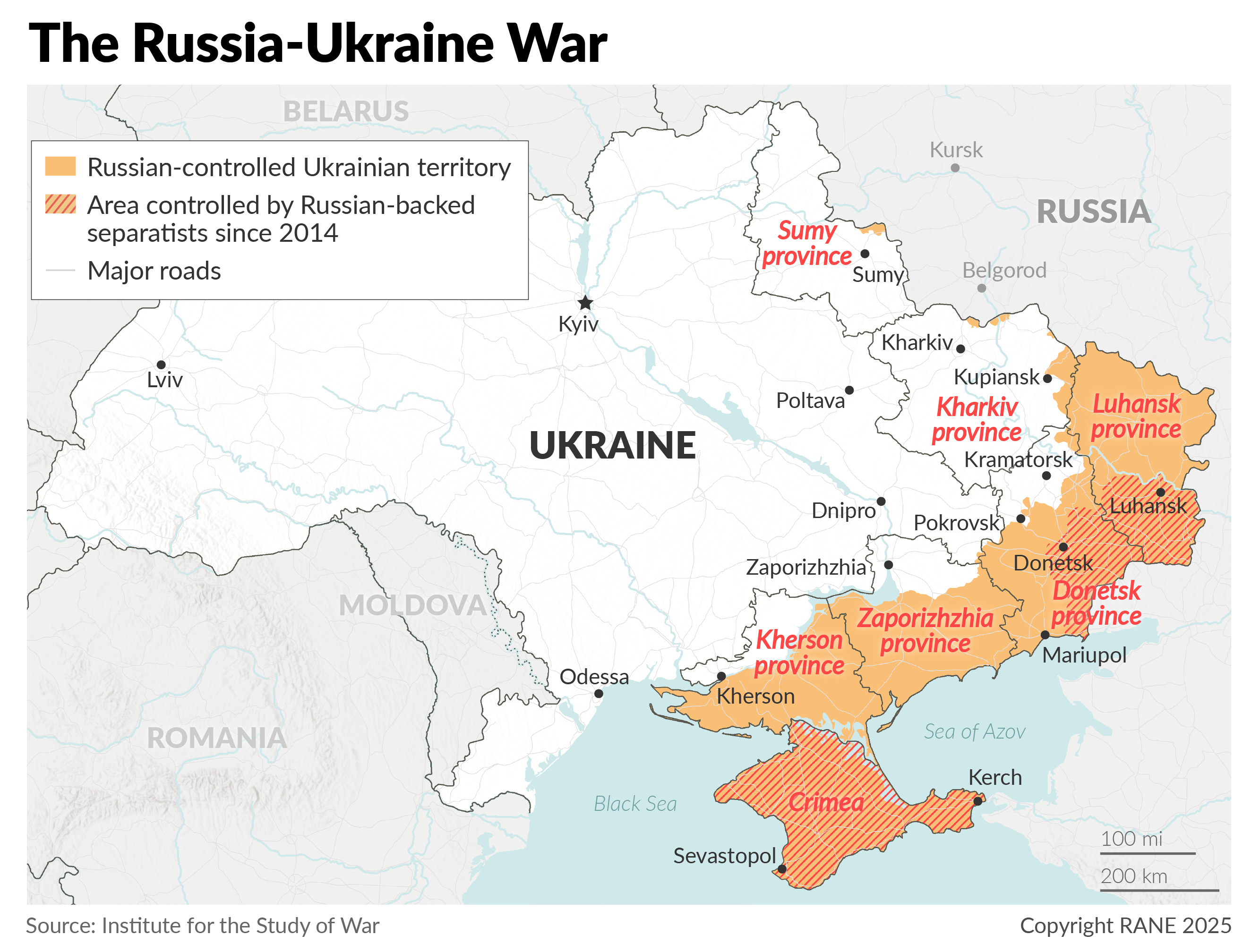
Despite the current intensification of diplomatic efforts, Ukrainian territorial concessions, security guarantees and the fate of frozen Russian assets remain core obstacles to a peace agreement. There are three main obstacles to a peace deal. The first is the territorial concessions. For Russia, controlling all of the Donbas region is politically important because Putin framed "protecting the people of Donbas" as the core rationale for the 2022 invasion and failing to fully "liberate" Donetsk and Luhansk would undermine the central narrative of the war. In addition, full control of Donbas gives Russia defensive depth east of the Dnipro River and pushes the front line farther from key Russian-held hubs such as Rostov and Luhansk. For Ukraine, giving up territories under its control would cause severe discontent both within the Ukrainian military and the broader public. The European Union also opposes a peace deal that would mean validating annexing another country's territory by force. The second obstacle is the security guarantees. Russia wants to make sure Ukraine remains weak after the war, which means a limited military, no foreign troops in Ukraine and no NATO accession. While NATO accession is off the table as the alliance itself is internally divided on this issue, Kyiv is seeking the strongest possible security guarantees short of NATO accession, as it wants to avoid weak guarantees that result in future Russian invasions. Ukraine wants to avoid a repetition of the Budapest Memorandum, a 1994 agreement which saw Kyiv relinquish the world's third-largest nuclear arsenal — which remained in Ukraine after the collapse of the Soviet Union — in exchange for security assurances regarding its sovereignty and territorial integrity which failed to prevent Russian invasions in 2014 and 2022. The third obstacle is the fate of frozen Russian financial assets, most of which are in Belgium. While the European Union and Ukraine would like to use the money to finance Ukraine's ongoing war efforts and potential reconstruction needs, the United States has suggested that some of the money could go to the United States while some may be returned to Russia. Of the three, this seems to be the easier obstacle to overcome (and appears to only recently have risen to the same level of the other two sticking points), as it is not vital for Ukraine's survival as a sovereign state. Still, Kyiv and Brussels are reluctant to give money back to Moscow without getting enough concessions in return, as this is the European Union's main leverage vis-a-vis Russia, especially if the bloc can overcome Belgium's resistance against seizing the funds.
Against this backdrop, in the final weeks of December and early weeks of January, four scenarios are possible:
Scenario #1. Negotiations continue, but with minimal progress (45%). Both Russia and Ukraine are interested in keeping the peace process alive, as Moscow and Kyiv want to avoid the White House increasing economic and political pressure against them and want to blame the other for the lack of progress in the negotiations. However, Kyiv is likely to insist on retaining currently held territory in Donetsk while Russia will insist on completing its annexation goals in the Donbas. In this scenario, success in Pokrovsk motivates the Kremlin to continue making territorial advances, including intensified operations toward Kramatorsk or Slovyansk before winter conditions make it more difficult, as Russian leadership calculates that further advances (no matter how slow or limited) will force Kyiv and Washington to compromise. This scenario carries severe risks for Ukraine, as the White House may once again threaten to end military and intelligence cooperation unless Kyiv accepts painful compromises. This scenario also carries some risks for Russia, as the White House may threaten additional sanctions (for example, against Russia's banking and/or energy sectors) if it perceives that Moscow is intentionally stalling the negotiations.
Scenario #2. Ukraine and Russia agree to a ceasefire that halts the fighting as they seek to find a mutually acceptable peace agreement (25%). Since the start of the peace process, Ukraine has claimed that a ceasefire should happen before a peace agreement, as Kyiv wants Moscow's attacks on its civilian and military infrastructure to end. This need has become particularly acute during the winter, as millions of Ukrainians face energy cuts because of Russia's attacks. Convincing Russia to accept a ceasefire would be harder, as Moscow has repeatedly claimed that the "root causes" of the war must be addressed before the fighting could end. For this scenario to materialize, the United States would need to increase sanctions pressure on Russia or, less likely, Ukraine would need to agree to painful territorial concessions if Moscow first agrees to halt the fighting. In this scenario, the territorial issues are postponed while combat lines are frozen roughly at current positions. This ceasefire would be extremely fragile and subject to constant violations from both sides, keeping open the possibility of a breakdown and a resumption of the war.
Scenario #3. An updated peace deal emerges in which both Ukraine and Russia make concessions (20%). In Ukraine, a combination of U.S. pressure and Russian territorial gains could result in Kyiv accepting limited territorial concessions under modest Western security guarantees that soften domestic backlash. For example, Ukraine could agree to give up Crimea, Luhansk and most of Donetsk while retaining some settlements currently under its control in western Donetsk to claim it did not "fully capitulate." Ukraine may also de facto accept the loss of certain areas but claim it will not recognize them as Russian (as it did after Moscow's annexation of Crimea). To make this deal more acceptable, the West could promise Ukraine a multiyear military financing program, coupled with a joint EU air defense umbrella (though no deployment of foreign troops). The issue of the frozen assets results in a compromise in which some of the funds are used for Ukraine's reconstruction while the rest are returned to Russia. In this scenario, Russia accepts because the deal secures its core demand (most, if not all, of the Donbas) with no foreign troops on the ground or NATO membership for Ukraine and a promise of progressive sanctions relief. This peace agreement would be very fragile, as it could create severe social, political and military unrest in Ukraine that could result in the ousting of President Volodymyr Zelensky and his replacement by a government that rejects the deal or in violations of the deal by Russia, which is likely to continue hybrid warfare operations against both Ukraine and its European allies regardless of a deal.
Scenario #4. Negotiations completely break down (10%). In this scenario, Ukraine or Russia withdraws from the negotiation track, citing unacceptable clauses. The subsequent events will depend on which withdraws and why. Should Ukraine abandon the process (primarily because it is unwilling or unable to make meaningful territorial concessions) then the chances of the United States ending military and intelligence support for Kyiv would be high. In this scenario, Ukraine would primarily rely on its European allies for military and financial support. While this would be enough to keep the war effort going for several months, it would raise severe concerns about sustainability in the medium to long term. It would particularly harm Ukraine's deep-strike campaign into Russian territory, which relies on U.S.-provided intelligence. Russia would be encouraged to continue the war and count on Kyiv running out of men, weapons and money. Should Russia officially abandon the peace process, the United States could announce new sanctions against Moscow while increasing military and economic support for Ukraine. While this would be unlikely to change Russia's calculations in the short term, it would likely force Moscow back to the negotiating table in the medium term. An alternative version of this scenario sees the United States exit the peace process after Ukraine or Russia withdraws from it (citing, for example, the need to focus on other issues). Since taking over in January, the Trump administration has repeatedly said that Ukraine is not "our" war and that the decision to end it was in Russian and Ukrainian hands, which could give the U.S. government a political argument to at least temporarily exit the peace process. This would represent a strategic victory for Russia, as this would result in Ukraine relying primarily on Europe to continue the war.
