
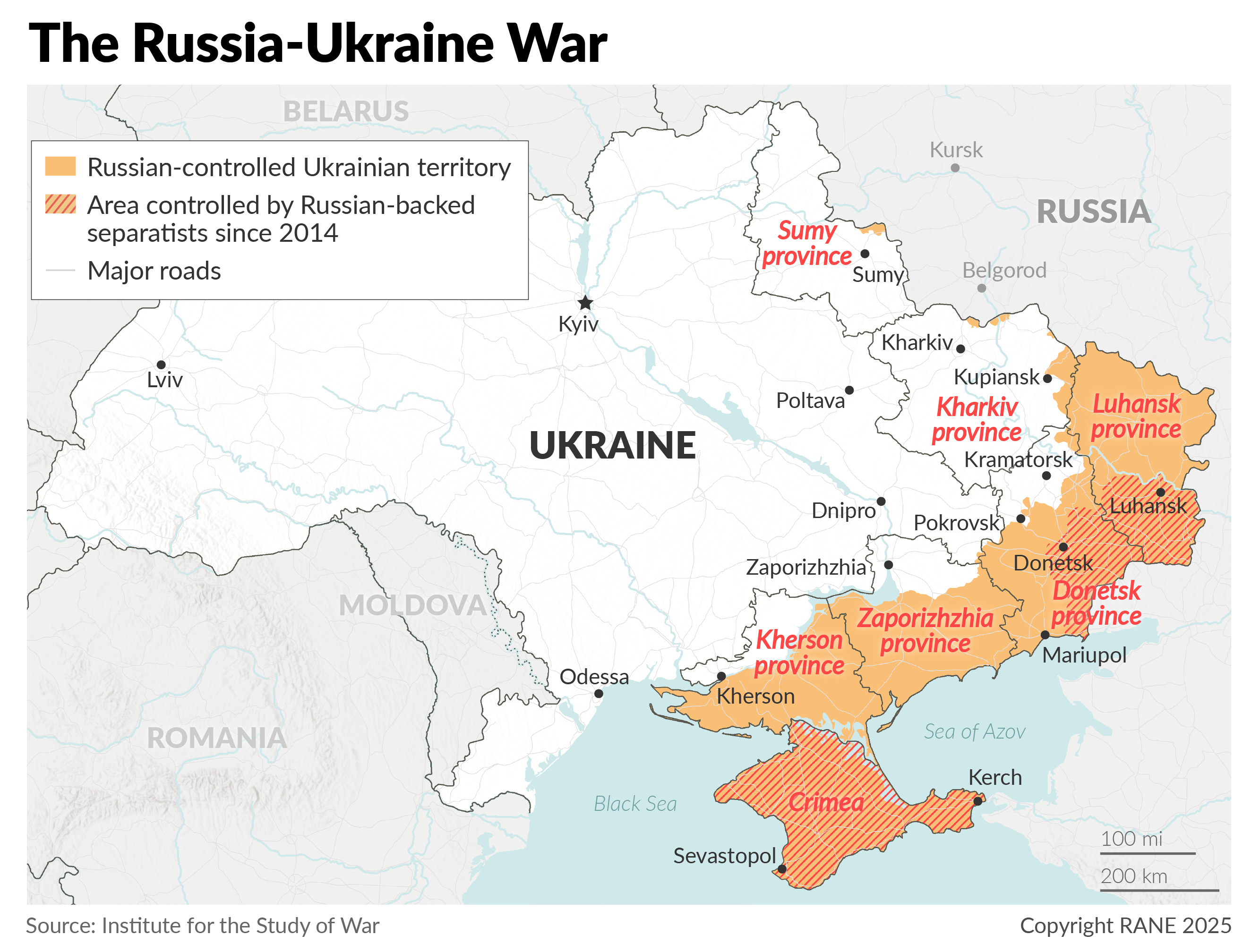
A U.S. ultimatum giving Ukraine until Nov. 27 to accept a U.S.-brokered peace plan marks the clearest attempt yet to translate U.S. leverage into a negotiated settlement that would formalize major Ukrainian concessions and freeze the war on terms favorable to Moscow, but Kyiv is unlikely to accede, meaning the war will probably continue, at least into 2026. On Nov. 21, U.S. President Donald Trump stated that he has given Ukraine a deadline of Thanksgiving Day (Nov. 27) to accept his administration's proposed 28-point peace plan with Russia, warning that failure to do so would trigger a suspension of U.S. intelligence and military support. The proposal envisions a negotiated settlement that would, among other things, reaffirm Ukraine's sovereignty while formalizing a major territorial and security compromise. Key elements of that compromise include the de facto recognition of Russian control over all of Crimea, Luhansk and Donetsk; a freeze along current frontlines in Kherson and Zaporizhzhia; and Ukraine's permanent renunciation of NATO membership, in exchange for conditional U.S. security guarantees and an end to the war. The plan couples these provisions with a U.S.- and EU-financed reconstruction package funded partly by frozen Russian assets, phased sanctions relief for Russia and its reintegration into the global economy, limits on the size and capabilities of Ukraine's armed forces, and a binding enforcement mechanism intended to monitor compliance, oversee redevelopment and maintain an immediate ceasefire. Confronted with these terms, Ukrainian President Volodymyr Zelensky warned that Ukraine faces "one of the most difficult moments in its history," saying the country must choose between "losing dignity and freedom or risking the loss of a major partner." Following discussions on Nov. 20 with U.S. Vice President JD Vance and Army Secretary Dan Driscoll, Zelensky announced that Ukraine, the United States and Europe will collaborate at the advisor level — i.e., between senior officials rather than between Zelensky and Trump directly, at least for now — to ensure the path to peace is "truly viable." Meanwhile, Russian President Vladimir Putin said the U.S. proposal "could form the basis for a final peace settlement" and was "in principle" aligned with Washington's proposals despite "current military and diplomatic difficulties."
- The U.S.-backed peace plan emerged from secret consultations between officials in the Trump administration and Russian representatives. Driscoll presented the plan to Zelensky during his visit to Ukraine on Nov. 20. Putin, speaking at the Security Council on Nov. 21, confirmed that Moscow had received the plan and noted that while Russia is broadly satisfied with the current situation on the battlefield, it remains open to peace talks. European leaders responded to the U.S.-backed peace proposal with clear scepticism and concern, emphasizing that any deal must preserve Ukraine's sovereignty and not amount to capitulation to Moscow.
Trump's renewed threat to curtail U.S. intelligence and arms support appears to be part of a coordinated strategy of economic pressure, diplomatic leverage and battlefield timing to push Kyiv and Moscow toward peace talks based on the proposed plan. The ultimatum coincides with increasing pressure from Washington against both Kyiv and Moscow to end the war, as secondary sanctions targeting Russian energy firms adopted on Oct. 22 entered into force Nov. 21, tightening financial pressure on Russia and its trading partners. This escalation of economic tools now dovetails with diplomatic coercion, as the Trump administration seeks to push Kyiv toward accepting the 28-point peace framework. At the same time, Ukraine's recent long-range strikes, including the first recently published strikes using U.S.-provided ATACMS missiles, deep into Russian territory (which rely on U.S. targeting data) are intended to put further pressure on Moscow. On the flip side, Russian troops have been advancing around Pokrovsk in Donetsk oblast, threatening supply lines, while Ukrainian commanders are warning of shortfalls in manpower and ammunition. This means that any reduction in U.S. intelligence support — the backbone of Ukraine's situational awareness, targeting precision and overall defensive posture — would immediately magnify battlefield stress, giving Washington additional leverage at a moment of Ukrainian vulnerability. In parallel, a corruption scandal in Kyiv potentially implicating Zelensky's inner circle has caused unease among European allies and weakened Zelensky's political standing. Taken together, these developments have created both the rationale and opportunity for the United States to use intelligence and weapons support to Ukraine as a potent coercive tool to shape the timing and terms of a potential settlement.
- Ukraine's battlefield performance depends heavily on U.S. intelligence for both defense and offense. American satellite imagery, signals intercepts and targeting data underpin air-defense cueing, long-range precision strikes and real-time situational awareness. These feeds are directly integrated into the operation of HIMARS and ATACMS systems and are also vital for civilian air raid warnings. Since 2014, U.S. and Ukrainian intelligence services have worked through embedded liaison officers in Kyiv, creating a near-continuous exchange of battlefield data. While European and commercial providers such as Maxar Technologies contribute imagery, their inputs depend on U.S. government data pipelines, making American intelligence the backbone of Ukraine's targeting and early warning systems.
- In March 2025, the Trump administration suspended U.S. intelligence sharing and some military aid to Ukraine, amid a similar situation in which Washington demanded Kyiv engage in peace talks with Russia on largely Moscow's terms. While the suspension was eventually reversed, it had immediate and lethal effects. Western and Ukrainian officials reported hundreds of Ukrainian deaths and Russian territorial gains in the Kursk region as the loss of U.S. satellite and signals data crippled Ukraine's ability to detect bombers, defend against airstrikes and conduct precision strikes. HIMARS operations stalled after U.S. and Maxar imagery feeds were halted, while Western liaison officers processing satellite data withdrew from Kyiv. Although some European agencies tried to fill the gap, they lacked the scale and speed of U.S. capabilities.
Despite the Trump administration's pressure, Zelensky is unlikely to accept the peace plan, portending a halt in U.S. intelligence support that would likely lead to immediate battlefield setbacks for Ukraine, but would not immediately end the fighting, prolonging the war into 2026. Despite their dismay at the U.S. proposal, Zelensky and European partners are unlikely to outright reject it for fear of further sullying ties with the White House. Instead, they will probably present a counterproposal that still dismisses many of the terms of the U.S. proposal seen by Kyiv and Brussels as capitulating to Moscow. But given the Trump administration's increasing frustration with the continuation of the war and desire to build on the momentum from its perceived success in negotiating ceasefires (however shaky) in places like Gaza, it is becoming increasingly likely that the United States will make good on its threats. That said, Washington is more likely to calibrate rather than completely cut intelligence support — e.g., by slowing data transfers, narrowing targeting parameters or selectively withholding satellite imagery — to pressure Kyiv without fully collapsing its defenses. But given the precedent set by the March 2025 suspension, a renewed suspension in U.S. intelligence assistance would still almost certainly produce swift and cascading effects on the battlefield, even if European countries were able to surge support. Ukraine's ability to anticipate missile launches, coordinate air defense responses and conduct deep strike operations would erode within days. Meanwhile, Ukrainian commanders would be forced to conserve scarce munitions dependent on intelligence, surveillance and reconnaissance (ISR) and instead rely on patchy European or commercial substitutes. In contrast to March, however, the current threat is integrated into a broader economic campaign and a defined diplomatic framework (i.e., the 28-point peace plan), giving Washington a concrete mechanism through which to translate military pressure into political concessions. This linkage makes the threat both more deliberate and more credible, since any reduction in intelligence would now serve a clear strategic objective rather than a display of leverage. In addition to its military consequences, a prolonged suspension would undermine allied confidence in U.S. reliability, deepening fault lines within NATO. Nonetheless, even a steady withdrawal of U.S. support is unlikely to prompt Zelensky to accept the U.S.-backed peace plan, which Kyiv views as too favorable to Moscow, making continued fighting — even if from a weaker position — still preferable. Ukraine will likely calculate that it can rely on increased European support and its own growing domestic weapons production, especially of crucial drones, to partially offset the U.S. void. Russian forces would be able to continue making territorial advances, potentially even larger ones, though at a very slow rate amid the presence of Ukrainian drones that have largely paralyzed the frontline and Russian troops' ongoing difficulty in developing effective tactics to breach Ukrainian defenses. This means the war will likely continue into at least 2026, when, if Ukrainian defenses become increasingly strained due to a potential sustained loss of U.S. support, some sort of settlement will become more likely.
